Kirjojen hintavertailu. Mukana 11 244 527 kirjaa ja 12 kauppaa.

Kirjahaku

Etsi kirjoja tekijän nimen, kirjan nimen tai ISBN:n perusteella.

1000 tulosta hakusanalla Phillip E. Wegner

Periodizing Jameson

Periodizing Jameson

Phillip E. Wegner

Northwestern University Press
2014
nidottu
For a half century, the American intellectual Fredric Jameson has been a driving force in literary and cultural theory. In Periodizing Jameson, Phillip E. Wegner builds upon Jameson’s unique dialectical method to demonstrate the value of Jameson’s tools—periodization, the fourfold hermeneutic, and the Greimasian semiotic square, among others—and to develop virtuoso readings of Jameson’s own work and the history of the contemporary American university in which it unfolds.Wegner shows how Jameson’s work intervenes in particular social, cultural, and political situations, using his scholarship both to develop original explorations of nineteenth-century fiction, popular films, and other prominent theorists, and to examine the changing fortunes of theory itself. In this way, Periodizing Jameson casts new light on the potential of and challenges to humanist intellectual work in the present.

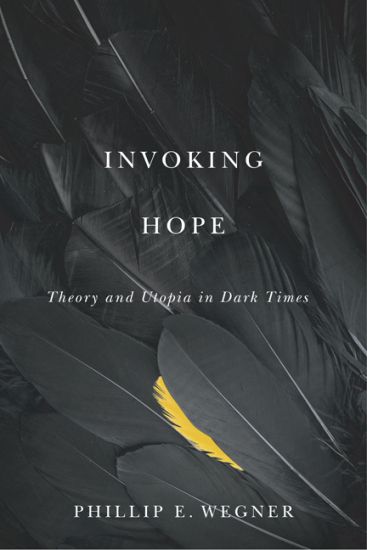
Invoking Hope

Invoking Hope

Phillip E. Wegner

University of Minnesota Press
2020
sidottu
An appeal for the importance of theory, utopia, and close consideration of our contemporary dark times What does any particular theory allow us to do? What is the value of doing so? And who benefits? In Invoking Hope, Phillip E. Wegner argues for the undiminished importance of the practices of theory, utopia, and a deep and critical reading of our current situation of what Bertolt Brecht refers to as finsteren Zeiten, or dark times.Invoking Hope was written in response to three events that occurred in 2016: the five hundredth anniversary of the publication of Thomas More’s Utopia; the one hundredth anniversary of the founding text in theory, Ferdinand de Saussure’s Course in General Linguistics; and the rise of the right-wing populism that culminated in the election of Donald Trump. Wegner offers original readings of major interventions in theory alongside dazzling utopian imaginaries developed from classical Greece to our global present-from Theodor Adorno, Ernst Bloch, Alain Badiou, Jacques Derrida, Fredric Jameson, Sarah Ahmed, Susan Buck-Morss, and Jacques Lacan to such works as Plato’s Republic, W. E. B. Du Bois’s John Brown, Isak Dinesen’s “Babette’s Feast,” Kim Stanley Robinson’s 2312, and more. Wegner comments on an expansive array of modernist and contemporary literature, film, theory, and popular culture.With Invoking Hope, Wegner provides an innovative lens for considering the rise of right-wing populism and the current crisis in democracy. He discusses challenges in the humanities and higher education and develops strategies of creative critical reading and hope against the grain of current trends in scholarship.
Invoking Hope

Invoking Hope

Phillip E. Wegner

University of Minnesota Press
2020
pokkari
An appeal for the importance of theory, utopia, and close consideration of our contemporary dark times What does any particular theory allow us to do? What is the value of doing so? And who benefits? In Invoking Hope, Phillip E. Wegner argues for the undiminished importance of the practices of theory, utopia, and a deep and critical reading of our current situation of what Bertolt Brecht refers to as finsteren Zeiten, or dark times.Invoking Hope was written in response to three events that occurred in 2016: the five hundredth anniversary of the publication of Thomas More’s Utopia; the one hundredth anniversary of the founding text in theory, Ferdinand de Saussure’s Course in General Linguistics; and the rise of the right-wing populism that culminated in the election of Donald Trump. Wegner offers original readings of major interventions in theory alongside dazzling utopian imaginaries developed from classical Greece to our global present-from Theodor Adorno, Ernst Bloch, Alain Badiou, Jacques Derrida, Fredric Jameson, Sarah Ahmed, Susan Buck-Morss, and Jacques Lacan to such works as Plato’s Republic, W. E. B. Du Bois’s John Brown, Isak Dinesen’s “Babette’s Feast,” Kim Stanley Robinson’s 2312, and more. Wegner comments on an expansive array of modernist and contemporary literature, film, theory, and popular culture.With Invoking Hope, Wegner provides an innovative lens for considering the rise of right-wing populism and the current crisis in democracy. He discusses challenges in the humanities and higher education and develops strategies of creative critical reading and hope against the grain of current trends in scholarship.
Shockwaves of Possibility

Shockwaves of Possibility

Phillip E. Wegner

Peter Lang AG, Internationaler Verlag der Wissenschaften
2014
nidottu
Shockwaves of Possibility explores the deep utopianism of one of the most significant modern cultural practices: science fiction. The author contends that utopianism is not simply a motif in SF, but rather is fundamental to its narrative dynamics. Drawing upon a rich array of theory and criticism in SF and utopian studies, the book opens with a global periodizing history that shows the inseparability of SF from developments in other cultural fields. It goes on to examine literature, film, television, comics, and animation in order to demonstrate SF’s unique effectiveness for grappling with the upheavals brought about by globalization. Shockwaves of Possibility proves SF’s vitality in the brave new world of the twenty-first century, as it illuminates the contours of the present and educates our desire for a radically other future.
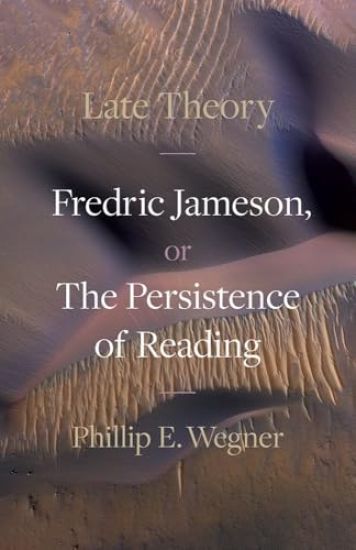
Late Theory

Late Theory

Phillip E. Wegner

UNIVERSITY OF MINNESOTA PRESS
2026
sidottu
A bold, dialectic engagement with Fredric Jameson's thought Fredric Jameson (1934–2024) is widely regarded as the most influential literary and cultural theorist of the past fifty years. The culmination of more than three decades of sustained engagement with Jameson's work, Late Theory offers a critical response to his late writings, namely the final volumes of his "Poetics of Social Forms," to develop an original and dialectical reading practice in conversation with his evolving thought. Jameson's final works bring renewed clarity to three foundational concerns that structure his intellectual legacy. These are the problem of periodization and the challenge of grasping the present as a historical category, the dangers posed by the rise of moralizing modes of critique in literary and cultural studies, and the radical interpretive potential unlocked by allegory and the semiotic method. Phillip E. Wegner shows how these late interventions mark not a conclusion but an extension of Jameson's long-standing project: envisioning the dialectic as a living, collective form of reasoning - a "thought mode of the future" capable of transforming our lives. At its core, Late Theory is a passionate argument for cultural and aesthetic education as a practice of solidarity and imagination. Foregrounding Jameson's enduring effort to build heterogeneous communities of readers committed to shared inquiry, Wegner affirms the urgency of reading, teaching, and thinking together in a moment of crisis for the university and global culture. Retail e-book files for this title are screen-reader friendly with images accompanied by short alt text and/or extended descriptions.
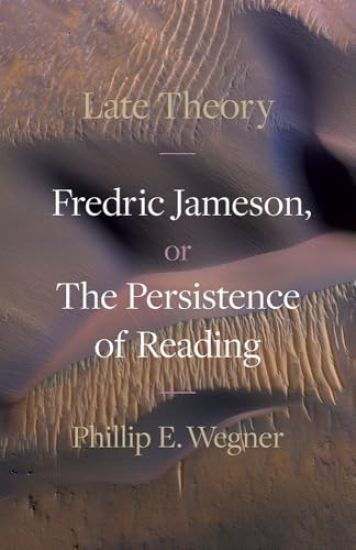
Late Theory

Late Theory

Phillip E. Wegner

UNIVERSITY OF MINNESOTA PRESS
2026
nidottu
A bold, dialectic engagement with Fredric Jameson's thought Fredric Jameson (1934–2024) is widely regarded as the most influential literary and cultural theorist of the past fifty years. The culmination of more than three decades of sustained engagement with Jameson's work, Late Theory offers a critical response to his late writings, namely the final volumes of his "Poetics of Social Forms," to develop an original and dialectical reading practice in conversation with his evolving thought. Jameson's final works bring renewed clarity to three foundational concerns that structure his intellectual legacy. These are the problem of periodization and the challenge of grasping the present as a historical category, the dangers posed by the rise of moralizing modes of critique in literary and cultural studies, and the radical interpretive potential unlocked by allegory and the semiotic method. Phillip E. Wegner shows how these late interventions mark not a conclusion but an extension of Jameson's long-standing project: envisioning the dialectic as a living, collective form of reasoning - a "thought mode of the future" capable of transforming our lives. At its core, Late Theory is a passionate argument for cultural and aesthetic education as a practice of solidarity and imagination. Foregrounding Jameson's enduring effort to build heterogeneous communities of readers committed to shared inquiry, Wegner affirms the urgency of reading, teaching, and thinking together in a moment of crisis for the university and global culture. Retail e-book files for this title are screen-reader friendly with images accompanied by short alt text and/or extended descriptions.
Life Between Two Deaths, 1989-2001

Life Between Two Deaths, 1989-2001

Philip E. Wegner

Duke University Press
2009
sidottu
Through virtuoso readings of significant works of American film, television, and fiction, Phillip E. Wegner demonstrates that the period between the fall of the Berlin Wall in November 1989 and the terrorist attacks of September 11, 2001 fostered a unique consciousness and represented a moment of immense historical possibilities now at risk of being forgotten in the midst of the “war on terror.” Wegner argues that 9/11 should be understood as a form of what Jacques Lacan called the “second death,” an event that repeats an earlier “fall,” in this instance the collapse of the Berlin Wall. By describing 9/11 as a repetition, Wegner does not deny its significance. Rather, he argues that it was only with the fall of the towers that the symbolic universe of the Cold War was finally destroyed and a true “new world order,” in which the United States assumed disturbing new powers, was put into place.Wegner shows how phenomena including the debate on globalization, neoliberal notions of the end of history, the explosive growth of the Internet, the efflorescence of new architectural and urban planning projects, developments in literary and cultural production, new turns in theory and philosophy, and the rapid growth of the antiglobalization movement came to characterize the long nineties. He offers readings of some of the most interesting cultural texts of the era: Don DeLillo’s White Noise; Joe Haldeman’s Forever trilogy; Octavia Butler’s Parable novels; the Terminator films; the movies Fight Club, Independence Day, Cape Fear, and Ghost Dog; and the television series Buffy the Vampire Slayer. In so doing, he illuminates fundamental issues concerning narrative, such as how beginnings and endings are recognized and how relationships between events are constructed.
Life Between Two Deaths, 1989-2001

Life Between Two Deaths, 1989-2001

Philip E. Wegner

Duke University Press
2009
pokkari
Through virtuoso readings of significant works of American film, television, and fiction, Phillip E. Wegner demonstrates that the period between the fall of the Berlin Wall in November 1989 and the terrorist attacks of September 11, 2001 fostered a unique consciousness and represented a moment of immense historical possibilities now at risk of being forgotten in the midst of the “war on terror.” Wegner argues that 9/11 should be understood as a form of what Jacques Lacan called the “second death,” an event that repeats an earlier “fall,” in this instance the collapse of the Berlin Wall. By describing 9/11 as a repetition, Wegner does not deny its significance. Rather, he argues that it was only with the fall of the towers that the symbolic universe of the Cold War was finally destroyed and a true “new world order,” in which the United States assumed disturbing new powers, was put into place.Wegner shows how phenomena including the debate on globalization, neoliberal notions of the end of history, the explosive growth of the Internet, the efflorescence of new architectural and urban planning projects, developments in literary and cultural production, new turns in theory and philosophy, and the rapid growth of the antiglobalization movement came to characterize the long nineties. He offers readings of some of the most interesting cultural texts of the era: Don DeLillo’s White Noise; Joe Haldeman’s Forever trilogy; Octavia Butler’s Parable novels; the Terminator films; the movies Fight Club, Independence Day, Cape Fear, and Ghost Dog; and the television series Buffy the Vampire Slayer. In so doing, he illuminates fundamental issues concerning narrative, such as how beginnings and endings are recognized and how relationships between events are constructed.
Appalachian Odyssey

Appalachian Odyssey

Phillip Obermiller; Thomas E. Wagner

Praeger Publishers Inc
2000
sidottu
One of the greatest internal migrations in American history has been the movement of the people of Appalachia to a variety of rural and urban destinations all over the country —- wherever economic opportunity beckoned, from the industrial Midwest to the timber empires of the Pacific Northwest. This movement (about five million in the 1950s alone) has taken place in several waves throughout the twentieth century, and continues to this day. Appalachian Odyssey provides an interdisciplinary exploration of the impact of this phenomenon on both the Appalachian region and the country as a whole.Scholars from a variety of social science disciplines bring their perspectives to this volume in an examination of the historical, political, social, economic, and cultural impact of a talented group often derided as hillbillies. Appalachian Odyssey provides a much-needed corrective to this bias, and a deeper understanding of a people who have significantly influenced the American story.
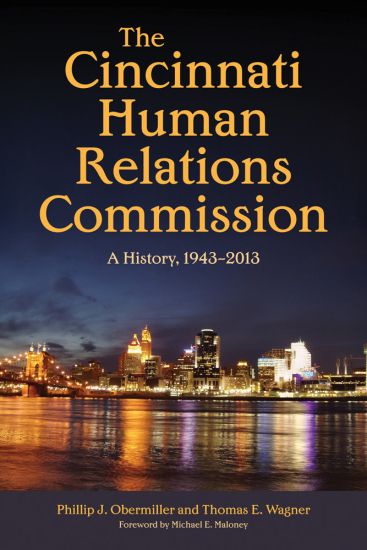
The Cincinnati Human Relations Commission

The Cincinnati Human Relations Commission

Phillip J. Obermiller; Thomas E. Wagner

Ohio University Press
2017
sidottu
In the summer of 1943, as World War II raged overseas, the United States also faced internal strife. Earlier that year, Detroit had erupted in a series of race riots that killed dozens and destroyed entire neighborhoods. Across the country, mayors and city councils sought to defuse racial tensions and promote nonviolent solutions to social and economic injustices. In Cincinnati, the result of those efforts was the Mayor's Friendly Relations Committee, later renamed the Cincinnati Human Relations Commission (CHRC). The Cincinnati Human Relations Commission: A History, 1943–2013, is a decade-by-decade chronicle of the agency: its accomplishments, challenges, and failures. The purpose of municipal human relations agencies like the CHRC was to give minority groups access to local government through internal advocacy, education, mediation, and persuasion—in clear contrast to the tactics of lawsuits, sit-ins, boycotts, and marches adopted by many external, nongovernmental organizations. In compiling this history, Phillip J. Obermiller and Thomas E. Wagner have drawn on an extensive base of archival records, reports, speeches, and media sources. In addition, archival and contemporary interviews provide first-person insight into the events and personalities that shaped the agency and the history of civil rights in this midwestern city.
African American Miners and Migrants

African American Miners and Migrants

Thomas E. Wagner; Philip J. Obermiller; William H Turner

University of Illinois Press
2004
nidottu
Thomas E. Wagner and Phillip J. Obermiller's African American Miners and Migrants documents the lives of Eastern Kentucky Social Club (EKSC) members, a group of black Appalachians who left the eastern Kentucky coalfields and their coal company hometowns in Harlan County. Bound together by segregation, the inherent dangers of mining, and coal company paternalism, it might seem that black miners and mountaineers would be eager to forget their past. Instead, members of the EKSC have chosen to celebrate their Harlan County roots. African American Miners and Migrants uses historical and archival research and extensive personal interviews to explore their reasons and the ties that still bind them to eastern Kentucky. The book also examines life in the model coal towns of Benham and Lynch in the context of Progressive Era policies, the practice of welfare capitalism, and the contemporary national trend of building corporate towns and planned communities.
Dynamics of Religious Organizations

Dynamics of Religious Organizations

Phillip E. Hammond

Oxford University Press
2000
sidottu
This book brings together some of the most acknowledged essays by Hammond written over the last decade and explores religious organizations, their internal dynamics, and their impact. The first half of the book examines issues such as: church membership; the formation of religious identity; the changing meaning religious organizations have in the mind of persons returning to church after 'dropping out' for a significant period; the orderly dynamics idertaken by small sects who, in growing, lower tension with social environments. The second half of the book examines the consequences of these internal dynamics including world system theory, the church and its impact on voting behaviours, the cultural impact of cults, ideological reformation, ethnicity and conscience, and the relationship between religious and ethnic identities.
CMOS Analog Circuit Design

CMOS Analog Circuit Design

Phillip E. Allen; Douglas R. Holberg

Oxford University Press Inc
2012
nidottu
Respected authors Phil Allen and Doug Holberg bring you the international third edition of their popular textbook, CMOS Analog Circuit Design. Working from the forefront of CMOS technology, Phil and Doug have combined their expertise as engineers and academics to present a cutting-edge and effective overview of the principles and techniques for designing circuits. Their two main goals are: to mix the academic and practical viewpoints in a treatment that is neither superficial nor overly detailed, and to teach analog integrated circuit design with a hierarchically organized approach. Most of the circuits, techniques, and principles presented in CMOS Analog Circuit Design come directly from the authors' industrial experience, making the book a valuable resource for both practicing engineers and students taking courses in analog electronics or CMOS analog design. The trademark approach of Phil and Doug's textbook is its design recipes, which take readers step-by-step through the creation of real circuits, explaining and demystifying complex design problems. The book provides detailed coverage of often-neglected areas and deliberately leaves out bipolar analog circuits, since CMOS is the dominant technology for analog integrated circuit design. The book is appropriate for advanced undergraduates and graduate students with background knowledge in basic electronics - including biasing, modeling, circuit, analysis, and frequency response. CMOS Analog Circuit Design, International Third Edition, presents a complete picture of design (including modeling, simulation, and testing) and enables readers to undertake the design of an analog circuit that can be implemented by CMOS technology.
CliffsNotes AP Biology 2021 Exam

CliffsNotes AP Biology 2021 Exam

Phillip E Pack

Houghton Mifflin Harcourt Publishing Company
2020
nidottu
CliffsNotes AP Biology 2021 Exam gives you exactly what you need to score a 5 on the exam: concise chapter reviews on every AP Biology subject, in-depth laboratory investigations, and full-length model practice exams to prepare you for the May 2021 exam. Revised to even better reflect the new AP Biology exam, this test-prep guide includes updated content tailored to the May 2021 exam. Features of the guide focus on what AP Biology test-takers need to score high on the exam: . Reviews of all subject areas . In-depth coverage of the all-important laboratory investigations . Two full-length model practice AP Biology exams Every review chapter includes review questions and answers to pinpoint problem areas. AUTHOR: Phillip E. Pack, Ph.D., taught AP Biology and gifted programs for 11 years and currently is Professor of Biology at Woodbury University in Burbank, California. He resides in Altadena, California.
With Liberty for All

With Liberty for All

Phillip E. Hammond

Westminster/John Knox Press,U.S.
1998
nidottu
The United States is founded upon the principles of freedom of religion, although it has been difficult at times to understand and apply those principles. Phillip Hammond argues that the Constitution assumes a radical religious liberty, which protects the convictions of individual Americans, whether or not those convictions are explicitly religious. This book is an excellent guide to the church-state debate of today, and deepens that discussion by examining the root cause of disagreement about what freedom of religion means in America.
The Indiana Jackass Regiment in the Civil War

The Indiana Jackass Regiment in the Civil War

Phillip E. Faller

McFarland Co Inc
2013
pokkari
This book contains never before published information, including artillery firing tables, for an Indiana infantry regiment converted to heavy artillery. It concentrates upon these Hoosiers' three-and-a-half years of duty in the Trans-Mississippi Theater and Gulf states during the Civil War, often as a separate command. They acted as infantry, cavalry and light artillery (with captured cannons) before being converted to heavy artillery in 1863. Their cannons and artillery equipment were hauled by hundreds of mules. The regiment participated in the taking of New Orleans, securing an important rail link to Morgan City, Louisiana, the Teche Campaign, the siege and reduction of Port Hudson, the Red River Campaign, and sieges and reductions of Fort Gaines, Fort Morgan, Spanish Fort and Fort Blakely, Alabama.
Defeating Darwinism by Opening Minds

Defeating Darwinism by Opening Minds

Phillip E. Johnson

Inter-Varsity Press,US
1997
nidottu
Voted one of Christianity Today's 1998 Books of the Year For decades, Christians have felt voiceless in the critical debate over evolution. Until now. Finally, ordinary Christians have the opportunity and the resources to defeat the false claims of Darwinism. With all of the complicated scientific debate swirling around the topic of evolution, Christians need an easy way to understand the basic issues without oversimplifying. Phillip Johnson has the answer: the key to defeating the false claims of Darwinism is to open our minds to good thinking habits. Here is first-rate advice on avoiding common mistakes in discussions about evolution, understanding the legacy of the Scopes trial, spotting deceptive arguments, and grasping the basic scientific issues without getting bogged down in unnecessary details. In the bestselling and critically acclaimed Darwin on Trial and Reason in the Balance, Phillip Johnson took on the academic elites and exposed the misleading claims of evolutionary naturalism.Defeating Darwinism by Opening Minds provides a new and powerful treatment of these issues for high-school students, parents, teachers, pastors, youth advisors and ordinary readers. Johnson aims not just to defeat a bad theory, but to defeat it in the right way-by opening minds to the truth.