

Kirjahaku
Etsi kirjoja tekijän nimen, kirjan nimen tai ISBN:n perusteella.
1000 tulosta hakusanalla Pieper Josef

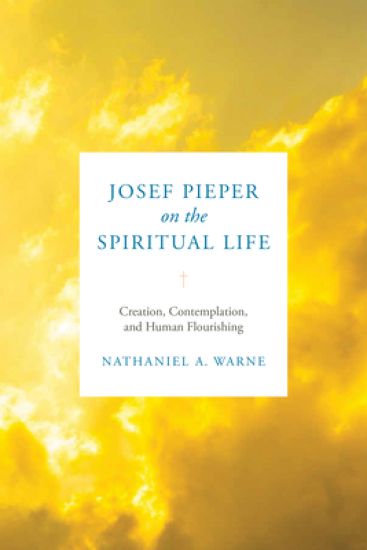
Josef Pieper on the Spiritual Life
Nathaniel A. Warne Adishian
UNIVERSITY OF NOTRE DAME PRESS
2023
sidottu
Warne's original study provides an insightful analysis of the role of contemplation and creation in the thought of Josef Pieper, illustrating the importance of this practice to earthly happiness and human flourishing. What is the relationship between creation, contemplation, human flourishing, and moral development? Nathaniel Warne's Josef Pieper on the Spiritual Life offers a sophisticated answer to this question through a systematic analysis of philosopher Josef Pieper's (1904–1997) thought. Warne's examination centers on the role of contemplation and creation in Pieper's thinking, arguing that contemplation of the created order is a key feature of earthly happiness. By emphasizing the importance of contemplation, Pieper illustrates the deep interconnections between ethics, creation, and spirituality. For Warne, to posit a binary between the contemplative life and active life creates a false dichotomy. Following Pieper, Warne claims that theology and spirituality cannot be bracketed from ethics and social action—indeed, our lived experience in the world blurs the lines between these practices. Contemplation and action are closer together than are typically assumed, and they have important implications for both our spiritual development and our engagement with the world around us. Ultimately, Warne's emphasis on creation and contemplation represents an attempt to resist a view of ethics and the spiritual life that is divorced from our environment. In response to this view, Warne argues that we need a renewed sense that creation and place are important for self-understanding. Contemplation of creation is, fundamentally, a form of communion with God—we thus need a more robust sense of how ethics and politics are rooted in God's creative action. Taking Pieper as a guide, Warne's study helps to deepen our thinking about these connections.

Katholische Wegbereiter Des Nationalsozialismus: Michael Schmaus, Joseph Lorz, Josef Pieper
Kurt Flasch
Verlag Vittorio Klostermann
2021
nidottu
The fateful year 1933 has been and is still being extensively researched, but one can still make discoveries. For example, in the Catholic city of Munster, the group of prominent Catholic authors animated by Hitler's Vice-Chancellor Franz von Papen to make hesitant centrist voters move over to National Socialism. They were such prominent professors of theology as Michael Schmaus and Joseph Lortz. The Catholic writer Josef Pieper also assiduously made his voice heard. Their common aim was to "prove" what they believed to be the providential kinship of the Church and National Socialism. Kurt Flasch examines their reasoning and describes their historical position. It is not a matter of debunking or late denazification. The perpetrators who wrote are well known. They became most respected teachers in the early German Federal Republic; this makes them an element of post-1945 German continuity worth exploring.

Schuld Und Sünde: Eine Notwendige Klärung Mit C.S. Lewis Und Josef Pieper
Brill Schoningh
2026
nidottu
Ein Schuldiger wird immer gesucht, wenn etwas geschehen ist, was nicht sein sollte. Warum ist von S nde und vom S nder hingegen kaum die Rede? Hier besteht Kl rungsbedarf. In allen Kulturen waren die Menschen mit dem Faktum eigener und fremder Schuld konfrontiert. Das Wissen darum wird greifbar in der Praxis der Strafe. Bestrafung setzt Schuld voraus, und Schuld die Freiheit des Handelns. S nde scheint dagegen kein Ph nomen der inneren Erfahrung zu sein. Und doch w re das eigentlich Schlimme der Schuld erst mit dem Ausdruck S nde benannt. Schuld gegen Menschen w re dann zugleich Verfehlung gegen Gott. Ist das so, ist alle Schuld auch S nde, weil uns die Erfahrung von Schuld n tigt, von Gott zu sprechen? Diese und weitere Fragen im Umkreis von Schuld und S nde werden heute kaum gestellt - Anlass genug, eine notwendige Kl rung mit C. S. Lewis und Josef Pieper zu versuchen.

In The Four Cardinal Virtues, Joseph Pieper delivers a stimulating quartet of essays on the four cardinal virtues. He demonstrates the unsound overvaluation of moderation that has made contemporary morality a hollow convention and points out the true significance of the Christian virtues.

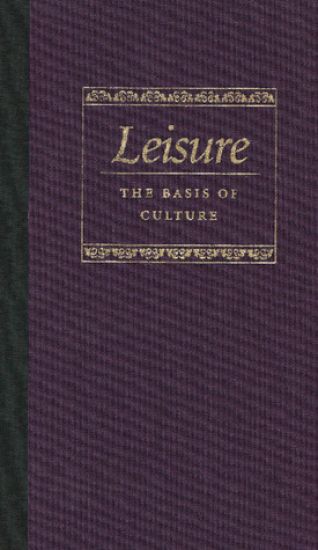
In this elegantly written (and produced) work, Josef Pieper introduces the reader to an understanding that leisure is nothing less than "an attitude of mind and a condition of the soul that fosters a capacity to perceive the reality of the world." Beginning with the Greeks, and through a series of philosophic, religious, and historical examples, Pieper demonstrates that "Leisure has been, and always will be, the first foundation of any culture." Of the frenetic contemporary clamor for things, entertainment, and distraction, Pieper observes, "in our bourgeois Western world total labor has vanquished leisure. Unless we regain the art of silence and insight, the ability for non-activity, unless we substitute true leisure for our hectic amusements, we will destroy our culture -- and ourselves." For, to Pieper, slavery is a state of mind and soul into which entire peoples descend when mental, moral, spiritual, and political independence is corrupted by a preoccupation with material well-being. Long unavailable, this reprint of the original edition of 1952 includes an introduction by T. S. Eliot.


The Human Wisdom of St. Thomas: A Breviary of Philosophy from the Works of St. Thomas Aquinas
Josef Pieper; Drostan MacLaren
Literary Licensing, LLC
2013
sidottu
The Human Wisdom of St. Thomas is a comprehensive and insightful book that offers a concise overview of the philosophy of St. Thomas Aquinas, one of the most influential theologians and philosophers in the history of Christianity. Written by renowned philosopher Josef Pieper, this breviary provides readers with a clear and accessible introduction to the thought of St. Thomas, drawing on his most important works and ideas.Pieper begins by exploring the life and legacy of St. Thomas, tracing his intellectual development and his contributions to the fields of theology, ethics, metaphysics, and more. He then delves into the key themes and concepts that define St. Thomas's philosophy, including his views on God, the nature of reality, the human person, and the relationship between faith and reason.Throughout the book, Pieper offers insightful commentary and analysis, highlighting the relevance and importance of St. Thomas's ideas for contemporary readers. He also includes a selection of St. Thomas's most important writings, providing readers with a firsthand look at the wisdom and insights of this great thinker.Overall, The Human Wisdom of St. Thomas is an essential read for anyone interested in philosophy, theology, or the history of ideas. With its clear and concise presentation of St. Thomas's thought, it offers readers a valuable resource for understanding the enduring legacy of this great thinker.This is a new release of the original 1948 edition.This scarce antiquarian book is a facsimile reprint of the old original and may contain some imperfections such as library marks and notations. Because we believe this work is culturally important, we have made it available as part of our commitment for protecting, preserving, and promoting the world's literature in affordable, high quality, modern editions, that are true to their original work.
The Human Wisdom of St. Thomas: A Breviary of Philosophy from the Works of St. Thomas Aquinas
Josef Pieper; Drostan MacLaren
Literary Licensing, LLC
2013
nidottu
One of the most important philosophy titles published in the twentieth century, Josef Pieper's Leisure, the Basis of Culture is more significant, even more crucial, today than it was when it first appeared more than fifty years ago. This edition also includes his work The Philosophical Act. Leisure is an attitude of the mind and a condition of the soul that fosters a capacity to perceive the reality of the world. Pieper shows that the Greeks and medieval Europeans, understood the great value and importance of leisure. He also points out that religion can be born only in leisure -- a leisure that allows time for the contemplation of the nature of God. Leisure has been, and always will be, the first foundation of any culture. Pieper maintains that our bourgeois world of total labor has vanquished leisure, and issues a startling warning: Unless we regain the art of silence and insight, the ability for non-activity, unless we substitute true leisure for our hectic amusements, we will destroy our culture -- and ourselves.

The Christian Idea of Man
Josef Pieper; Dan Farrelly; John Haldane
ST AUGUSTINE'S PRESS
2011
sidottu
In The Christian Idea of Man Josef Pieper brings off an extraordinary feat. He acknowledges that whoever introduces the theme of “virtue” and “the virtues” can expect to be met with a smile – of various shades of condescension. He then proceeds to single out “prudence” as the fundamental virtue on which the other cardinal virtues are based. In defining it, he does away with the shallow connotations which have debased it in modern times. Similarly, he manages to divest it of all traces of “moralism,” which, to a large extent has become identified with the Christian idea of virtue and has made it fall into general disrepute. For Pieper, prudence is fundamentally based on a clear perception of reality – of things as they are – and the prudent person is the one who acts in accordance with this perception. It has nothing to do with knowing how to avoid decisions which might be to one’s disadvantage. Similarly, justice, which is based on prudence, involves acting toward other persons according to one’s perception of the truth of the circumstances – again, a perception of things “as they are.” This is not a reference to any “status quo,” but to the reality as constituted by the Creator. In referring to courage [fortitude], Pieper discusses the overcoming of fear. This does not imply having no fear but, precisely, overcoming it. With regard to the fundamental fear of death, Pieper rejects the approaches which contend that there is nothing to fear in death. On the contrary, there is everything to fear in death: it concerns the question of possible absolute annihilation! Here Pieper introduces the consideration of the “theological” virtues of faith, hope, and love [charity]. When confronted with the question of possible annihilation, the Christian’s faith is paramount. Belief in God lets him confront danger and overcome even the most radical fear – through hope in God. His love of God does not wipe out fear but gives him courage. Moderation is seen as the last in the hierarchy of the cardinal virtues. Through its manifestation, in recent Christian thinking, with chastity and abstinence, it became in the Christian mind the most prominent characteristic of the Christian idea of man and one that dominated everything else. It has been reduced to the status of the most private of the virtues and is combined with a moralistic conception of the good. Pieper’s analysis of moderation shows how this virtue needs to be rethought, although, even then, it will remain the last in the hierarchy of virtues.

The Christian Idea of Man
Josef Pieper; Dan Farrelly; John Haldane
ST AUGUSTINE'S PRESS
2011
nidottu
In The Christian Idea of Man Josef Pieper brings off an extraordinary feat. He acknowledges that whoever introduces the theme of “virtue” and “the virtues” can expect to be met with a smile – of various shades of condescension. He then proceeds to single out “prudence” as the fundamental virtue on which the other cardinal virtues are based. In defining it, he does away with the shallow connotations which have debased it in modern times. Similarly, he manages to divest it of all traces of “moralism,” which, to a large extent has become identified with the Christian idea of virtue and has made it fall into general disrepute. For Pieper, prudence is fundamentally based on a clear perception of reality – of things as they are – and the prudent person is the one who acts in accordance with this perception. It has nothing to do with knowing how to avoid decisions which might be to one’s disadvantage. Similarly, justice, which is based on prudence, involves acting toward other persons according to one’s perception of the truth of the circumstances – again, a perception of things “as they are.” This is not a reference to any “status quo,” but to the reality as constituted by the Creator. In referring to courage [fortitude], Pieper discusses the overcoming of fear. This does not imply having no fear but, precisely, overcoming it. With regard to the fundamental fear of death, Pieper rejects the approaches which contend that there is nothing to fear in death. On the contrary, there is everything to fear in death: it concerns the question of possible absolute annihilation! Here Pieper introduces the consideration of the “theological” virtues of faith, hope, and love [charity]. When confronted with the question of possible annihilation, the Christian’s faith is paramount. Belief in God lets him confront danger and overcome even the most radical fear – through hope in God. His love of God does not wipe out fear but gives him courage. Moderation is seen as the last in the hierarchy of the cardinal virtues. Through its manifestation, in recent Christian thinking, with chastity and abstinence, it became in the Christian mind the most prominent characteristic of the Christian idea of man and one that dominated everything else. It has been reduced to the status of the most private of the virtues and is combined with a moralistic conception of the good. Pieper’s analysis of moderation shows how this virtue needs to be rethought, although, even then, it will remain the last in the hierarchy of virtues.