Kirjojen hintavertailu. Mukana 11 244 527 kirjaa ja 12 kauppaa.

Kirjahaku

Etsi kirjoja tekijän nimen, kirjan nimen tai ISBN:n perusteella.

1000 tulosta hakusanalla Pierre Simeon

Le Plat de Carnaval, Ou Les Beignets Apprêtés Par Guillaume Bonnepâte, Pour Remettre
Le plat de carnaval, ou Les beignets appretes par Guillaume Bonnepate, pour remettre en appetit ceux qui l'ont perduDate de l'edition originale: 1802Ce livre est la reproduction fidele d'une oeuvre publiee avant 1920 et fait partie d'une collection de livres reimprimes a la demande editee par Hachette Livre, dans le cadre d'un partenariat avec la Bibliotheque nationale de France, offrant l'opportunite d'acceder a des ouvrages anciens et souvent rares issus des fonds patrimoniaux de la BnF.Les oeuvres faisant partie de cette collection ont ete numerisees par la BnF et sont presentes sur Gallica, sa bibliotheque numerique.En entreprenant de redonner vie a ces ouvrages au travers d'une collection de livres reimprimes a la demande, nous leur donnons la possibilite de rencontrer un public elargi et participons a la transmission de connaissances et de savoirs parfois difficilement accessibles.Nous avons cherche a concilier la reproduction fidele d'un livre ancien a partir de sa version numerisee avec le souci d'un confort de lecture optimal. Nous esperons que les ouvrages de cette nouvelle collection vous apporteront entiere satisfaction.Pour plus d'informations, rendez-vous sur www.hachettebnf.fr
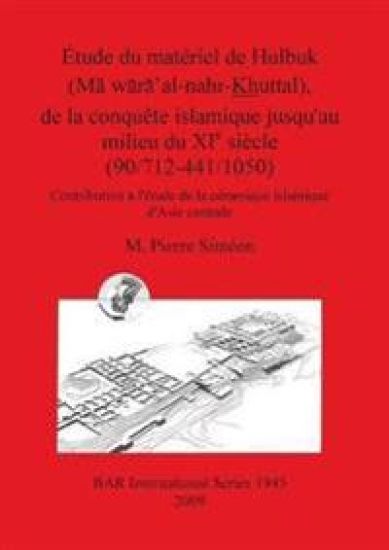
Étude du matériel de Hulbuk (M waxa' al-nahr Khuttal) de la conquête islamique jusqu'au milieu du XIe siècle (90/712-441/1050)
This study sets forth a typological classification of hitherto undocumented ceramic artefacts from the Hulbuk excavation site (south east of Tadjikistan, Kuliob district). The chronological period in question is rich in technical innovations and decorative creations. The ninth century saw the beginning of the development of glazed pottery. Under the Abbasids, considerable advances were made in science, in particular chemistry, and this led to the emergence of techniques, such as glaze, which modified the ceramic craft. French text.
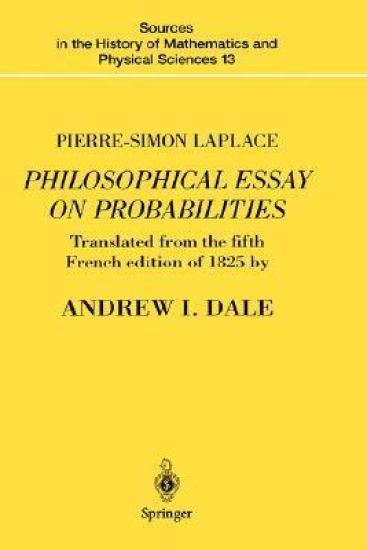
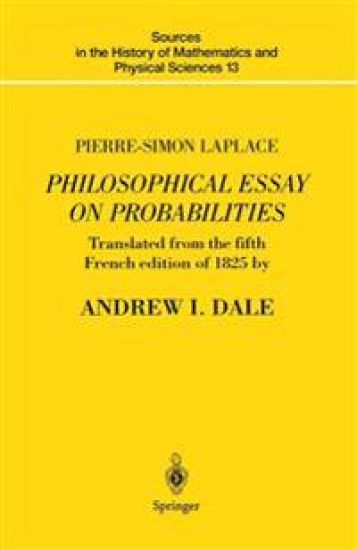
Pierre-Simon Laplace Philosophical Essay on Probabilities

Pierre-Simon Laplace Philosophical Essay on Probabilities

Pierre-Simon Laplace

Springer-Verlag New York Inc.
1994
sidottu
Pierre-Simon Laplace (1749-1827) is remembered amoung probabilitists today particularly for his "Theorie analytique des probabilites", published in 1812. The "Essai philosophique dur les probabilites" is his introduction for the second edition of this work. Here Laplace provided a popular exposition on his "Theorie". The "Essai", based on a lecture on probability given by Laplace in 1794, underwent sweeping changes, almost doubling in size, in the various editions published during Laplace's lifetime. Translations of various editions in different languages have apeared over the years. The only English translation of 1902 reads awkwardly today. This is a thorough and modern translation based on the recent re-issue, with its voluminous notes, of the fifth edition of 1826, with preface by Rene Thom and postscript by Bernard Bru. In the second part of the book, the reader is provided with an extensive commentary by the translator including valuable histographical and mathematical remarks and various proofs.
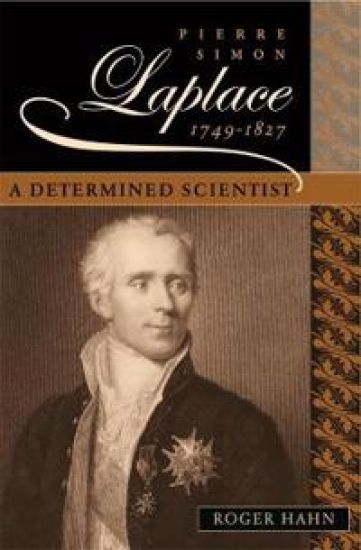
Pierre Simon Laplace, 1749–1827

Pierre Simon Laplace, 1749–1827

Hahn Roger

Harvard University Press
2005
sidottu
Often referred to as the Newton of France, Pierre Simon Laplace has been called the greatest scientist of the late eighteenth and early nineteenth centuries. He affirmed the stability of the solar system and offered a powerful hypothesis about its origins. A skillful mathematician and popular philosopher, Laplace also did pioneering work on probability theory, in devising a method of inverse probabilities associated with his classic formulation of physical determinism in the universe. With Lavoisier and several younger disciples, he also made decisive advances in chemistry and mathematical physics.Roger Hahn, who has devoted years to researching Laplace's life, has compiled a rich archive of his scientific correspondence. In this compact biography, also based in part on unpublished private papers, Hahn follows Laplace's journey from would-be priest in the provinces to Parisian academician, popularizer of science during the French Revolution, religious skeptic, and supporter of Napoleon. By the end of his life, Laplace had become a well-rewarded dean of French science.In this first full-length biography, Hahn illuminates the man in his historical setting. Elegantly written, Pierre Simon Laplace reflects a lifetime of thinking and research by a distinguished historian of science on the fortunes of a singularly important figure in the annals of Enlightenment science.
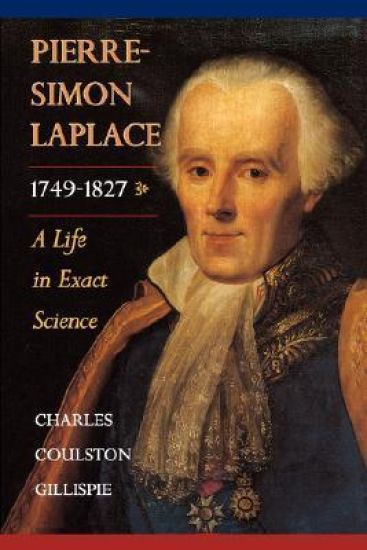
Pierre-Simon Laplace, 1749-1827

Pierre-Simon Laplace, 1749-1827

Charles Coulston Gillispie

Princeton University Press
2000
pokkari
Pierre-Simon Laplace was among the most influential scientists in history. Often referred to as the lawgiver of French science, he is known for his technical contributions to exact science, for the philosophical point of view he developed in the presentation of his work, and for the leading part he took in forming the modern discipline of mathematical physics. His two most famous treatises were the five-volume Traite de mecanique celeste (1799-1825) and Theorie analytique des probabilites (1812). In the former he demonstrated mathematically the stability of the solar system in service to the universal Newtonian law of gravity. In the latter he developed probability from a set of miscellaneous problems concerning games, averages, mortality, and insurance risks into the branch of mathematics that permitted the quantification of estimates of error and the drawing of statistical inferences, wherever data warranted, in social, medical, and juridical matters, as well as in the physical sciences. This book traces the development of Laplace's research program and of his participation in the Academy of Science during the last decades of the Old Regime into the early years of the French Revolution. A scientific biography by Charles Gillispie comprises the major portion of the book. Robert Fox contributes an account of Laplace's attempt to form a school of young physicists who would extend the Newtonian model from astronomy to physics, and Ivor Grattan-Guinness summarizes the history of the scientist's most important single mathematical contribution, the Laplace Transform.
Pierre-Simon Laplace Philosophical Essay on Probabilities

Pierre-Simon Laplace Philosophical Essay on Probabilities

Pierre-Simon Laplace

Springer-Verlag New York Inc.
2011
nidottu
Pierre-Simon Laplace (1749-1827) is remembered amoung probabilitists today particularly for his "Theorie analytique des probabilites", published in 1812. The "Essai philosophique dur les probabilites" is his introduction for the second edition of this work. Here Laplace provided a popular exposition on his "Theorie". The "Essai", based on a lecture on probability given by Laplace in 1794, underwent sweeping changes, almost doubling in size, in the various editions published during Laplace's lifetime. Translations of various editions in different languages have apeared over the years. The only English translation of 1902 reads awkwardly today. This is a thorough and modern translation based on the recent re-issue, with its voluminous notes, of the fifth edition of 1826, with preface by Rene Thom and postscript by Bernard Bru. In the second part of the book, the reader is provided with an extensive commentary by the translator including valuable histographical and mathematical remarks and various proofs.
Pierre-Simon Girard (1765-1836), an early French civil engineer

Pierre-Simon Girard (1765-1836), an early French civil engineer

Margaret Bradley

Editions Universitaires Europeennes
2017
pokkari
This is an account of the life and career of an early graduate of the Paris Ecole des Ponts et Chauss es (School of bridges and highways). He began research in fluid mechanics and the strength of materials while still a student in the 1780s. This was followed by planning of the French canal network and, in 1792, he won a French Academy of Sciences prize for his paper on the theory of locks. When Bonaparte planned his 1798 Egyptian expedition, he recruited many scholars to accompany him, and Girard was selected as one of them. He attracted the attention of the future emperor through his meticulous work and dedication to duty; this same devotion he demanded of his subordinates, earning their hostility. As a result of Bonaparte's influence, Girard was able to surmount the rigid career hierarchy in the Ponts et Chauss es Service, and achieved early high promotion, provoking the jealousy of his colleagues. He became director of the work on the Ourcq canal, a vast enterprise involving the Paris water-supply. He went from strength to strength and published widely. 1830, he became president of the Acad mie des sciences, and was promoted officier de la L gion d'Honneur in 1831.
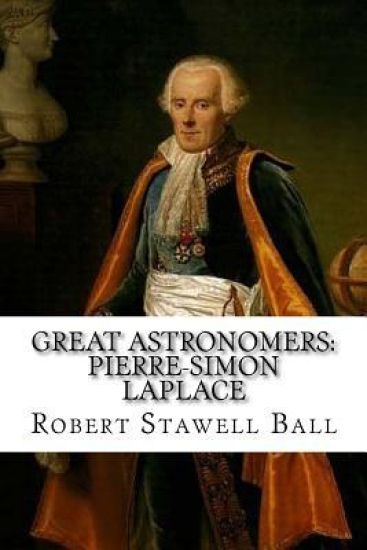
Great Astronomers: Pierre-Simon Laplace Robert Stawell Ball

Great Astronomers: Pierre-Simon Laplace Robert Stawell Ball

Robert Stawell Ball

Createspace Independent Publishing Platform
2017
nidottu
Pierre-Simon, Marquis de Laplace (1749-1827), was a French mathematician and astronomer, sometimes referred to as the French Newton. His work was pivotal to the mathematical development of astronomy, physics, and statistics. He possessed a phenomenal mathematical ability, superior to that of any of his contemporaries. Laplace summarized and extended the work of his predecessors in his five-volume M canique C leste (Celestial Mechanics) (1799-1825). This work elevated the geometric study of classical mechanics to one based on calculus, opening up a broader range of problems.
Observations de M. Pierre-Victor Sur Cette Question:

Observations de M. Pierre-Victor Sur Cette Question:

Pierre-Simon Lerebours

Hachette Livre - BNF
2016
pokkari
Observations de M. Pierre-Victor sur cette question: a quelles causes faut-il attribuer la decadence de la tragedie en France ? proposee par le Congres scientifique de France, dans sa 8e session, tenue a Besancon en septembre 1840Date de l'edition originale: 1842Appartient a l'ensemble documentaire: FrancComt1Ce livre est la reproduction fidele d'une oeuvre publiee avant 1920 et fait partie d'une collection de livres reimprimes a la demande editee par Hachette Livre, dans le cadre d'un partenariat avec la Bibliotheque nationale de France, offrant l'opportunite d'acceder a des ouvrages anciens et souvent rares issus des fonds patrimoniaux de la BnF.Les oeuvres faisant partie de cette collection ont ete numerisees par la BnF et sont presentes sur Gallica, sa bibliotheque numerique.En entreprenant de redonner vie a ces ouvrages au travers d'une collection de livres reimprimes a la demande, nous leur donnons la possibilite de rencontrer un public elargi et participons a la transmission de connaissances et de savoirs parfois difficilement accessibles.Nous avons cherche a concilier la reproduction fidele d'un livre ancien a partir de sa version numerisee avec le souci d'un confort de lecture optimal. Nous esperons que les ouvrages de cette nouvelle collection vous apporteront entiere satisfaction.Pour plus d'informations, rendez-vous sur www.hachettebnf.fr