Kirjahaku
Etsi kirjoja tekijän nimen, kirjan nimen tai ISBN:n perusteella.
193 tulosta hakusanalla Quintilian
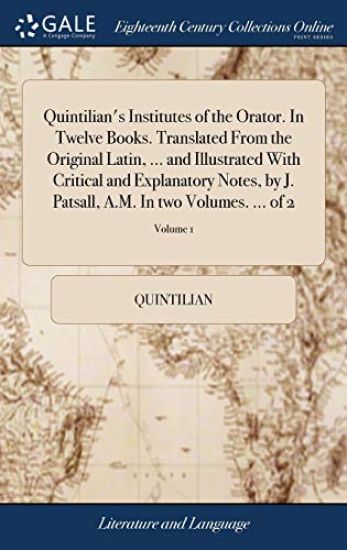
Quintilian's Institutes of the Orator. In Twelve Books. Translated From the Original Latin, ... and Illustrated With Critical and Explanatory Notes, by J. Patsall, A.M. In two Volumes. ... of 2; Volume 1
Quintilian
Gale Ecco, Print Editions
2018
sidottu
The 18th century was a wealth of knowledge, exploration and rapidly growing technology and expanding record-keeping made possible by advances in the printing press. In its determination to preserve the century of revolution, Gale initiated a revolution of its own: digitization of epic proportions to preserve these invaluable works in the largest archive of its kind. Now for the first time these high-quality digital copies of original 18th century manuscripts are available in print, making them highly accessible to libraries, undergraduate students, and independent scholars.Western literary study flows out of eighteenth-century works by Alexander Pope, Daniel Defoe, Henry Fielding, Frances Burney, Denis Diderot, Johann Gottfried Herder, Johann Wolfgang von Goethe, and others. Experience the birth of the modern novel, or compare the development of language using dictionaries and grammar discourses. ++++The below data was compiled from various identification fields in the bibliographic record of this title. This data is provided as an additional tool in helping to insure edition identification: ++++British LibraryT139487London: printed for B. Law; and J. Wilkie, 1774. 2v.; 8

The Tenth and Twelfth Books of the institutions of Quintilian. With Explanatory Notes. by Henry S. Frieze...
Quintilian
University of Michigan Library
2006
pokkari
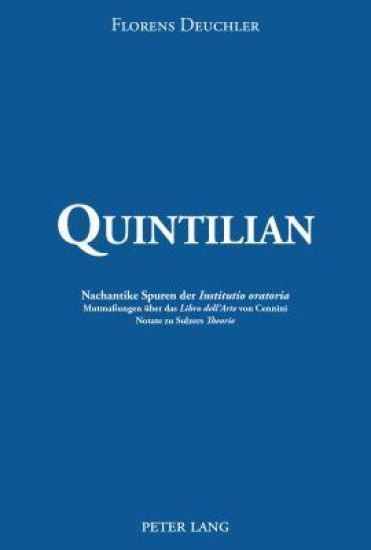
Quintilians Ruhm - im ersten Jahrhundert unserer Zeitrechnung aufgebaut -, sein Ruf als Lehrer, Denker und Gelehrter sind nie verblasst; seine Institutio oratoria verharrte als sichtbarer Meilenstein und Zeuge in der memoria der Rhetorik, und der Verfasser fand als Kenner der Materie selbst noch am Hofe des Sonnenkoenigs in Versailles hohe Beachtung und wurdiges Lob. Friedrich der Grosse rief im 18. Jahrhundert eindringlich zum Studium der Institutio an hoeheren Schulen auf. Die bildungsgeschichtliche Leistung Quintilians ist beachtlich, und sie ist trotzdem kaum bekannt, denn die Institutio wird ausserhalb von Fachzirkeln der Redekunst selten zu Rate gezogen. Neuere Kunst- oder Kunstlergeschichten gingen mit staunenswerter Achtlosigkeit an ihr vorbei - und so entgingen der Forschung moegliche Quellen und Anregungen sowie grundlegende Impulse fur weitergehende Einsichten. Den Auswirkungen Quintilians wird vor allem im Libro dell'Arte des Cennino Cennini (um 1400) nachgegangen. Der aus der Toskana stammende Maler ubernahm aus der spatantiken Quelle vor allem die Wegweisungen zu einem gesunden, geordneten und moralisch einwandfreien Lebenswandel.
This book has been considered by academicians and scholars of great significance and value to literature. This forms a part of the knowledge base for future generations. So that the book is never forgotten we have represented this book in a print format as the same form as it was originally first published. Hence any marks or annotations seen are left intentionally to preserve its true nature.

Quintilian Institutionis Oratoriae Vol. I
Clarendon Press
1970
muu
Quintilian Institutionis Oratoriae Vol. I
Quintilian Institutionis Oratoriae Vol. II
Clarendon Press
1970
muu
Quintilian Institutionis Oratoriae Vol. II
Quintilian Institutio Oratoria Book 2
Oxford University Press
2006
sidottu
An edition, with a new Latin text and full commentary, of Book 2 of Quintilian's Education of the Orator. Education and the conceptualization of technical disciplines are now focal points of research into Graeco-Roman antiquity, and Quintilian's work is central to both areas. Following the treatment of elementary education in Book 1, Quintilian proceeds to the discussion of the second stage of instruction, provided by the teacher of rhetoric. He gives important insights into the way teaching was conducted in a rhetorical school in Rome in the first century AD, and discusses the various elementary rhetorical exercises one by one. The second half of the book is concerned with Quintilian's theoretical conception of rhetoric. Rhetoric is seen as an 'art', a technical discipline grounded in rules and organized like medicine or seafaring, and - less obviously - as a virtue. The section as a whole provides an argument for Quintilian's celebrated claim that the perfect orator is 'a good man, skilled in speaking'.

Quintilian on the Teaching of Speaking and Writing
Southern Illinois University Press
1987
sidottu
Quintilian s method is based on the interrelationship between speaking, reading, and writing. Murphy lists and defines the main elements that appear in the "Institutio oratorio. "Each of these elementsPrecept, Imitation, Composition Exercises, Declamation, and Sequencingis further subdivided according to goals and exercises.The first two books of the "Institutio oratorio "concern the early education of the orator, with the focus on the interplay between seen-language and heard-language. Book Ten is an adult s commentary on the instruction of rhetoric. It involves itself primarily with "facilitas, "the readiness to use language in any situation."

Quintilian on the Teaching of Speaking and Writing
James J. Murphy; Cleve Wiese
Southern Illinois University Press
2015
nidottu
A contemporary approach to a classic text from one of ancient Rome’s master educatorsQuintilian on the Teaching of Speaking and Writing offers scholars and students insights into the pedagogies of Marcus Fabius Quintilianus (ca. CE 35–ca. CE 95), one of Rome’s most famous teachers of rhetoric. Providing translations of three key sections from Quintilian’s important and influential Institutio oratoria (Education of the Orator), this volume outlines the systematic educational processes that Quintilian inherited from the Greeks, foregrounding his rationale for rhetorical education based on the interrelationship between reading, speaking, listening, and writing, and emphasizing the blending of moral purpose and artistic skill. A contemporary approach to one of the most influential educational work in the history of Western culture, this book provides access not only to translations of key sections of Quintilian’s educational program but also a robust contemporary framework for the training of humane and effective citizens through the teaching of speaking and writing.
Quintilian's Institutes of the Orator
Charles Rollin; Charles Quintilian
Hutson Street Press
2025
sidottu

Quintilian's Institutes of the Orator
Charles Rollin; Charles Quintilian
Hutson Street Press
2025
pokkari

The Instituto Oratoria of Quintilian
Quintilian; Harold Edgeworth (TRN) Butler
Kessinger Pub
2009
pokkari
Quintiliani Institutionis Oratoriae Liber X, Part 1
Quintilian; William (EDT) Peterson
Kessinger Pub
2008
pokkari
Quintilian's Institutes of Oratory
Outlook Verlag
2025
sidottu
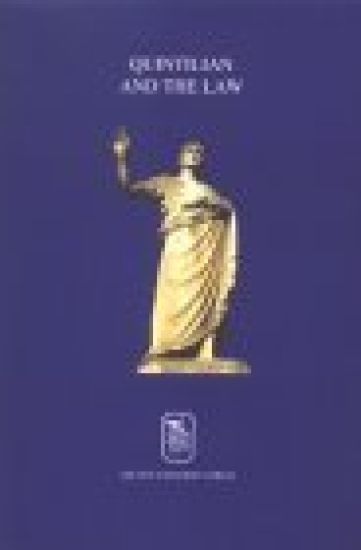
Quintilian and the Law
Leuven University Press
2003
pokkari
The art of persuasion, as practised today in political debate as well as in the courts of law, has been developed in the rhetorical tradition, but its authors have disappeared from view. One of them was Quintilian, who wrote his Institutio oratoria at the end of the first century AD. This book is special because it contains one of the fullest surveys of rhetorical insights ever written and because it has come down to us in its entirety. Quintilian’s rhetorical system has been used in teaching rhetoric at universities since the Middle Ages. The purpose of ‘Quintilian and the Law’ is to reintroduce Quintilian’s Institutio oratoria to modern readers, and to show that the topics discussed in it are still very much alive today. To that end, modern experts of law and rhetoric present their views on the Institutio oratoria, each dealing with one of the twelve books of which it consists. The authors were free to choose their own way of working, so that some books are described in their entirety, others are discussed from one particular point of view, and others still are treated only with regard to a particular section. In Roman times, the shortest way to a political career was by working in the law courts. There, one could acquire a reputation for having a thorough knowledge of the law and for being able to speak well in public. In his Institutio oratoria, Quintilian not only formulated important insights in juridical argumentation, in the art of speech-writing, and in the performative aspects of advocacy, he also discussed the ethical problems involved. Because Quintilian larded his instructions with numerous examples from practice, his book takes us back into the Roman law courts and helps us experience their exciting atmosphere. The essays in this book reflect the wide range of subjects discussed by Quintilian. They deal with (one of) six themes: (1) the ideal orator in a historical perspective, (2) his education, (3) rhetoric and communication, (4) argumentation, (5) Roman law in the Institutio oratoria, and (6) emotions in the courtroom. However, in honour of its author, they are arranged in the order of the Institutio oratoria.
Quintilian's Institutes of oratory; or, Education of an orator. In twelve books (Volume I)
John Selby Watson
Alpha Edition
2019
pokkari