Kirjojen hintavertailu. Mukana 11 699 587 kirjaa ja 12 kauppaa.

Kirjahaku

Etsi kirjoja tekijän nimen, kirjan nimen tai ISBN:n perusteella.

1000 tulosta hakusanalla R. Michael Alvarez; Thad E. Hall

Electronic Elections

Electronic Elections

R. Michael Alvarez; Thad E. Hall

Princeton University Press
2010
pokkari
Since the 2000 presidential election, the United States has been embroiled in debates about electronic voting. Critics say the new technologies invite tampering and fraud. Advocates say they enhance the accuracy of vote counts and make casting ballots easier--and ultimately foster greater political participation. Electronic Elections cuts through the media spin to assess the advantages and risks associated with different ways of casting ballots--and shows how e-voting can be the future of American democracy. Elections by nature are fraught with risk. Michael Alvarez and Thad Hall fully examine the range of past methods and the new technologies that have been created to try to minimize risk and accurately reflect the will of voters. Drawing upon a wealth of new data on how different kinds of electronic voting machines have performed in recent elections nationwide, they evaluate the security issues that have been the subject of so much media attention, and examine the impacts the new computer-based solutions is having on voter participation. Alvarez and Hall explain why the benefits of e-voting can outweigh the challenges, and they argue that media coverage of the new technologies has emphasized their problems while virtually ignoring their enormous potential for empowering more citizens to vote. The authors also offer ways to improve voting technologies and to develop more effective means of implementing and evaluating these systems. Electronic Elections makes a case for how e-voting can work in the United States, showing why making it work right is essential to the future vibrancy of the democratic process.
Point, Click, and Vote

Point, Click, and Vote

R. Michael Alvarez; Thad E. Hall

Brookings Institution
2003
nidottu
"Whether responding to a CNN.com survey or voting for the NFL All-Pro team, computer users are becoming more and more comfortable with Internet polls. Computer use in the United States continues to grow—more than half of all American households now have a personal computer. The next question, then, becomes obvious. Should Americans be able to use the Internet in the most important polls of all? Some advocates of Internet voting argue that Americans are well suited to casting their ballots online in political elections. They are eager to make use of new technology, and they have relatively broad access to the Internet. Voting would become easier for people stuck at home, at the office, or on the road. Internet voting might encourage greater political participation among young adults, a group that stays away from the polling place in droves. It would hold special appeal for military personnel overseas, whose ability to vote is a growing concern. There are serious concerns, however, regarding computer security and voter fraud, unequal Internet access across socioeconomic lines (the ""digital divide""), and the civic consequences of moving elections away from schools and other polling places and into private homes and offices. After all, showing up to vote is the most public civic activity many Americans engage in, and it is often their only overt participation in the democratic process. In Point, Click, and Vote, voting experts Michael Alvarez and Thad Hall make a strong case for greater experimentation with Internet voting. In their words, ""There is no way to know whether any argument regarding Internet voting is accurate unless real Internet voting systems are tested, and they should be tested in small-scale, scientific trials so that their successes and failures can be evaluated."" In other words, you never know until you try, and it's time to try harder. The authors offer a realistic plan for putting pilot remote Internet voting programs into effect nationwide. Such programs would allow U.S. voters in selected areas to cast their ballots over any Internet connection; they would not even need to leave home. If these pilot programs are successful, the next step is to consider how they might be implemented on a larger scale in future elections. "

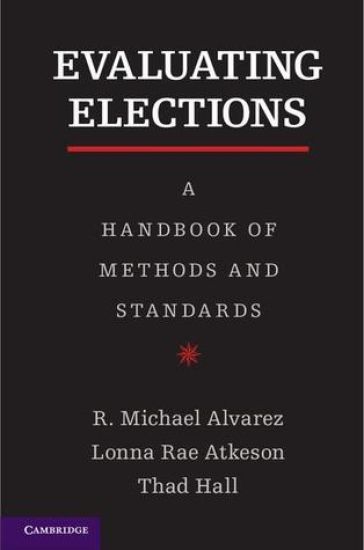
Evaluating Elections

Evaluating Elections

R. Michael Alvarez; Lonna Rae Atkeson; Thad E. Hall

Cambridge University Press
2012
sidottu
In competitive and contested democratic elections, insuring integrity is critical. Evaluating Elections shows why systematic analysis and reporting of election performance is important and how data-driven performance management can be used by election officials to improve elections. The authors outline how performance management systems can function in elections and their benefits for voters, candidates and political parties. Journalists, election administrators and even candidates often ask whether recent elections were run well, whether there were problems in the administration of a particular state's elections and how well elections were run across the country. The authors explain that such questions are difficult to answer because of the complexity of election administration and because there is currently no standard or accepted framework to assess the general quality of an election.
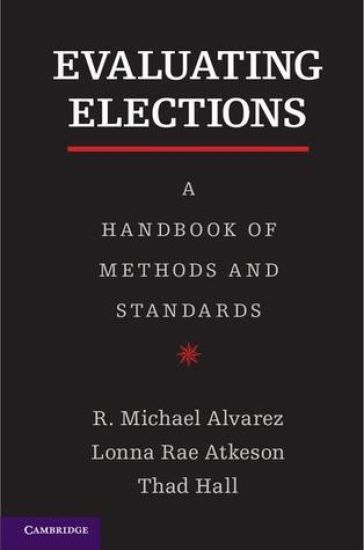
Evaluating Elections

Evaluating Elections

Alvarez R. Michael; Atkeson Lonna Rae; Hall Thad E.

Cambridge University Press
2012
pokkari
In competitive and contested democratic elections, insuring integrity is critical. Evaluating Elections shows why systematic analysis and reporting of election performance is important and how data-driven performance management can be used by election officials to improve elections. The authors outline how performance management systems can function in elections and their benefits for voters, candidates and political parties. Journalists, election administrators and even candidates often ask whether recent elections were run well, whether there were problems in the administration of a particular state's elections and how well elections were run across the country. The authors explain that such questions are difficult to answer because of the complexity of election administration and because there is currently no standard or accepted framework to assess the general quality of an election.
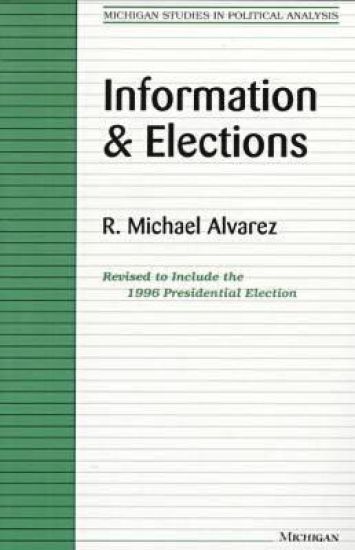
Information and Elections

Information and Elections

R. Michael Alvarez

The University of Michigan Press
1998
nidottu
R. Michael Alvarez examines how voters make their decisions in presidential elections. He begins with the assumption that voters have neither the incentive nor the inclination to be well-informed about politics and presidential candidates. Candidates themselves have incentives to provide ambiguous information about themselves, their records and their issue positions. Yet the author shows that a tremendous amount of information is made available about presidential candidates. And he uncovers clear and striking evidence that people are not likely to vote for candidates about whom they know very little. Alvarez explores how voters learn about candidates through the course of a campaign. He provides a detailed analysis of the media coverage of presidential campaigns and shows that there is a tremendous amount of media coverage of these campaigns, that much of this coverage is about issues and is informative, and that voters learn from this coverage. The paperback edition of this work has been updated to include information on the 1996 Presidential election. Information and Elections is a book that will be read by all who are interested in campaigns and electoral behavior in presidential and other elections. "Thoughtfully conceptualized, painstakingly analyzed, with empirically significant conclusions on presidential election voting behavior, this book is recommended for both upper-division undergraduate and graduate collections." --Choice R. Michael Alvarez is Associate Professor of Political Science, California Institute of Technology.
Hard Choices, Easy Answers

Hard Choices, Easy Answers

R. Michael Alvarez; John Brehm

Princeton University Press
2002
pokkari
Those who seek to accurately gauge public opinion must first ask themselves: Why are certain opinions highly volatile while others are relatively fixed? Why are some surveys affected by question wording or communicative medium (e.g., telephone) while others seem immune? In Hard Choices, Easy Answers, R. Michael Alvarez and John Brehm develop a new theory of response variability that, by reconciling the strengths and weaknesses of the standard approaches, will help pollsters and scholars alike better resolve such perennial problems. Working within the context of U.S. public opinion, they contend that the answers Americans give rest on a variegated structure of political predispositions--diverse but widely shared values, beliefs, expectations, and evaluations. Alvarez and Brehm argue that respondents deploy what they know about politics (often little) to think in terms of what they value and believe. Working with sophisticated statistical models, they offer a unique analysis of not just what a respondent is likely to choose, but also how variable those choices would be under differing circumstances. American public opinion can be characterized in one of three forms of variability, conclude the authors: ambivalence, equivocation, and uncertainty. Respondents are sometimes ambivalent, as in attitudes toward abortion or euthanasia. They are often equivocal, as in views about the scope of government. But most often, they are uncertain, sure of what they value, but unsure how to use those values in political choices.
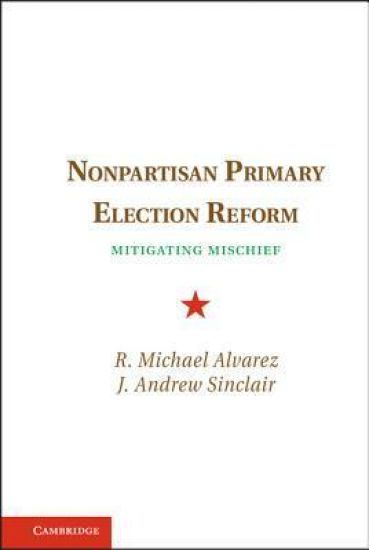
Nonpartisan Primary Election Reform

Nonpartisan Primary Election Reform

R. Michael Alvarez; J. Andrew Sinclair

Cambridge University Press
2015
sidottu
Over the years, observers of American politics have noted the deleterious effects of party polarization in both the national and state legislatures. Reformers have tried to address this problem by changing primary election laws. A theory underlies these legal changes: the reformers tend to believe that 'more open' primary laws will produce more centrist, moderate, or pragmatic candidates. The 'top-two' primary, just implemented in California, represents the future of these antiparty efforts. Nonpartisan Primary Election Reform examines California's first use of the top-two primary system in 2012. R. Michael Alvarez and J. Andrew Sinclair evaluate the primary from a variety of perspectives and using several different methodologies. Although the first use of this primary system in California did not immediately reshape the state's politics, it also did not have many of the deleterious consequences that some observers had feared. This study provides the foundation for future studies of state primary systems.
Nonpartisan Primary Election Reform

Nonpartisan Primary Election Reform

R. Michael Alvarez; J. Andrew Sinclair

Cambridge University Press
2015
pokkari
Over the years, observers of American politics have noted the deleterious effects of party polarization in both the national and state legislatures. Reformers have tried to address this problem by changing primary election laws. A theory underlies these legal changes: the reformers tend to believe that 'more open' primary laws will produce more centrist, moderate, or pragmatic candidates. The 'top-two' primary, just implemented in California, represents the future of these antiparty efforts. Nonpartisan Primary Election Reform examines California's first use of the top-two primary system in 2012. R. Michael Alvarez and J. Andrew Sinclair evaluate the primary from a variety of perspectives and using several different methodologies. Although the first use of this primary system in California did not immediately reshape the state's politics, it also did not have many of the deleterious consequences that some observers had feared. This study provides the foundation for future studies of state primary systems.
Securing American Elections

Securing American Elections

R. Michael Alvarez; Nicholas Adams-Cohen; Seo-young Silvia Kim; Yimeng Li

Cambridge University Press
2020
pokkari
The integrity of democratic elections, both in the United States and abroad, is an important problem. In this Element, we present a data-driven approach that evaluates the performance of the administration of a democratic election, before, during, and after Election Day. We show that this data-driven method can help to improve confidence in the integrity of American elections.
New Faces, New Voices

New Faces, New Voices

Marisa A. Abrajano; R. Michael Alvarez

Princeton University Press
2012
pokkari
Making up 14.2 percent of the American population, Hispanics are now the largest minority group in the United States. Clearly, securing the Hispanic vote is more important to political parties than ever before. Yet, despite the current size of the Hispanic population, is there a clear Hispanic politics? Who are Hispanic voters? What are their political preferences and attitudes, and why? The first comprehensive study of Hispanic voters in the United States, New Faces, New Voices paints a complex portrait of this diverse and growing population. Examining race, politics, and comparative political behavior, Marisa Abrajano and R. Michael Alvarez counter the preconceived notion of Hispanic voters as one homogenous group. The authors discuss the concept of Hispanic political identity, taking into account the ethnic, generational, and linguistic distinctions within the Hispanic population. They compare Hispanic registration, turnout, and participation to those of non-Hispanics, consider the socioeconomic factors contributing to Hispanics' levels of political knowledge, determine what segment of the Hispanic population votes in federal elections, and explore the prospects for political relationships among Hispanics and non-Hispanics. Finally, the authors look at Hispanic opinions on social and economic issues, factoring in whether these attitudes are affected by generational status and ethnicity. A unique and nuanced perspective on the Hispanic electoral population, New Faces, New Voices is essential for understanding the political characteristics of the largest and fastest growing group of minority voters in the United States.
An Analysis of Michael R. Gottfredson and Travish Hirschi's A General Theory of Crime
Michael R. Gottfredson and Travish Hirschi’s 1990 A General Theory of Crime is a classic text that helped reshape the discipline of criminology. It is also a testament to the powers of clear reasoning and interpretation. In critical thinking terms, reasoning is all about presenting a solid and persuasive case – and as many people instinctively understand, the most persuasive reasoning is that which bases itself on a single, simple hook. In Gottfredson and Hirschi’s case, this hook was what has come to be known as the “self-control theory of crime” – the idea that the tendency to commit crime is directly related to an individual’s level of self-control. While the dominant schools of thought of the time tended to focus on crime as the product of complex environmental factors, with little attempt to unify different theories, Gottfredson and Hirschi sought to interpret things so as to provide a single overarching concept that explained why crimes of all sorts were committed. Moreover, while other theories of crime concentrated on understanding and explaining specific types of law-breaking, the self-control model could, in Gottfredson and Hirschi’s view, be seen as the basis for understanding the root cause for all crime in all contexts. While such simplicity inevitably attracted as much criticism as agreement, subsequent studies have provided real-world corroboration for the General Theory’s persuasive reasoning.
Michael R. Lehnert

Michael R. Lehnert

VDM Publishing House
2010
nidottu
Observera att förlaget som ger ut denna produkt baserar innehållet i sina produkter på fria källor som Wikipedia. Boken är med stor sannolikhet endast ett utdrag ur dessa informationskällor, alltså inte en vanlig bok i den bemärkelsen.