Kirjojen hintavertailu. Mukana 11 244 527 kirjaa ja 12 kauppaa.

Kirjahaku

Etsi kirjoja tekijän nimen, kirjan nimen tai ISBN:n perusteella.

1000 tulosta hakusanalla R.J.B. Bosworth

Italy and the Wider World

Italy and the Wider World

R.J.B. Bosworth

Routledge
1995
sidottu
Richard Bosworth's overview of Italy's role in European and world politics from 1860 to 1960 is lively and iconclastic. Based on a combination of primary research and secondary material he examines Italian diplomacy, military power, commerce, culture, tourism and ideology. His account challenges many aspects of current Italian historiography and offers an original vision of the place of Italy in modern history.
Italy and the Wider World

Italy and the Wider World

R.J.B. Bosworth

Routledge
2013
nidottu
Richard Bosworth's overview of Italy's role in European and world politics from 1860 to 1960 is lively and iconclastic. Based on a combination of primary research and secondary material he examines Italian diplomacy, military power, commerce, culture, tourism and ideology. His account challenges many aspects of current Italian historiography and offers an original vision of the place of Italy in modern history.
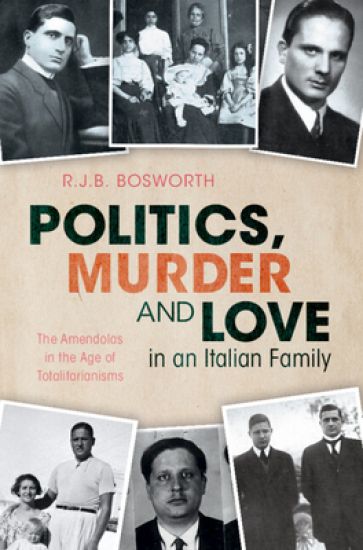
Politics, Murder and Love in an Italian Family

Politics, Murder and Love in an Italian Family

R.J.B. Bosworth

Cambridge University Press
2023
sidottu
What did it mean to live with fascism, communism, and totalitarianism in modern Italy? And what should we learn from the experiences of a martyred liberal democrat father and his communist son? Through the prism of a single, exceptional family, the Amendolas, R.J.B. Bosworth reveals the heart of twentieth-century Italian politics. Giovanni and Giorgio Amendola, father and son, were both highly capable and dedicated Anti-Fascists. Each failed to make it to the top of the Italian political pyramid but nevertheless played a major part in Italy's history. Both also had rich but contrasting private lives. Each married a foreign and accomplished woman: Giovanni, a woman from a distinguished German-Russian intellectual family; Giorgio, a Parisian working class girl, who, to him, embodied Revolution. This vivid and engaging biographical study explores the highs and lows of a family that was at the centre of Italian politics over several generations. Tracing the complex relationship between Anti-Fascist politics and the private lives of individuals and of the family, Politics, Murder and Love in an Italian Family offers a profound portrait of a century of Italian life.
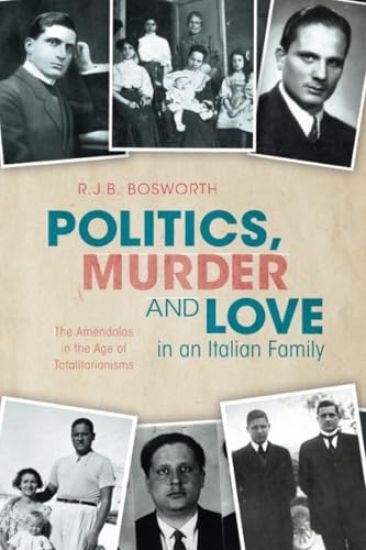
Politics, Murder and Love in an Italian Family

Politics, Murder and Love in an Italian Family

R.J.B. Bosworth

Cambridge University Press
2025
pokkari
What did it mean to live with fascism, communism, and totalitarianism in modern Italy? And what should we learn from the experiences of a martyred liberal democrat father and his communist son? Through the prism of a single, exceptional family, the Amendolas, R.J.B. Bosworth reveals the heart of twentieth-century Italian politics. Giovanni and Giorgio Amendola, father and son, were both highly capable and dedicated Anti-Fascists. Each failed to make it to the top of the Italian political pyramid but nevertheless played a major part in Italy's history. Both also had rich but contrasting private lives. Each married a foreign and accomplished woman: Giovanni, a woman from a distinguished German-Russian intellectual family; Giorgio, a Parisian working class girl, who, to him, embodied Revolution. This vivid and engaging biographical study explores the highs and lows of a family that was at the centre of Italian politics over several generations. Tracing the complex relationship between Anti-Fascist politics and the private lives of individuals and of the family, Politics, Murder and Love in an Italian Family offers a profound portrait of a century of Italian life.
Mussolini's Italy

Mussolini's Italy

R J B Bosworth

Penguin Books Ltd
2006
pokkari
For almost all nations the First World War was an unparalleled disaster, but the Italian experience especially was to have catastrophic consequences. Weakened and embittered, trying and failing to come to terms with 600,000 dead and with an entire generation of men militarized by fighting, Italy gave birth to a new form of political life: Fascism.Richard Bosworth brings to life the period when Italians participated in a vast and ultimately ruinous political experiment under their dictator, Benito Mussolini, and his fascist henchmen. The fascists were the first totalitarians, aiming to reshape Italy and its people utterly. Their regime was based on a cult of violence and obedience. Yet, despite this, Italians found ingenious ways of adapting, limiting, undermining and ridiculing Mussolini's ambitions for them. The heart of this book is its engagement with the life of these ordinary Italians and their families, struggling through terrible times. Bosworth creates a powerful, plausible and entertaining picture of Italian life and a regime which - as the world hurtled towards the cataclysm of the Second World War - was to force humiliation, defeat, invasion and the utter collapse of the nation state.
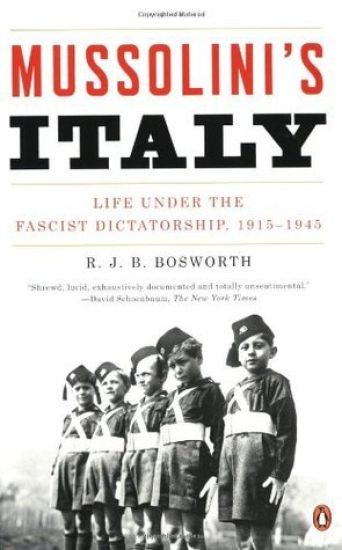
Mussolini's Italy: Life Under the Fascist Dictatorship, 1915-1945
An evaluation of Italy's notorious Fascist period under dictator Benito Mussolini considers its violence and demands for obedience, noting how it served as a model for other twentieth-century dictatorships while arguing that the nation's largely undeveloped country and tribal family structures helped Italians to devise creative survival and resistance methods. Reprint. 25,000 first printing.
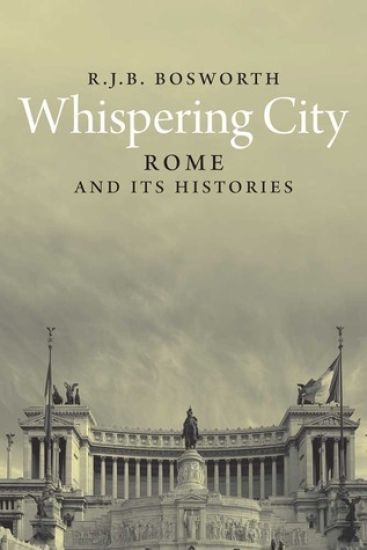
Whispering City

Whispering City

R. J. B. Bosworth

Yale University Press
2011
sidottu
An accomplished Italianist looks beyond Rome's storied facades to offer insight into the many histories of one of the world's best-loved cities In Civilization and Its Discontents, Sigmund Freud claimed that Rome must be comprehended as "not a human dwelling place but a mental entity," in which the palaces of the Caesars still stand alongside modern apartment buildings in layers of brick, mortar, and memory. "The observer would need merely to shift the focus of his eyes, perhaps, or change his position, in order to call up a view of either the one or the other."In this one-of-a-kind book, historian Richard Bosworth accepts Freud's challenge, drawing upon his expertise in Italian pasts to explore the many layers of history found within the Eternal City. Often beginning his analysis with sites and monuments that can still be found in contemporary Rome, Bosworth expands his scope to review how political groups of different eras—the Catholic Church, makers of the Italian nation, Fascists, and "ordinary" Romans (be they citizens, immigrants, or tourists)—read meaning into the city around them. Weaving in the city's quintessential figures (Garibaldi, Pius XII, Mussolini, and Berlusconi) and architectural icons (the Vatican, St. Peter's Basilica, the Victor Emmanuel Monument, and EUR) with those forgotten or unknown, Bosworth explores the many histories that whisper their rival and competing messages and seek to impose their truth upon the passing crowds. But as this delightful study will reveal, Rome, that magisterial palimpsest, has never accepted a single reading of its historic meaning.
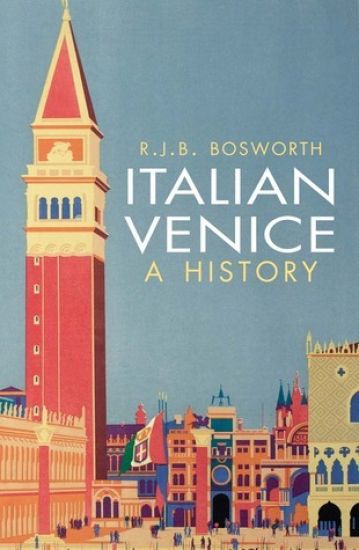
Italian Venice

Italian Venice

R. J. B. Bosworth

Yale University Press
2015
pokkari
In this elegant book Richard Bosworth explores Venice—not the glorious Venice of the Venetian Republic, but from the fall of the Republic in 1797 and the Risorgimento up through the present day. Bosworth looks at the glamour and squalor of the belle époque and the dark underbelly of modernization, the two world wars, and the far-reaching oppressions of the fascist regime, through to the “Disneylandification” of Venice and the tourist boom, the worldwide attention of the biennale and film festival, and current threats of subsidence and flooding posed by global warming. He draws out major themes—the increasingly anachronistic but deeply embedded Catholic Church, the two faces of modernization, consumerism versus culture. Bosworth interrogates not just Venice’s history but its meanings, and how the city’s past has been co-opted to suit present and sometimes ulterior aims. Venice, he shows, is a city where its histories as well as its waters ripple on the surface.
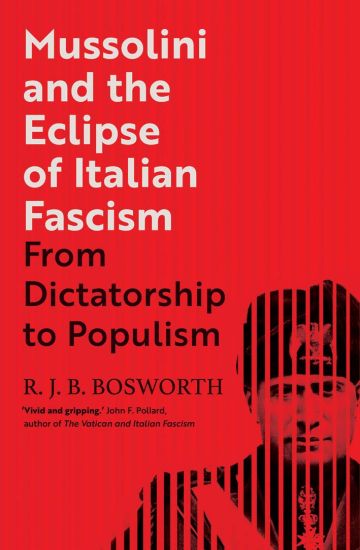
Mussolini and the Eclipse of Italian Fascism

Mussolini and the Eclipse of Italian Fascism

R. J. B. Bosworth

Yale University Press
2021
sidottu
An incisive account of how Mussolini pioneered populism in reaction to Hitler’s rise—and thereby reinforced his role as a model for later authoritarian leaders"A passionately engaged history of a Mussolini and an Italy caught up in the monstrous gravitational waves engendered by the coming of Third Reich."—Giuseppe Finaldi, author of Mussolini and Italian Fascism On the tenth anniversary of his rise to power in 1932, Benito Mussolini (1883–1945) seemed to many the “good dictator.” He was the first totalitarian and the first fascist in modern Europe. But a year later Hitler’s entrance onto the political stage signaled a German takeover of the fascist ideology. In this definitive account, eminent historian R.J.B. Bosworth charts Mussolini’s leadership in reaction to Hitler. Bosworth shows how Italy’s decline in ideological pre-eminence, as well as in military and diplomatic power, led Mussolini to pursue a more populist approach: angry and bellicose words at home, violent aggression abroad, and a more extreme emphasis on charisma. In his embittered efforts to bolster an increasingly hollow and ruthless regime, it was Mussolini, rather than Hitler, who offered the model for all subsequent authoritarians.
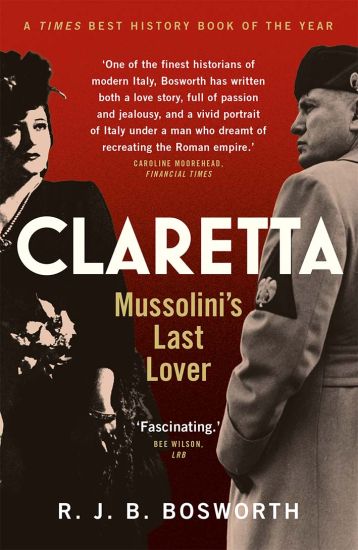
Claretta

Claretta

R. J. B. Bosworth

Yale University Press
2021
pokkari
A master historian illuminates the tumultuous relationship of Mussolini and his young lover Claretta Petacci"One of the finest historians of modern Italy, Bosworth has written both a love story, full of passion and jealousy, and a vivid portrait of Italy under a man who dreamt of recreating the Roman empire.”—Caroline Moorehead, Financial Times Few deaths are as gruesome and infamous as those of Benito Mussolini, Italy’s fascist dictator, and Claretta (or Clara) Petacci, his much-younger lover. Shot dead by Italian partisans after attempting to flee the country in 1945, the couple’s bodies were then hanged upside down in Milan’s main square in ignominious public display. This provocative book is the first to mine Clara’s extensive diaries, family correspondence, and other sources that have only recently become available to discover how the last in Mussolini’s long line of lovers became his intimate and how she came to her violent fate at his side. R. J. B. Bosworth explores the social climbing of Claretta’s family, her naïve and self-interested commitment to fascism, her diary’s graphically detailed accounts of sexual life with Mussolini, and much more. Brimful of new and arresting information, the book sheds intimate light not only on an ordinary-extraordinary woman living at the heart of Italy’s totalitarian fascist state but also on Mussolini himself.
Italy the Least of the Great Powers

Italy the Least of the Great Powers

R. J. B. Bosworth

Cambridge University Press
2005
pokkari
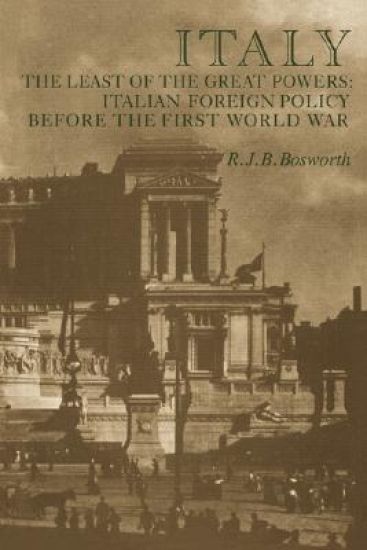
In the heart of Rome beside the Capitol, confronting the Piazza Venezia, stands the Victor Emmanuel monument. In Rome, which until 1945 was so often accorded the adjectives 'eternal' or 'imperial', the monumentissimo (as sardonic socialists labelled it) is the most public, most theatrical and most excessive architectural celebration of post-Risorgimento Italian patriotism, nationalism and perhaps imperialism. This book asks why the Victor Emmanuel monument, planned after 1878 and opened in 1911, was a structure raised by Liberal and not Fascist Italy. Through a detailed study of diplomacy, of policy-making, of policy-makers, and of the distribution of real power in pre-First World War Italy, it demonstrates how important foreign policy, and a foreign policy of greatness, was to Liberal Italy. Weakened by economic backwardness, regional diversity, and the gulf between the legal-political world and 'real' society, Liberal Italy was nonetheless ambitious to be a Great Power. This monograph contributes to a number of major historiographical debates. It produces evidence which casts doubts on the thesis that fascism was a parenthesis in Italian history.
Nationalism

Nationalism

Bosworth R. J. B.

Longman
2007
nidottu
Why do many of us swell with pride at the sound of the national anthem or sight of the national flag? Why do we use our nationalities to describe who we are? Why do politicians claim to stand for ?national values? above all else?In his new critical study of nationalism, R.J.B. Bosworth explores the origins and purpose of the division of human kind into national groupings. The book explores the history of nationalism, arguing that the present is seeing a dangerous growth of what might be called 'national fundamentalism'. Bosworth suggests that nations work best when they possess the ability to criticize their nationalism. They become menacing when they demand the nationalization of people?s empathy, lauding ?national values?, for example, rather than humane or civilized ones. Nationalism demonstrates how the globalizing world is seeing a renaissance and adaptation of ideas that were prevalent in the inter-war period, and challenges us to decide whether we should reject nationalist fundamentalism in a civilized world.
Local Government, Local Legislation
In the mid-Victorian period, when British international influence and power were at their height, concerns about local economic and social conditions were only slowly coming to be recognised as part of the obligations and expectations of central government.Adopting a legal history perspective, this study reveals how municipal authorities of this period had few public law powers to regulate local conditions, or to provide services, and thus the more enterprising went direct to Parliament to obtain – at a price – the passing specific local Bills to address their needs. Identifying and analysing for the first time the 335 local Parliamentary Bills promoted by local authorities in the period from the passing of the Local Government Act 1858 to the first annual report of the Local Government Board in 1872, the book draws three main conclusions from this huge mass of local statute book material. The first is that, far from being an uncoordinated mass of inconsistent, quixotic provisions, these Acts have a substantial degree of cohesion as a body of material. Second, the towns and cities of northern England secured more than half of them. Thirdly, the costs of promotions (and the vested interests involved in them) represented a huge and often wasteful outlay that a more pragmatic and forward-looking Parliamentary attitude could have greatly reduced.
Local Government, Local Legislation
In the mid-Victorian period, when British international influence and power were at their height, concerns about local economic and social conditions were only slowly coming to be recognised as part of the obligations and expectations of central government.Adopting a legal history perspective, this study reveals how municipal authorities of this period had few public law powers to regulate local conditions, or to provide services, and thus the more enterprising went direct to Parliament to obtain – at a price – the passing specific local Bills to address their needs. Identifying and analysing for the first time the 335 local Parliamentary Bills promoted by local authorities in the period from the passing of the Local Government Act 1858 to the first annual report of the Local Government Board in 1872, the book draws three main conclusions from this huge mass of local statute book material. The first is that, far from being an uncoordinated mass of inconsistent, quixotic provisions, these Acts have a substantial degree of cohesion as a body of material. Second, the towns and cities of northern England secured more than half of them. Thirdly, the costs of promotions (and the vested interests involved in them) represented a huge and often wasteful outlay that a more pragmatic and forward-looking Parliamentary attitude could have greatly reduced.
Culture, Ideology, And World Order

Culture, Ideology, And World Order

R.b.j. Walker

TAYLOR FRANCIS LTD
2019
sidottu
Contemporary discourse about human affairs is largely grounded in the specific historical experience and interests of a few dominant societies. This poses an important challenge to all those who urge that we need to adopt a global perspective on modern political life, whether in terms of international relations, comparative and developmental politi
Culture, Ideology, And World Order

Culture, Ideology, And World Order

R.b.j. Walker

TAYLOR FRANCIS LTD
2021
nidottu
Contemporary discourse about human affairs is largely grounded in the specific historical experience and interests of a few dominant societies. This poses an important challenge to all those who urge that we need to adopt a global perspective on modern political life, whether in terms of international relations, comparative and developmental politi
How to Count

How to Count

R.B.J.T. Allenby; Alan Slomson

TAYLOR FRANCIS LTD
2024
nidottu
Emphasizes a Problem Solving ApproachA first course in combinatoricsCompletely revised, How to Count: An Introduction to Combinatorics, Second Edition shows how to solve numerous classic and other interesting combinatorial problems. The authors take an easily accessible approach that introduces problems before leading into the theory involved. Although the authors present most of the topics through concrete problems, they also emphasize the importance of proofs in mathematics.New to the Second EditionThis second edition incorporates 50 percent more material. It includes seven new chapters that cover occupancy problems, Stirling and Catalan numbers, graph theory, trees, Dirichlet’s pigeonhole principle, Ramsey theory, and rook polynomials. This edition also contains more than 450 exercises. Ideal for both classroom teaching and self-study, this text requires only a modest amount of mathematical background. In an engaging way, it covers many combinatorial tools, such as the inclusion-exclusion principle, generating functions, recurrence relations, and Pólya’s counting theorem.
Out of Line

Out of Line

R.B.J. Walker

Routledge
2015
sidottu
A collection of essays on the politics of boundaries, this book addresses a broad range of cases, some geographical, some legal, and some involving less tangible practices of inclusion and exclusion. The book begins by exploring the boundary between modern Western forms of international relations and their constitutive outsides. Beyond this, the author engages with relations between subjectivity and security, security and nature, social movements and a world politics, as well as the politics of spatiotemporal dislocation. Two chapters address the work of Thomas Hobbes and Max Weber as exemplary accounts of the relationship between boundaries and the constitution of modern forms of politics. Each chapter speaks not only to the politics of specific boundary practices, but also to the limits within which modern politics has been shaped in relation to claims about spatiality, temporality, sovereignty and subjectivity. In this way, the book draws attention to a pervasive account of a scalar order of higher and lower that has shaped more familiar distinctions between internality and externality. Offering an analysis of the relation between concepts of internationalism, imperialism and exceptionalism, as well as the implications of spatiotemporal dislocation for claims about democracy, the book links contemporary claims about the transformation of boundaries to various ways in which political life is said to be in crisis and in need of novel forms of critique. Brought up to date by a new and extensive introductory essay and an assessment of the status of political judgement after 9/11, this book is essential reading for students and scholars of politics, international relations, political theory and political sociology.
Out of Line

Out of Line

R.B.J. Walker

Routledge
2015
nidottu
A collection of essays on the politics of boundaries, this book addresses a broad range of cases, some geographical, some legal, and some involving less tangible practices of inclusion and exclusion. The book begins by exploring the boundary between modern Western forms of international relations and their constitutive outsides. Beyond this, the author engages with relations between subjectivity and security, security and nature, social movements and a world politics, as well as the politics of spatiotemporal dislocation. Two chapters address the work of Thomas Hobbes and Max Weber as exemplary accounts of the relationship between boundaries and the constitution of modern forms of politics. Each chapter speaks not only to the politics of specific boundary practices, but also to the limits within which modern politics has been shaped in relation to claims about spatiality, temporality, sovereignty and subjectivity. In this way, the book draws attention to a pervasive account of a scalar order of higher and lower that has shaped more familiar distinctions between internality and externality. Offering an analysis of the relation between concepts of internationalism, imperialism and exceptionalism, as well as the implications of spatiotemporal dislocation for claims about democracy, the book links contemporary claims about the transformation of boundaries to various ways in which political life is said to be in crisis and in need of novel forms of critique. Brought up to date by a new and extensive introductory essay and an assessment of the status of political judgement after 9/11, this book is essential reading for students and scholars of politics, international relations, political theory and political sociology.