Kirjojen hintavertailu. Mukana 11 342 296 kirjaa ja 12 kauppaa.

Kirjahaku

Etsi kirjoja tekijän nimen, kirjan nimen tai ISBN:n perusteella.

696 tulosta hakusanalla Ragnar E Lofstedt

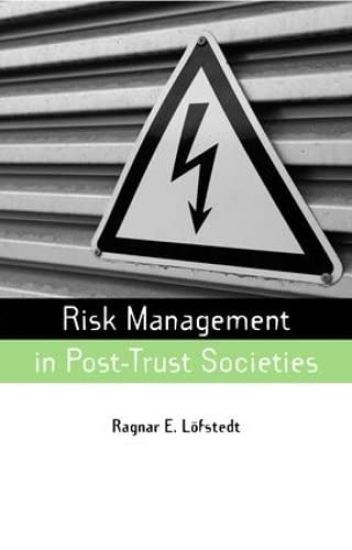
Risk Management in Post-Trust Societies

Risk Management in Post-Trust Societies

Ragnar E Lofstedt

Routledge
2017
sidottu
?A thought-provoking and invaluable book for anyone who cares about risk communication and management in the 21st century? Anna Jung, Director General, European Food Information Council ?Professor Ragnar L?fstedt has once again produced a most interesting book on risk management and trust, well-based on theory and built on empirical findings? Mikael Karlsson, President, Swedish Society for Nature Conservation ?Highlights the difficult balancing task facing risk regulators. Regulatory inaction against real risks can undermine public trust. However, exaggerated responses to risks can also jeopardize regulators? credibility. The diverse international case studies developed by Ragnar L?fstedt provide guidance for how regulators can navigate these and other frequently competing concerns? W. Kip Viscusi, Cogan Professor of Law and Economics, Harvard University, USA ?In democracies, government policies cannot succeed without public acceptance. Yet complex risk management requires technical expertise. How to reconcile these competing needs? Ragnar L?fstedt provocatively challenges recent research claiming that risk managers must engender public trust via deliberative dialogue. He uses four cases studies to argue that the reasons for distrust vary and demand different responses; that in some cases trust can flow from technical competence without public deliberation; and that in others public deliberation can actually aggravate distrust. Trust me: L?fstedt?s book will add spice to the debate over risk, experts, the public and trust? Jonathan B. Wiener, Perkins Professor of Law and Environmental Policy, Duke University, USA We live in ?post-trust? societies, in which public confidence in governments and corporations over health, food and environmental risk is eroding rapidly. Good risk communication can help companies, governments and institutions minimize disputes, resolve issues and anticipate problems. Without such communication, the best policies can become
Risk Management in Post-Trust Societies

Risk Management in Post-Trust Societies

Ragnar E Lofstedt

Earthscan Ltd
2008
nidottu
?A thought-provoking and invaluable book for anyone who cares about risk communication and management in the 21st century? Anna Jung, Director General, European Food Information Council ?Professor Ragnar L?fstedt has once again produced a most interesting book on risk management and trust, well-based on theory and built on empirical findings? Mikael Karlsson, President, Swedish Society for Nature Conservation ?Highlights the difficult balancing task facing risk regulators. Regulatory inaction against real risks can undermine public trust. However, exaggerated responses to risks can also jeopardize regulators? credibility. The diverse international case studies developed by Ragnar L?fstedt provide guidance for how regulators can navigate these and other frequently competing concerns? W. Kip Viscusi, Cogan Professor of Law and Economics, Harvard University, USA ?In democracies, government policies cannot succeed without public acceptance. Yet complex risk management requires technical expertise. How to reconcile these competing needs? Ragnar L?fstedt provocatively challenges recent research claiming that risk managers must engender public trust via deliberative dialogue. He uses four cases studies to argue that the reasons for distrust vary and demand different responses; that in some cases trust can flow from technical competence without public deliberation; and that in others public deliberation can actually aggravate distrust. Trust me: L?fstedt?s book will add spice to the debate over risk, experts, the public and trust? Jonathan B. Wiener, Perkins Professor of Law and Environmental Policy, Duke University, USA We live in ?post-trust? societies, in which public confidence in governments and corporations over health, food and environmental risk is eroding rapidly. Good risk communication can help companies, governments and institutions minimize disputes, resolve issues and anticipate problems. Without such communication, the best policies can become derailed and trust can be lost. Most policy-makers still use outdated methods to communicate policies and achieve their objectives - methods developed before public trust in industry and government was affected by health scares such as BSE, genetically modified organisms and dioxins in Belgian chicken. This book provides effective methods for managing and communicating risk effectively in contemporary societies.
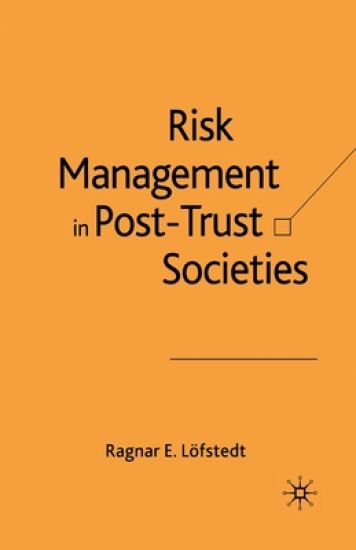
Risk Management in Post-Trust Societies

Risk Management in Post-Trust Societies

Ragnar E. Löfstedt

Palgrave Macmillan
2005
nidottu
Risk communication helps companies, governments and institutions minimise disputes, resolve issues and anticipate problems before they result in an irreversible breakdown in communications. Without good risk communication and good risk management, policy makers have no roadmap to guide them through unforeseen problems, which frequently derails the best policies and results in a breakdown in communications and a loss of trust on behalf of those they are trying hardest to persuade. Most policy makers still use outdated methods - developed at a time before health scares like BSE, genetically modified organisms and dioxin in Belgian chicken feed eroded public confidence in industry and government - to communicate policies and achieve their objectives. Good risk communication is still possible, however. In this book, through the use of a host of case studies from four countries, the author identifies a series of methods that are set to work in a post trust society.
Risk Management in Post-Trust Societies

Risk Management in Post-Trust Societies

Ragnar E. Löfstedt

Palgrave Macmillan
2005
sidottu
Risk communication helps companies, governments and institutions minimise disputes, resolve issues and anticipate problems before they result in an irreversible breakdown in communications. Without good risk communication and good risk management, policy makers have no roadmap to guide them through unforeseen problems, which frequently derails the best policies and results in a breakdown in communications and a loss of trust on behalf of those they are trying hardest to persuade. Most policy makers still use outdated methods - developed at a time before health scares like BSE, genetically modified organisms and dioxin in Belgian chicken feed eroded public confidence in industry and government - to communicate policies and achieve their objectives. Good risk communication is still possible, however. In this book, through the use of a host of case studies from four countries, the author identifies a series of methods that are set to work in a post trust society.
Cases in Climate Change Policy

Cases in Climate Change Policy

Ragnar E. Lofsted

Routledge
2017
sidottu
This volume examines case studies on EU countries' policy to combat climate change, examining the constraints of and opportunities for the implementation of climate change strategies in these countries. The introductory section provides an overview of the climate change problem and its potential effects, examining the roles of different greenhouse gases, the main emission sources, the likely consequences of climate change and the scope for abatement and adapation. The second part consists of six detailed case studies on diverse national strategies. The book concludes with a comparative analysis of the findings of the case studies, and suggestions for approaches to implement emission reduction strategies.
Cases in Climate Change Policy

Cases in Climate Change Policy

Ragnar E. Lofsted

Earthscan Ltd
1997
nidottu
This volume examines case studies on EU countries' policy to combat climate change, examining the constraints of and opportunities for the implementation of climate change strategies in these countries. The introductory section provides an overview of the climate change problem and its potential effects, examining the roles of different greenhouse gases, the main emission sources, the likely consequences of climate change and the scope for abatement and adapation. The second part consists of six detailed case studies on diverse national strategies. The book concludes with a comparative analysis of the findings of the case studies, and suggestions for approaches to implement emission reduction strategies.
The Thesis [i.e. Tsesis] oil Spill

The Thesis [i.e. Tsesis] oil Spill

Gunnar Aneer; Sture Hansson; Ragnar Elmgren

Palala Press
2018
pokkari
This work has been selected by scholars as being culturally important, and is part of the knowledge base of civilization as we know it. This work was reproduced from the original artifact, and remains as true to the original work as possible. Therefore, you will see the original copyright references, library stamps (as most of these works have been housed in our most important libraries around the world), and other notations in the work.This work is in the public domain in the United States of America, and possibly other nations. Within the United States, you may freely copy and distribute this work, as no entity (individual or corporate) has a copyright on the body of the work.As a reproduction of a historical artifact, this work may contain missing or blurred pages, poor pictures, errant marks, etc. Scholars believe, and we concur, that this work is important enough to be preserved, reproduced, and made generally available to the public. We appreciate your support of the preservation process, and thank you for being an important part of keeping this knowledge alive and relevant.
Tranströmer och det politiska

Tranströmer och det politiska

Gustav Borsgård; Ragnar Haake; Annelie Brännström Öhman; Anna Möller Sibelius; Sofia Pulls; Anders Öhman; Maria Jönsson; Anders E Johansson

Ellerströms förlag AB
2020
nidottu
Tomas Tranströmer räknas som en av Sveriges mest betydande poeter genom tiderna. Samtidigt hör det till berättelsen om Tranströmer att han utsattes för hård kritik under 1960- och 70-talen för att hans poesi ansågs vara politiskt oengagerad. Hur kan man såhär femtio år senare förstå den kritiken? Stämmer det över huvud taget att Tranströmer hade kritikerkåren emot sig? Hur är det möjligt att från vår sida av millennieskiftet se på politiska dimensioner i Tranströmers poesi?I antologin Tranströmer och det politiska undersöker åtta litteraturvetare från Umeå, Sundsvall och Åbo den tranströmerska poesins förhållande till politiken. Texterna tar avstamp i aspekter som diktjaget, parrelationen, tilliten till språket, civilisationskritiken, jämlikhets­tanken eller helt enkelt i den egna, känslomässigt grundade, upplevelsen av att läsa Tranströmers dikter. Antologin visar dels att det finns skäl att revidera litteraturhistorieskrivningen om Tranströmer, dels att det är möjligt att betrakta hans poesi som just politisk – även om den inte ­behandlar vad man i vardagligt tal kallar för politik.
Ragnar Rommetveit

Ragnar Rommetveit

Psychology Press
2003
nidottu
This special issue of Mind, Culture, and Activity revisits Rommetveit's ideas in admiration for his quest to understand meaning, language, and mind. It also reflects the inspiration he has provided for those struggling with these issues. Written by those studying Rommetveit and one by Rommetveit himself, all three articles are attempts to spell out, extend, and apply ideas that Rommetveit outlined in his writings at some point early in his career. Rommetveit, however has moved ahead in his struggle to understand the ethical dimensions of communication--including the communication involved in the study of communication--which represents his newest project.
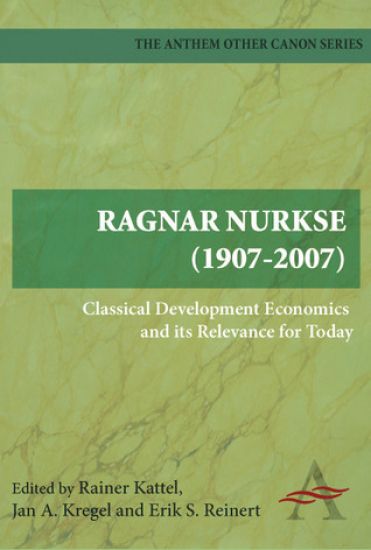
Ragnar Nurkse (1907-2007)
‘Ragnar Nurkse (1907-2007): Classical Development Economics and its Relevance for Today’ presents a selection of papers that casts new insight on Nurkse’s thought, and discusses his relevance for today, in light of the renewed interest in Nurkse amongst development economists. The volume also celebrates the 100th anniversary of this profoundly important thinker’s birth.
Ragnar Nurkse

Ragnar Nurkse

Anthem Press
2011
nidottu
‘Ragnar Nurkse, Trade and Development’ is a timely reprint of Nurkse’s most important works, given the renewed interest in his writings amongst development economists, who are turning to this pioneering thinker in search for new inspiration. This volume aims to make his rarely published works available for an audience of economists, policy makers, researchers and students.
Ragnar Rommetveit

Ragnar Rommetveit

Psychology Press Ltd
2017
sidottu
This special issue of Mind, Culture, and Activity revisits Rommetveit's ideas in admiration for his quest to understand meaning, language, and mind. It also reflects the inspiration he has provided for those struggling with these issues. Written by those studying Rommetveit and one by Rommetveit himself, all three articles are attempts to spell out, extend, and apply ideas that Rommetveit outlined in his writings at some point early in his career. Rommetveit, however has moved ahead in his struggle to understand the ethical dimensions of communication--including the communication involved in the study of communication--which represents his newest project.
Ragnar Nurkse (1907-2007)
‘Ragnar Nurkse (1907-2007): Classical Development Economics and its Relevance for Today’ presents a selection of papers that casts new insight on Nurkse’s thought, and discusses his relevance for today, in light of the renewed interest in Nurkse amongst development economists. The volume also celebrates the 100th anniversary of this profoundly important thinker’s birth.
Ragnar Nurkse

Ragnar Nurkse

Anthem Press
2009
sidottu
‘Ragnar Nurkse, Trade and Development’ is a timely reprint of Nurkse’s most important works, given the renewed interest in his writings amongst development economists, who are turning to this pioneering thinker in search for new inspiration. This volume aims to make his rarely published works available for an audience of economists, policy makers, researchers and students.