

Kirjahaku
Etsi kirjoja tekijän nimen, kirjan nimen tai ISBN:n perusteella.
1000 tulosta hakusanalla Ramon F D'Elosua



Defensa Que A Favor Del Alferez D. Valente Gonzalez
Juan Ordonez; Ramon F. Valdes
KESSINGER PUBLISHING, LLC
2010
pokkari

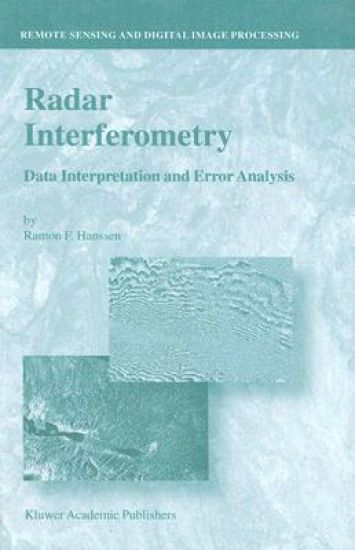
This book is the product of five and a half years of research dedicated to the und- standing of radar interferometry, a relatively new space-geodetic technique for m- suring the earth’s topography and its deformation. The main reason for undertaking this work, early 1995, was the fact that this technique proved to be extremely useful for wide-scale, fine-resolution deformation measurements. Especially the interf- ometric products from the ERS-1 satellite provided beautiful first results—several interferometric images appeared as highlights on the cover of journals such as Nature and Science. Accuracies of a few millimeters in the radar line of sight were claimed in semi-continuous image data acquired globally, irrespective of cloud cover or solar illumination. Unfortunately, because of the relative lack of supportive observations at these resolutions and accuracies, validation of the precision and reliability of the results remained an issue of concern. From a geodetic point of view, several survey techniques are commonly available to measure a specific geophysical phenomenon. To make an optimal choice between these techniques it is important to have a uniform and quantitative approach for describing the errors and how these errors propagate to the estimated parameters. In this context, the research described in this book was initiated. It describes issues involved with different types of errors, induced by the sensor, the data processing, satellite positioning accuracy, atmospheric propagation, and scattering character- tics. Nevertheless, as the first item in the subtitle “Data Interpretation and Error Analysis” suggests, data interpretation is not always straightforward.

The American cowboy emerges from these pages as a recognizable human being with little resemblance to the picturesque inventions of the horse opera. Ramon F. Adams, a highly respected authority on the old West, talks straight about what the cowhand really did and thought. His cow-punching, broncobusting, trail driving; his rodeo riding, poker playing, socializing; his horse, guns, rope, clothing, sleeping bag; his eating and drinking habits; his attitude toward God, women, bosses; his unwritten code of conduct—everything about this vanished breed is told with absorbing authenticity, in the rich and varied lingo of the range.

Come an' Get It was the most familiar and welcome call on the range era of the great trail drives following the Civil War. In this entertaining volume, Ramon F. Adams, author of the popular Western Words, tell the story of the old cowboy cooks, and the result is another highly original contribution to the folklore of the cattle country.Although the cowboy cleared the Southwestern frontier of savage Indians and opened the land for settlement, the cook and his commissary contributed greatly to the success of the operation; for as an army depends upon its mess-kitchens, so the cowboys depended upon the chuck wagon. Without it, there would have been to trail drives to rescue Texas from bankruptcy following the Civil War, no roundups to speed the development of the cattle industry, and no beef for the heavily populated areas of the United States.The author records the place and influence of the range cook upon Western life. He discusses the functions of ""coosie,"" the food he served, and his methods of preparing it-giving recipes for sourdough biscuits, fluff-duffs, son-of-a-bitch stew, and other distinctive dishes of the range. He describes, too, ""the wagon,"" its evolution, and its place in the hearts of the men who called it home.Although there remain a few chuck wagons on the larger ranches today, they have become so scarce that one is rarely seen except in a museum or a rodeo parade, and the younger generation of cooks, like the cowboys themselves has been tamed.Every cook was a ""character,"" perhaps with reason, for no man ever worked under greater difficulties or with fewer conveniences. Anecdotes and incidents which illuminate the idiosyncrasies of these ""Sultans of the Skillets"" are recounted with gusto.Nick Eggenhofer's drawings help Mr. Adams bring the cook and his accoutrement vividly to life.

This immense book, by a noted bibliographer of the West, is beyond question the fairest, most complete and most learned evaluation of printed references to western outlaws to appear until now....It will stand for many years, solid as a rock amid the flooding maelstrom of western myth and legend, pointing up the truth about those men of the past who lived by their wits and their guns. It will be impossible for anyone studying that era and such men to do so without reference to this volume."" - Los Angeles Times""Adams turns again to the books and histories of the western gunmen and outlaws and critically examines 425 titles, most of which rate as 'burs' under his saddle. Ramon Adams' plea is that the writers must stop compounding each other's errors into legend. In this book, with great skill and without malice, he has pointed out past mistakes. His book should be in the essential baggage of every writer on western outlaws and on every library shelf."" - American West""The value of this book to writers and historians of the badman tradition cannot be overestimated, for Adams has replaced rumors, myths, and falsehoods with documented historical facts. It is a book for all conscientious students of and writers on the American West; henceforth, any writer of 'authentic Western history' who refuses to check with Adams should be, as the judge said to Billy the Kid in one legend, 'hanged by the neck until dead, dead, dead.'"" - Southwest Review
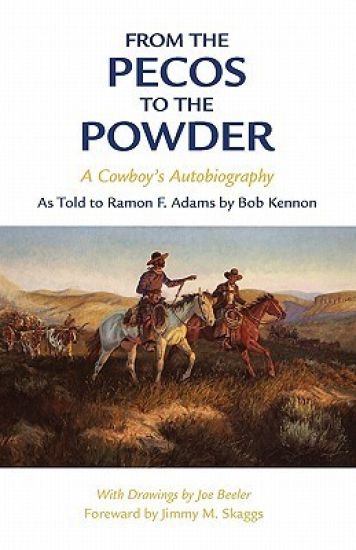
One of the last Old-time cowboys here tells his own story: his boyhood in Texas, wandering from ranch to ranch in the Southwest, the trek to Montana with a trail herd, and his life thereafter among the people and ranches of the area. His account is full of anecdotes, humorous or tragic, which themselves illuminate facets of a way of life that is no more.Bob Kennon knew the Ketchums, Kid Curry, and Western artist Charles M. Russell, who was his friend, as well as many prominent ranchmen of his day.""Perhaps I am the last living rider of those boys who, in 1896, came up that long trail to Montana from what was then the largest ranch in the world, the Terrazas Ranch in Old Mexico,"" he begins. And he goes on to tell just what the cowboy business was really like not only on the trail and the range, but in the wild, infrequent visits to town, encounters with camp cooks and titled Englishmen, rodeo performances, and all that belongs to the cowboy's existence. The smell of the bunkhouse and the atmosphere of the range pervade every page.
Charles M. Russell, the Cowboy Artist
Ramon F. (Ramon Frederick) 18 Adams
Hassell Street Press
2021
sidottu
This work has been selected by scholars as being culturally important and is part of the knowledge base of civilization as we know it.This work is in the public domain in the United States of America, and possibly other nations. Within the United States, you may freely copy and distribute this work, as no entity (individual or corporate) has a copyright on the body of the work.Scholars believe, and we concur, that this work is important enough to be preserved, reproduced, and made generally available to the public. To ensure a quality reading experience, this work has been proofread and republished using a format that seamlessly blends the original graphical elements with text in an easy-to-read typeface.We appreciate your support of the preservation process, and thank you for being an important part of keeping this knowledge alive and relevant.

Charles M. Russell, the Cowboy Artist
Ramon F. (Ramon Frederick) 18 Adams
Hassell Street Press
2021
nidottu
This work has been selected by scholars as being culturally important and is part of the knowledge base of civilization as we know it.This work is in the public domain in the United States of America, and possibly other nations. Within the United States, you may freely copy and distribute this work, as no entity (individual or corporate) has a copyright on the body of the work.Scholars believe, and we concur, that this work is important enough to be preserved, reproduced, and made generally available to the public. To ensure a quality reading experience, this work has been proofread and republished using a format that seamlessly blends the original graphical elements with text in an easy-to-read typeface.We appreciate your support of the preservation process, and thank you for being an important part of keeping this knowledge alive and relevant.

Charles M. Russell, the Cowboy Artist: A Biography
Ramon F. Adams; Homer E. Britzman
Literary Licensing, LLC
2011
sidottu
""Charles M. Russell, The Cowboy Artist: A Biography"" is a comprehensive account of the life and work of one of America's most iconic Western artists, Charles M. Russell. Written by Ramon F. Adams, a noted Western historian and biographer, the book traces Russell's life from his childhood in Missouri to his years as a cowboy in Montana, and finally to his success as a painter, sculptor, and writer. Adams delves into Russell's artistic process and the inspiration behind his work, which often depicted the rugged beauty and harsh realities of life in the American West. The book also examines Russell's personal life, including his marriage to his wife Nancy and his friendships with other notable figures of the time, such as Teddy Roosevelt and Will Rogers. Filled with beautiful illustrations of Russell's artwork, as well as photographs of the artist and his surroundings, ""Charles M. Russell, The Cowboy Artist: A Biography"" is a must-read for anyone interested in the history of the American West or the life and work of this beloved artist.This scarce antiquarian book is a facsimile reprint of the old original and may contain some imperfections such as library marks and notations. Because we believe this work is culturally important, we have made it available as part of our commitment for protecting, preserving, and promoting the world's literature in affordable, high quality, modern editions, that are true to their original work.

Charles M. Russell, the Cowboy Artist: A Biography
Ramon F. Adams; Homer E. Britzman
Literary Licensing, LLC
2011
nidottu


100 Preguntas para Aprobar su Examen de Manejo Escrito del DMV en California: La colección más completa de preguntas reales para el examen de conducir
Ramón F. Gutiérrez
Independently Published
2019
nidottu

This book is the product of five and a half years of research dedicated to the und- standing of radar interferometry, a relatively new space-geodetic technique for m- suring the earth’s topography and its deformation. The main reason for undertaking this work, early 1995, was the fact that this technique proved to be extremely useful for wide-scale, fine-resolution deformation measurements. Especially the interf- ometric products from the ERS-1 satellite provided beautiful first results—several interferometric images appeared as highlights on the cover of journals such as Nature and Science. Accuracies of a few millimeters in the radar line of sight were claimed in semi-continuous image data acquired globally, irrespective of cloud cover or solar illumination. Unfortunately, because of the relative lack of supportive observations at these resolutions and accuracies, validation of the precision and reliability of the results remained an issue of concern. From a geodetic point of view, several survey techniques are commonly available to measure a specific geophysical phenomenon. To make an optimal choice between these techniques it is important to have a uniform and quantitative approach for describing the errors and how these errors propagate to the estimated parameters. In this context, the research described in this book was initiated. It describes issues involved with different types of errors, induced by the sensor, the data processing, satellite positioning accuracy, atmospheric propagation, and scattering character- tics. Nevertheless, as the first item in the subtitle “Data Interpretation and Error Analysis” suggests, data interpretation is not always straightforward.

Star Wars Comic-Kollektion
Haden Blackman; Randy Stradley; Ramón F. Bachs
Panini Verlags GmbH
2019
sidottu

Mavericks: The Salty Comments of an Old-Time Cowpuncher
Frank M. King; Charles Marion Russell; Ramon F. Adams
Literary Licensing, LLC
2011
sidottu
Mavericks: The Salty Comments Of An Old-Time Cowpuncher is a book written by Frank M. King that provides a unique insight into the life and times of cowboys in the American West. The author, who grew up on a ranch in Montana, shares his personal experiences and observations from his years spent working on ranches and riding the range. The book is filled with colorful anecdotes, humorous stories, and salty comments that capture the spirit and character of the cowboys who helped shape the West. King's writing style is straightforward and authentic, and he doesn't shy away from describing the harsh realities of life on the range. This book is a must-read for anyone interested in the history and culture of the American West, and for those who love a good cowboy story.Preface By H. E. Britzman.This scarce antiquarian book is a facsimile reprint of the old original and may contain some imperfections such as library marks and notations. Because we believe this work is culturally important, we have made it available as part of our commitment for protecting, preserving, and promoting the world's literature in affordable, high quality, modern editions, that are true to their original work.