Kirjojen hintavertailu. Mukana 11 244 527 kirjaa ja 12 kauppaa.

Kirjahaku

Etsi kirjoja tekijän nimen, kirjan nimen tai ISBN:n perusteella.

1000 tulosta hakusanalla Raymond Nickerson

Conditional Reasoning

Conditional Reasoning

Raymond Nickerson

Oxford University Press Inc
2015
sidottu
Conditional reasoning is reasoning that involves statements of the sort If A (Antecedent) then C (Consequent). This type of reasoning is ubiquitous; everyone engages in it. Indeed, the ability to do so may be considered a defining human characteristic. Without this ability, human cognition would be greatly impoverished. "What-if" thinking could not occur. There would be no retrospective efforts to understand history by imagining how it could have taken a different course. Decisions that take possible contingencies into account could not be made; there could be no attempts to influence the future by selecting actions on the basis of their expected effects. Despite the commonness and importance of conditional reasoning and the considerable attention it has received from scholars, it remains the subject of much continuing debate. Unsettled questions, both normative and empirical, continue to be asked. What constitutes normative conditional reasoning? How do people engage in it? Does what people do match what would be expected of a rational agent with the abilities and limitations of human beings? If not, how does it deviate and how might people's ability to engage in it be improved? This book reviews the work of prominent psychologists and philosophers on conditional reasoning. It describes empirical research on how people deal with conditional arguments and on how conditional statements are used and interpreted in everyday communication. It examines philosophical and theoretical treatments of the mental processes that support conditional reasoning. Its extensive coverage of the subject makes it an ideal resource for students, teachers, and researchers with a focus on cognition across disciplines.
Conditional Reasoning

Conditional Reasoning

Raymond Nickerson

Oxford University Press Inc
2017
nidottu
Conditional reasoning is reasoning that involves statements of the sort If A (Antecedent) then C (Consequent). This type of reasoning is ubiquitous; everyone engages in it. Indeed, the ability to do so may be considered a defining human characteristic. Without this ability, human cognition would be greatly impoverished. "What-if" thinking could not occur. There would be no retrospective efforts to understand history by imagining how it could have taken a different course. Decisions that take possible contingencies into account could not be made; there could be no attempts to influence the future by selecting actions on the basis of their expected effects. Despite the commonness and importance of conditional reasoning and the considerable attention it has received from scholars, it remains the subject of much continuing debate. Unsettled questions, both normative and empirical, continue to be asked. What constitutes normative conditional reasoning? How do people engage in it? Does what people do match what would be expected of a rational agent with the abilities and limitations of human beings? If not, how does it deviate and how might people's ability to engage in it be improved? This book reviews the work of prominent psychologists and philosophers on conditional reasoning. It describes empirical research on how people deal with conditional arguments and on how conditional statements are used and interpreted in everyday communication. It examines philosophical and theoretical treatments of the mental processes that support conditional reasoning. Its extensive coverage of the subject makes it an ideal resource for students, teachers, and researchers with a focus on cognition across disciplines.
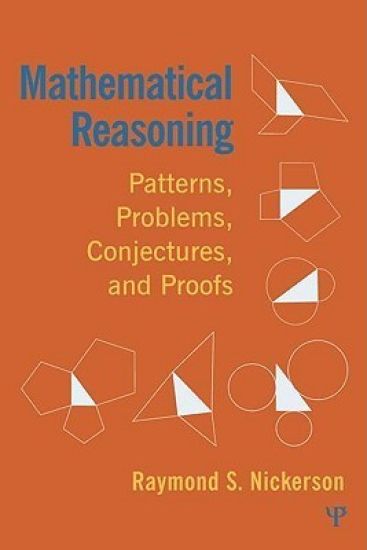
Mathematical Reasoning

Mathematical Reasoning

Raymond Nickerson

Psychology Press Ltd
2015
nidottu
The development of mathematical competence -- both by humans as a species over millennia and by individuals over their lifetimes -- is a fascinating aspect of human cognition.This book explores when and why the rudiments of mathematical capability first appeared among human beings, what its fundamental concepts are, and how and why it has grown into the richly branching complex of specialties that it is today. It discusses whether the ‘truths’ of mathematics are discoveries or inventions, and what prompts the emergence of concepts that appear to be descriptive of nothing in human experience. Also covered is the role of esthetics in mathematics: What exactly are mathematicians seeing when they describe a mathematical entity as ‘beautiful’? There is discussion of whether mathematical disability is distinguishable from a general cognitive deficit and whether the potential for mathematical reasoning is best developed through instruction.This volume is unique in the vast range of psychological questions it covers, as revealed in the work habits and products of numerous mathematicians. It provides fascinating reading for researchers and students with an interest in cognition in general and mathematical cognition in particular. Instructors of mathematics will also find the book’s insights illuminating.
Mathematical Reasoning

Mathematical Reasoning

Raymond Nickerson

Psychology Press Ltd
2009
sidottu
The development of mathematical competence -- both by humans as a species over millennia and by individuals over their lifetimes -- is a fascinating aspect of human cognition.This book explores when and why the rudiments of mathematical capability first appeared among human beings, what its fundamental concepts are, and how and why it has grown into the richly branching complex of specialties that it is today. It discusses whether the ‘truths’ of mathematics are discoveries or inventions, and what prompts the emergence of concepts that appear to be descriptive of nothing in human experience. Also covered is the role of esthetics in mathematics: What exactly are mathematicians seeing when they describe a mathematical entity as ‘beautiful’? There is discussion of whether mathematical disability is distinguishable from a general cognitive deficit and whether the potential for mathematical reasoning is best developed through instruction.This volume is unique in the vast range of psychological questions it covers, as revealed in the work habits and products of numerous mathematicians. It provides fascinating reading for researchers and students with an interest in cognition in general and mathematical cognition in particular. Instructors of mathematics will also find the book’s insights illuminating.
Using Computers

Using Computers

Raymond S. Nickerson

Bradford Books
1987
pokkari
Industry veteran Raymond Nickerson provides an extensive introduction to the information technology revolution that is transforming industrial society. He focuses particularly on the study of person-computer interaction, noting how computers are affecting their users and society as a whole, and describes a variety of ways in which information technology is expected to develop in the forseeable future.Nickerson summarizes the development of information technology and discusses many of its applications - in farming, research, education and training, manufacturing, general management, retailing, defense, and elsewhere - that have already had a substantial impact on society. He reviews the human-factors research that has been done and is underway, with special attention to the physical and cognitive interface, including languages, conversational interactions, and the concepts of friendliness and usability.Raymond S. Nickerson is Senior Vice President of BBN Laboratories, a subsidiary of Bolt Beranek and Newman Inc. A Bradford Book.
Handbook of Applied Cognition

Handbook of Applied Cognition

Raymond S. Nickerson; Roger W. Schvaneveldt; Susan T. Dumais; D. Stephen Lindsay; Michelene T. H. Chi

John Wiley Sons Inc
1999
sidottu
Cognitive psychology is the basis of many applications in almost every area of technology, business, industry, and education. This book provides workers in applied arenas with presentations of research aimed directly at the problems and issues that confront them. It will cover key areas including business and industry, computers and technology, education and information, and health and law.
Looking Ahead

Looking Ahead

Raymond S. Nickerson

CRC Press Inc
1992
sidottu
This volume aims to review some of the recent developments and trends that seem especially relevant to any attempt to understand near-term-future possibilities; to consider what a variety of knowledgeable people are saying about changes and developments that could occur; and to relate the possibilities to needs and opportunities for human factors research. Human factors, in this case, includes not only the implications of human capabilities and limitations for the design of equipment and machines intended for human use, but also applied psychology in a more general sense. In particular, it is taken to involve social systems as well as physical ones, the interaction of people with the environment as well as with machines, the facilitation of communication between people as well as between people and computers, and the design of policies and procedures as well as the design of equipment. The author's intention is to focus on anticipated problems -- including opportunities as well as difficulties -- and ask how human factors research might contribute to solutions. It is assumed that there are ways in which such research could be useful in addressing societal problems that the profession has not yet realized and that these are more likely to be recognized in the future if the community is actively seeking to identify them.
Psychology and Environmental Change

Psychology and Environmental Change

Raymond S. Nickerson

Psychology Press
2002
sidottu
This book stimulates thinking on the topic of detrimental environmental change and how research psychologists can help to address the problem. In addition to reporting environmentally relevant psychological research, the author identifies the most pressing questions from an environmental point of view. Psychology and Environmental Change: *focuses on ways in which human behavior contributes to the problem; *deals with the assessment and change of attitudes and with studies of change of behavior; *proposes ways in which psychological research can contribute to making technology and its products more environmentally benign; and *introduces topics such as consumption, risk assessment, cost-benefit and tradeoff analyses, competition, negotiation, and policymaking, and how they relate to the objective of protecting the environment.
Psychology and Environmental Change

Psychology and Environmental Change

Raymond S. Nickerson

Psychology Press
2002
nidottu
This book stimulates thinking on the topic of detrimental environmental change and how research psychologists can help to address the problem. In addition to reporting environmentally relevant psychological research, the author identifies the most pressing questions from an environmental point of view. Psychology and Environmental Change: *focuses on ways in which human behavior contributes to the problem; *deals with the assessment and change of attitudes and with studies of change of behavior; *proposes ways in which psychological research can contribute to making technology and its products more environmentally benign; and *introduces topics such as consumption, risk assessment, cost-benefit and tradeoff analyses, competition, negotiation, and policymaking, and how they relate to the objective of protecting the environment.
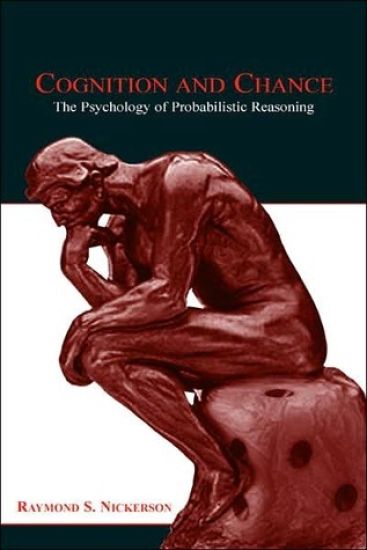
Cognition and Chance

Cognition and Chance

Raymond S. Nickerson

Psychology Press
2004
sidottu
Lack of ability to think probabilistically makes one prone to a variety of irrational fears and vulnerable to scams designed to exploit probabilistic naiveté, impairs decision making under uncertainty, facilitates the misinterpretation of statistical information, and precludes critical evaluation of likelihood claims. Cognition and Chance presents an overview of the information needed to avoid such pitfalls and to assess and respond to probabilistic situations in a rational way. Dr. Nickerson investigates such questions as how good individuals are at thinking probabilistically and how consistent their reasoning under uncertainty is with principles of mathematical statistics and probability theory. He reviews evidence that has been produced in researchers' attempts to investigate these and similar types of questions. Seven conceptual chapters address such topics as probability, chance, randomness, coincidences, inverse probability, paradoxes, dilemmas, and statistics. The remaining five chapters focus on empirical studies of individuals' abilities and limitations as probabilistic thinkers. Topics include estimation and prediction, perception of covariation, choice under uncertainty, and people as intuitive probabilists. Cognition and Chance is intended to appeal to researchers and students in the areas of probability, statistics, psychology, business, economics, decision theory, and social dilemmas.
Cognition and Chance

Cognition and Chance

Raymond S. Nickerson

Psychology Press
2004
nidottu
Lack of ability to think probabilistically makes one prone to a variety of irrational fears and vulnerable to scams designed to exploit probabilistic naiveté, impairs decision making under uncertainty, facilitates the misinterpretation of statistical information, and precludes critical evaluation of likelihood claims. Cognition and Chance presents an overview of the information needed to avoid such pitfalls and to assess and respond to probabilistic situations in a rational way. Dr. Nickerson investigates such questions as how good individuals are at thinking probabilistically and how consistent their reasoning under uncertainty is with principles of mathematical statistics and probability theory. He reviews evidence that has been produced in researchers' attempts to investigate these and similar types of questions. Seven conceptual chapters address such topics as probability, chance, randomness, coincidences, inverse probability, paradoxes, dilemmas, and statistics. The remaining five chapters focus on empirical studies of individuals' abilities and limitations as probabilistic thinkers. Topics include estimation and prediction, perception of covariation, choice under uncertainty, and people as intuitive probabilists. Cognition and Chance is intended to appeal to researchers and students in the areas of probability, statistics, psychology, business, economics, decision theory, and social dilemmas.
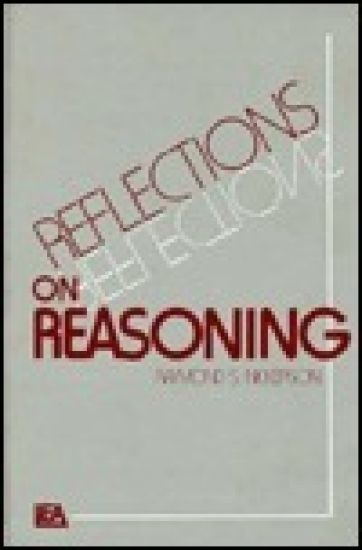
Reflections on Reasoning

Reflections on Reasoning

Raymond S. Nickerson

Lawrence Erlbaum Associates Inc
1986
sidottu
This book is an adaptation of a report entitled Notes about Reasoning, prepared under a project on The Training of Higher Cognitive Learning and Thinking Skills that was sponsored by the National Institute of Education. My purpose in producing the notes was to help me clarify my own thinking about reasoning and how the ability to reason effectively might be enhanced in the classroom. I did not intend to write a textbook on reasoning or a scholarly review of research on reasoning processes, and this book is not presented as either now. It still has the character of a collection of thoughts; it is being published with the hope that some of the ideas and suggestions in it may stimulate some others, especially teachers and students, to reflect more than they otherwise might have upon what it means to reason effectively. One does not, of course, become an effective reasoner by reading a book on reasoning or by taking a course in reasoning. Learning to reason well is surely a lifelong process—or at least a lifelong challenge. If this book is useful in helping some readers to see the value of an enduring commitment to that challenge, it will have served its purpose. I wish to thank the NIE Project Officers, Patricia Butler and Joseph Psotka, for their support and encouragement. I am grateful also to John Swets, Richard Herrnstein, David Perkins and Carol Chomsky for helpful comments on an early draft of the manuscript, to Anne Kerwin and Patricia Carroll for typing the manuscript and to Brenda Starr and Frank DiPace for making electronic delivery of it to the printer possible by working around the differences between the sending and receiving systems. Special thanks to my wife, Doris, for her constant help of countless types, and most especially for bringing into the world the four beautiful people to whom this book is dedicated.
Reflections on Reasoning

Reflections on Reasoning

Raymond S. Nickerson

Lawrence Erlbaum Associates Inc
1986
nidottu
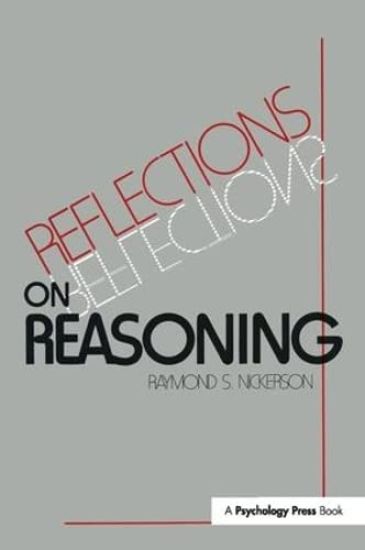
First published in 1986. Reflections on Reasoning Is a clearly written introduction that guides high school and college students, teachers, and parents through straightforward discussions on the nature of logic, belief, and argument. While examining the nature of reasoning, Nickerson offers practical examples from everyday life to Illustrate how we can become more effective and self-aware in our reasoning.
Argumentation

Argumentation

Raymond S. Nickerson

Cambridge University Press
2020
pokkari
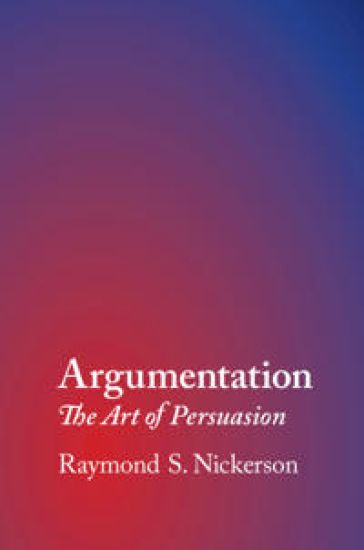
Drawing from the study of human reasoning, Argumentation describes different types of arguments and explains how they influence beliefs and behaviour. Raymond Nickerson identifies many of the fallacies, biases, and other flaws often found in arguments as well as 'stratagems' (schemes, illogical and alogical tactics) that people regularly use to persuade others. Much attention is given to the evaluation of arguments. Readers will learn a new schematic for evaluating arguments based on cognitive science. As a source for understanding and evaluating arguments in decision-making, it is ideal for courses on cognition, reasoning, and psychology.
Argumentation

Argumentation

Raymond S. Nickerson

Cambridge University Press
2020
sidottu
Drawing from the study of human reasoning, Argumentation describes different types of arguments and explains how they influence beliefs and behaviour. Raymond Nickerson identifies many of the fallacies, biases, and other flaws often found in arguments as well as 'stratagems' (schemes, illogical and alogical tactics) that people regularly use to persuade others. Much attention is given to the evaluation of arguments. Readers will learn a new schematic for evaluating arguments based on cognitive science. As a source for understanding and evaluating arguments in decision-making, it is ideal for courses on cognition, reasoning, and psychology.
Aspects of Rationality

Aspects of Rationality

Raymond S. Nickerson

Psychology Press Ltd
2016
nidottu
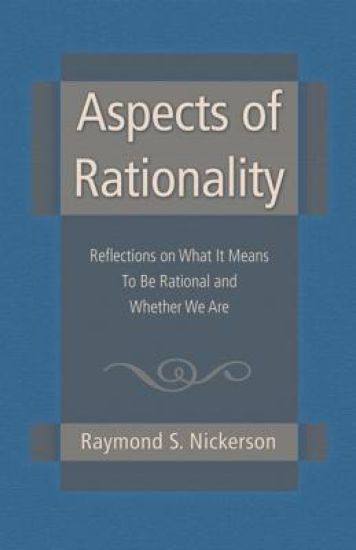
What does it mean to be rational – to reason well and effectively? How does rationality, broadly conceived, relate to the knowledge one acquires, the beliefs one forms, the explanations one constructs or appropriates, the judgments and decisions one makes, the values one adopts? What is the character of human reasoning and, in particular, does it tend to be rational?Much has been written about human rationality – or lack thereof. In recent years, some writers have focused attention on the numerous ways in which people appear not to be rational, at least if being rational is taken to mean always thinking or behaving in accordance with some normative standard. Others have argued that, if human reasoning is as flawed as this work suggests, it is a wonder that we, as a species, are around to notice the fact.This book examines much of the experimental research on reasoning as it relates to a variety of conceptions of rationality, not limited to conformity of thought and behavior or to the dictates of one or another normative system. The discussion focuses on specific topics that represent essential aspects of any adequately inclusive conception of rationality: intelligence and knowledge; beliefs; goals, values and affect; explanations; judgment and choice; understanding and wisdom.
Reflections on Reasoning

Reflections on Reasoning

Raymond S. Nickerson

Routledge
2017
sidottu
First published in 1986. Reflections on Reasoning Is a clearly written introduction that guides high school and college students, teachers, and parents through straightforward discussions on the nature of logic, belief, and argument. While examining the nature of reasoning, Nickerson offers practical examples from everyday life to Illustrate how we can become more effective and self-aware in our reasoning.
Aspects of Rationality

Aspects of Rationality

Raymond S. Nickerson

Psychology Press Ltd
2007
sidottu
What does it mean to be rational – to reason well and effectively? How does rationality, broadly conceived, relate to the knowledge one acquires, the beliefs one forms, the explanations one constructs or appropriates, the judgments and decisions one makes, the values one adopts? What is the character of human reasoning and, in particular, does it tend to be rational?Much has been written about human rationality – or lack thereof. In recent years, some writers have focused attention on the numerous ways in which people appear not to be rational, at least if being rational is taken to mean always thinking or behaving in accordance with some normative standard. Others have argued that, if human reasoning is as flawed as this work suggests, it is a wonder that we, as a species, are around to notice the fact.This book examines much of the experimental research on reasoning as it relates to a variety of conceptions of rationality, not limited to conformity of thought and behavior or to the dictates of one or another normative system. The discussion focuses on specific topics that represent essential aspects of any adequately inclusive conception of rationality: intelligence and knowledge; beliefs; goals, values and affect; explanations; judgment and choice; understanding and wisdom.