Kirjojen hintavertailu. Mukana 11 244 527 kirjaa ja 12 kauppaa.

Kirjahaku

Etsi kirjoja tekijän nimen, kirjan nimen tai ISBN:n perusteella.

1000 tulosta hakusanalla Raymond P. W. Scott

Tandem Techniques

Tandem Techniques

Raymond P. W. Scott

John Wiley Sons Inc
1997
sidottu
A comprehensive manual for the analyst (or chromatographer) for evaluating and using the various tandem systems obtained by combining different methods of chromatography and spectroscopy. It introduces the reader to the different separation techniques that can be combined with spectroscopic techniques. Gives essential details of the different interface designs that are necessary for each tandem technique. Provides practical examples of the use of each technique, describing the analytical performance and sensitivity in terms that allow direct comparison between techniques. In addition to describing research prototype tandem combinations, it presents commercially available systems. Offers many detailed diagrams to facilitate rapid comprehension.
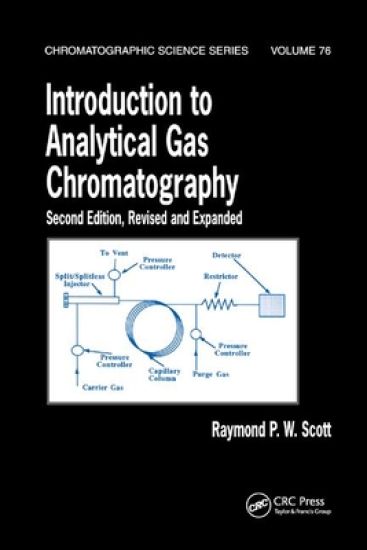
Introduction to Analytical Gas Chromatography, Revised and Expanded
Covering the principles of chromatographic separation, the chromatographic process from a physical chemical perspective, instrumentation for performing analyses, and operational procedures, this second edition offers information needed for the successful practice of gas chromatography. It contains examples of available apparatus, detectors, columns, stationary phases and operating conditions.
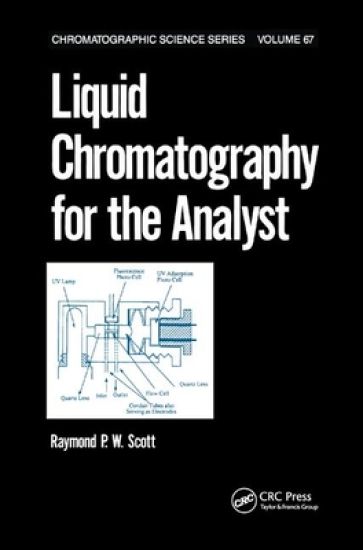
Liquid Chromatography for the Analyst

Liquid Chromatography for the Analyst

Raymond P.W. Scott

CRC Press
2019
nidottu
This work provides a clear presentation of the chromatographic process - demonstrating the functions of all associated instrumentation and the procedures necessary to obtain accurate qualitative and quantitative results. The work supplies a host of applications from a variety of sources to help identify the best equipment, the most appropriate columns and the most suitable phase systems for specific samples.
Introduction to Analytical Gas Chromatography, Revised and Expanded
Covering the principles of chromatographic separation, the chromatographic process from a physical chemical perspective, instrumentation for performing analyses, and operational procedures, this second edition offers information needed for the successful practice of gas chromatography. It contains examples of available apparatus, detectors, columns, stationary phases and operating conditions.
Liquid Chromatography for the Analyst

Liquid Chromatography for the Analyst

Raymond P.W. Scott

CRC Press Inc
1994
sidottu
This work provides a clear presentation of the chromatographic process - demonstrating the functions of all associated instrumentation and the procedures necessary to obtain accurate qualitative and quantitative results. The work supplies a host of applications from a variety of sources to help identify the best equipment, the most appropriate columns and the most suitable phase systems for specific samples.
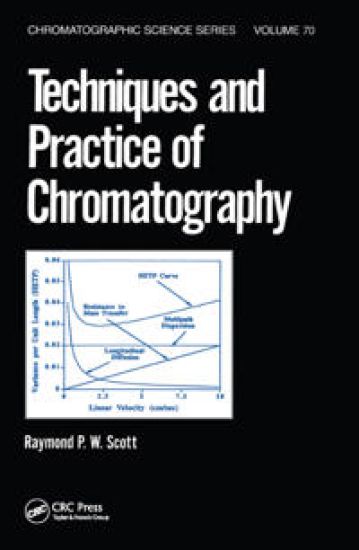
Techniques and Practice of Chromatography

Techniques and Practice of Chromatography

Raymond P.W. Scott

CRC Press Inc
1995
sidottu
This work introduces scientists of all disciplines to the chromatographic process and how it functions. The basic principles of chromatographic separation and specific chromatographic procedures, including gas, liquid and thin-layer chromatography, are covered. For each separation method the book details its characteristics, the instrumentation required, the procedures necessary for effective use, areas of application and examples of its use.;This work is intended for analytical chemists, laboratory technicians, and upper-level undergraduate and graduate students in analytical chemistry or separation science courses.
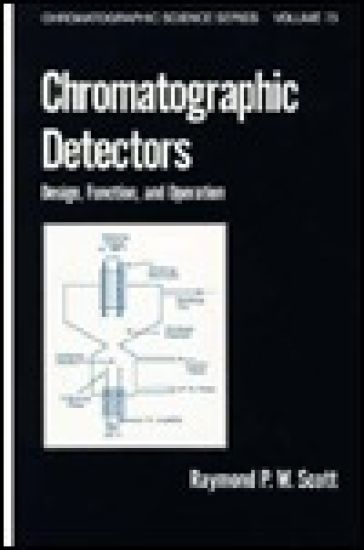
Chromatographic Detectors

Chromatographic Detectors

Raymond P.W. Scott

CRC Press Inc
1996
sidottu
"Comprehensively covers the design, construction, and operation of gas chromatography, liquid chromatography, and thin-layer chromatography detectors--all in one convenient, up-to-date source. Emphasizes the essential use of common specifications to describe all detectors, allowing easy comparison of their attributes."
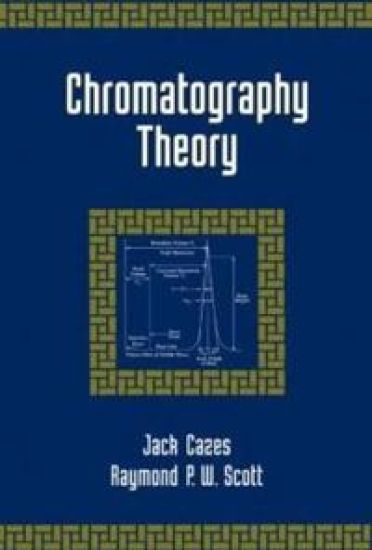
Chromatography Theory

Chromatography Theory

Jack Cazes; Raymond P.W. Scott

CRC Press Inc
2002
sidottu
This title presents a comprehensive overview of the principles, methods and fundamental theories used in the separation, quantification and analysis of individual compounds and substances. It identifies recent advances, mathematical relationships and useful design techniques for optimal system operation and control of chemical and chromatographic processes.
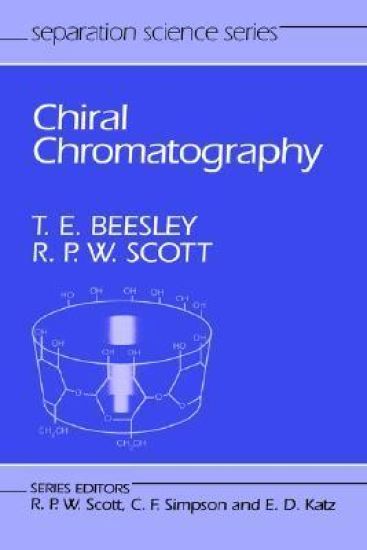
Chiral Chromatography

Chiral Chromatography

Thomas E. Beesley; Raymond P. W. Scott

John Wiley Sons Inc
1998
sidottu
Chiral Chromatography Thomas E. Beesley Advanced Separation Technologies Inc., Whippany, New Jersey, USA Raymond P. W. Scott Chemistry Department, Georgetown University, Washington DC, USA and Chemistry Department, Birkbeck College, University of London, UK Analytical techniques based on separation processes, such as chromatography and electrophoresis, are finding a growing range of applications in chemical, pharmaceutical and clinical laboratories. The Wiley Separation Science Series provides the analyst in these laboratories with well-focused books covering individual techniques, so that they can be applied more efficiently and effectively to contemporary analytical problems. The different enantiomers of a drug can exhibit widely different physiological activity in degree and nature. As a result, the separation and identification of enantiomers is now a very important analytical problem and chiral chromatography is the natural technique to apply to the resolution of such mixtures. Chiral Chromatography provides the reader with a basic understanding of the nature of chromatographic separations and relates the principles specifically to the separation of enantiomers. The following information is included: * chiral separations involving both gas and liquid chromatography * descriptions of the apparatus used for both techniques * detailed discussion on the retention mechanism that results in chiral selectivity * the structure and synthesis of a wide range of chirally active stationary phases used in both gas and liquid chromatography * preparative applications for large scale purification of enantiomers * applications of capillary electrophoresis and capillary electrochromatography. In addition to the above, a large number of examples of the separation of both commercially and physiologically interesting chiral mixtures are given, as is a detailed discussion on the mechanism of selectivity of each example. Thomas Beesley was founder and is the CEO for a leading manufacturer of chiral stationary phases and has published papers on TLC, HPLC and chiral separations involving cyclodextrins. He has also coauthored papers with Daniel W. Armstrong, an expert on modern cyclodextrin columns. Raymond Scott has worked in the field of separation science for over 40 years and has contributed extensively to the development of both gas and liquid chromatography publishing over 160 papers on the subjects.
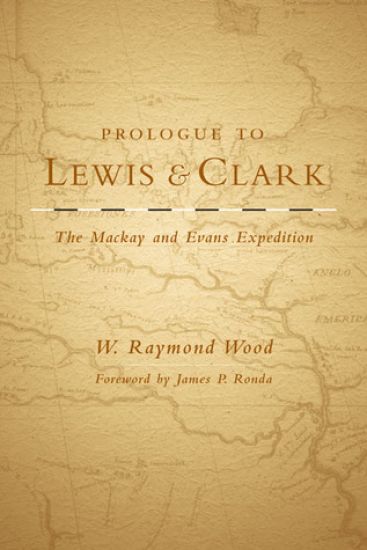
Prologue to Lewis and Clark

Prologue to Lewis and Clark

W. Raymond Wood; James P. Ronda

University of Oklahoma Press
2003
sidottu
To follow the journeys made by Mackay and Evans up the Missouri and across the plains in 1795-97 is to begin to appreciate the kind of world Lewis and Clark found when they voyaged up the river in 1804. . . . Of all those waterways, none has captured the American imagination more than the Missouri. . . . It is a river of promise, of dreams, and of dreams denied."" -James P. Ronda, from the ForewordWhen Mackay and Evans returned to Spanish St. Louis in 1797, they were hailed as ""the two most illustrious travelers in the northern parts of this continent."" Ironically, though the findings of Mackay and Evans were responsible for much of the early success of Lewis and Clark in their expedition, the adulation that followed Lewis and Clark's successful return completely eclipsed Mackay and Evans's reputations. In Prologue to Lewis and Clark, W. Raymond Wood narrates the history of this long-forgotten but important expedition up the Missouri River.The Mackay and Evans expedition was more than an exploratory mission. It was the last effort by Spain to gain control over the Missouri River basin in the decade before the United States purchased the Louisiana territory. In that respect, it failed. But the expedition was successful as a journey of exploration. The maps and documents they created later provided the Lewis and Clark expedition with invaluable information for its first full year.Consolidating a collection of eighteen contemporary documents relating to the Mackay and Evans expedition as well as his own research and analysis, Wood provides an in-depth examination of the expedition's background, execution, and final results.Volume 79 in the American Exploration and Travel Series
Prologue to Lewis and Clark

Prologue to Lewis and Clark

W. Raymond Wood; James P. Ronda

University of Oklahoma Press
2005
nidottu
To follow the journeys made by Mackay and Evans up the Missouri and across the plains in 1795-97 is to begin to appreciate the kind of world Lewis and Clark found when they voyaged up the river in 1804. . . . Of all those waterways, none has captured the American imagination more than the Missouri. . . . It is a river of promise, of dreams, and of dreams denied."" -James P. Ronda, from the ForewordWhen Mackay and Evans returned to Spanish St. Louis in 1797, they were hailed as ""the two most illustrious travelers in the northern parts of this continent."" Ironically, though the findings of Mackay and Evans were responsible for much of the early success of Lewis and Clark in their expedition, the adulation that followed Lewis and Clark's successful return completely eclipsed Mackay and Evans's reputations. In Prologue to Lewis and Clark, W. Raymond Wood narrates the history of this long-forgotten but important expedition up the Missouri River.The Mackay and Evans expedition was more than an exploratory mission. It was the last effort by Spain to gain control over the Missouri River basin in the decade before the United States purchased the Louisiana territory. In that respect, it failed. But the expedition was successful as a journey of exploration. The maps and documents they created later provided the Lewis and Clark expedition with invaluable information for its first full year.Consolidating a collection of eighteen contemporary documents relating to the Mackay and Evans expedition as well as his own research and analysis, Wood provides an in-depth examination of the expedition's background, execution, and final results.Volume 79 in the American Exploration and Travel Series
A Short History of the Jewish People: From Legendary Times to Modern Statehood
Where did the Jews come from? How did they retain their strong sense of community through centuries of dispersion? How have the Jews of the present, with their proud ethnic identity and thriving national home, emerged out of the downtrodden Jews of the past? Such questions arise naturally in the minds of anyone contemplating the long history of Jewish people. In one concise, authoritative volume, A Short History of the Jewish People provides insights and answers. This sweeping and highly informative work presents the major geographical, cultural, and political forces that have determined the course of Jewish history, introducing the many individuals, both religious and secular, who have shaped the character, mindset, and prospects of the Jewish people. Organized chronologically, the narrative follows the Jewish experience from legendary times to the peace agreements currently being negotiated in the Middle East. And, to give this overview an international and timely perspective, Raymond P. Scheindlin focuses his study on the pivotal events and dominant communities within each historical period. Written by a respected Hebrew scholar, cultural historian, noted author, and rabbi, A Short History of the Jewish People carefully describes the story of a people as varied as the many cultures in which they have lived. Including detailed maps and stirring photos, as well as timelines and sidebars, this pioneering work is a valuable resource for anyone broadly curious about the Jewish people.
Song of the Distant Dove

Song of the Distant Dove

Raymond P. Scheindlin

Oxford University Press Inc
2007
sidottu
Judah Halevi (ca 1085-1141), the best-known and most beloved of premodern Hebrew poets, abandoned his home and family in Spain and spent the last year of his life traveling to the Land of Israel, where he hoped to die amid its sacred ruins. The events of his journey and its meaning to him are preserved in recently discovered letters of the age and in his ever-popular poetry. The Song of the Distant Dove tells the story of Halevis journey through selections from the documents, some never before available in English, and explores its meaning through discussions of his stirring poetry, presented in new verse translations with full commentary. In the course of the discussion, we meet Halevis circle of Jewish businessmen and intellectuals in Islamic Spain and Egypt, examine their way of life, and learn about their place in Arabic and Islamic culture, then at its height. We learn that Halevi was partially motivated by a desire to repudiate his contemporaries hybrid Judeo-Arabic culture and return to a purely Jewish way of life; yet the echoes of the Islamic religious sensibility in his poetry show that he could not escape it completely. And while the precarious situation of the Jews as a tolerated minority in the Islamic world weighed heavily on him, the poetry shows that he was motivated not so much by national sentiment as by his own distinctive inner life. Touching on literature, religion, and history, this book provides a thorough introduction to Judeo-Arabic culture as well as a close look at a commanding personality of the agea doctor, theologian, communal leader, and, above all, a poet and at one of the best-documented episodes in medieval Jewish religious history.
Reducing the Risks for Substance Abuse

Reducing the Risks for Substance Abuse

Raymond P. Daugherty

Kluwer Academic/Plenum Publishers
1998
nidottu
Authors Raymond P. Daugherty and Carl Leukefeld argue for replacing the youth-based, `zero tolerance' approach to substance abuse prevention that has been dominant in the field over the past two decades. Their dynamic alternative is the Lifestyle Risk Reduction Model, which revises standard prevention strategies to make them relevant throughout the entire life span. Features of this revolutionary new paradigm include Five Principles of Lifestyle Risk Reduction (LRR), Five Conditions of Effective LRR, and the LLR Formulas.
People-Plant Relationships

People-Plant Relationships

Raymond P Poincelot; Joel Flagler

CRC Press
2019
nidottu
Presenting the latest research on cross-cultural people-plant relationships, this volume conveys the psychological, physiological, and social responses to plants and the significant role these responses play in improved physical and mental health. With chapters written by field experts, it identifies research priorities and methodologies and outlines the steps for developing a research agenda to aid horticulturalists in their work with social scientists to gain a better understanding of people-plant relationships. This resource covers a wide array of topics including home horticulture and Lyme disease, indoor plants and pollution reduction, and plants and therapy.
Leading for Growth

Leading for Growth

Raymond P. Davis; Alan R. Shrader

Jossey-Bass Inc.,U.S.
2007
sidottu
How any business leader can create an atmosphere of competitiveness for exceptional growth When Ray Davis took over the local 40-person South Umpqua Bank in 1994, many people in the industry poked fun at his insistence that employees answer the phone with a cheery "World's Greatest Bank." Eleven years, $7 billion in assets, and 128 branches (or " bank stores" in Umpqua lingo) later, the moniker seems quite apt. Other banks scratched their heads when Davis sent his tellers to Ritz-Carlton to learn customer service and were intrigued when he hired a cutting-edge design firm to completely re-think retail layout. Now, with a top design award under their belt, a name change (there never was a North Umpqua bank), and a completely new definition of the banking business, Umpqua has become the darling of the entrepreneurial press and a growth powerhouse. The New York Times calls Umpqua "Starbucks with tellers." Ray Davis (Portland, OR), named by U.S. Banker as one of the 25 most influential people in the financial industry in 2005, is President and CEO of Umpqua Holdings Corporation. Alan Shrader (Moraga, CA) is an experienced writer and editor of business books.