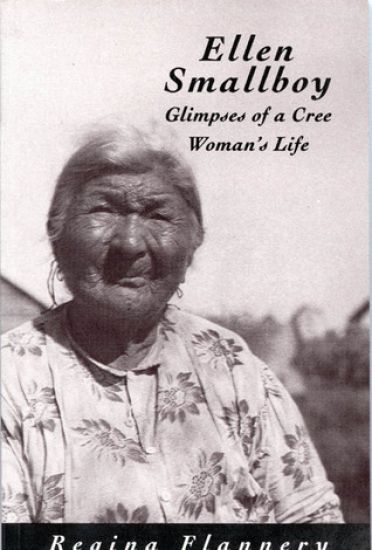
Flannery recounts Smallboy's childhood at Lake Kesagami, her father's early death and the effect of this tragedy, her marriage to Simon Smallboy and move to French River, and her old age at Moose Factory. Through Smallboy's anecdotes and episodes in her life, long-vanished values and norms of Cree society are illustrated and recorded. A concise history of European contact with James Bay Cree by John Long and a summary of literature on the Cree of Moose Factory and James Bay by Laura Peers place Smallboy's life in historical context.
Flannery and Regina tells the story of Flannery O’Connor and her mother, Regina, after Flannery’s lupus diagnosis forced her to move back to Milledgeville, Georgia. Just as her career as one of the twentieth century’s most distinguished writers of short fiction was beginning to take off, the disease that killed her father confined her to the family farm, Andalusia. The book fills in the gaps for fans of Flannery on the role of Regina in her life but more broadly presents a story of two women in the South of the 1950s and 1960s navigating financial independence, a changing rural landscape, and social norms. It’s a story of a mother and daughter, sometimes understanding each other, often not, but trying to cobble together parallel and overlapping lives. Perhaps most interesting to readers of O’Connor, or anyone interested in the biography of an author no longer able to control a public image, is the detailing of how Regina tried to direct and cultivate Flannery’s image after her death, though we get the sense she understood very little of her daughter as an artist.
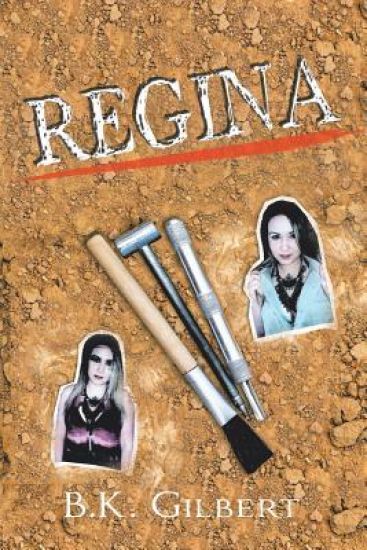
The girl made for fun has no idea what to do with herself when not having fun.Regina simply can't sit still long enough to find herself. Rather than patience, she prefers the life of a queen, for queens are adored, idolized, entertained and obeyed. She, who hates being cruel to others, too often finds herself being cruel with her affections. Get ready for a wild romp of growth and self-discovery... sometimes learned the hard way. From her worst mistake to the realization of her dreams, Regina is a story of young girl's progress across the board from pawn to queen. Prepare your heart for falling in love through stumbles, celebrations and the sweet beauty of becoming that which is worth waiting for.
"...'What great Champion is this, ' the Court Magician breathed, 'that even his handmaiden can wield the Test blade ' 'Don't you think she might be the Champion' Tickle asked, looking a little nervously at the point Regina was waving around. 'That could never be ' the man declared passionately. 'No maiden could ever take up arms in our Circle It would be against Nature, Custom, and The Proper Order of Things.' ..." Young Lady Regina-Valerie, spoilt only child of a wealthy Lord, is gorgeous, brilliant academically, artistically and musically, and outstanding at individual sports (avoiding team ones). Unfortunately she puts everyone off by seeming too perfect and by masking innate shyness with razorblades-in-honey politeness. Her only friend is her Siamese, Tickle. In constantly warring Warrior Magic Circle land, a creeping evil is detected. White-hot magic reveals where to find a Champion Knight to oppose an expected Warlock Dark Champion, and Regina and her cat are at the designated place. They enter the Circle to discover, during adventures with War-prince Peal and bullied handmaiden Princess Chime, that an already repressive society is indeed worsening savagely. Returning home to seek the foretold Champion, Regina recruits school rival Alistair who stutters in her presence unless using a Scots accent. Alistair fails the 'Test' challenge. To everyone's consternation, Regina doesn't. Back in the Circle they are attacked by giant Army Ants, as the first of many battles against vile Warlock creatures while they seek a prophesied Key, vital for success but fatal to the user. Various quest-themed journeys and adventures teach and change them - as they themselves teach and change the society. Surprises constantly arise. Humour, excitement and sheer fun interlink throughout. How can the adversary be identified and confronted? If successful in this, who must die using the Key - and where do they find it? These questions are spectacularly answered, and several final twists round off a truly magical experience.
Jane lost her husband, William, in a car accident. Her life was turned upside down at losing him. All she wanted to do was stay at home alone. Then her life turned for the better when she joined an archaeology dig in the northern part of Egypt. Even though life was starting to come to order, there were still problems to come and people she knew were out to kill her and the whole crew on the dig. Janet was a lucky charm when it came to finding the princess. She found the first clue to the burial site the first day she arrived. Not knowing what it was, she never mentioned it to anyone. Until one day, after Janet had fainted from the heat, the professor accidentally saw it in her tent. After finding the princess and her burial site, her life was threatened and she was in danger. After all had settled down and all the crooks had been captured, the dig site got back to normal. Janet found love and a life with a man whom she loved, and he loved her very deeply.
'A fantastic, feminist dance through history.' - JULIA QUINNWhat queens would England have had if firstborn daughters, not firstborn sons, had inherited the throne?We may think of princesses as dutiful and elegant, wearing long flowing dresses, but the eldest daughters of England’s kings have been very different.Political intriguers. Abducted nuns who demanded divorces. Murderers.It’s time we rediscovered the politicians we lost, the masterminds we see negotiating nunneries not armies, the personalities shining brilliantly even hundreds of years later: the queens who should have been.Let’s meet them.
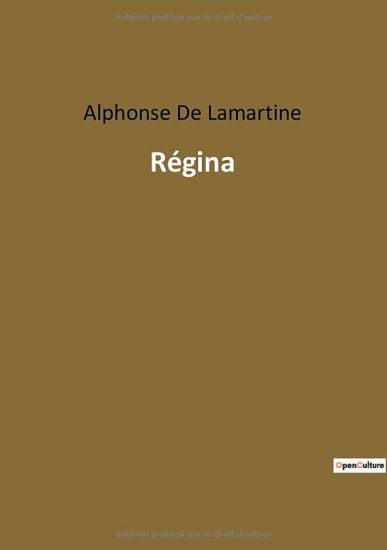
Regina, bref roman du po te romantique Aphonse de Lamartine est une suite de son roman Graziella, avec lequel il est traditionnellement publi . Le narrateur est le m me et fait allusion dans le chapitre V son amour italien impossible. Cette fois, c'est d'une princesse en exil, R gina, qu'il s' prend, frapp de sa beaut . Mais R gina aime son meilleur ami Saluce, qui, emprisonn en Italie, lui a confi l'amour de sa vie. Apr s avoir racont l'origine de la passion entre R gina et Saluce partir du r cit qu'elle lui en a fait, le narrateur le compl te gr ce la publication des lettres de son ami et r v le le malheur: R gina est promise contre son gr un prince. Saluce l'enl ve pour la soustraire ce destin et se retrouve enferm au ch teau Saint-Ange. Ce drame d'amour se noue et se d noue trangement, autour du geste, finalement ambigu, du sacrifice.
Regina - A Song of Many Days is an unchanged, high-quality reprint of the original edition of 1860. Hansebooks is editor of the literature on different topic areas such as research and science, travel and expeditions, cooking and nutrition, medicine, and other genres. As a publisher we focus on the preservation of historical literature. Many works of historical writers and scientists are available today as antiques only. Hansebooks newly publishes these books and contributes to the preservation of literature which has become rare and historical knowledge for the future.
**'A fantastic, feminist dance through history.' - Julia Quinn What queens would England have had if firstborn daughters, not firstborn sons, had inherited the throne? We may think of princesses as dutiful and elegant, wearing long flowing dresses, but the eldest daughters of England’s kings have been very different. Political intriguers. Abducted nuns who demanded divorces. Murderers. It’s time we rediscovered the politicians we lost, the masterminds we see negotiating nunneries not armies, the personalities shining brilliantly even hundreds of years later: the queens who should have been. Let’s meet them.
For SSAA unaccompanied Originally written for SATB, this hymn to the 'Queen of the Heavens' is a glorious work, replete with dramatic changes of mood and texture. The majestic chords of the opening bars quickly give way to a spirited exchange between the voices. This pattern of contrasts is repeated throughout the piece before the final jubilant chords fade away to pianissimo. This is an approachable and rewarding motet, appropriate for any time of the year and in particular, the Feast of the Blessed Virgin Mary and Eastertide. The original SATB version of Regina Caeli has also been recorded by the renowned American choir, the Phoenix Chorale, and released on a Grammy award-winning CD by Chandos (Spotless Rose CHSA 5066).
for SATB unaccompanied This hymn to the 'Queen of the Heavens' is a glorious work, replete with dramatic changes of mood and texture. The majestic chords of the opening bars quickly give way to a spirited section in which unison altos and basses mimic the insistent flourishes of the sopranos and tenors. This pattern of contrasts is repeated throughout the piece before the final jubilant chords fade away to a modest triple piano. This is an approachable and rewarding motet, appropriate for the Feast of the Blessed Virgin Mary in addition to Eastertide. Regina caeli has been recorded by the renowned American choir, the Phoenix Chorale, and released on a Grammy award-winning CD by Chandos (Spotless Rose CHSA 5066)
The first African American to head a branch of the New York Public Library (NYPL), Regina Andrews led an extraordinary life. Allied with W. E. B. Du Bois, Andrews fought for promotion and equal pay against entrenched sexism and racism and battled institutional restrictions confining African American librarians to only a few neighborhoods within New York City. Andrews also played a key role in the Harlem Renaissance, supporting writers and intellectuals with dedicated workspace at her 135th Street Branch Library. After hours she cohosted a legendary salon that drew the likes of Langston Hughes and Zora Neale Hurston. Her work as an actress and playwright helped establish the Harlem Experimental Theater, where she wrote plays about lynching, passing, and the Underground Railroad. Ethelene Whitmire's new biography offers the first full-length study of Andrews's activism and pioneering work with the NYPL. Whitmire's portrait of her sustained efforts to break down barriers reveals Andrews's legacy and places her within the NYPL's larger history.
The first African American to head a branch of the New York Public Library (NYPL), Regina Andrews led an extraordinary life. Allied with W. E. B. Du Bois, Andrews fought for promotion and equal pay against entrenched sexism and racism and battled institutional restrictions confining African American librarians to only a few neighborhoods within New York City. Andrews also played a key role in the Harlem Renaissance, supporting writers and intellectuals with dedicated workspace at her 135th Street Branch Library. After hours she cohosted a legendary salon that drew the likes of Langston Hughes and Zora Neale Hurston. Her work as an actress and playwright helped establish the Harlem Experimental Theater, where she wrote plays about lynching, passing, and the Underground Railroad. Ethelene Whitmire's new biography offers the first full-length study of Andrews's activism and pioneering work with the NYPL. Whitmire's portrait of her sustained efforts to break down barriers reveals Andrews's legacy and places her within the NYPL's larger history.