Kirjojen hintavertailu. Mukana 11 244 527 kirjaa ja 12 kauppaa.

Kirjahaku

Etsi kirjoja tekijän nimen, kirjan nimen tai ISBN:n perusteella.

1000 tulosta hakusanalla Regis Debray

Régis Debray et la médiologie
Ce volume réunit un ensemble d’études sur et autour de la médiologie de Régis Debray. Il présente l’avantage de comporter des essais explicatifs clairs et précis sur la théorie et la pratique médiologiques par des médiologues eux-mêmes (Régis Debray, Daniel Bougnoux et Louise Merzeau). L’ouvrage comprend également des analyses sur la réception de la médiologie, notamment aux Etats-Unis, ainsi qu’une série d’articles qui situent la médiologie dans le contexte plus large des disciplines dites connexes, notamment la sémiologie, l’anthropologie, les media studies et cultural studies d’inspiration anglo-américaine, la culture internet et le post-média. Cet ensemble d’études « médio-média » fait le point aussi bien sur le personnage de Régis Debray que sur le chantier médiologique qu’il a initié. Un ouvrage utile pour toute personne qui s’interesse à la question essentielle de la transmission culturelle.
Transmitting Culture

Transmitting Culture

Régis Debray

Columbia University Press
2004
pokkari
How do we explain the fact that certain ideas, at certain moments in time, can have earthshaking effects? Or that some cultures have left an indelible mark while others have not? Why did Jesus, rather than Mani the Mesopotamian or the Eastern god Mithra, take hold among masses of people? Why did Karl Marx instead of Pierre Proudhon or Auguste Comte leave his mark on the century? Behind these questions lies the matter of the human need to conserve, hand down, and transmit cultural meanings - the study of the means of transmission and of the long evolutionary history of media. In a departure, Regis Debray redefines communication as the inescapable conditioning of civilization's meanings and messages by their technologies of transmission and lays the groundwork for a science of the transmission of cultural forms - in a word, mediology."Transmitting Culture" examines the difference between communication and transmission and argues that ideas and their legacies should be rethought not in terms of "communication" from sender to receiver but of "mediation" by the vectors and messengers of meaning. "Transmitting Culture" stresses the technologies and institutions long overlooked by philosophy and the human sciences in the study of symbols and signs throughout the history of civilizations. Ranging widely from the history of religion and the printing press to the French and industrial revolutions, from the role and place of authority to scientific inquiry, "Transmitting Culture" establishes a new approach to the cultural history of communication.
Charles de Gaulle

Charles de Gaulle

Régis Debray

Verso Books
1994
nidottu
In this elegant and original book, Régis Debray argues that for two hundred years the defeats of the left have stemmed from its failure to understand what it likes to call the 'national question', while equally its successes have grown from an unacknowledged liaison with the 'unreal reality' of the nation.According to Debray, Charles de Gaulle was no narrow nationalist. By grounding his actions in a generous philosophy of the nation he was able to wed boldness to insight: on 14 June 1940 he appointed himself leader of the free French, disregarding the overwhelming parliamentary and legal mandate according to Petain. This intuitive action was to be resoundingly vindicated in the resistance and liberation of France.This study of De Gaulle is offered as an indictment of the shallowness of contemporary politics in the West. For Debray, De Gaulle is not only the last statesman in the classic mould, he is also the first to anticipate the politics of the twenty-first century. De Gaulle's aloofness from the media and disdain for the base arts of electioneering have an exemplary quality, Debray believes, reaffirming the vocation of political leadership as something other than adapting to popular preferences or allowing professional communicators and opinion pollsters to set every agenda.
Critique of Political Reason

Critique of Political Reason

Régis Debray

Verso Books
1983
nidottu
Régis Debray's major new work is an exploration of the foundations and limits of political discourse and action. Focusing, with his familiar verve and fluency, on the mechanism through which ideologies mobilize historical subjects, Debray argues that there is a common pattern in all great political or religious movements. Each possesses an apparatus that releases affective charges of belonging and closure; each is tended by bodies of functionaries who maintain its continuity and transmit its doctrines. The great mobilizing ideologies-Christianity, Islam, Marxism-deploy corps of priests, teachers, cadres. The real foundation of "political reason", for Debray, lies in the human need to participate in closed groups, denying or mitigating the harshness of the external world and the fact of death.
Revolution in the Revolution?

Revolution in the Revolution?

Régis Debray

Verso Books
2017
nidottu
Revolution in the Revolution? is a brilliant, pragmatic assessment of the situation in Latin America in the 1960s. First published in 1967, it became a controversial handbook for guerrilla warfare and revolution, read alongside Che's own pamphlets, and remains fully as important as the writings of Guevara. Lucid and compelling, it spares no personage, no institution, and no concept, taking on not only Russian and Chinese strategies but Trotskyism as well. The year it was published, Debray was convicted of having been part of Guevara's guerrilla group and sentenced to 30 years in prison. He was released in 1970, following an international campaign, which included appeals by Jean-Paul Sartre, André Malraux, General Charles de Gaulle and Pope Paul VI.
Civilization

Civilization

Régis Debray

Verso Books
2019
sidottu
'Civilisation' - a hard term to define. But while every society has a distinctive culture, authentic civilisations must offer those they subjugate an attractive way of life. Their imprint outlasts their imperium.A century ago, Debray argues, there was a European civilisation of which America was an outlying culture; but today the relationship is reversed. 'In 1900, an American of taste was a European in exile; in 2000, a trendy European is a frustrated American - or one waiting for a visa'. Characteristic of American civilization is its three overarching fetishes: space, image and happiness. America is a civilization of space and image, whereas Europe was one of time and writing. And its kitsch infantilism blinds itself to the tragic complexities of human life. A measure of America's success is how its 'globish' jargon has so successfully infiltrated European languages.For Debray, the dominance of American civilisation is a historical fait accompli, yet he sees a model for Europe in Vienna after its exclusion from the German Reich. For decades to come, Europe can still offer a rich cultural seedbed. 'Some will call it decadence, others liberation. Why not both?'
Conversations with Allende

Conversations with Allende

Régis Debray

Verso Books
2023
nidottu
The election in Chile of the Marxist leader of the Socialist Party, Salvador Allende, to the presidency in October 1970 inaugurated a political situation unique in Latin America and of world-wide significance. Allende's Popular Unity coalition embraced Socialists and Communists and campaigned on an election programme of unprecedented radicalism - nothing less than the abolition of monopoly capitalism and imperialism in Chile. In this book, Régis Debray, recently released from his Bolivian gaol, questioned President Allende about his strategy for socialism. These discussions ranged widely over the history of the workers' movement in Chile, the strength of imperialism in Latin America, the experience of the first months of the Allende government, the role of the Chilean armed forces, Allende's personal background and friendship with Che Guevara, the seizure of land by peasants since the Popular Unity victory, and the international outlook of the new Chile.In an introductory essay, Debray furnished an analysis of Chilean history and politics which situated Allende in the past and present of the country and explored the dynamics of the class struggle now unfolding there. For this new anniversary edition, leading Chilean leftist scholar Camila Vergara has written a new introduction which appraises the book in the light of recent political developments in Chile.
Praised Be Our Lords

Praised Be Our Lords

Régis Debray

Verso Books
2007
nidottu
Régis Debray is one of France's leading intellectuals, whose life has intersected with key moments of the twentieth century.In this explosive memoir, Debray recounts his journey from Louis Althusser and the Parisian lecture theatres, to Cuba and the revolution of the 1960s. From Debray's torture and imprisonment in Bolivia while in search of Che Guevara, to the corridors of power in the Elysée Palace-where he served as advisor to President Mitterrand-Praised Be Our Lords is an account of an extraordinary life and an exploration of the mechanisms of political passion.
Media Manifestos

Media Manifestos

Régis Debray

Verso Books
1996
nidottu
In this volume Régis Debray sums up over a decade of his research and writing on the evolution of subjects of communication and the technologically transmitted interventions of the modern intelligentsia in France. Media Manifestos announces the battle-readiness of a new sub-discipline of the sciences humaines: "medialogy." Scion of that semiology of the sixties linked with the names of Roland Barthes and Umberto Eco-and affiliated trans-Atlantically to the semiotics of C.S. Pierce and media analyses of Marshall McLuhan ("media is message")-"mediology" is in dialectical revolt against its parent thought-system. Determined not to lapse back into the uncritical empiricism and psychologism with which semiology broke, mediology is just as resolved to dispel the cult or illusion of the signifier as the be-all-and-end-all, slough off the scholasticism of the code, and recover the world-in all its mediatized materiality. In this enterprise its ally is the work of French historians of mentalités, of the hard and evolutionary sciences, and of the technologies of transmission (from stylus and clay to quill and parchment to press and paper to mouse and screen).Written with Debray's customary brio, Media Manifestos is no mere contribution to the vogue of "media studies." It remains steeped in the intellectual culture of Louis Althusser and Michel Foucault, indebted to the neolithic anthropology of Leroi-Gourhan and the study of science and technology of Serres and Latour, informed by the material histories of the Annales school, yet plugged into the audiovisual culture of today's "videosphere" (as against the printerly "graphosphere" of yesterday, and the scriptorly "logosphere" of the day before that). Debray's work turns a neologism ("mediology") into a tool-kit with which to rethink the whole business of mediation from the city-state to the internet.
God

God

Régis Debray

Verso Books
2004
sidottu
God, who has changed the lives - and deaths - of men and women, has in turn changed His face and His meaning several times over since His birth three thousand years ago. He may have kept the same name throughout, but God has been addressed in many different ways and cannot be said to have the same characteristics in the year 500 BC as in AD 400 or in the twenty-first century, nor is He the same entity in Jerusalem or Constantinople as in Rome or New York. The omnipotent and punitive God of the Hebrews is not the consoling and intimate God of the Christians, and is certainly not identical with the impersonal cosmic Energy of the New Agers.Regis Debray's purpose in this major new book is to trace the episodes of the genesis of God, His itinerary and the costs of His survival. Debray shifts the spotlight away from the theological foreground and moves it backstage to the machinery of divine production by going back, from the Law, to the Tablets themselves and by scrutinizing Heaven at its most down-to-earth. Throughout this beautifully illustrated book, he is able to focus his attention not just on what was written, but on how it was written: with what tools, on what surface, for what social purpose and in what physical environment.Debray contends that, in order to discover how God's fire was transferred from the desert to the prairie, we ought first to bracket the philosophical questions and focus on empirical information. However, he claims that this does not lessen its significance, but rather gives new life to spiritual issues. God: An Itinerary uses the histories of the Eternal and of the West to illuminate one another and to throw light on contemporary civilization itself.
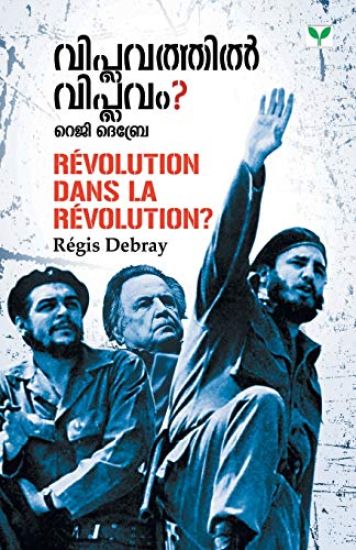
Viplavathil Viplavam

Viplavathil Viplavam

Regis Debray

Green Books Pvt Ltd
2018
pokkari
സോഷ്യലിസത്തിലേക്കുള്ള മാർഗം സായുധവിപ്ലവം മാത്രമാണെന്നുള്ള ആശയം ശക്തിയാർജ്ജിച്ച ഒരു കാലഘട്ടത്തിൽ ഫിഡൽ കാസ്]ട്രോയുടെയും ചെഗുവേരരെയുടെയും സുഹൃത്തായ ഫ്രഞ്ച് ചിന്തകൻ റെജി ദെബ്രെ ചിട്ടപ്പെടുത്തിയ രാഷ്ട്രീയ രേഖയാണ് ഈ പുസ്തകം. വിവർത്തനം പ്രഭ ആർ. ചാറ്റർജി
Maskerna : en lektion i förälskelse

Maskerna : en lektion i förälskelse

Régis Debray; Chris Forsne

CKM Förlag
2016
sidottu
Kärleken och politiken, åtrån till kvinnorna och den kollektiva hänryckningen i den revolutionära kampen. Oförsonliga motsatspar eller två sidor av samma personliga drivkraft? I första delen av sin självbiografiska trilogi, Maskerna, söker Régis Debray reda ut vad som förde honom bort från den borgerliga tryggheten i det tidiga 60-talets Frankrike till en äventyrlig odyssé i de latinamerikanska revolutionernas kölvatten. Därefter tillbaka till författarskap och politiskt engagemang i Mitterrands socialistparti. Desillusionerad av mötet med den nordamerikanska kapitalismen fångas han i tjugoårsåldern av den karibiska vinden och beger sig mot revolutionens och Castros Kuba. I sällskap med en mörk skönhet, hans blivande hustru, genomkorsar han sydamerikanska nationer i uppror. Oväntat blir Fidel hans förtrogne och Che Guevara hans kamrat i gerillakrigets Bolivia. Priset är tre år i militärens fängelse. I Chile väntar Salvador Allende och tron på en fredlig väg till socialismen. Även den stora passionen. Silvia, kvinnan i hans liv. Men vad vet vi egentligen om den vi älskar? Vi bär alla masker. När de faller... När man lärt sig att leva, är det redan för sent. (Louis Aragon).