Kirjojen hintavertailu. Mukana 12 458 170 kirjaa ja 12 kauppaa.

Kirjahaku

Etsi kirjoja tekijän nimen, kirjan nimen tai ISBN:n perusteella.

1000 tulosta hakusanalla René Descartes

The Correspondence between Princess Elisabeth of Bohemia and René Descartes
Between the years 1643 and 1649, Princess Elisabeth of Bohemia (1618-80) and Rene Descartes (1596-1650) exchanged fifty-eight letters - thirty-two from Descartes and twenty-six from Elisabeth. Their correspondence contains the only known extant philosophical writings by Elisabeth and reveals her mastery of metaphysics, analytic geometry, and moral philosophy, as well as her keen interest in natural philosophy. The letters are essential reading for anyone interested in Descartes' philosophy, in particular his account of the human being as a union of mind and body, as well as his ethics. They also provide a unique insight into the character of their authors and the way ideas develop through intellectual collaboration. Philosophers have long been familiar with Descartes' side of the correspondence. Now Elisabeth's letters - never before available in translation in their entirety - emerge in this volume, adding much-needed context and depth both to Descartes' ideas and the legacy of the princess. Lisa Shapiro's annotated edition, which also includes Elisabeth's correspondence with the Quakers William Penn and Robert Barclay, will be heralded by students of philosophy, feminist theorists, and historians of the early modern period.
Rene Descartes
A collection of the most significant contributions to Cartesian scholarship. Nearly 120 articles are brought together on Cartesian method, epistemology, metaphysics and Descartes' contributions to mathematics and science
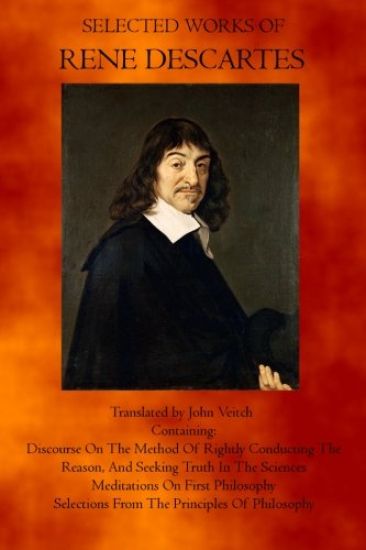
Selected Works of Rene Descartes

Selected Works of Rene Descartes

Rene Descartes

Theophania Publishing
2011
nidottu
Thank you for checking out this book by Theophania Publishing. We appreciate your business and look forward to serving you soon. We have thousands of titles available, and we invite you to search for us by name, contact us via our website, or download our most recent catalogues. Ren Descartes was a French philosopher and writer who spent most of his adult life in the Dutch Republic. He has been dubbed the 'Father of Modern Philosophy', and much subsequent Western philosophy is a response to his writings, which are studied closely to this day. In particular, his Meditations on First Philosophy continues to be a standard text at most university philosophy departments. Descartes's influence in mathematics is equally apparent; the Cartesian coordinate system, allowing geometric shapes to be expressed in algebraic equations, was named after him. He is credited as the father of analytical geometry. Descartes was also one of the key figures in the Scientific Revolution. Descartes frequently sets his views apart from those of his predecessors. In the opening section of the Passions of the Soul, a treatise on the Early Modern version of what are now commonly called emotions, Descartes goes so far as to assert that he will write on this topic "as if no one had written on these matters before". Many elements of his philosophy have precedents in late Aristotelianism, the revived Stoicism of the 16th century, or in earlier philosophers like St. Augustine. In his natural philosophy, he differs from the Schools on two major points: First, he rejects the analysis of corporeal substance into matter and form; second, he rejects any appeal to ends, divine or natural, in explaining natural phenomena. In his theology, he insists on the absolute freedom of God's act of creation. Descartes was a major figure in 17th century continental rationalism, later advocated by Baruch Spinoza and Gottfried Leibniz, and opposed by the empiricist school of thought consisting of Hobbes, Locke, Berkeley, Jean-Jacques Rousseau, and Hume. Leibniz, Spinoza and Descartes were all well versed in mathematics as well as philosophy, and Descartes and Leibniz contributed greatly to science as well. As the inventor of the Cartesian coordinate system, Descartes founded analytic geometry, the bridge between algebra and geometry, crucial to the discovery of infinitesimal calculus and analysis. He is perhaps best known for the philosophical statement "Cogito ergo sum" (French: Je pense, donc je suis; English: I think, therefore I am; or I am thinking, therefore I exist or I do think, therefore I do exist), found in part IV of Discourse on the Method.
Works of René Descartes

Works of René Descartes

Rene Descartes

Createspace Independent Publishing Platform
2017
nidottu
Works of Ren Descartes is a collection of works by the famed writer, philosopher, mathematician, and scientist. Dubbed the father of modern western philosophy, much of subsequent Western philosophy is a response to his writings, which are studied closely to this day. A native of the Kingdom of France, he spent about 20 years (1629-49) of his life in the Dutch Republic after serving for a while in the Dutch States Army of Maurice of Nassau, Prince of Orange and the Stadtholder of the United Provinces. He is generally considered one of the most notable intellectual representatives of the Dutch Golden Age. The collection includes: Rules for the Direction of the Mind (1628) Discourse on the Method (1637) Meditations on First Philosophy (1641) Principles of Philosophy (1644) Odin's Library Classics is dedicated to bringing the world the best of humankind's literature from throughout the ages. Carefully selected, each work is unabridged from classic works of fiction, nonfiction, poetry, or drama.
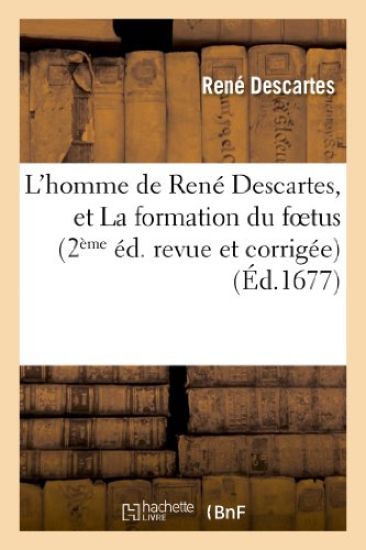
L'Homme de René Descartes, Et La Formation Du Foetus Ou Traité de la Lumière Du Mesme Autheur
L'homme de Rene Descartes, et La formation du foetus; ou Traite de la lumiere du mesme autheur (2e ed. rev. et corr.) / avec les remarques de Louis de La Forge; publ. par Clerselier et suivi de la trad. de la preface de Schuyl]Date de l'edition originale: 1677Ce livre est la reproduction fidele d'une oeuvre publiee avant 1920 et fait partie d'une collection de livres reimprimes a la demande editee par Hachette Livre, dans le cadre d'un partenariat avec la Bibliotheque nationale de France, offrant l'opportunite d'acceder a des ouvrages anciens et souvent rares issus des fonds patrimoniaux de la BnF.Les oeuvres faisant partie de cette collection ont ete numerisees par la BnF et sont presentes sur Gallica, sa bibliotheque numerique.En entreprenant de redonner vie a ces ouvrages au travers d'une collection de livres reimprimes a la demande, nous leur donnons la possibilite de rencontrer un public elargi et participons a la transmission de connaissances et de savoirs parfois difficilement accessibles.Nous avons cherche a concilier la reproduction fidele d'un livre ancien a partir de sa version numerisee avec le souci d'un confort de lecture optimal. Nous esperons que les ouvrages de cette nouvelle collection vous apporteront entiere satisfaction.Pour plus d'informations, rendez-vous sur www.hachettebnf.fr
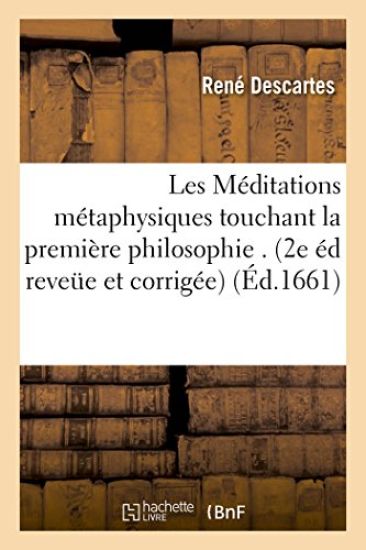
Les Méditations Métaphysiques de René Descartes Touchant La Première Philosophie.
Les Meditations metaphysiques de Rene Descartes touchant la premiere philosophie . 2e edition reveue et corrigee par le traducteur (Charles d'Albert, duc de Luynes) et augmentee de la version d'une lettre de M. Des Cartes au R. P. Dinet, et de celle des septiesmes objections et de leurs responses (par Claude Clerselier.)Date de l'edition originale: 1661Ce livre est la reproduction fidele d'une oeuvre publiee avant 1920 et fait partie d'une collection de livres reimprimes a la demande editee par Hachette Livre, dans le cadre d'un partenariat avec la Bibliotheque nationale de France, offrant l'opportunite d'acceder a des ouvrages anciens et souvent rares issus des fonds patrimoniaux de la BnF.Les oeuvres faisant partie de cette collection ont ete numerisees par la BnF et sont presentes sur Gallica, sa bibliotheque numerique.En entreprenant de redonner vie a ces ouvrages au travers d'une collection de livres reimprimes a la demande, nous leur donnons la possibilite de rencontrer un public elargi et participons a la transmission de connaissances et de savoirs parfois difficilement accessibles.Nous avons cherche a concilier la reproduction fidele d'un livre ancien a partir de sa version numerisee avec le souci d'un confort de lecture optimal. Nous esperons que les ouvrages de cette nouvelle collection vous apporteront entiere satisfaction.Pour plus d'informations, rendez-vous sur www.hachettebnf.fr
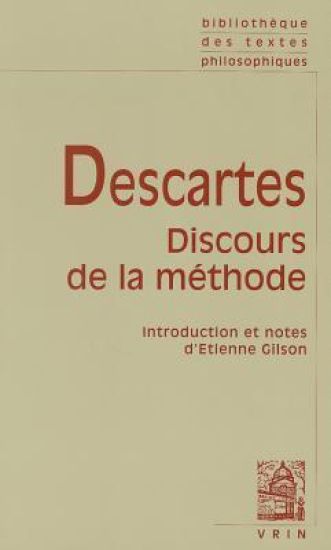
Rene Descartes: Discours de la Methode

Rene Descartes: Discours de la Methode

Rene Descartes

Librarie Philosophique J. Vrin
1984
nidottu
On appelle methode, l'ordre que la pensee doit suivre pour parvenir a la sagesse et conformement auquel elle pense une fois qu'elle y est parvenue. Mais qu'est-ce que la sagesse? C'est la chose du monde la plus desirable, et celle pourtant a laquelle les hommes pensent le moins. Or, le philosophe s'interesse beaucoup moins au contenu qu'a la perfection de son esprit meme; il s'efforce d'acquerir une intelligence toujours capable de discerner le vrai dans l'ordre theorique et une volonte toujours capable de suivre le bien dans l'ordre pratique; c'est etre sage que de les avoir acquis; philosopher, c'est travailler a les acquerir.
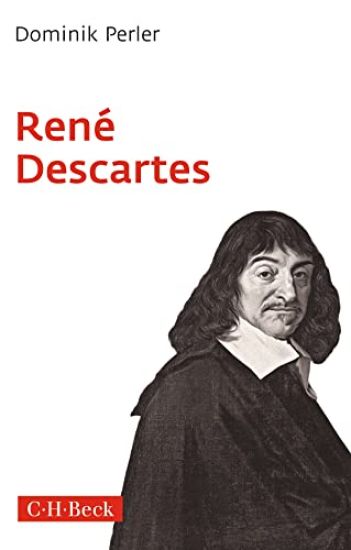
Rene Descartes

Rene Descartes

Sandra Bollenbacher

Grin Publishing
2012
nidottu
Studienarbeit aus dem Jahr 2006 im Fachbereich Philosophie - Philosophie des 17. und 18. Jahrhunderts, Note: 2,0, Ruprecht-Karls-Universit t Heidelberg, Veranstaltung: Einf hrung in die Philosophie, Sprache: Deutsch, Abstract: Ren Descartes wurde am 31.03.1596 in Frankreich geboren und starb am 11.02.1650. Im Jahre 1641 verfasste er die "Meditationes de Prima Philosphia" - die "Meditationen ber die Erste Philosophie." Das Werk ist in der Gelehrtensprache Latein geschrieben und besteht aus sechs einzelnen Meditationen, die alle in Monologform in der ersten Person Singular geschrieben sind. In der ersten Meditation "Woran man zweifeln kann" befasst er sich mit dem methodischen Zweifel. Descartes hat erkannt, dass vieles falsch ist, was er in seiner Jugend f r wahr gehalten hat und dass alles, was er daraus schloss, anzuzweifeln ist. Deshalb m chte er alles umst rzen, indem er die Grundlagen und Prinzipien anzweifelt, um am Ende etwas Festes zu erlangen, das nicht mehr angezweifelt werden kann. In der zweiten Meditation " ber die Natur des menschlichen Geistes; da er leichter erkennbar als der K rper" m chte er, von allem befreit, was einen Zweifel zul sst, herausfinden, was ER eigentlich ist. Am Ende kommt er zu der Erkenntnis, dass die Existenz seines Geistes und damit seine eigene nicht angezweifelt werden kann, da er denkt. Wie Descartes in seiner Argumentation von dem Anfang, alles anzuzweifeln, zu dieser festen, unumst lichen Erkenntnis kommt, wird im Folgenden dargestellt.