In Job's final concession to God, he uses a phrase generally translated from the Hebrew as, ""Wherefore I abhor myself, and repent in dust and ashes"" (afar va-eifer). A very small number of scholars see this translation as forced. While most translations have Job referring to himself with the words afar va-eifer, this small group of scholars does not believe the Hebrew to be so clear. They maintain that the phrase afar va-eifer could just as easily be translated as referring to God. In this translation of the text, Job is calling God ""dust and ashes."" Can Job truly be referring to God, not himself, as dust and ashes? How dare he? And if he did, what did this mean theologically? If this linguistic analysis is correct, how are we to understand not only the ending of the book, but also the entire story of Job? These are the questions From Job to the Shoah strives to answer. The conclusions it reaches have profound theological implications, especially in our modern era when the ""dust and ashes"" of the six million Jews murdered in the Holocaust still hang heavily above us.
In Job's final concession to God, he uses a phrase generally translated from the Hebrew as, "Wherefore I abhor myself, and repent in dust and ashes" (afar va-eifer). A very small number of scholars see this translation as forced. While most translations have Job referring to himself with the words afar va-eifer, this small group of scholars does not believe the Hebrew to be so clear. They maintain that the phrase afar va-eifer could just as easily be translated as referring to God. In this translation of the text, Job is calling God "dust and ashes."Can Job truly be referring to God, not himself, as dust and ashes? How dare he? And if he did, what did this mean theologically? If this linguistic analysis is correct, how are we to understand not only the ending of the book, but also the entire story of Job? These are the questions From Job to the Shoah strives to answer. The conclusions it reaches have profound theological implications, especially in our modern era when the "dust and ashes" of the six million Jews murdered in the Holocaust still hang heavily above us.
As with both its predecessors, this book of life lessons derived from the Bible is meant for elementary school students and their parents. One arguably simplistic approach to looking at Numbers is to see it as a story of a sinful people and a wrathful God. However, the stories in Numbers are rarely black and white. This book strives to examine Numbers in more nuanced depth, while keeping the life lessons simple and easy to understand. By doing so, this book can serve as a valuable guide to parents and students alike as they learn the text of Numbers and gain new insights into it.
One of the most common phrases in the Torah is "And the LORD spoke to Moses, saying . . ." So many of the Torah's commandments are introduced in this way. These words represent God speaking to Moses and instructing him what to repeat or teach to the Jewish people. Yet, this phrase is not found at all in Deuteronomy, and this helps explain why this book is so very different from the other books of the Torah. Deuteronomy is Moses's book. It is the record of Moses's final speech to the Jewish people before his death. But this leads to a very basic and very fundamental question. Why are the words of man, even a man as great as Moses, part of God's holy Torah? A very good question, a powerful one indeed. And while we may not come up with a good or satisfying answer, this book examines and presents life lessons just as important as those found in any other biblical text.
Judaism has always found meaning in the sacrificial rites, called avodah or service in Hebrew. For more than twelve hundred years, beginning with the Mishkan (the Tabernacle) in the Sinai wilderness and continuing through both the First and Second Temple periods, animal sacrifice was the principal form of communal service of God for the Jewish people. This all came to an abrupt end with the destruction of the Second Temple by the Romans in 68 CE, and the Jewish people turned to prayer as their primary mode of worship. From this perspective, it might seem that the study of Leviticus, which is largely about the laws of sacrifice, would seem unnecessary, if not irrelevant, for young children. Nothing could be further from the truth. Leviticus is replete with important life lessons for children, ranging from not bearing grudges to being truthful in business. From the responsibility to care for the poor to the obligation to strive to be "holy," we find everyday aspects of one's life (as opposed to limiting this to rituals and religious celebrations). Throughout the book, Leviticus emphasizes the dignity of human beings and what this means for our personal interactions with one another. It can and ought to be taught (in an age-appropriate manner) to young children, and that is what this book strives to do.
Judaism has always found meaning in the sacrificial rites, called avodah or service in Hebrew. For more than twelve hundred years, beginning with the Mishkan (the Tabernacle) in the Sinai wilderness and continuing through both the First and Second Temple periods, animal sacrifice was the principal form of communal service of God for the Jewish people. This all came to an abrupt end with the destruction of the Second Temple by the Romans in 68 CE, and the Jewish people turned to prayer as their primary mode of worship. From this perspective, it might seem that the study of Leviticus, which is largely about the laws of sacrifice, would seem unnecessary, if not irrelevant, for young children. Nothing could be further from the truth. Leviticus is replete with important life lessons for children, ranging from not bearing grudges to being truthful in business. From the responsibility to care for the poor to the obligation to strive to be "holy," we find everyday aspects of one's life (as opposed to limiting this to rituals and religious celebrations). Throughout the book, Leviticus emphasizes the dignity of human beings and what this means for our personal interactions with one another. It can and ought to be taught (in an age-appropriate manner) to young children, and that is what this book strives to do.
One of the most common phrases in the Torah is "And the LORD spoke to Moses, saying . . ." So many of the Torah's commandments are introduced in this way. These words represent God speaking to Moses and instructing him what to repeat or teach to the Jewish people. Yet, this phrase is not found at all in Deuteronomy, and this helps explain why this book is so very different from the other books of the Torah. Deuteronomy is Moses's book. It is the record of Moses's final speech to the Jewish people before his death. But this leads to a very basic and very fundamental question. Why are the words of man, even a man as great as Moses, part of God's holy Torah? A very good question, a powerful one indeed. And while we may not come up with a good or satisfying answer, this book examines and presents life lessons just as important as those found in any other biblical text.
Genesis contains a rich, nuanced text, and yet, when taught to children, it is often done through a series of ""factoids,"" such as the number of animals brought into the ark or Esau's red lentil soup. Worst still, children are frequently discouraged from asking questions about its complex storylines. This book was written to redress both pedagogical shortcomings. It does so by reminding children that the Bible teaches us to be truly good people via amazing stories of brave men and women doing incredible things. However, the most valuable lessons we learn from the Bible seem to come from people's daily lives: how they speak to their spouses, how they treat their children, how they interact with their neighbors. Perhaps most importantly, the Bible teaches us to ask questions. At times, the answers to our questions come easily. At other times, the answers we seek are hidden away, and so we are left to think and wonder. Nonetheless, ask we must, because by asking questions, we can deepen our connection to the ones we address the questions to, be it parents, teachers, or even God himself.
No matter how many times you have read stories from the Bible, there is always something new to learn from the lives of its characters and the challenges they face. This is especially true for the book of Exodus, and this second Curious Student's Guide will help your children glean new insights into the Exodus narrative. This book will guide your children to these lessons by first summarizing key stories from Exodus and then asking thought-provoking questions. Consider the following example: Every reader of Exodus knows that Moses is its hero, but how many are aware of Miriam's heroism? Miriam is six years old when Moses is born. Very often, adults tell six-year-old children that they are too little to do this or that. But it is Miriam who approaches Pharaoh's daughter after she pulls baby Moses from the river to ask, ""Shall I go and get you a Hebrew woman to nurse the child for you?"" How dare any slave, especially a child, speak to Pharaoh's daughter and tell her what to do? Miriam dares, and by highlighting her bravery, this book challenges young readers to think about what they can accomplish by speaking up. With this Curious Student's Guide in hand, your children will discover similarly important life lessons they can apply to their own lives.
No matter how many times you have read stories from the Bible, there is always something new to learn from the lives of its characters and the challenges they face. This is especially true for the book of Exodus, and this second Curious Student's Guide will help your children glean new insights into the Exodus narrative. This book will guide your children to these lessons by first summarizing key stories from Exodus and then asking thought-provoking questions. Consider the following example: Every reader of Exodus knows that Moses is its hero, but how many are aware of Miriam's heroism? Miriam is six years old when Moses is born. Very often, adults tell six-year-old children that they are too little to do this or that. But it is Miriam who approaches Pharaoh's daughter after she pulls baby Moses from the river to ask, ""Shall I go and get you a Hebrew woman to nurse the child for you?"" How dare any slave, especially a child, speak to Pharaoh's daughter and tell her what to do? Miriam dares, and by highlighting her bravery, this book challenges young readers to think about what they can accomplish by speaking up. With this Curious Student's Guide in hand, your children will discover similarly important life lessons they can apply to their own lives.
While it is true the Bible does relate important episodes in the history of the Jewish people, it is thought of as being much more than a history book. This is why many question the Bible's rationale for including a book such as Numbers, one that seems to be little more than a history book. In comparison, Genesis as a history book makes sense. It tells of the creation of the heavens and earth and the foundational stories of the Jewish people. Even Exodus, which relates the departure of the Jewish people from Egypt, has many legal sections. This thus begs the question: what exactly is the Book of Numbers, and what role does it play in the overall narrative of the Bible? Presenting Numbers as the book of character development is the major guiding principle of the pedagogical approach set forth in this book for teaching Numbers. This approach can also be used for teaching Genesis. However, the characters in Genesis are portrayed as either ""very good"" or ""evil."" Not so in Numbers, whose main personalities can and should be viewed in hues of grey, making it a very appropriate vehicle for teaching character development to high school students. ""Rabbi Reuven Travis has done it again His excellent book on Numbers (Bamidbar, in the Jewish tradition) is a fascinating and worthwhile read. He combines tight textual readings with erudite analysis--and sweet ethical conversation too --and makes a page turning book about one of the 'Five Books of Moses.' Everyone will gain from reading this work."" --Michael J. Broyde, Emory University School of Law ""The relevance and value of tradition--especially religious tradition, and even more so Jewish tradition--is one of the pressing concerns of the postmodern age. . . . Drawing on years of experience as an educator and scholar, Rabbi Travis has masterfully stepped into the breach, offering us all--but especially students--a pedagogically compelling, interpretively sound, and exegetically creative account of the Book of Bamidbar that lays bare the Torah's nuanced appreciation for life's grey areas. . . . This is a work that will benefit teachers, students, and lay readers alike."" --Shlomo C. Pill, Senior Fellow, The Center for the Study of Law and Religion, Emory University School of Law Reuven Travis teaches Bible, Jewish law, and Jewish history at Atlanta's only Modern Orthodox day school. He earned his bachelor's degree from Dartmouth College, where he graduated Phi Beta Kappa. He holds a master's degree in teaching from Mercer University and a master's in Judaic studies from Spertus College. He received his rabbinic ordination in 2006 from Rabbi Michael J. Broyde. He is the author of From Job to the Shoah (2013).
While it is true the Bible does relate important episodes in the history of the Jewish people, it is thought of as being much more than a history book. This is why many question the Bible's rationale for including a book such as Numbers, one that seems to be little more than a history book. In comparison, Genesis as a history book makes sense. It tells of the creation of the heavens and earth and the foundational stories of the Jewish people. Even Exodus, which relates the departure of the Jewish people from Egypt, has many legal sections. This thus begs the question: what exactly is the Book of Numbers, and what role does it play in the overall narrative of the Bible? Presenting Numbers as the book of character development is the major guiding principle of the pedagogical approach set forth in this book for teaching Numbers. This approach can also be used for teaching Genesis. However, the characters in Genesis are portrayed as either ""very good"" or ""evil."" Not so in Numbers, whose main personalities can and should be viewed in hues of grey, making it a very appropriate vehicle for teaching character development to high school students. ""Rabbi Reuven Travis has done it again His excellent book on Numbers (Bamidbar, in the Jewish tradition) is a fascinating and worthwhile read. He combines tight textual readings with erudite analysis--and sweet ethical conversation too --and makes a page turning book about one of the 'Five Books of Moses.' Everyone will gain from reading this work."" --Michael J. Broyde, Emory University School of Law ""The relevance and value of tradition--especially religious tradition, and even more so Jewish tradition--is one of the pressing concerns of the postmodern age. . . . Drawing on years of experience as an educator and scholar, Rabbi Travis has masterfully stepped into the breach, offering us all--but especially students--a pedagogically compelling, interpretively sound, and exegetically creative account of the Book of Bamidbar that lays bare the Torah's nuanced appreciation for life's grey areas. . . . This is a work that will benefit teachers, students, and lay readers alike."" --Shlomo C. Pill, Senior Fellow, The Center for the Study of Law and Religion, Emory University School of Law Reuven Travis teaches Bible, Jewish law, and Jewish history at Atlanta's only Modern Orthodox day school. He earned his bachelor's degree from Dartmouth College, where he graduated Phi Beta Kappa. He holds a master's degree in teaching from Mercer University and a master's in Judaic studies from Spertus College. He received his rabbinic ordination in 2006 from Rabbi Michael J. Broyde. He is the author of From Job to the Shoah (2013).
God's charge to the Jewish people at Sinai was to be a kingdom of priests and a holy nation. Nowhere is freedom found in this exhortation, even though the Jews had been freed from slavery only seven weeks prior. That is because the Jews were not liberated merely to become a free people. God wanted them and expected them to evolve into a nation committed to creating a law-abiding society. From this perspective, freedom is just a necessary precondition to achieving this. America's founders understood this and wove this idea into the basic fabric of the democracy they were creating. What has for centuries set America apart from other nations is its synergistic linking between freedom and the law, which, of course, is something that goes to the heart of the Exodus story. The first of the national goals enumerated in the preamble to the US Constitution is to form a more perfect Union, followed by to establish Justice. We truly believe that America is and always has been a great country. Yet greatness does not equate to perfection, and America's history is marked by episodes, slavery foremost among them, that were far from the founder's stated goals for their emerging nation. Falling short of the mark, as the American and Jewish people have done more times than either would like to remember, does not negate their aspirational national goals. It just means that we must be prepared to honestly assess morally challenging situations when they arise and then recommit ourselves to our goals, be it becoming a kingdom of priests and a holy nation or creating a more perfect Union. Never losing sight of this is the true enduring lesson of Exodus.
God's charge to the Jewish people at Sinai was to be a kingdom of priests and a holy nation. Nowhere is freedom found in this exhortation, even though the Jews had been freed from slavery only seven weeks prior. That is because the Jews were not liberated merely to become a free people. God wanted them and expected them to evolve into a nation committed to creating a law-abiding society. From this perspective, freedom is just a necessary precondition to achieving this. America's founders understood this and wove this idea into the basic fabric of the democracy they were creating. What has for centuries set America apart from other nations is its synergistic linking between freedom and the law, which, of course, is something that goes to the heart of the Exodus story. The first of the national goals enumerated in the preamble to the US Constitution is to form a more perfect Union, followed by to establish Justice. We truly believe that America is and always has been a great country. Yet greatness does not equate to perfection, and America's history is marked by episodes, slavery foremost among them, that were far from the founder's stated goals for their emerging nation. Falling short of the mark, as the American and Jewish people have done more times than either would like to remember, does not negate their aspirational national goals. It just means that we must be prepared to honestly assess morally challenging situations when they arise and then recommit ourselves to our goals, be it becoming a kingdom of priests and a holy nation or creating a more perfect Union. Never losing sight of this is the true enduring lesson of Exodus.
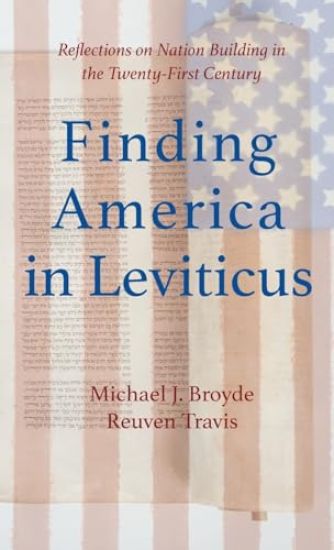
It would seem that we have taken on an impossible task in this book: trying to demonstrate to modern Americans, be they secular or religious, Jews or Christians, that the sacrificial rites found in Leviticus have any germaneness to their lives. After all, to the extent that any modern reader turns to the pages of Leviticus at all, the notion that they would be inspired by the text and pine for the restoration of animal sacrifices is ludicrous However, Leviticus is more than laws of sacrifices. As we demonstrate, Leviticus sets forth a template for nation-building via large, regularly-scheduled communal gatherings intended to foster national unity and identity among the Jewish people.
It would seem that we have taken on an impossible task in this book: trying to demonstrate to modern Americans, be they secular or religious, Jews or Christians, that the sacrificial rites found in Leviticus have any germaneness to their lives. After all, to the extent that any modern reader turns to the pages of Leviticus at all, the notion that they would be inspired by the text and pine for the restoration of animal sacrifices is ludicrous However, Leviticus is more than laws of sacrifices. As we demonstrate, Leviticus sets forth a template for nation-building via large, regularly-scheduled communal gatherings intended to foster national unity and identity among the Jewish people.