Kirjojen hintavertailu. Mukana 11 627 378 kirjaa ja 12 kauppaa.

Kirjahaku

Etsi kirjoja tekijän nimen, kirjan nimen tai ISBN:n perusteella.

1000 tulosta hakusanalla Richard A Arenberg; Alan S Frumin

Congressional Procedure

Congressional Procedure

Richard A Arenberg; Alan S Frumin

TheCapitol.Net
2018
pokkari
This comprehensive guide to Congress is ideal for anyone who wants to know how Congress really works, including federal executives, attorneys, lobbyists, media and public affairs staff, government affairs, policy and budget analysts, congressional office staff and students. Clear explanation of the legislative process, budget process, and House and Senate business Legislative process flowchart Explanation of the electoral college and votes by states Relationship between budget resolutions and appropriation and authorization bills Amendment tree and amendment procedures How members are assigned to committees Glossary of legislative terms Each chapter concludes with Review Questions. Chapter 1 examines the relationship between the U.S. Constitution and the House and Senate. It discusses Constitutional provisions that directly affect Congress. The makeup, roles and leadership of the House and Senate are compared and contrasted. Congressional committees and their place and power in the House and Senate are explored. Chapter 2 begins with a discussion of why members submit legislation, explains the forms of legislation, and lays out the steps involved in drafting legislation. Bills, joint resolutions, concurrent resolutions and simple House and Senate resolutions and their purposes are separately described. Ends with a flowchart of the legislative process. In Chapter 3, the work of Congressional committees is examined in greater detail: types of committees and their structures; subcommittees; power of the chairs of committees; hearings, markups and amendment procedure in committee; and the reporting of legislation to the House and Senate floor. Chapters 4 and 5 follow the course of legislation through the respective chambers and some of the more arcane elements of House and Senate floor action. Chapter 4 addresses some of the unique characteristics of the House including the central and crucial role played by the Rules Committee and the special rules it reports. Scheduling, consideration, amending, and passage of legislation through the House is described in detail. Chapter 5 discusses the handling of legislation on the Senate floor, including unique Senate characteristics like the filibuster, the nuclear option, holds, and the filling of the amendment tree. Chapter 6 explains the various procedures for resolving differences in legislation between the Senate and the House. The budget process is addressed in Chapter 7, including appropriations and authorization procedures, the 1974 Budget and Impoundment Control Act and the key role it has played since its adoption, the use of the optional budget reconciliation process, and the somewhat complex but crucial Byrd Rule. Chapter 8 concludes the detail and analysis of Congressional procedure with a number of processes that are not strictly legislative, including a number of Constitutional responsibilities given to Congress such as oversight and investigation and advice and consent, counting of Electoral College ballots, and impeachment. The conclusion, Chapter 9, describes the way in which many of the procedures explained in this book are increasingly being used, and some would say abused, in both the House and the Senate. Glossary Index Also see related CRS Reports and links on TCNCPAM.com For detailed Table of Contents, see CongressionalProcedure.com
Congressional Procedure

Congressional Procedure

Richard A Arenberg; Alan S Frumin

TheCapitol.Net
2018
sidottu
Congressional Procedure, explains the legislative and congressional budget processes along with all aspects of Congress.This comprehensive guide to Congress is ideal for anyone who wants to know how Congress really works, including federal executives, attorneys, lobbyists, media and public affairs staff, government affairs, policy and budget analysts, congressional office staff and students. Clear explanation of the legislative process, budget process, and House and Senate business Legislative process flowchart Explanation of the electoral college and votes by states Relationship between budget resolutions and appropriation and authorization bills Amendment tree and amendment procedures How members are assigned to committees Glossary of legislative terms Each chapter concludes with Review Questions. Chapter 1 examines the relationship between the U.S. Constitution and the House and Senate. It discusses Constitutional provisions that directly affect Congress. The makeup, roles and leadership of the House and Senate are compared and contrasted. Congressional committees and their place and power in the House and Senate are explored. Chapter 2 begins with a discussion of why members submit legislation, explains the forms of legislation, and lays out the steps involved in drafting legislation. Bills, joint resolutions, concurrent resolutions and simple House and Senate resolutions and their purposes are separately described. Ends with a flowchart of the legislative process. In Chapter 3, the work of Congressional committees is examined in greater detail: types of committees and their structures; subcommittees; power of the chairs of committees; hearings, markups and amendment procedure in committee; and the reporting of legislation to the House and Senate floor. Chapters 4 and 5 follow the course of legislation through the respective chambers and some of the more arcane elements of House and Senate floor action. Chapter 4 addresses some of the unique characteristics of the House including the central and crucial role played by the Rules Committee and the special rules it reports. Scheduling, consideration, amending, and passage of legislation through the House is described in detail. Chapter 5 discusses the handling of legislation on the Senate floor, including unique Senate characteristics like the filibuster, the nuclear option, holds, and the filling of the amendment tree. Chapter 6 explains the various procedures for resolving differences in legislation between the Senate and the House. The budget process is addressed in Chapter 7, including appropriations and authorization procedures, the 1974 Budget and Impoundment Control Act and the key role it has played since its adoption, the use of the optional budget reconciliation process, and the somewhat complex but crucial Byrd Rule. Chapter 8 concludes the detail and analysis of Congressional procedure with a number of processes that are not strictly legislative, including a number of Constitutional responsibilities given to Congress such as oversight and investigation and advice and consent, counting of Electoral College ballots, and impeachment. The conclusion, Chapter 9, describes the way in which many of the procedures explained in this book are increasingly being used, and some would say abused, in both the House and the Senate. Glossary Index Also see related CRS Reports and links on TCNCPAM.com For detailed Table of Contents, see CongressionalProcedure.com
Defending the Filibuster, Revised and Updated Edition

Defending the Filibuster, Revised and Updated Edition

Richard A. Arenberg; Robert B. Dove

Indiana University Press
2014
pokkari
Many argue that the Senate filibuster is undemocratic or even unconstitutional. Recent legislative disputes have brought criticism of Senate rules into sharp relief, and demands for abolition or reform of the filibuster have increased. In Defending the Filibuster, a veteran Senate aide and a former Senate Parliamentarian maintain that the filibuster is fundamental to the character of the Senate, protecting the rights of the minority in American politics, assuring stability and deliberation in government, and helping to preserve constitutional principles of checks and balances and separation of powers. Richard A. Arenberg and Robert B. Dove provide an instructive historical overview of the development of Senate rules, describe related procedures and tactics, and argue passionately for measured reforms. Thoroughly updated to reflect recent events, this edition includes a new chapter recounting the events of 2012–13 that led to the first use of the "nuclear option" to restrict the use of the filibuster for presidential nominations, as well as a new foreword by former US Senator Olympia Snowe. The authors offer a stimulating assessment of the likelihood of further changes in Senate procedure and make their own proposals for reform.
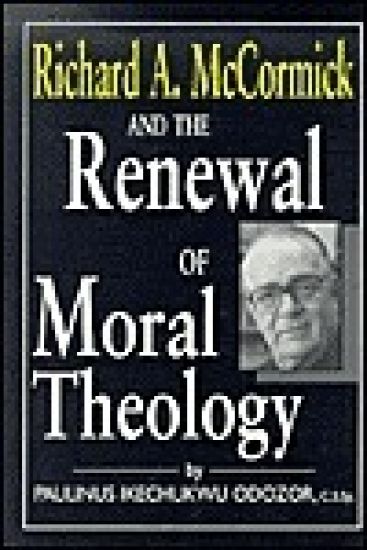
Richard A. McCormick and the Renewal of Moral Theology

Richard A. McCormick and the Renewal of Moral Theology

Odozor Paulinus Ikechukwu

University of Notre Dame Press
1995
sidottu
In a career that spanned the periods before, during, and after the Second Vatican Council, Richard A. McCormick, S.J. (1922–2000), was one of the major American theologians who demonstrated broad interest in Christian theological ethics and has written extensively on the issues of fundamental and special theology. When the Second Vatican Council directed that attention should be paid to the renewal of moral theology, McCormick answered that challenge. In this study Paulinus Ikechukwu Odozor, C.S.Sp., examines McCormick’s thought and work in detail and sets it against the backdrop of larger developments that have taken place within the Church and the field of moral theology. Odozor begins by establishing McCormick’s contribution to the renewal of moral theology and reconstructs McCormick’s theological program by situating him within various social, theological, and professional contexts. He then goes on to show whether and to what extent McCormick has been consistent and coherent in his moral theological discourse. To effectively pursue the aims of this study, Odozor divided it into seven chapters. The first chapter delineates the parameters of pre-Vatican II moral theology and situates McCormick and his work in a larger context by defining the historical, social, and ecclesial contexts of his formation. The next five chapters take up themes central to understanding McCormick’s work, including the nature of Christian ethics, the Church as moral teacher, proportionate reasoning, anthropology, and casuistry. In addition to his insightful analysis of McCormick’s contributions to the field, Odozor includes a sensitive treatment of the complex interactions between McCormick as an individual scholar and the world in relation to which his identity as a scholar was formed and transformed.
Richard a. McCormick and the Renewal of Moral Theology

Richard a. McCormick and the Renewal of Moral Theology

Paulinus Ikechukwu Odozor

University of Notre Dame Press
2017
nidottu
In a career that spanned the periods before, during, and after the Second Vatican Council, Richard A. McCormick, S.J. (1922–2000), was one of the major American theologians who demonstrated broad interest in Christian theological ethics and has written extensively on the issues of fundamental and special theology. When the Second Vatican Council directed that attention should be paid to the renewal of moral theology, McCormick answered that challenge. In this study Paulinus Ikechukwu Odozor, C.S.Sp., examines McCormick's thought and work in detail and sets it against the backdrop of larger developments that have taken place within the Church and the field of moral theology. Odozor begins by establishing McCormick's contribution to the renewal of moral theology and reconstructs McCormick's theological program by situating him within various social, theological, and professional contexts. He then goes on to show whether and to what extent McCormick has been consistent and coherent in his moral theological discourse. To effectively pursue the aims of this study, Odozor divided it into seven chapters. The first chapter delineates the parameters of pre-Vatican II moral theology and situates McCormick and his work in a larger context by defining the historical, social, and ecclesial contexts of his formation. The next five chapters take up themes central to understanding McCormick's work, including the nature of Christian ethics, the Church as moral teacher, proportionate reasoning, anthropology, and casuistry. In addition to his insightful analysis of McCormick's contributions to the field, Odozor includes a sensitive treatment of the complex interactions between McCormick as an individual scholar and the world in relation to which his identity as a scholar was formed and transformed.
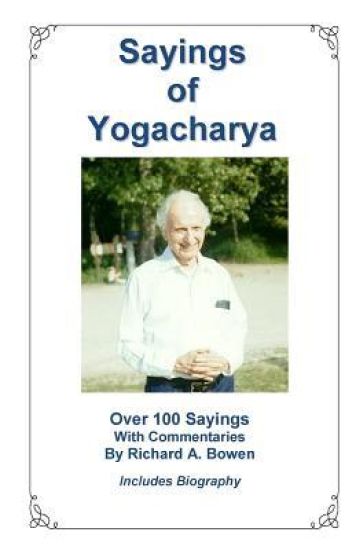
Sayings of Yogacharya: Over 100 Sayings with Commentary by Richard A. Bowen
Revised with 18 new entries, this 46-page book contains sayings, comments, philosophy, and instructions by Yogacharya John Oliver Black. Mr. Black was a direct disciple of Paramahansa Yogananda and studied with him for more than 30 years. Founder of Golden Lotus and Song of the Morning Ranch, a yoga retreat in northern Michigan, Yogahcharya Oliver instructed students from around the country and from around the world. The sayings in this book help one understand and appreciate this advanced disciple. From them we can obtain insight into your own natures and a deeper appreciation of the science of yoga.
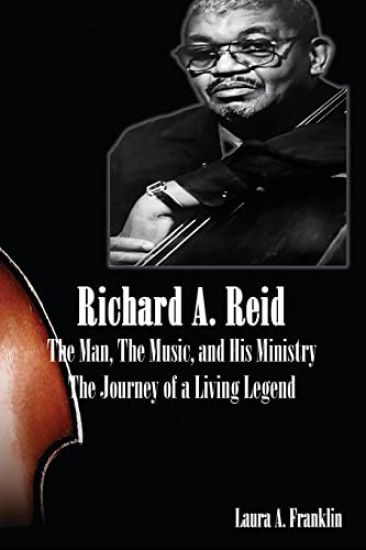
Richard A. Reid

Richard A. Reid

Laura A Franklin

Virtualbookworm.com Publishing
2023
pokkari
Musical legend Richard A. Reid is described by his family and friends as someone you can always count on. He came from humble means, raised by his mother and older brother, Cecil. Richard was sickly as a child with whooping cough and many didn't think he would live past infancy. But Richard says, "I fooled them." Becoming a living legend in the Jazz and R&B world was not his goal in life. He just wanted to play his bass, take care of his family, love God, and love people. It is because of those things - and his humility and God's hand on him - that helped him become who he is today.
The Stories of Richard: A man's discovery of his world and his place in it.

The Stories of Richard: A man's discovery of his world and his place in it.

Bonnie M. Austin

Createspace Independent Publishing Platform
2013
nidottu
Follow the life one of the foremost permaculture experts in the midwest as he tells it through his stories. Richard Herman has devoted his life's work to sustainable agriculture, animal husbandry and medical care, permaculture, and leading youth in wilderness adventures and education. This book reflects a series of verbatim interviews that took place over a period of several years, which illustrate the life of this gentle futurist. Its purpose is to follow the growth of Richard's evolution to the remarkable man he has become today. It has been my pleasure to learn about the unique life of Richard and, as I share it with you, I believe you will wonder, as I have, at how he has made himself into the exceptional model for those who care about the gifts that have been given to us. Bonnie M. Austin
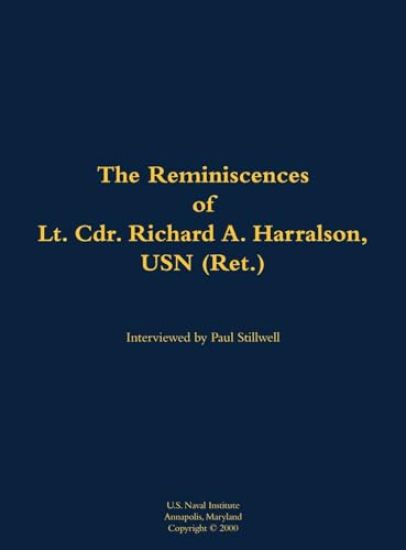
The Reminiscences of Lt. Cdr. Richard A. Harralson, USN (Ret.)
As he grew up in California, Harralson developed a great love for radio. Following his enlistment in the Navy in 1937, he attended boot camp and then radio school. Early assignments included the aircraft carrier Saratoga (CV-3) and the flag allowance of Commander Aircraft Battle Force (RADM Ernest J. King) on board the Lexington (CV-2). In 1940-41 he served as a radioman in the Asiatic Fleet flag allowance on board the heavy cruisers Augusta (CA-31) and later the Houston (CA-30). In 1941 he moved ashore to the naval radio station at Cavite in the Philippines. He was captured on Corregidor in the spring of 1942, transferred to Japan, and imprisoned for the rest of World War II. After release he went to electronics technician school, later was commissioned as an ensign in 1946. In the late 1940s he was radio officer at the Portsmouth, New Hampshire, Naval Base and then attended electronics maintenance school at Great Lakes, Illinois. During the Korean War he served in the escort carrier Sicily (CVE-118) under the command of Captain John S. Thach. Later assignments in the 1950s included instructor duty at the electronics maintenance school at Great Lakes, as officer in charge of a Black Sea listening post in Turkey, communication officer in the missile test ship Mississippi (EAG-128), and electronics maintenance at the combat information center school at Glynco, Georgia. He retired from active duty in 1957 and subsequently worked in California for Aerojet.
Arguments for a Non-Transformational Grammar

Arguments for a Non-Transformational Grammar

Richard A. Hudson

University of Chicago Press
1976
sidottu
For the past decade, the dominant transformational theory of syntax has produced the most interesting insights into syntactic properties. Over the same period another theory, systemic grammar, has been developed very quietly as an alternative to the transformational model. In this work Richard A. Hudson outlines "daughter-dependency theory," which is derived from systemic grammar, and offers empirical reasons for preferring it to any version of transformational grammar. The goal of daughter-dependency theory is the same as that of Chomskyan transformational grammar—to generate syntactic structures for all (and only) syntactically well-formed sentences that would relate to both the phonological and the semantic structures of the sentences. However, unlike transformational grammars, those based on daughter-dependency theory generate a single syntactic structure for each sentence. This structure incorporates all the kinds of information that are spread, in a transformational grammar, over to a series of structures (deep, surface, and intermediate). Instead of the combination of phrase-structure rules and transformations found in transformational grammars, daughter-dependency grammars contain rules with the following functions: classification, dependency-marking, or ordering. Hudson's strong arguments for a non-transformational grammar stress the capacity of daughter-dependency theory to reflect the facts of language structure and to capture generalizations that transformational models miss. An important attraction of Hudson's theory is that the syntax is more concrete, with no abstract underlying elements. In the appendixes, the author outlines a partial grammar for English and a small lexicon and distinguishes his theory from standard dependency theory. Hudson's provocative thesis is supported by his thorough knowledge of transformational grammar.
A Guide to America's Sex Laws

A Guide to America's Sex Laws

Richard A. Posner; Katharine B. Silbaugh

University of Chicago Press
1996
sidottu
Sex, although considered by many in our culture the quintessential private activity, is blanketed by a large number and variety of laws. This text presents a concise compendium of the America's sex laws and brings together in one place, and summarizes, the laws regulating personal sexual activity. In doing so, the book reveals gaps, anachronisms, anomalies, inequalities , and irrationalities, and provides an empirical basis for studies of sexual regulation. In some states, for example, sexual relations between consenting adults of the same sex is a crime, in some states the age of consent to marriage is lower for females than for males, and in some states marital rape is not a crime. Such a mixed quilt of state laws means that a sexual practice that is perfectly legitimate in one state is illegal in another.
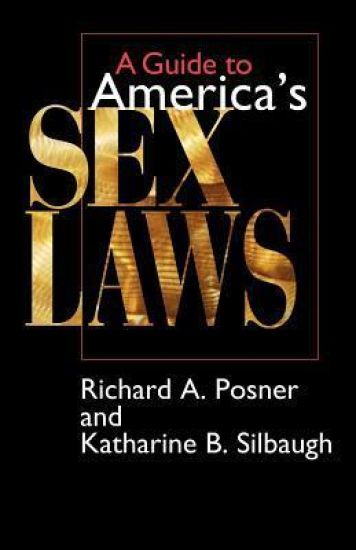
A Guide to America's Sex Laws

A Guide to America's Sex Laws

Richard A. Posner; Katharine B. Silbaugh

University of Chicago Press
1998
nidottu
A Guide to America's Sex Laws is the first concise compendium of the nation's sex laws. It summarizes the laws regulating personal sexual activity, revealing gaps, anachronisms, anomalies, inequalities, and irrationalities, and providing an empirical basis for studies of sexual regulation. Judge Richard A. Posner and Katharine B. Silbaugh cover broadly defined areas of regulation, providing background and definitions and placing the laws in their historical and constitutional context. From Alabama to Wyoming, this informative and fascinating reference book will be an essential resource."It takes only a few minutes with A Guide to [America's] Sex to realize that the nation's laws governing what two consenting adults can do with one another are an odd jumble."—Eric Fidler, San Diego Commerce"Especially noteworthy is how laws governing various sexual activities vary from state to state."—Library Journal"Fascinating and often surprising facts are concisely documented and conveniently organized in A Guide."—Carlin Meyer, New York Law Journal
Security Prices in a Competitive Market

Security Prices in a Competitive Market

Richard A. Brealey

MIT Press
2003
pokkari
This book is a sequel to An Introduction to Risk and Return from Common Stocks (The MIT Press, 1969), although it is fully self-contained and can be read independently. Both books describe in non-technical language the behavior of common stock prices as revealed by formal statistical work. In the process they offer a broad survey of recent quantitative academic research on the subject, much of which is currently in an inaccessible form.The earlier book, which the New York Times says "rates high as reading for every professional investor," was concerned with the basic factors affecting risk and return from common stocks. The present work is concerned primarily with unusual factors that may influence the value of an investment. It is divided into three parts: the first considers various company decisions that may affect the price of its stock (decisions on capital structure, dividend policy, and acquisitions); the second looks at particular types of activity in the stock (insider trading, short selling, and secondary distributions); while the third considers securities that are convertible to common stock. Richard Brealey continues to cover new ground. Little of the material in this book can be found in existing investments texts, and like his first book, it should provide an invaluable source of information for the professional investor and may well be received in the same spirit.
Statistical Learning from a Regression Perspective

Statistical Learning from a Regression Perspective

Richard A. Berk

Springer-Verlag New York Inc.
2008
sidottu
Statistical Learning from a Regression Perspective considers statistical learning applications when interest centers on the conditional distribution of the response variable, given a set of predictors, and when it is important to characterize how the predictors are related to the response. As a first approximation, this is can be seen as an extension of nonparametric regression. Among the statistical learning procedures examined are bagging, random forests, boosting, and support vector machines. Response variables may be quantitative or categorical. Real applications are emphasized, especially those with practical implications. One important theme is the need to explicitly take into account asymmetric costs in the fitting process. For example, in some situations false positives may be far less costly than false negatives. Another important theme is to not automatically cede modeling decisions to a fitting algorithm. In many settings, subject-matter knowledge should trump formal fitting criteria. Yet another important theme is to appreciate the limitation of one’s data and not apply statistical learning procedures that require more than the data can provide. The material is written for graduate students in the social and life sciences and for researchers who want to apply statistical learning procedures to scientific and policy problems. Intuitive explanations and visual representations are prominent. All of the analyses included are done in R.