This history of the black community of Indianapolis in the 20th century focuses on methods of political action—protracted negotiations, interracial coalitions, petition, and legal challenge—employed to secure their civil rights. These methods of "polite protest" set Indianapolis apart from many Northern cities. Richard B. Pierce looks at how the black community worked to alter the political and social culture of Indianapolis. As local leaders became concerned with the city's image, black leaders found it possible to achieve gains by working with whites inside the existing power structure, while continuing to press for further reform and advancement. Pierce describes how Indianapolis differed from its Northern cousins such as Milwaukee, Chicago, and Detroit. Here, the city's people, black and white, created their own patterns and platforms of racial relations in the public and cultural spheres.
"[This] critical edition of a selection of Richard B. Moore's essays closes one more gap in the astonishing history of twentieth-century Afro-American nationalism." —Journal of American History "This first collection of Moore's writings . . . [is] a welcome and important contribution to scholarship concerned with the political and intellectual history of African peoples in general and of African peoples in the Americas, in particular. . . . an inspiration to those who follow after to study and emulate his life and achievement." —Journal of American Ethnic History
On taking office in 2001, Dick Cheney crowned himself the first imperial vice president in the nation's history, transforming a traditionally inconsequential office into a de facto fourth branch of government. Taking a less journalistic and personal approach to Cheney than previous biographers, this critical new biography shows exactly how Cheney engineered his arrogation of vast executive powers—and the dire consequences his power grab has had and will long continue to have for the office of the vice presidency, the balance of powers, the Constitution, geopolitics, and America's security, strength, and prestige. Taking advantage of the administration's global war on terrorism, a president inexperienced in matters of war and peace, and a Republican Congress that rated party power above institutional prerogatives, Vice President Cheney moved with astonishing speed and energy to assume a dominant role on the national and international stage as the effective president-in-proxy of the United States. Cheney asserted that all constitutional checks and balances and all individual liberties under the Bill of Rights are subservient to the president's powers as commander-in-chief in confronting international terrorism. Although former administrations had made power grabs in the past in times of national crisis, no president-and certainly no vice president-has ever exerted such sweeping claims of executive power on so many fronts in violation of the bedrock principles of the Constitution.
Richard B. Morris, an internationally known early American scholar, was a historian at both City College of New York and Columbia University. Morris' dissertation, Studies in the History of American Law, helped establish American legal history as a field. His Government and Labor in Early America was a landmark publication. He won the Bancroft Prize for his masterpiece, The Peacemakers, in 1966. This biography is based primarily on Morris' extensive papers and the recollections of historians who knew him well. Prominent historians of the twentieth century such as Evarts Greene, Charles M. Andrews, Lawrence Henry Gipson, Perry Miller, Merrill Jensen, Dumas Malone, Julian Boyd, Allan Nevins, and Henry Commager, among others, appear throughout. Subjects discussed include anti-Semitism, the celebrated New American Nation series, and Morris' suspicions about the innocence of Alger Hiss. This book was one of the History New Network's books of the month in July 2005.
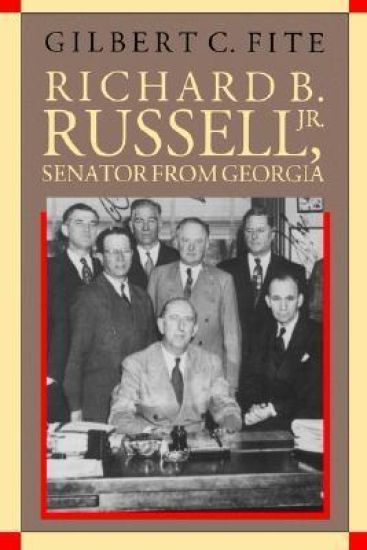
Richard B. Russell, Jr., represented Georgia in the United States Senate from 1933 to 1971, a period of sweeping social change. Russell (1879-1971) was regarded by his fellow senators as the quintessential member of the Senate's establishment, and they dubbed him ""a Senator's Senator"" and ""the Georgia Giant."" So great was his popularity in Congress that Lyndon B. Johnson once said, ""If the membership of the Senate were to cast a secret vote on the man they believed best qualifies to be president of the United States, they would choose Richard Russell."" Gilbert Fite's masterful biography begins with Russell's upbringing in an elite Georgia family. The highly stratified and class-conscious society of his early years would later influence Russell's legislative agenda. In 1920, Russell was elected to the Georgia General Assembly, and in 1931 he became governor of Georgia. He held that office until 1933, when he began his thirty-eight years of service in the U.S. Senate. During Russell's long senatorial career, he was deeply involved in many of the most important episodes of our national life: the New Deal, World War II, the MacArthur investigation, the foreign aid debate, and the Warren Commission inquiry. His greatest contribution, according to Fite, was his fierce determination to maintain a strong national defense during the Cold War; in his sixteen years as chairman of the Armed Services Committee, he emerged as the acknowledged leader in Congress on defense matters. A career-long member of the Senate Appropriations Committee, Russell also became one of the nation's strongest advocates of farm price supports. Under his sponsorship, the Senate enacted legislation establishing the school lunch program and distribution of food to the needy. But Russell never abandoned his dedication to the South's traditional values, and he became the leader of the Southern Bloc that staunchly fought to defeat civil rights legislation and maintain the structures of segregation. Russell's unwillingness to compromise on civil rights, says Fite, meant that his career was ultimately one of regional rather than national leadership.
On taking office in 2001, Dick Cheney crowned himself the first imperial vice president in the nation's history, transforming a traditionally inconsequential office into a de facto fourth branch of government. Taking a less journalistic and personal approach to Cheney than previous biographers, this critical new biography shows exactly how Cheney engineered his arrogation of vast executive powers—and the dire consequences his power grab has had and will long continue to have for the office of the vice presidency, the balance of powers, the Constitution, geopolitics, and America's security, strength, and prestige.Taking advantage of the administration's global war on terrorism, a president inexperienced in matters of war and peace, and a Republican Congress that rated party power above institutional prerogatives, Vice President Cheney moved with astonishing speed and energy to assume a dominant role on the national and international stage as the effective president-in-proxy of the United States. Cheney asserted that all constitutional checks and balances and all individual liberties under the Bill of Rights are subservient to the president's powers as commander-in-chief in confronting international terrorism. Although former administrations had made power grabs in the past in times of national crisis, no president-and certainly no vice president-has ever exerted such sweeping claims of executive power on so many fronts in violation of the bedrock principles of the Constitution.