Kirjojen hintavertailu. Mukana 11 699 587 kirjaa ja 12 kauppaa.

Kirjahaku

Etsi kirjoja tekijän nimen, kirjan nimen tai ISBN:n perusteella.

1000 tulosta hakusanalla Richard Doyle; William Makepeace Thackeray

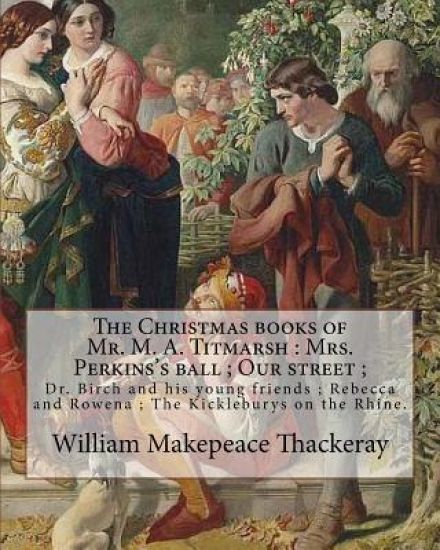
The Christmas books of Mr. M. A. Titmarsh: Mrs. Perkins's ball; Our street; Dr. Birch and his young friends; Rebecca and Rowena; The Kickleburys on th
William Makepeace Thackeray (18 July 1811 - 24 December 1863) was an English novelist of the 19th century. He is known for his satirical works, particularly Vanity Fair, a panoramic portrait of English society. BIOGRAPHY: Thackeray, an only child, was born in Calcutta, British India, where his father, Richmond Thackeray (1 September 1781 - 13 September 1815), was secretary to the Board of Revenue in the British East India Company. His mother, Anne Becher (1792-1864), was the second daughter of Harriet Becher and John Harman Becher, who was also a secretary (writer) for the East India Company. Richmond died in 1815, which caused Anne to send her son to England in 1816, while she remained in British India. The ship on which he travelled made a short stopover at St. Helena, where the imprisoned Napoleon was pointed out to him. Once in England he was educated at schools in Southampton and Chiswick, and then at Charterhouse School, where he became a close friend of John Leech. Thackeray disliked Charterhouse, and parodied it in his fiction as "Slaughterhouse". Nevertheless, Thackeray was honoured in the Charterhouse Chapel with a monument after his death. Illness in his last year there, during which he reportedly grew to his full height of six foot three, postponed his matriculation at Trinity College, Cambridge, until February 1829. citation needed]Never too keen on academic studies, Thackeray left Cambridge in 1830, but some of his earliest published writing appeared in two university periodicals, The Snob and The Gownsman. Thackeray then travelled for some time on the continent, visiting Paris and Weimar, where he met Goethe. He returned to England and began to study law at the Middle Temple, but soon gave that up. On reaching the age of 21 he came into his inheritance from his father, but he squandered much of it on gambling and on funding two unsuccessful newspapers, The National Standard and The Constitutional, for which he had hoped to write. He also lost a good part of his fortune in the collapse of two Indian banks. Forced to consider a profession to support himself, he turned first to art, which he studied in Paris, but did not pursue it, except in later years as the illustrator of some of his own novels and other writings. Thackeray's years of semi-idleness ended after he married, on 20 August 1836, Isabella Gethin Shawe (1816-1893), second daughter of Isabella Creagh Shawe and Matthew Shawe, a colonel who had died after distinguished service, primarily in India. The Thackerays had three children, all girls: Anne Isabella (1837-1919), Jane (who died at eight months old) and Harriet Marian (1840-1875), who married Sir Leslie Stephen, editor, biographer and philosopher...... Richard "Dickie" Doyle (18 September 1824 - 10 December 1883) was a notable illustrator of the Victorian era. His work frequently appeared, amongst other places, in Punch magazine; he drew the cover of the first issue, and designed the magazine's masthead, a design that was used for over a century.
The Book of Ballads. Edited by Bon Gaultier. Illustrated by Alfred Crowquill and Richard Doyle.
Title: The Book of Ballads. Edited by Bon Gaultier. Illustrated by Alfred Crowquill and Richard Doyle.Publisher: British Library, Historical Print EditionsThe British Library is the national library of the United Kingdom. It is one of the world's largest research libraries holding over 150 million items in all known languages and formats: books, journals, newspapers, sound recordings, patents, maps, stamps, prints and much more. Its collections include around 14 million books, along with substantial additional collections of manuscripts and historical items dating back as far as 300 BC.The POETRY & DRAMA collection includes books from the British Library digitised by Microsoft. The books reflect the complex and changing role of literature in society, ranging from Bardic poetry to Victorian verse. Containing many classic works from important dramatists and poets, this collection has something for every lover of the stage and verse. ++++The below data was compiled from various identification fields in the bibliographic record of this title. This data is provided as an additional tool in helping to insure edition identification: ++++ British Library Anonymous; Aytoun, William; 1849. 8 . 11645.e.6.
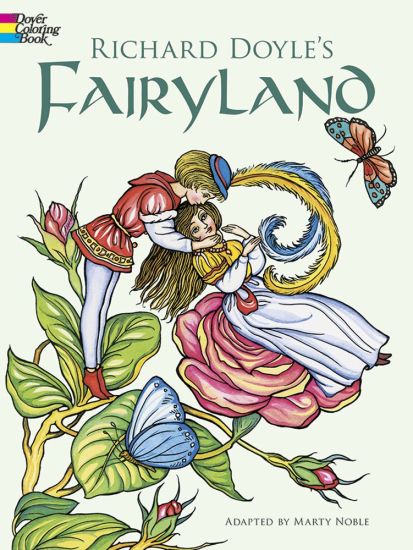
Richard Doyle's Fairyland Coloring Book

Richard Doyle's Fairyland Coloring Book

Richard Doyle

Dover Publications Inc.
2002
nidottu
Famed for his charming illustrations of elves, fairies, and gnomes, the prominent Victorian artist Richard Doyle (1824-1883) produced a host of these delightful characters for The Princess Nobody: A Tale of Fairyland, a book he created with British author Andrew Lang in 1884.Illustrator Marty Noble has skillfully adapted 29 of the English artist's most delightful watercolors from that enchanting book. Brimming with a multitude of nature s tiniest creatures of the air, field, and stream, the collection also features pixies, imps, and a petite princess and an equally diminutive prince. These captivating figures can be brought to life by colorists and fairyland devotees as they apply their own hues to enchanting scenes of mischievous sprites at play. Captions accompany each illustration."
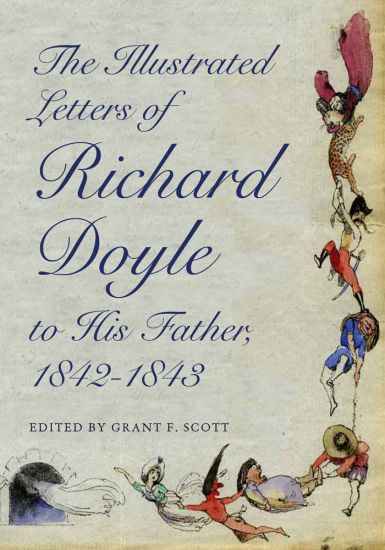
The Illustrated Letters of Richard Doyle to His Father, 1842–1843
Before he joined the staff of Punch and designed its iconic front cover, illustrator Richard "Dicky" Doyle was a young man whose father (political caricaturist John Doyle) charged him with sending a weekly letter, even though they lived under the same roof. This volume collects the fifty-three illustrated missives in their entirety for the first time and provides an uncommon peek into the intimate but expansive observations of a precocious social commentator and artist. In a series of vivid manuscript canvases, Doyle observes Victorian customs and society. He visits operas, plays, and parades. He watches the queen visiting the House of Commons and witnesses the state funeral of the Duke of Sussex. He is caught up in the Chartist riots of August 1842 and is robbed during one of the melees. And he provides countless illustrations of ordinary people strolling in the streets and swarming the parks and picture galleries of the metropolis. The sketches offer a fresh perspective on major social and cultural events of London during the early 1840s by a keen observer not yet twenty years old. Doyle's epistles anticipate the modern comic strip and the graphic novel, especially in their experimentation with sequential narrative and their ingenious use of space. The letters are accompanied by a full biographical and critical introduction with new material about Doyle's life.
The battle of life. A love story. By: Charles Dickens, and By: Daniel Maclise, By: Richard Doyle (illustrator), By: Clarkson Frederick Stanfield(Illus

The battle of life. A love story. By: Charles Dickens, and By: Daniel Maclise, By: Richard Doyle (illustrator), By: Clarkson Frederick Stanfield(Illus

Daniel Maclise; Richard Doyle; Clarkson Frederick Stanfield

Createspace Independent Publishing Platform
2017
nidottu
John Leech (29 August 1817 - 29 October 1864 in London) was an English caricaturist and illustrator. He is best known for his work for Punch, a humorous magazine for a broad middle-class audience, combining verbal and graphic political satire with light social comedy. Leech catered to contemporary prejudices, such as anti-Americanism and antisemitism and supported acceptable social reforms. Leech's critical yet humorous cartoons on the Crimean War help shape public attitudes toward heroism, warfare, and Britons role in the world............... Clarkson Frederick Stanfield RA (3 December 1793 - 18 May 1867) was a prominent English marine painter; he is often though inaccurately called William Clarkson Stanfield..... Richard "Dickie" Doyle (18 September 1824 - 10 December 1883) was a notable illustrator of the Victorian era. His work frequently appeared, amongst other places, in Punch magazine; he drew the cover of the first issue, and designed the magazine's masthead, a design that was used for over a century......... Daniel Maclise RA (25 January 1806 - 25 April 1870) was an Irish history, literary and portrait painter, and illustrator, who worked for most of his life in London, England................. Charles John Huffam Dickens ( 7 February 1812 - 9 June 1870) was an English writer and social critic. He created some of the world's best-known fictional characters and is regarded by many as the greatest novelist of the Victorian era. His works enjoyed unprecedented popularity during his lifetime, and by the 20th century critics and scholars had recognised him as a literary genius. His novels and short stories enjoy lasting popularity...................
Doyle Arts Inspirations

Doyle Arts Inspirations

Richard Doyle

Doyle Arts
2020
nidottu
Take a journey of discovery through the visual and literary works of artist and poet Richard Doyle. Whether it be the soft tones of a watercolor painting, or the soft words of an inspirational poem, there is something for everyone in this diverse display of artistic and literary talent. All works are unique to the author and include original paintings, photography, poems, quotes, and haiku's.
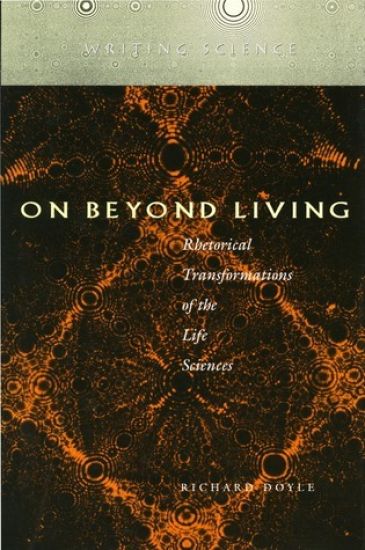
On Beyond Living

On Beyond Living

Richard Doyle

Stanford University Press
1997
sidottu
What do biologists study when they study "life" today? Drawing on tools from rhetoric and poststructuralist theory, the author argues that the ascent of molecular biology, with its emphasis on molecules such as DNA rather than organisms, was enabled by crucial rhetorical "softwares." Metaphors such as the genetic "code" made possible a transformation of the very concept of life, a transformation that often casts organisms as information systems. With careful readings of key texts from the history of molecular biology—such as those of Erwin Schrödinger, George Gamow, Jacques Monod, and François Jacob—the author maps out the complex relations between the practices of rhetoric and the technoscientific triumphs they accompanied, triumphs that bolstered a "postvital" biology that increasingly elides and questions the boundary between organisms and machines. There have been many popular books, and a few academic ones, on the Human Genome Initiatives. On Beyond Living is a genealogy of these initiatives, a map of how we have come to equate human beings with "information." Melding contemporary theory with scientific discourse, it is certain to provoke discussion (and controversy) in the fields of cultural studies, theory, and science with its penetrating inquiries into the relations between rhetoric and technoscience.
Wetwares

Wetwares

Richard Doyle

University of Minnesota Press
2003
sidottu
The mind of the machine, the body suspended in time, organs exchanged, thought computed, genes manipulated, DNA samples abducted by aliens: the terrain between science and speculation, fraught with the possibility of technological and perhaps even evolutionary transformations, is the territory Richard Doyle explores in Wetwares. In a manner at once sober and playful, Doyle maps potentials for human transformation by new ecologies of information in the early twenty-first century. Wetwares ranges over recent research in artificial life, cloning, cryonics, computer science, organ transplantation, and alien abduction. Moving between actual technical practices, serious speculative technology, and science fiction, Doyle shows us emerging scientific paradigms where "life" becomes more a matter of information than of inner vitality--in short, becomes "wetwares" for DNA and computer networks. Viewing technologies of immortality--from cryonics to artificial life--as disciplines for welcoming a thoroughly other future, a future of neither capital, god, human, nor organism, the book offers tools for an evolutionary, transhuman mutation in the utterly unpredictable decades to come.
Wetwares

Wetwares

Richard Doyle

University of Minnesota Press
2003
nidottu
A dizzying tour of the ways technologies, both real and imagined, can transform humanityThe mind of the machine, the body suspended in time, organs exchanged, thought computed, genes manipulated, DNA samples abducted by aliens: the terrain between science and speculation, fraught with the possibility of technological and perhaps even evolutionary transformations, is the territory Richard Doyle explores in Wetwares. In a manner at once sober and playful, Doyle maps potentials for human transformation by new ecologies of information in the early twenty-first century.Wetwares ranges over recent research in artificial life, cloning, cryonics, computer science, organ transplantation, and alien abduction. Moving between actual technical practices, serious speculative technology, and science fiction, Doyle shows us emerging scientific paradigms where “life” becomes more a matter of information than of inner vitality-in short, becomes “wetwares” for DNA and computer networks. Viewing technologies of immortality-from cryonics to artificial life-as disciplines for welcoming a thoroughly other future, a future of neither capital, god, human, nor organism, the book offers tools for an evolutionary, transhuman mutation in the utterly unpredictable decades to come.