Kirjojen hintavertailu. Mukana 11 699 587 kirjaa ja 12 kauppaa.

Kirjahaku

Etsi kirjoja tekijän nimen, kirjan nimen tai ISBN:n perusteella.

1000 tulosta hakusanalla Richard J. Evans

Richard J. Evans

Richard J. Evans

VDM Publishing House
2010
nidottu
Observera att förlaget som ger ut denna produkt baserar innehållet i sina produkter på fria källor som Wikipedia. Boken är med stor sannolikhet endast ett utdrag ur dessa informationskällor, alltså inte en vanlig bok i den bemärkelsen.
An Analysis of Richard J. Evans's In Defence of History

An Analysis of Richard J. Evans's In Defence of History

Nicholas Piercey; Tom Stammers

Macat International Limited
2017
nidottu
Richard Evans wrote In Defence of History at a time when the historian's profession was coming under heavy attack as a result of the ‘cultural turn’ taken by the discipline during the late 1980s and the 1990s. Historians were being forced to face up to postmodern thinking, which argued that, because all texts were the product of biased writers who had incomplete information, none could be privileged above others. In this reading, there could be no objective history, merely the study of the texts themselves. While In Defence of History addresses all aspects of historical method, its key focus is on an extensive evaluation of this postmodern thinking. Evans judges the acceptability of the reasoning advanced by the postmodernists – and finds it badly wanting. He is strongly critical both of the relevance and of the adequacy of their arguments, seeking to show that, ultimately, they are guilty of failing to accept the logic of their own position. All texts are equally valid, or invalid, they suggest – while insisting that the products of their own school are in fact more ‘true’ than those of their opponents. Evans concludes by pointing out that this same argument could be advanced to suggest that the works of Holocaust deniers are just as valid as are those of historians who accept that the Nazis set out to commit genocide. So why, he demands, is no postmodernist willing to say as much? A devastating example of the usefulness of relentless evaluation.
An Analysis of Richard J. Evans's In Defence of History

An Analysis of Richard J. Evans's In Defence of History

Nicholas Piercey; Tom Stammers

Macat International Limited
2017
sidottu
Richard Evans wrote In Defence of History at a time when the historian's profession was coming under heavy attack as a result of the ‘cultural turn’ taken by the discipline during the late 1980s and the 1990s. Historians were being forced to face up to postmodern thinking, which argued that, because all texts were the product of biased writers who had incomplete information, none could be privileged above others. In this reading, there could be no objective history, merely the study of the texts themselves. While In Defence of History addresses all aspects of historical method, its key focus is on an extensive evaluation of this postmodern thinking. Evans judges the acceptability of the reasoning advanced by the postmodernists – and finds it badly wanting. He is strongly critical both of the relevance and of the adequacy of their arguments, seeking to show that, ultimately, they are guilty of failing to accept the logic of their own position. All texts are equally valid, or invalid, they suggest – while insisting that the products of their own school are in fact more ‘true’ than those of their opponents. Evans concludes by pointing out that this same argument could be advanced to suggest that the works of Holocaust deniers are just as valid as are those of historians who accept that the Nazis set out to commit genocide. So why, he demands, is no postmodernist willing to say as much? A devastating example of the usefulness of relentless evaluation.
The Coming of the Third Reich

The Coming of the Third Reich

Richard J. Evans

Penguin Books Ltd
2004
pokkari
Richard J. Evans' The Coming of the Third Reich: How the Nazis Destroyed Democracy and Seized Power in Germany explores how the First World War, the Weimar Republic and the Great Depression paved the way for Nazi rule. They started as little more than a gang of extremists and thugs, yet in a few years the Nazis had turned Germany into a one-party state and led one of Europe's most advanced nations into moral, physical and cultural ruin and despair. In this consummate and compelling history, the first book in his acclaimed trilogy on the rise and fall of Nazi Germany, Richard Evans reveals how and why it happened, questions whether the rise of Hitler was inevitable and dramatically re-creates the maelstrom of disorder, economic disaster, violence and polarization that gave rise to the terror of the Third Reich. 'Monumental ... gripping ... the definitive account of our time' Andrew Roberts, Daily Telegraph 'Impressive ... perceptive ... humane ... the most comprehensive history in any language of the disastrous epoch of the Third Reich' Ian Kershaw, author of Hitler 'The most gripping account I've read of German life before and during the rise of the Nazis' A.S. Byatt, Times Literary Supplement Books of the Year Sir Richard J. Evans is Professor of Modern History at Cambridge University. His previous books include In Defence of History, Telling Lies about Hitler and the companions to this title, The Coming of the Third Reich and The Third Reich at War.
The Third Reich in Power, 1933 - 1939

The Third Reich in Power, 1933 - 1939

Richard J. Evans

Penguin Books Ltd
2006
pokkari
The second book in his acclaimed trilogy on the rise and fall of Nazi Germany, Richard J. Evans' The Third Reich in Power: How the Nazis Won Over the Hearts and Minds of a Nation explores how Hitler turned Germany from a vibrant democracy into a one-party state. Before Hitler seized power in 1933, Germany had been famous for its sophistication and complexity. So how was it possible for a group of ideological obsessives to re-mould it into a one-party state directed at war and race hate? How did the Nazis win over the hearts and minds of Germany's citizens, twist science, religion and culture, and transform the country's politics to achieve total dominance so quickly? From the Nuremberg Laws to the Olympic Games, Kristallnacht to the Hitler Youth, this gripping account shows how a whole population became enmeshed in a dictatorship that was consumed by hatred and driven by war. 'Impressive ... perceptive ... humane' Ian Kershaw 'Excellent ... powerful ... it makes an indelible impression' Robert Service, Sunday Times 'Likely to be the standard work for some years to come' Spectator Books of the Year 'A rich and detailed description of just what the Third Reich did in every compartment of the state and every corner of society ... Evans's magisterial study should be on our shelves for a long time to come' Economist 'Written with great style and human sympathy' Daily Telegraph Books of the Year 'Evans brilliantly conveys how the Fuhrer reignited Germans' pride as he led them to catastrophe' Neal Ascherson, Observer Sir Richard J. Evans is Professor of Modern History at Cambridge University. His previous books include In Defence of History, Telling Lies about Hitler and the companions to this title, The Coming of the Third Reich and The Third Reich at War.
The Third Reich at War

The Third Reich at War

Richard J. Evans

Penguin Books Ltd
2009
pokkari
The final book in his acclaimed trilogy on the rise and fall of Nazi Germany, Richard J. Evans's The Third Reich at War: How the Nazis Led Germany from Conquest to Disaster shows how Germany rushed headlong into destroying itself, shattering an entire continent. In 1939 Hitler mobilized Germany into all-out war. Richard Evans's astonishing, acclaimed history conjures up a whole society plunged into conflict - from generals and front-line soldiers to Hitler Youth activists and middle-class housewives - tracing events from the invasion of Poland and the Battle of Stalingrad to Hitler's plans for genocide and his eventual suicide. 'Masterly ... will surely be the standard history for many years to come ... This is a warning for the future, as much as a judgement on the past' Richard Overy, Daily Telegraph 'We all know how the story ends ... but Richard Evans brings it masterfully home ... magnificent' Peter Preston, Observer 'A chilling, brilliant read' Dominic Sandbrook, Sunday Telegraph Books of the Year 'It is hard to do justice to the humanity and scholarly range of The Third Reich at War ... triumphant ... a masterful historical narrative and the most comprehensive account of Nazi Germany' Nicholas Stargardt, The Times Literary Supplement 'It gives the reader persuasive answers to questions asked for so long, that will continue to be asked, about this most violent and inexplicable of regimes' Mark Mazower, Guardian Sir Richard J. Evans is Professor of Modern History at Cambridge University. His previous books include In Defence of History, Telling Lies about Hitler and the companions to this title, The Coming of the Third Reich and The Third Reich in Power.
The Pursuit of Power

The Pursuit of Power

Richard J. Evans

Penguin Books Ltd
2017
pokkari
'A scintillating, encyclopaedic history, rich in detail from the arcane to the familiar... a veritable tour de force' Richard Overy, New Statesman'Transnational history at its finest ... .. social, political and cultural themes swirl together in one great canvas of immense detail and beauty' Gerard DeGroot, The Times'Dazzlingly erudite and entertaining' Dominic Sandbrook, The Sunday TimesA masterpiece which brings to life an extraordinarly turbulent and dramatic era of revolutionary change.The Pursuit of Power draws on a lifetime of thinking about nineteenth-century Europe to create an extraordinarily rich, surprising and entertaining panorama of a continent undergoing drastic transformation. The book aims to reignite the sense of wonder that permeated this remarkable era, as rulers and ruled navigated overwhelming cultural, political and technological changes. It was a time where what was seen as modern with amazing speed appeared old-fashioned, where huge cities sprang up in a generation, new European countries were created and where, for the first time, humans could communicate almost instantly over thousands of miles. In the period bounded by the Battle of Waterloo and the outbreak of World War I, Europe dominated the rest of the world as never before or since: this book breaks new ground by showing how the continent shaped, and was shaped by, its interactions with other parts of the globe.Richard Evans explores fully the revolutions, empire-building and wars that marked the nineteenth century, but the book is about so much more, whether it is illness, serfdom, religion or philosophy. The Pursuit of Power is a work by a historian at the height of his powers: essential for anyone trying to understand Europe, then or now.
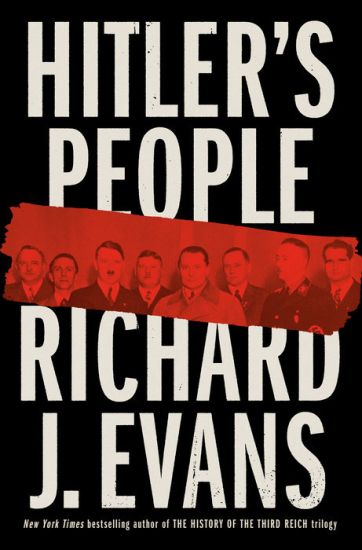
Hitler's People

Hitler's People

Richard J. Evans

PENGUIN BOOKS LTD
2025
pokkari
Why did so many Germans take part in the crimes of Nazi Germany? How did they come to support Hitler and follow him almost to the very end? For too long, the Nazis have been presented as little more than psychopaths or criminals. In his major new work, renowned historian Richard J. Evans makes use of a mass of recently unearthed new evidence to strip away the veneer of myth and legend from the faces of the Third Reich and present a more realistic view of Nazi perpetrators as human beings who were disturbingly like us.Evans offers rounded, fresh and often startling new portraits of the men and women who created and served Nazi Germany, beginning with Hitler himself and going on to encompass leading figures like Göring, Goebbels and Himmler, enforcers of Hitler’s orders such as Eichmann and Heydrich, propagandists like Leni Riefenstahl, low-level perpetrators such as the notorious Irma Grese and unknown sympathizers and fellow-travellers who helped the regime in myriad ways.Hitler’s People is a chilling, brilliantly written work which allows the reader to understand the texture and values of the Third Reich and just how far individuals will go when so many normal moral constraints have disappeared.
The Coming Of The Third Reich

The Coming Of The Third Reich

Richard J. Evans

The Penguin Press
2005
pokkari
The first in a three-volume series, a definitive history of Adolf Hitler's rise to power and the collapse of democracy in Nazi Germany explains why Nazism's ideology of hatred and racism found fertile ground in a country embittered by military defeat and economic disaster following World War I, undermined by an alienated army and civil service, and prey to widespread resentment, suspicion, and extremism. Reprint.
Death in Hamburg

Death in Hamburg

Richard J. Evans

Penguin Putnam Inc
2005
pokkari
'The terrible cholera epidemic of 1892' offers a wealth of insights into the inner life of a great European city at the height of the industrial age. Why were nearly 10,000 people killed in six weeks in Hamburg, whilst most of Europe was left almost unscathed? As Richard J.Evans explains, it was largely because the town was a unique anomaly: a 'free city' within Germany governed by local notables, who believed in the 'English' ideals of laissez-faire. Their failure to supply clean water, fresh air and pure food played a major role in the catastrophe. Their medical theories, influenced by political and economic interest, only made matters worse. The whole story of 'the cholera years' is tragically revealing of the age's social inequalities and administrative incompetence; it also offers some disquieting parallels with today's attitudes to AIDS.
The Third Reich in Power

The Third Reich in Power

Richard J. Evans

PENGUIN BOOKS
2006
nidottu
Documents the radical and rapid transformation of Germany in its first year under Nazi rule, exploring how virtually every area of life, from the arts and religion to education and literature, was reordered to comply with the regime's preparations for the war, in an account that also describes the increasing brutality that was suffered by marginalized groups. Reprint. 40,000 first printing.
The Pursuit of Power: Europe 1815-1914

The Pursuit of Power: Europe 1815-1914

Richard J. Evans

PENGUIN BOOKS
2017
nidottu
An Economist Best Book of the Year "Sweeping . . . an ambitious synthesis . . . Evans] writes with admirable narrative power and possesses a wonderful eye for local color . . . Fascinating."--Stephen Schuker, The Wall Street JournalFrom the bestselling author of The Third Reich at War, a masterly account of Europe in the age of its global hegemony; the latest volume in the Penguin History of Europe series Richard J. Evans, bestselling historian of Nazi Germany, returns with a monumental new addition to the acclaimed Penguin History of Europe series, covering the period from the fall of Napoleon to the outbreak of World War I. Evans's gripping narrative ranges across a century of social and national conflicts, from the revolutions of 1830 and 1848 to the unification of both Germany and Italy, from the Russo-Turkish wars to the Balkan upheavals that brought this era of relative peace and growing prosperity to an end. Among the great themes it discusses are the decline of religious belief and the rise of secular science and medicine, the journey of art, music, and literature from Romanticism to Modernism, the replacement of old-regime punishments by the modern prison, the end of aristocratic domination and the emergence of industrial society, and the dramatic struggle of feminists for women's equality and emancipation. Uniting the era's broad-ranging transformations was the pursuit of power in all segments of life, from the banker striving for economic power to the serf seeking to escape the power of his landlord, from the engineer asserting society's power over the environment to the psychiatrist attempting to exert science's power over human nature itself. The first single-volume history of the century, this comprehensive and sweeping account gives the reader a magnificently human picture of Europe in the age when it dominated the rest of the globe.
The Third Reich at War, 1939-1945

The Third Reich at War, 1939-1945

Richard J. Evans

PENGUIN BOOKS
2010
nidottu
An absorbing, revelatory, and definitive account of one of the greatest tragedies in human history, by the author of The Coming of the Third Reich, The Third Reich in Power, and Hitler's People "This is history in the grand style, the kind of large-scale narrative that few historians dare to write these days. It is difficult to imagine how it could be improved upon, let alone surpassed." --The Washington Post "This superb book is not simply a military history; it is a comprehensive portrait of a society at war...A masterpiece of historical research and analysis...Likely to remain the best study of the Third Reich at war for many years to come." --The Christian Science Monitor Adroitly blending narrative, description, and analysis, Richard J. Evans portrays a society rushing headlong to self-destruction and taking much of Europe with it. Interweaving a broad narrative of the war's progress from a wide range of people, Evans reveals the dynamics of a society plunged into war at every level. The great battles and events of the conflict are here, but just as telling is Evans's re- creation of the daily experience of ordinary Germans in wartime. At the center of the book is the Nazi extermi­nation of the Jews. The Third Reich at War lays bare the most momentous and tragic years of the Nazi regime.
The Hitler Conspiracies: The Protocols - The Stab in the Back - The Reichstag Fire - Rudolf Hess - The Escape from the Bunker
The idea that historical events, catastrophes in particular, didn't happen on their own but were driven by the hidden machinations of malign influences has deep roots. The appeal is clear: we can ascribe these events not to human shortsightedness or frailty, or to the contingencies of fate and circumstance, but to unseen forces. Conspiracy theories and paranoia go hand in hand. Something, or someone, is trying to control our lives and to regain that control we need to expose the truth. Conspiracy theories have lately proliferated, powered by the Internet and social media, as well as by the declining influence of the traditional gatekeepers of facts and information. In his new book, Richard J. Evans, one of the world's leading historians of the Third Reich, explores this new golden age of conspiracy theories and what underlies it. To do that, he focuses on five of the most enduring conspiracies theories of the Nazi period, including those that fueled Hitler's rise in the first place. Hence he reexamines the notorious anti-Semitic forgery The Protocols of the Elders of Zion; the "stab-in-the-back" myth about the of the role of Jews in Germany's loss in World War One; and the 1933 burning of the Reichstag, which the Nazis used to solidify their grip on power. Evans also delves into the multiple rumors regarding the ill-fated and mysterious 1941 flight to England by Rudolf Hess, Deputy Leader of the Nazi Party, and his death in Spandau prison in 1987. Lastly, he turns to the recurrent rumor that Hitler somehow managed to escape from Berlin in 1945 and live out his days in Argentina. The Hitler Conspiracies is a book about fantasies and fictions, fabrications and falsifications. A distinguished work of history by one of the world's most distinguished historians, it offers equally a hard look at our own troubled times, a "post-truth" era in which "alternative facts" have gained new standing.
Eric Hobsbawm: A Life in History

Eric Hobsbawm: A Life in History

Richard J. Evans

Oxford University Press
2019
sidottu
Eric Hobsbawm's works have had a nearly incalculable effect across generations of readers and students, influencing more than the practice of history but also the perception of it. Born in Alexandria, Egypt, of second-generation British parents, Hobsbawm was orphaned at age fourteen in 1931. Living with an uncle in Berlin, he experienced the full force of world economic depression, and in the charged reaction to it in Germany was forced to choose between Nazism and Communism, which was no choice at all. Hobsbawm's lifelong allegiance to Communism inspired his pioneering work in social history, particularly the trilogy for which he is most famous--The Age of Revolution, The Age of Capital, and The Age of Empire--covering what he termed "the long nineteenth century" in Europe. Selling in the millions of copies, these held sway among generations of readers, some of whom went on to have prominent careers in politics and business. In this comprehensive biography of Hobsbawm, acclaimed historian Richard Evans (author of The Third Reich Trilogy, among other works) offers both a living portrait and vital insight into one of the most influential intellectual figures of the twentieth century. Using exclusive and unrestricted access to the unpublished material, Evans places Hobsbawm's writings within their historical and political context. Hobsbawm's Marxism made him a controversial figure but also, uniquely and universally, someone who commanded respect even among those who did not share-or who even outright rejected-his political beliefs. Eric Hobsbawm: A Life in History gives us one of the 20th century's most colorful and intellectually compelling figures. It is an intellectual life of the century itself.
Third Reich in History and Memory

Third Reich in History and Memory

Richard J. Evans

Oxford University Press
2017
nidottu
In the seventy years since the demise of the Third Reich, there has been a significant transformation in the ways in which the modern world understands Nazism. In this brilliant and eye-opening collection, Richard J. Evans, the acclaimed author of the Third Reich trilogy, offers a critical commentary on that transformation, exploring how major changes in perspective have informed research and writing on the Third Reich in recent years.Drawing on his most notable writings from the last two decades, Evans reveals the shifting perspectives on Nazism's rise to political power, its economic intricacies, and its subterranean extension into postwar Germany. Evans considers how the Third Reich is increasingly viewed in a broader international context, as part of the age of imperialism; discusses the growing emphasis on the larger economic and cultural circumstances of the era; and emphasizes the development of research into Nazi society, particularly in the understanding of Nazi Germany as a political system based on popular approval and consent. Exploring the complex relationship between memory and history, Evans also points out the places where the growing need to confront the misdeeds of Nazism and expose the complicity of those who participated has led to crude and sweeping condemnation, when instead historians should be making careful distinctions.Written with Evans' sharp-eyed insight and characteristically compelling style, these essays offer a summation of the collective cultural memory of Nazism in the present, and suggest the degree to which memory must be subjected to the close scrutiny of history.
The Hitler Conspiracies: The Protocols - The Stab in the Back - The Reichstag Fire - Rudolf Hess - The Escape from the Bunker
The idea that historical events, catastrophes in particular, didn't happen on their own but were driven by the hidden machinations of malign influences has deep roots. The appeal is clear: we can ascribe these events not to human shortsightedness or frailty, or to the contingencies of fate and circumstance, but to unseen forces. Conspiracy theories and paranoia go hand in hand. Something, or someone, is trying to control our lives and to regain that control we need to expose the truth. Conspiracy theories have lately proliferated, powered by the Internet and social media, as well as by the declining influence of the traditional gatekeepers of facts and information. In his new book, Richard J. Evans, one of the world's leading historians of the Third Reich, explores this new golden age of conspiracy theories and what underlies it. To do that, he focuses on five of the most enduring conspiracies theories of the Nazi period, including those that fueled Hitler's rise in the first place. Hence he reexamines the notorious anti-Semitic forgery The Protocols of the Elders of Zion; the "stab-in-the-back" myth about the of the role of Jews in Germany's loss in World War One; and the 1933 burning of the Reichstag, which the Nazis used to solidify their grip on power. Evans also delves into the multiple rumors regarding the ill-fated and mysterious 1941 flight to England by Rudolf Hess, Deputy Leader of the Nazi Party, and his death in Spandau prison in 1987. Lastly, he turns to the recurrent rumor that Hitler somehow managed to escape from Berlin in 1945 and live out his days in Argentina. The Hitler Conspiracies is a book about fantasies and fictions, fabrications and falsifications. A distinguished work of history by one of the world's most distinguished historians, it offers equally a hard look at our own troubled times, a "post-truth" era in which "alternative facts" have gained new standing.
Rituals of Retribution

Rituals of Retribution

Richard J. Evans

Oxford University Press
1996
sidottu
COPYWRITER - Modern History section for 1996 cat The state has no greater power over its own citizens than that of killing them. This book examines the use of that supreme sanction in Germany, from the seventeenth century to the present. Richard Evans analyses the system of `traditional' capital punishments set out in German law, and the ritual practices and cultural readings associated with them by the time of the early modern period. He shows how this system was challenged by Enlightenment theories of punishment and broke down under the impact of secularization and social change in the first half of the nineteenth century. The abolition of the death penalty became a classic liberal case which triumphed, if only momentarily, in the 1948 Revolution. In Germany far more than anywhere else in Europe, capital punishment was identified with anti-liberal, authoritarian concepts of sovereignty. Its definitive reinstatement by Bismarck in the 1880s marked not only the defeat of liberalism but also coincided with the emergence of new, Social Darwinist attitudes towards criminality which gradually changed the terms of debate. The triumph of these attitudes under the Nazis laid the foundations for the massive expansion of capital punishment which took place during Hitler's `Third Reich'. After the Second World War, the death penalty was abolished, largely as a result of a chance combination of circumstances, but continued to be used in the Stalinist system of justice in East Germany until its forced abandonment as a result of international pressure exerted in the regime in the 1970s and 1980s. This remarkable and disturbing book casts new light on the history of German attitudes to law, deviance, cruelty, suffering and death, illuminating many aspects of Germany's modern political development. Using sources ranging from folksongs and ballads to the newly released government papers from the former German Democratic Republic, Richard Evans scrutinizes the ideologies behind capital punishment and comments on interpretations of the history of punishment offered by writers such as Foucault and Elias. He has made a formidable contribution not only to scholarship on German history but also to the social theory of punishement, and to the current debate on the death penalty.
Hitler's People

Hitler's People

Richard J. Evans

PENGUIN BOOKS LTD
2024
sidottu
THE SUNDAY TIMES TOP TEN BESTSELLER‘Elegantly written and powerfully argued … it ranks among the best works on this terrible period’ Sunday TimesA biographical study of Hitler's inner circle offers a new way to understand the horrors of the Nazi regimeWhy did so many Germans take part in the crimes of Nazi Germany? How did they come to support Hitler and follow him almost to the very end? For too long, the Nazis have been presented as little more than psychopaths or criminals. In his major new work, renowned historian Richard J. Evans makes use of a mass of recently unearthed new evidence to strip away the veneer of myth and legend from the faces of the Third Reich and present a more realistic view of Nazi perpetrators as human beings who were disturbingly like us.Evans offers rounded, fresh and often startling new portraits of the men and women who created and served Nazi Germany, beginning with Hitler himself and going on to encompass leading figures like Göring, Goebbels and Himmler, enforcers of Hitler’s orders such as Eichmann and Heydrich, propagandists like Leni Riefenstahl, low-level perpetrators such as the notorious Irma Grese and unknown sympathizers and fellow-travellers who helped the regime in myriad ways.Hitler’s People is a chilling, brilliantly written work which allows the reader to understand the texture and values of the Third Reich and just how far individuals will go when so many normal moral constraints have disappeared.