Kirjojen hintavertailu. Mukana 11 244 527 kirjaa ja 12 kauppaa.

Kirjahaku

Etsi kirjoja tekijän nimen, kirjan nimen tai ISBN:n perusteella.

1000 tulosta hakusanalla Richard Pettigrew

Epistemic Risk and the Demands of Rationality

Epistemic Risk and the Demands of Rationality

Richard Pettigrew

Oxford University Press
2022
sidottu
How much does rationality constrain what we should believe on the basis of our evidence? According to this book, not very much. For most people and most bodies of evidence, there is a wide range of beliefs that rationality permits them to have in response to that evidence. The argument, which takes inspiration from William James' ideas in 'The Will to Believe', proceeds from two premises. The first is a theory about the basis of epistemic rationality. It's called epistemic utility theory, and it says that what it is epistemically rational for you to believe is what it would be rational for you to choose if you were given the chance to pick your beliefs and, when picking them, you were to care only about their epistemic value. So, to say which beliefs are permitted, we must say how to measure epistemic value, and which decision rule to use when picking your beliefs. The second premise is a claim about attitudes to epistemic risk, and it says that rationality permits many different such attitudes. These attitudes can show up in epistemic utility theory in two ways: in the way you measure epistemic value; and in the decision rule you use to pick beliefs. This book explores the latter. The result is permissivism about epistemic rationality: different attitudes to epistemic risk lead to different choices of prior beliefs; given most bodies of evidence, different priors lead to different posteriors; and even once we fix your attitudes to epistemic risk, if they are at all risk-inclined, there is a range of different priors and therefore different posteriors they permit.

Accuracy and the Laws of Credence

Accuracy and the Laws of Credence

Richard Pettigrew

Oxford University Press
2016
sidottu
Richard Pettigrew offers an extended investigation into a particular way of justifying the rational principles that govern our credences (or degrees of belief). The main principles that he justifies are the central tenets of Bayesian epistemology, though many other related principles are discussed along the way. These are: Probabilism, the claims that credences should obey the laws of probability; the Principal Principle, which says how credences in hypotheses about the objective chances should relate to credences in other propositions; the Principle of Indifference, which says that, in the absence of evidence, we should distribute our credences equally over all possibilities we entertain; and Conditionalization, the Bayesian account of how we should plan to respond when we receive new evidence. Ultimately, then, this book is a study in the foundations of Bayesianism. To justify these principles, Pettigrew looks to decision theory. He treats an agent's credences as if they were a choice she makes between different options, gives an account of the purely epistemic utility enjoyed by different sets of credences, and then appeals to the principles of decision theory to show that, when epistemic utility is measured in this way, the credences that violate the principles listed above are ruled out as irrational. The account of epistemic utility set out here is the veritist's: the sole fundamental source of epistemic utility for credences is their accuracy. Thus, Pettigrew conducts an investigation in the version of epistemic utility theory known as accuracy-first epistemology. The book can also be read as an extended reply on behalf of the veritist to the evidentialist's objection that veritism cannot account for certain evidential principles of credal rationality, such as the Principal Principle, the Principle of Indifference, and Conditionalization.
Choosing for Changing Selves

Choosing for Changing Selves

Richard Pettigrew

Oxford University Press
2020
sidottu
What we value, like, endorse, want, and prefer changes over the course of our lives, sometimes as a result of decisions we make--such as when we choose to become a parent or move to a new country--and sometimes as a result of forces beyond our control--such as when our political views change as we grow older. This poses a problem for any theory of how we ought to make decisions. Which values and preferences should we appeal to when we are making our decisions? Our current values? Our past ones? Our future ones? Or some amalgamation of all them? But if that, which amalgamation? In Choosing for Changing Selves, Richard Pettigrew presents a theory of rational decision making for agents who recognise that their values will change over time and whose decisions will affect those future times.
Accuracy and the Laws of Credence

Accuracy and the Laws of Credence

Richard Pettigrew

Oxford University Press
2018
nidottu
Richard Pettigrew offers an extended investigation into a particular way of justifying the rational principles that govern our credences (or degrees of belief). The main principles that he justifies are the central tenets of Bayesian epistemology, though many other related principles are discussed along the way. These are: Probabilism, the claims that credences should obey the laws of probability; the Principal Principle, which says how credences in hypotheses about the objective chances should relate to credences in other propositions; the Principle of Indifference, which says that, in the absence of evidence, we should distribute our credences equally over all possibilities we entertain; and Conditionalization, the Bayesian account of how we should plan to respond when we receive new evidence. Ultimately, then, this book is a study in the foundations of Bayesianism. To justify these principles, Pettigrew looks to decision theory. He treats an agent's credences as if they were a choice she makes between different options, gives an account of the purely epistemic utility enjoyed by different sets of credences, and then appeals to the principles of decision theory to show that, when epistemic utility is measured in this way, the credences that violate the principles listed above are ruled out as irrational. The account of epistemic utility set out here is the veritist's: the sole fundamental source of epistemic utility for credences is their accuracy. Thus, Pettigrew conducts an investigation in the version of I^epistemic utility theory known as accuracy-first epistemology. The book can also be read as an extended reply on behalf of the veritist to the evidentialist's objection that veritism cannot account for certain evidential principles of credal rationality, such as the Principal Principle, the Principle of Indifference, and Conditionalization.
Dutch Book Arguments

Dutch Book Arguments

Richard Pettigrew

Cambridge University Press
2020
pokkari
Our beliefs come in degrees. I'm 70% confident it will rain tomorrow, and 0.001% sure my lottery ticket will win. What's more, we think these degrees of belief should abide by certain principles if they are to be rational. For instance, you shouldn't believe that a person's taller than 6ft more strongly than you believe that they're taller than 5ft, since the former entails the latter. In Dutch Book arguments, we try to establish the principles of rationality for degrees of belief by appealing to their role in guiding decisions. In particular, we show that degrees of belief that don't satisfy the principles will always guide action in some way that is bad or undesirable. In this Element, we present Dutch Book arguments for the principles of Probabilism, Conditionalization, and the Reflection Principle, among others, and we formulate and consider the most serious objections to them.
Opinion Pooling

Opinion Pooling

Lee Elkin; Richard Pettigrew

Cambridge University Press
2025
pokkari
Disagreement is a common feature of a social world. For various reasons, however, we sometimes need to resolve a disagreement into a single set of opinions. This can be achieved by pooling the opinions of individuals that make up the group. In this Element, we provide an opinionated survey on some ways of pooling opinions: linear pooling, multiplicative pooling (including geometric), and pooling through imprecise probabilities. While we give significant attention to the axiomatic approach in evaluating pooling strategies, we also evaluate them in terms of the epistemic and practical goals they might meet. In doing so, we connect opinion pooling to some philosophical problems in social epistemology and the philosophy of action, illuminating different perspectives one might take when figuring out how to pool opinions for a given purpose. This title is also available as Open Access on Cambridge Core.
Opinion Pooling

Opinion Pooling

Lee Elkin; Richard Pettigrew

Cambridge University Press
2025
sidottu
Disagreement is a common feature of a social world. For various reasons, however, we sometimes need to resolve a disagreement into a single set of opinions. This can be achieved by pooling the opinions of individuals that make up the group. In this Element, we provide an opinionated survey on some ways of pooling opinions: linear pooling, multiplicative pooling (including geometric), and pooling through imprecise probabilities. While we give significant attention to the axiomatic approach in evaluating pooling strategies, we also evaluate them in terms of the epistemic and practical goals they might meet. In doing so, we connect opinion pooling to some philosophical problems in social epistemology and the philosophy of action, illuminating different perspectives one might take when figuring out how to pool opinions for a given purpose. This title is also available as Open Access on Cambridge Core.
Who are Universities For?

Who are Universities For?

Tom Sperlinger; Josie McLellan; Richard Pettigrew

Bristol University Press
2018
nidottu
The university system is no longer fit for purpose. UK higher education was designed for much smaller numbers of students and a very different labour market. Students display worrying levels of mental health issues, exacerbated by unprecedented levels of debt, and the dubious privilege of competing for poorly-paid graduate internships. Meanwhile who goes to university is still too often determined by place of birth, gender, class or ethnicity. Who are universities for? argues for a large-scale shake up of how we organise higher education, how we combine it with work, and how it fits into our lives. It includes radical proposals for reform of the curriculum and how we admit students to higher education, with part-time study (currently in crisis in England) becoming the norm. A short, polemical but also deeply practical book, Who are universities for? offers concrete solutions to the problems facing UK higher education and a way forward for universities to become more inclusive and more responsive to local and global challenges.
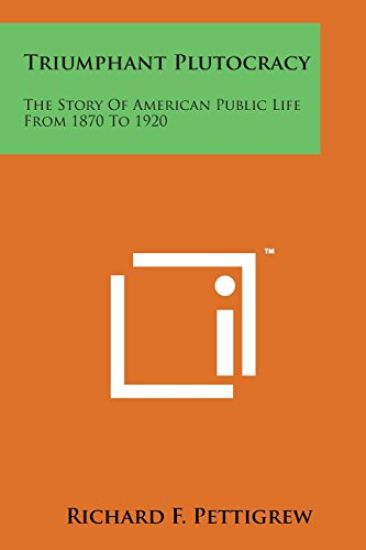
Triumphant Plutocracy

Triumphant Plutocracy

Richard Franklin Pettigrew

Pantianos Classics
1922
pokkari
Richard Pettigrew was a United States Senator during the Gilded Age; a time when the captains of industry gained unprecedented power. His recollections of public service span decades.Running on an anti-corruption platform and representing South Dakota, Pettigrew was appalled as the wealthy owners of the trusts exerted unhealthy influence on the burgeoning economy of the USA. With controlling interests in land, rail, steel, oil, commodities and labor, the trust owners drove out fair competition and monopolized vast swathes of the U.S. economy. Antitrust laws supported by Pettigrew took decades to materialize; as these memoirs grimly rue, much damage was done in the meanwhile.To stall the legislation, the trust owners offered colossal campaign contributions and donations to politicians in their states. Under the guise of lobbying, many millions of dollars in bonds plus cash payments and job offers, were handed to Congressional representatives and their families. Yet Senators like Pettigrew struck back against the corruption; the Sherman antitrust laws, the creation of national parks and expansions of federal ownership of assets vital to the national interest put a brake on the Gilded Age.The final chapters of Pettigrew's memoirs reflect on world events, and the fate of nations which never muzzled their monopolies and distributed wealth across their economies.
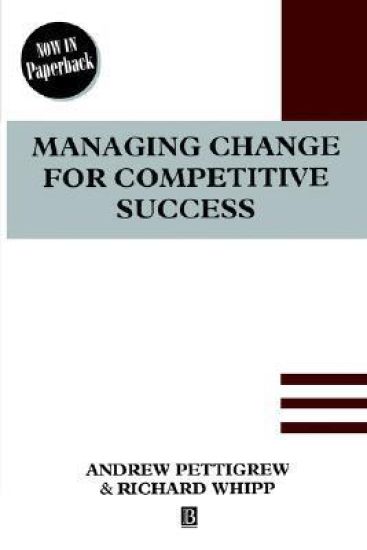
Managing Change for Competitive Success

Managing Change for Competitive Success

Andrew Pettigrew; Richard Whipp

Blackwell Publishers
1993
nidottu
This extremely successful book, already in use on courses in hardback, is now being made available in paperback. Based on a major in-depth study of four UK industry sectors, the book provides an authoritative and searching analysis of how UK companies manage strategic change and how it effects their competitive performance.
Richard

Richard

Ben Myers

Picador
2011
pokkari
In February 1995, Richey Edwards checked out of a London hotel instead of flying to the US with the rest of the Manic Street Preachers. There were a few subsequent sightings but then nothing. His body was never found, and he was declared legally dead in November 2008. Now Richard tells the story of his life – and disappearance – as he might have told it. ‘This moving, tender novel tells the story of a lost boy adrift in a world that he can’t make sense of’ Marie Claire ‘Myers deserves credit not only for adding a third dimension to Edwards, but for trying a fourth, for attempting to document a period of his life that seems destined to remain a mystery’ The Times ‘A sympathetic and sad imagining of the boy who became a reluctant pop idol’ Time Out ‘Harrowing and hauntingly sad’ Mojo