Kirjahaku
Etsi kirjoja tekijän nimen, kirjan nimen tai ISBN:n perusteella.
1000 tulosta hakusanalla Richard Stillman
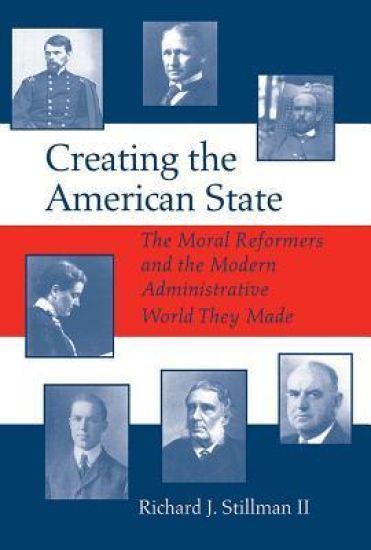
In this illuminating and provocative study, Stillman provides a new understanding of the foundation of the American state. Whether renewing a driver's license, traveling on an airplane, or just watching in fascination as a robot probes Mars, we all participate in the everyday workings of the modern administrative state. As Stillman demonstrates in this study, however, we have not, until now, fully investigated or appreciated this administrative state\u00d4s origins or its evolution into the entity that so affects our lives today. Stillman reveals that this modern enterprise emerged from a complex foundation of ideas and ideals rather than as a result of a simple, rational plan or cataclysmic event, as previously contended. In fact, he finds that the basis for our current administrative state lies in the lives of the seven individuals who, during the late 19th and early 20th centuries, invented its various elements. Stillman also finds that although they lived at different times, these seven founders-George William Curtis, Charles Francis Adams, Jr., Emory Upton, Jane Addams, Frederick W. Taylor, Richard Childs, and Louis Brownlow-had much in common: all were products of intensely Protestant, small-town America, and all were motivated by strong moral idealism. Indeed, Stillman finds that state making in the United States has been a continuation of the Protestant goal to \u0022protest and purify.\u0022 Some names are more recognizable than others, but all, through remarkable moral fervor and exceptional leadership skills, invented the administrative practices and procedures so familiar today.
From the early postwar period until his death at the turn of the century, Dwight Waldo was one of the most authoritative voices in the field of public administration. Through probing questions, creative ideas, and novel insights, he perhaps contributed more than any other single figure to the development of public administration as a discipline in the mid-20th century, from his classic, masterful debut The Administrative State (1948) to his last published book, The Enterprise of Public Administration (1980). In this new look at Dwight Waldo’s writing, Richard Stillman offers a representative selection of Waldo’s most important works alongside introductory essays to help a seasoned public administration scholar as well as the novice student alike appreciate and comprehend Waldo’s remarkable contribution to this critical field of study. Selections have been chosen for their ability to speak to current and ongoing concerns of the field in the 21st century as well as for their utility, readability, and importance. This anthology provides new generations of readers with a fresh look at the work of this prolific, profoundly influential author, while offering both administrative scholars and practitioners renewed access to many of his hard-to-find works. This book will be required reading for all those interested in public administration as a field of inquiry and practice.
Search for Public Administration
Brack Brown; Richard Stillman; Dwight Waldo
Texas A M University Press
2000
nidottu
In the arena of public-administration scholarship, one of the most prominent performers is Dwight Waldo. Such an outstanding position was not given to him; he achieved it by giving his entire career--more than forty years--to the study of institutions and ideas. His prolific writing and lecturing took him to six continents but often put him in the controversial position of steadfast neutrality when volatile issues dramatically polarized his colleagues. This book, which consists of transcribed interviews with Waldo plus separate analyses and comments by the authors and by Waldo, was written by two of his former students. Brown and Stillman's informal conversations with their mentor give new perspective to the events and forces that shaped public administration in the post--World War II era. Being open to new concepts, refusing to embrace academic partisanship, and "generalizing" his studies in order to view public administration as a whole in an era of specialization make Waldo an almost unclassifiable academic. He is known for critiquing and recording events that have shaped public administration, and his favorite topics range from traditional views to emerging trends in mid-twentieth-century public administration scholars--the socalled Minnowbrook Conference--is an example of his receptiveness to change and to the probing of old ideas and new frontiers. Dwight Waldo is a preeminent interpreter of public administration as a profession, as he would like to see it, and his practice of answering questions with questions indicates that the search for public administration--how to support or deny funding, how to divide responsibilities, how to compromise between private enterprise and central authority--is not finite and that public administration is not a static exercise but a goal to be sought, however much searching it takes.
Revolutionary Genius: The Life and Legacy of Richard Stallman chronicles the extraordinary journey of a computer programming genius, Richard Stallman, who dedicated his life to fighting for software freedom. From his early hacking days to the creation of the Free Software Foundation, Stallmans unwavering commitment to open source software and his impact on the world of technology and society at large are explored in detail. This book delves into Stallmans personal life and philosophy while also examining the ongoing battle for software freedom, Internet privacy, and corporate dominance. Discover the lasting influence of a visionary who shaped the digital landscape we know today.
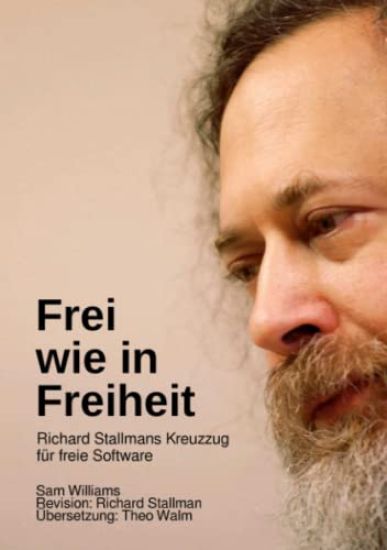
Free as in Freedom: Richard Stallman and the Free
Sam Williams
O'Reilly Media, Inc, USA
2012
nidottu
Free as in Freedom interweaves biographical snapshots of GNU project founder Richard Stallman with the political, social and economic history of the free software movement. It examines Stallman's unique personality and how that personality has been at turns a driving force and a drawback in terms of the movement's overall success. Free as in Freedom examines one man's 20-year attempt to codify and communicate the ethics of 1970s era "hacking" culture in such a way that later generations might easily share and build upon the knowledge of their computing forebears. The book documents Stallman's personal evolution from teenage misfit to prescient adult hacker to political leader and examines how that evolution has shaped the free software movement. Like Alan Greenspan in the financial sector, Richard Stallman has assumed the role of tribal elder within the hacking community, a community that bills itself as anarchic and averse to central leadership or authority. How did this paradox come about? Free as in Freedom provides an answer. It also looks at how the latest twists and turns in the software marketplace have diminished Stallman's leadership role in some areas while augmenting it in others. Finally, Free as in Freedom examines both Stallman and the free software movement from historical viewpoint. Will future generations see Stallman as a genius or crackpot? The answer to that question depends partly on which side of the free software debate the reader currently stands and partly upon the reader's own outlook for the future. 100 years from now, when terms such as "computer," "operating system" and perhaps even "software" itself seem hopelessly quaint, will Richard Stallman's particular vision of freedom still resonate, or will it have taken its place alongside other utopian concepts on the 'ash-heap of history?'
Free as in Freedom Richard Stallmans Crusade for Free Software (Edition1)
F W Sears
Alpha Editions
2025
nidottu
Debugging with GDB: The GNU Source-Level Debugger, Tenth Edition, for GDB version 8.1.50.20180116-git. This book is available for free at gnu.org. This book is printed in grayscale.The purpose of a debugger such as gdb is to allow you to see what is going on "inside" another program while it executes - or what another program was doing at the moment it crashed. gdb can do four main kinds of things (plus other things in support of these) to help you catch bugs in the act: - Start your program, specifying anything that might affect its behavior. - Make your program stop on specified conditions. - Examine what has happened, when your program has stopped. - Change things in your program, so you can experiment with correcting the effects of one bug and go on to learn about another.
Everyone dies once. But what if a chosen few were raised from the dead? Two thousand years ago Jesus resurrected his friend, Lazarus, who founded a secret organization: SOAR. Since then Jesus has added to the resurrected--The Awakened--to aid Lazarus in SOAR's battle against Satan's slaves, the UnVeilers. The threat is escalating. The UnVeilers have stepped up their attacks on mankind through a charming leader and a devastating series of bombings in Dubai and Tel Aviv. But the invasion doesn't stop with international terrorism. The UnVeilers are searching for a secret that Jesus embedded in Lazarus' journal that not even Lazarus knows--and it will determine the fate of mankind. After a failed cyber-attack against SOAR's computers, Lazarus and his team of experts must find the secret before the UnVeilers do. What clue is he overlooking that could turn the tide of this ageless conflict? The souls fighting with Lazarus are weary, but the war against evil is far from won. Can Lazarus and his team set aside their longing for heaven and put a stop to these satanic attacks before it's too late?
Everyone dies once...what if a chosen few were raised from the dead?Now that the threat from Abdul Ba'ith has been eliminated, Lazarus and his team at SOAR hope to help Ricki discover the secret in his journal. That hope is dashed when he discovers that the UDs have even bigger plans in the works--plans that threaten the stability of the entire world. North Korea is ruled by a UD who has overseen the development of a deadly airborne disease. The virus is on its way to the Middle East by boat where ISIS will use it to destroy Israel on October 10th. Lazarus joins a team sent to North Korea to eliminate the UD responsible for the program while another team searches for the virus in the Middle East, hoping to destroy it before it can be used. The odds are stacked against both teams as event after event arises to impede their progress. Will Lazarus be able to free North Korea of its dictatorial leader? Will Shiri's team be able to locate the virus and neutralize it before it is released on Israel? It's a world-wide hunt with more than the existence of Israel at stake, because the virus will spread from Israel to the rest of the world.
Bison: The Yacc-compatible Parser Generator
Richard Stallman; Charles Donnelly
Samurai Media Limited
2015
nidottu
Biographie ber Richard Stallman, den Verfasser der GNU GPL, Autor des gcc und Gr nder der Free Software Foundation.
GNU Emacs Lisp Reference Manual 1/2
Dan Laliberte; Richard Stallman; Bil Lewis
Samurai Media Limited
2015
nidottu
Most of the GNU Emacs text editor is written in the programming language called Emacs Lisp. You can write new code in Emacs Lisp and install it as an extension to the editor. However, Emacs Lisp is more than a mere "extension language"; it is a full computer programming language in its own right. You can use it as you would any other programming language. Because Emacs Lisp is designed for use in an editor, it has special features for scanning and parsing text as well as features for handling files, buffers, displays, subprocesses, and so on. Emacs Lisp is closely integrated with the editing facilities; thus, editing commands are functions that can also conveniently be called from Lisp programs, and parameters for customization are ordinary Lisp variables. This manual attempts to be a full description of Emacs Lisp. For a beginner's introduction to Emacs Lisp, see An Introduction to Emacs Lisp Programming, by Bob Chassell, also published by the Free Software Foundation. This manual presumes considerable familiarity with the use of Emacs for editing; see The GNU Emacs Manual for this basic information. Generally speaking, the earlier chapters describe features of Emacs Lisp that have counterparts in many programming languages, and later chapters describe features that are peculiar to Emacs Lisp or relate specifically to editing. This is the GNU Emacs Lisp Reference Manual, corresponding to Emacs version 24.5. As Emacs Lisp became such a big project over the years, we had to split this reference manual in two parts that are two separate physical books. To keep it consistent with our digital manual, the references and page numbers cover both physical books as it were one. Therefore please note that you probably want to have both parts.
GNU Emacs Lisp Reference Manual 2/2
Dan Laliberte; Richard Stallman; Bil Lewis
Samurai Media Limited
2015
nidottu
Most of the GNU Emacs text editor is written in the programming language called Emacs Lisp. You can write new code in Emacs Lisp and install it as an extension to the editor. However, Emacs Lisp is more than a mere "extension language"; it is a full computer programming language in its own right. You can use it as you would any other programming language. Because Emacs Lisp is designed for use in an editor, it has special features for scanning and parsing text as well as features for handling files, buffers, displays, subprocesses, and so on. Emacs Lisp is closely integrated with the editing facilities; thus, editing commands are functions that can also conveniently be called from Lisp programs, and parameters for customization are ordinary Lisp variables. This manual attempts to be a full description of Emacs Lisp. For a beginner's introduction to Emacs Lisp, see An Introduction to Emacs Lisp Programming, by Bob Chassell, also published by the Free Software Foundation. This manual presumes considerable familiarity with the use of Emacs for editing; see The GNU Emacs Manual for this basic information. Generally speaking, the earlier chapters describe features of Emacs Lisp that have counterparts in many programming languages, and later chapters describe features that are peculiar to Emacs Lisp or relate specifically to editing. This is the GNU Emacs Lisp Reference Manual, corresponding to Emacs version 24.5. As Emacs Lisp became such a big project over the years, we had to split this reference manual in two parts that are two separate physical books. To keep it consistent with our digital manual, the references and page numbers cover both physical books as it were one. Therefore please note that you probably want to have both parts.
GNU Diffutils Reference Manual
Paul Eggert; Richard Stallman; David MacKenzie
Samurai Media Limited
2015
nidottu
Computer users often find occasion to ask how two files differ. Perhaps one file is a newer version of the other file. Or maybe the two files started out as identical copies but were changed by different people. You can use the diff command to show differences between two files, or each corresponding file in two directories. diff outputs differences between files line by line in any of several formats, selectable by command line options. This set of differences is often called a diff or patch. For files that are identical, diff normally produces no output; for binary (non-text) files, diff normally reports only that they are different. You can use the cmp command to show the byte and line numbers where two files differ. cmp can also show all the bytes that differ between the two files, side by side. A way to compare two files character by character is the Emacs command M-x compare-windows. See Section "Other Window" in The GNU Emacs Manual, for more information on that command. You can use the diff3 command to show differences among three files. When two people have made independent changes to a common original, diff3 can report the differences between the original and the two changed versions, and can produce a merged file that contains both persons' changes together with warnings about conflicts. You can use the sdiff command to merge two files interactively. You can use the set of differences produced by diff to distribute updates to text files (such as program source code) to other people. This method is especially useful when the differences are small compared to the complete files. Given diff output, you can use the patch program to update, or patch, a copy of the file. If you think of diff as subtracting one file from another to produce their difference, you can think of patch as adding the difference to one file to reproduce the other. This manual first concentrates on making diffs, and later shows how to use diffs to update files.
GNU Emacs Lisp Reference Manual
Bil Lewis; Dan Laliberte; Richard Stallman
12th Media Services
2014
pokkari
This manual attempts to be a full description of Emacs Lisp. This manual presumes considerable familiarity with the use of Emacs for editing. Most of the GNU Emacs text editor is written in the programming language called Emacs Lisp. You can write new code in Emacs Lisp and install it as an extension to the editor. However, Emacs Lisp is more than a mere extension language; it is a full computer programming language in its own right. You can use it as you would any other programming language. Generally speaking, the earlier chapters describe features of Emacs Lisp that have counterparts in many programming languages, and later chapters describe features that are peculiar to Emacs Lisp or relate specically to editing. This is edition 3.1 of the GNU Emacs Lisp Reference Manual, corresponding to Emacs version 25.2. This manual is available online for free at gnu.org. This manual is printed in grayscale.
GNU Make Reference Manual
Richard M Stallman; Roland McGrath; Paul D Smith
12th Media Services
2016
pokkari
The make utility automatically determines which pieces of a large program need to be recompiled, and issues commands to recompile them. This manual describes GNU make, which was implemented by Richard Stallman and Roland McGrath. This book is available as a free PDF from gnu.org.The Make program is indispensable to maintainers of free software systems. The GNU Make manual, written by the program's original authors, is the definitive tutorial. It also includes an introductory chapter for novice users. The Make utility automates the process of compilation; it is especially useful when the source files of large programs change. It is a small program with a lot of power. This book will show you: How to write your own makefiles Make's rule syntax and how to write your own rules How the Make utility can be configured to automatically put binary and source files in the right places. How to use make to create archive files automatically Define, set and use Make's variables How Make uses targets so that you can broaden or narrow Make's recompilation efforts on demand. And much more This manual provides a complete explanation of Make, both the basics and extended features.
GCC 8.0 GNU Compiler Collection Internals documents the internals of the GNU compilers, including how to port them to new targets and some information about how to write front ends for new languages. It corresponds to the compilers (GCC) version 8.0.1. The use of the GNU compilers is documented in a separate manual. See Section "Introduction" in Using the GNU Compiler Collection (GCC). This manual is mainly a reference manual rather than a tutorial. It discusses how to contribute to GCC (see Chapter 1 Contributing], page 3), the characteristics of the machines supported by GCC as hosts and targets (see Chapter 2 Portability], page 5), how GCC relates to the ABIs on such systems (see Chapter 3 Interface], page 7), and the characteristics of the languages for which GCC front ends are written (see Chapter 5 Languages], page 59). It then describes the GCC source tree structure and build system, some of the interfaces to GCC front ends, and how support for a target system is implemented in GCC. This manual is available online for free at gnu.org. This manual is printed in grayscale.
The GNU C Library Reference Manual Version 2.26
Sandra Loosemore; Richard M Stallman; Roland McGrath
12th Media Services
2018
pokkari