

Kirjahaku
Etsi kirjoja tekijän nimen, kirjan nimen tai ISBN:n perusteella.
1000 tulosta hakusanalla Richard W Curney

This book examines the political origins of financial institutions across fifteen developed democracies, with focused case studies on the US, France, Japan, Austria, and Germany.The institutional arrangements of financial systems are widely seen as a central distinguishing feature of ‘varieties of capitalism’. Through a wide-range of case studies, this book contends that political battles between landed interests, labor, and owners of capital have fundamentally shaped modern financial arrangements. Demonstrating how these conflicts have shaped contemporary financial architecture in a number of different contexts, author Richard W. Carney offers an innovative approach to explaining the distinctive capitalist arrangements of nation-states. By demonstrating the importance of landed interests to nations’ institutional configurations, the book has clear implications for developing countries such as India and China.Providing a detailed account of the development of financial institutions, this book will be of interest to students and scholars of political science, sociology, business, finance, and law. It will also offer insights valuable to government policymakers, analysts at international organizations, and the business community.
This book examines the political origins of financial institutions across fifteen developed democracies, with focused case studies on the US, France, Japan, Austria, and Germany.The institutional arrangements of financial systems are widely seen as a central distinguishing feature of ‘varieties of capitalism’. Through a wide-range of case studies, this book contends that political battles between landed interests, labor, and owners of capital have fundamentally shaped modern financial arrangements. Demonstrating how these conflicts have shaped contemporary financial architecture in a number of different contexts, author Richard W. Carney offers an innovative approach to explaining the distinctive capitalist arrangements of nation-states. By demonstrating the importance of landed interests to nations’ institutional configurations, the book has clear implications for developing countries such as India and China.Providing a detailed account of the development of financial institutions, this book will be of interest to students and scholars of political science, sociology, business, finance, and law. It will also offer insights valuable to government policymakers, analysts at international organizations, and the business community.
How is China acquiring global influence? Rather than focusing exclusively on China's interests, this book considers a vital but overlooked feature – the interests of recipient countries. Richard W. Carney argues that countries in which political leaders rely more heavily on clientelism coupled with greater control over the corporate sector have a higher demand for Chinese infrastructure spending. Through a combination of statistical analyses and case studies, Carney shows that electoral autocracies (in contrast to closed autocracies, electoral democracies, and liberal democracies) display these features most prominently and are the most avid recipients. This in turn contributes to elevated levels of Chinese digital technologies imports which facilitates the spread of Chinese technical standards, enabling China to create the scale to assert its dominance over the emerging digital economy. Electoral autocracies are the most prevalent type of regime, and are therefore essential partners to China's global ambitions.
How is China acquiring global influence? Rather than focusing exclusively on China's interests, this book considers a vital but overlooked feature – the interests of recipient countries. Richard W. Carney argues that countries in which political leaders rely more heavily on clientelism coupled with greater control over the corporate sector have a higher demand for Chinese infrastructure spending. Through a combination of statistical analyses and case studies, Carney shows that electoral autocracies (in contrast to closed autocracies, electoral democracies, and liberal democracies) display these features most prominently and are the most avid recipients. This in turn contributes to elevated levels of Chinese digital technologies imports which facilitates the spread of Chinese technical standards, enabling China to create the scale to assert its dominance over the emerging digital economy. Electoral autocracies are the most prevalent type of regime, and are therefore essential partners to China's global ambitions.
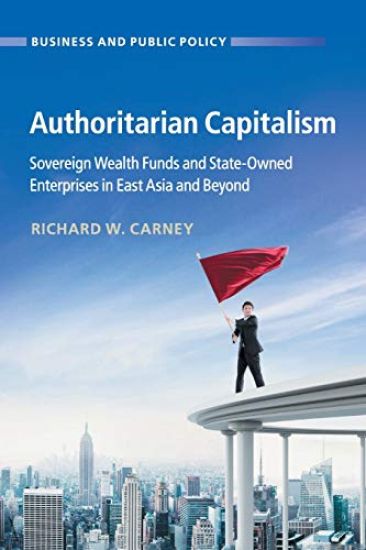
Since 1945, the liberal-democratic model of capitalism spread across the globe, ultimately prevailing over communism. Over the past two decades, a new statist-authoritarian model has begun diffusing across East Asia. Rather than rejecting capitalism, authoritarian leaders harness it to uphold their rule. Based on extensive research of East Asia's largest corporations and sovereign wealth funds, this book argues that the most aggressive version of this model does not belong to China. Rather, it can be found in Malaysia and Singapore. Although these countries are small, the implications are profound because one-third of all countries in the world possess the same type of regime. With an increasing number of these authoritarian regimes establishing sovereign wealth funds, their ability to intervene in the corporate sectors of other countries is rapidly expanding.

Since 1945, the liberal-democratic model of capitalism spread across the globe, ultimately prevailing over communism. Over the past two decades, a new statist-authoritarian model has begun diffusing across East Asia. Rather than rejecting capitalism, authoritarian leaders harness it to uphold their rule. Based on extensive research of East Asia's largest corporations and sovereign wealth funds, this book argues that the most aggressive version of this model does not belong to China. Rather, it can be found in Malaysia and Singapore. Although these countries are small, the implications are profound because one-third of all countries in the world possess the same type of regime. With an increasing number of these authoritarian regimes establishing sovereign wealth funds, their ability to intervene in the corporate sectors of other countries is rapidly expanding.


Defense of Capt. Richard W. Meade, Tried for the Loss of the United States Steamer San Jacinto
Richard W 1807-1870 Meade
Hutson Street Press
2025
sidottu

Defense of Capt. Richard W. Meade, Tried for the Loss of the United States Steamer San Jacinto
Richard W 1807-1870 Meade
Hutson Street Press
2025
pokkari

Richard W. Werner, Petitioner, V. Heinwerner Motor Parts Corporation. U.S. Supreme Court Transcript of Record with Supporting Pleadings
S L Wheeler; Arthur H Boettcher
Gale Ecco, U.S. Supreme Court Records
2011
pokkari

A WWII Story: Richard W. Thompson
Richard W. Thompson
Createspace Independent Publishing Platform
2014
nidottu

Meditations on THE IMITATION OF CHRIST: Meditations by Richard W. Linford
Richard W. Linford
Independently Published
2019
nidottu
The IMITATION OF CHRIST by Thomas A Kempis - translated by Rev. William Benham - is a companion to the Holy Bible and other scriptures and is of inestimable worth, having helped millions worship at the feet of the Savior. The text of IMITATION OF CHRIST is numbered and in paragraph form. Meditations are in brackets. I am an attorney at law, a businessman, an artist, writer, and gardener. I am an active member of The Church of Jesus Christ of Latter-day Saints. I work at being a good husband, dad, and granddad. I have written a number of books that can be seen at www.amazon.com by typing my name Richard W. Linford in the amazon.com search bar. I have painted more than 800 oil and acrylic paintings.

Memorial Of Richard W. Dickinson
Robert Carter And Brothers Publisher
KESSINGER PUBLISHING, LLC
2009
pokkari

Memorial Of Richard W. Dickinson
Robert Carter And Brothers Publisher
KESSINGER PUBLISHING, LLC
2010
sidottu

Rocky Mountain Dick, Richard W. Rock: Stories of His Adventures in Capturing Wild Animals
Nolie Mumey
Literary Licensing, LLC
2012
nidottu
The Reminiscences of Rear Adm. Richard W. Schneider, USCGR (Ret.)
Naval Institute Press
2023
sidottu
Schneider has had an unconventional career. He set out to be an active-duty career officer in the Coast Guard. But the illness and death of his first wife led him into the Coast Guard Reserve and a new career in higher education while rearing the couple’s daughters. The memoir thus details his active Coast Guard service, career in higher education, and his role in reshaping the fundamental nature of the Coast Guard Reserve. Schneider graduated from the Coast Guard Academy in 1968 and was on board the cutter USCGC Dallas (WHEC-716) during Vietnam War service. Subsequently, he was an instructor at Officer Candidate School, a graduate student at Wesleyan University, and taught at the Coast Guard Academy before transferring to the Coast Guard Reserve in 1977. He worked 1977-85 as executive officer, University of Delaware-College of Marine Studies and in 1985 earned a Ph.D. from the University of Delaware. He served in a variety of administrative positions at Drexel University from 1985 to 1992. His reserve duty was at Indian River, Delaware, the Philadelphia Marine Safety Office, and the New York Marine Safety Office. He has served as president of Norwich University, a private military institution in Northfield, Vermont, since 1992. As a senior reserve officer in the 1990s Schneider was involved in the transformation of the Coast Guard Reserve.