Kirjojen hintavertailu. Mukana 11 213 693 kirjaa ja 12 kauppaa.

Kirjahaku

Etsi kirjoja tekijän nimen, kirjan nimen tai ISBN:n perusteella.

1000 tulosta hakusanalla Richard Wright Procter

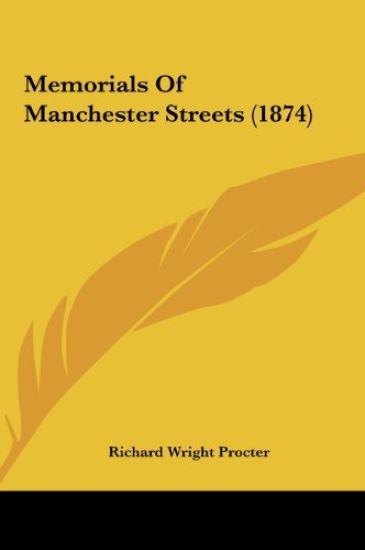
Memorials of Manchester Streets.

Memorials of Manchester Streets.

Richard Wright Procter

British Library, Historical Print Editions
2011
pokkari
Title: Memorials of Manchester Streets.Publisher: British Library, Historical Print EditionsThe British Library is the national library of the United Kingdom. It is one of the world's largest research libraries holding over 150 million items in all known languages and formats: books, journals, newspapers, sound recordings, patents, maps, stamps, prints and much more. Its collections include around 14 million books, along with substantial additional collections of manuscripts and historical items dating back as far as 300 BC.The HISTORY OF BRITAIN & IRELAND collection includes books from the British Library digitised by Microsoft. As well as historical works, this collection includes geographies, travelogues, and titles covering periods of competition and cooperation among the people of Great Britain and Ireland. Works also explore the countries' relations with France, Germany, the Low Countries, Denmark, and Scandinavia. ++++The below data was compiled from various identification fields in the bibliographic record of this title. This data is provided as an additional tool in helping to insure edition identification: ++++ British Library Procter, Richard Wright; 1874. 8 . 10360.ff.29.
Memorials of Manchester streets

Memorials of Manchester streets

Richard Wright Procter

Alpha Edition
2019
pokkari
This book has been considered by academicians and scholars of great significance and value to literature. This forms a part of the knowledge base for future generations. So that the book is never forgotten we have represented this book in a print format as the same form as it was originally first published. Hence any marks or annotations seen are left intentionally to preserve its true nature.
Richard Wright

Richard Wright

Hazel Rowley

University of Chicago Press
2008
nidottu
Consistently an outsider - a child of the fundamentalist South with an eighth-grade education, a self-taught intellectual, a black man married to a white woman - Richard Wright nonetheless became the unparalleled voice of his time. The first full-scale biography of the author best known for his searing novels Black Boy and Native Son, Richard Wright: The Life and Times brings the man and his work - in all their complexity and distinction - to vibrant life. Acclaimed biographer Hazel Rowley chronicles Wright's unprecedented journey from a sharecropper's shack in Mississippi to Chicago's South Side to international renown as a writer and outspoken critic of racism.Drawing on journals, letters, and eyewitness accounts, Richard Wright probes the author's relationships with Langston Hughes and Ralph Ellison, his attraction to Communism, and his so-called exile in France. Skillfully interweaving quotes from Wright's own writings, Rowley deftly portrays a passionate, courageous, and flawed man who would become one of our most enduring literary figures.
Richard Wright

Richard Wright

Palgrave Macmillan
2011
sidottu
This wide-ranging collection of essays contains unexplored themes and theoretical orientations centering on racism and spatial dimensions; the transnational and political Wright; Wright and masculinity, Wright and the American 1950s and 1960s; and some of the first analyses of Wright's recently published A Father ' s Law (2008).
Richard Wright

Richard Wright

Keneth Kinnamon

McFarland Co Inc
2006
pokkari
African-American writer Richard Wright (1908-1960) was celebrated during the early 1940s for his searing autobiography (Black Boy) and fiction (Native Son). By 1947 he felt so unwelcome in his homeland that he exiled himself and his family in Paris. But his writings changed American culture forever, and today they are mainstays of literature and composition classes. He and his works are also the subjects of numerous critical essays and commentaries by contemporary writers. This volume presents a comprehensive annotated bibliography of those essays, books, and articles from 1983 through 2003. Arranged alphabetically by author within years are some 8,320 entries ranging from unpublished dissertations to book-length studies of African American literature and literary criticism. Also included as an appendix are addenda to the author's earlier bibliography covering the years from 1934 through 1982. This is the exhaustive reference for serious students of Richard Wright and his critics.
Richard Wright

Richard Wright

Toru Kiuchi; Yoshinobu Hakutani

McFarland Co Inc
2014
pokkari
In this minutely detailed, comprehensive chronology, Toru Kiuchi and Yoshinobu Hakutani document the life in letters of the greatest African American writer of the twentieth century. The author of Black Boy and Native Son, among other works, Wright wrote unflinchingly about the black experience in the United States, where his books still influence discussions of race and social justice. Entries are documented by Wright's journals, articles, and other works published and unpublished, as well as his letters to and from friends, associates, writers and public figures. Part One covers Wright's life through the year 1946, the period in which he published his best-known work. Part Two covers the final fifteen years of his life in exile, a prolific period in which he wrote two novels, four works of nonfiction, and four thousand haiku. Each part begins with a historical and critical introduction.
Richard Wright

Richard Wright

Rizzoli International Publications
2010
sidottu
An extensive monograph surveying the recent major works of artist Richard Wright. This fully illustrated publication presents Wright’s exquisite paintings and drawings. Wright states "I wanted to get to the idea without the object getting in the way." This attitude led to paintings of extraordinary skill made directly onto the wall that do away with the physicality of the canvas. This publication records these special transient events where paintings have appeared, and for the most part, no longer exist. Winner of the prestigious Turner Prize (2009), Wright’s work was praised by the judges for its "profound originality and beauty."
Richard Wright

Richard Wright

Palgrave Macmillan
2011
nidottu
This wide-ranging collection of essays contains unexplored themes and theoretical orientations centering on racism and spatial dimensions; the transnational and political Wright; Wright and masculinity, Wright and the American 1950s and 1960s; and some of the first analyses of Wright's recently published A Father ' s Law (2008).
Richard Wright

Richard Wright

University Press of Mississippi
2017
nidottu
Contributions by Robert J. Butler, Ginevra Geraci, Yoshinobu Hakutani, Floyd W. Hayes III, Joseph Keith, Toru Kiuchi, John Lowe, Sachi Nakachi, Virginia Whatley Smith, and John Zheng.Critics in this volume reassess the prescient nature of Richard Wright’s mind as well as his life and body of writings, especially those directly concerned with America and its racial dynamics. This edited collection offers new readings and understandings of the particular America that became Wright’s focus at the beginning of his career and was still prominent in his mind at the end.Virginia Whatley Smith’s edited collection examines Wright’s fixation with America at home and from abroad: his oppression by, rejection of, conflict with, revolts against, and flight from America. Other people have written on Wright’s revolutionary heroes, his difficulties with the FBI, and his works as a postcolonial provocateur; but none have focused singly on his treatment of America. Wherever Wright traveled, he always positioned himself as an African American as he compared his experiences to those at hand.However, as his domestic settlements changed to international residences, Wright’s craftsmanship changed as well. To convey his cultural message, Wright created characters, themes, and plots that would expose arbitrary and whimsical American policies, oppressive rules which would invariably ensnare Wright’s protagonists and sink them more deeply into the quagmire of racial subjugation as they grasped for a fleeting moment of freedom.Smith’s collection brings to the fore new ways of looking at Wright, particularly his post–Native Son international writings. Indeed, no critical interrogations have considered the full significance of Wright’s masterful crime fictions. In addition, the author’s haiku poetry complements the fictional pieces addressed here, reflecting Wright’s attitude toward America as he, near the end of his life, searched for nirvana—his antidote to American racism.
Richard Wright: The Library of America Unexpurgated Edition: Native Son / Uncle Tom's Children / Black Boy / And More
For the first time in a deluxe boxed set, the definitive edition of Richard Wright's landmark works in the form in which he intended them to be read. Here, in authoritative texts based on the author's original typescripts and proofs, is the Library of America's acclaimed edition of Richard Wright's major works. Wright's first novel, Lawd Today , published posthumously in 1963 and here presented for the first time in its original form, interweaves news bulletins, songs, exuberant wordplay, and scenes of confrontation and celebration into a kaleidoscopic chronicle of the events of one day in the life of a black Chicago postal worker. Uncle Tom's Children first brought Wright to national attention. The characters in these five stories struggle to survive the cruelty of racism in the South, as Wright asks "what quality of will must a Negro possess to live and die with dignity in a country that denied his humanity." Wright's masterpiece, Native Son, exploded on the American literary scene in 1940. The story of Bigger Thomas, a young black man living in the raw, noisy, crowded slums of Chicago's South Side, captured the hopes and yearnings, the pain and rage of black Americans with an unprecedented intensity and vividness. The text printed in this volume restores the changes and cuts--including the replacement of an entire scene--that Wright was forced to make by book club editors who feared offending their readers. Wright's wrenching memoir Black Boy, an eloquent account of his struggle to escape a life of poverty, ignorance and fear in his native South, was an immediate bestseller when it appeared in 1945. But Wright's complete autobiography, published for the first time in this volume as Black Boy (American Hunger), is a far more complex and probing work, chronicaling his encounter with racism in the North, his apprenticeship as a writer, and his disillusionment with the Communist Party. Wright's 1953 novel The Outsider appears here in a text that restores the many stylistic changes and long cuts made by his editors without his knowledge. When Cross Damon is mistakenly believed to have died in a subway accident, he seizes the opportunity to invent a new life for himself. The text here, based on Wright's final, corrected typescript, casts new light on his development of the style he called "poetic realism." Boxed set contains Richard Wright: Early Works, 936 pp., and Richard Wright: Later Works, 887 pp., volumes #55 and #56 in the Library of America series.
Richard Wright

Richard Wright

Michel Fabre

University Press of Mississippi
2008
nidottu
This bibliography of Richard Wright's library and reading serves as a key to understanding the development, philosophies, and aesthetics of this great writer and provides accurate information for the study of intertextuality in his works. Richard Wright, born in Mississippi in 1908, was largely self-taught. His only formal schooling was high school. As he recounts in Black Boy, he used a white friend's library card at the Memphis Public Library, where blacks were not allowed. That books were almost ""living companions"" for Wright is easily understandable. Through books and, later, through relationships with writers, he broadened his perspectives, his understanding of society, and the very craft of writing. In the history of Richard Wright, perhaps more than with other writers, a knowledge of what he actually read, and of what authors he preferred, is essential in explaining his intellectual development. Michel Fabre, Wright's biographer and foremost Wright scholar, details the volumes in Wright's library and the facts of Wright's reading habits. This listing of books that formed and influenced him includes second-hand books he bought while living in extreme poverty in Chicago, some borrowed books never returned, books purchased in New York and Paris, books Wright deemed required reading for a growing novelist, gift books, and others in a comprehensive list on such subjects as contemporary American literature, classic European works, criminology, psychiatry, and social sciences. In compiling this listing Fabre goes beyond the actual contents of Wright's library, for he includes also titles drawn from references in Wright's works and from accounts of people who knew him and his reading habits. Included also is an appendix that collects for the first time reviews written by Wright, his prefaces, forewords, and blurbs. They show his appreciation of diverse genres and styles, although his ideological commitment remained the same. In them one sees Wright as an author ready to help younger writers, black and white, American and French.