Kirjojen hintavertailu. Mukana 12 376 041 kirjaa ja 12 kauppaa.

Kirjahaku

Etsi kirjoja tekijän nimen, kirjan nimen tai ISBN:n perusteella.

1000 tulosta hakusanalla Robert A. Beauregard

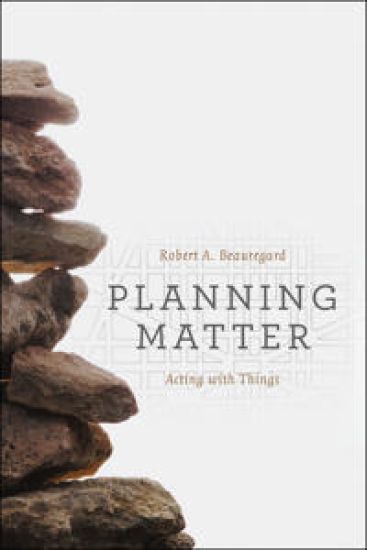
Planning Matter

Planning Matter

Robert A. Beauregard

University of Chicago Press
2015
sidottu
City and regional planners talk constantly about the things of the world-from highway interchanges and retention ponds to zoning documents and conference rooms-yet most seem to have a poor understanding of the materiality of the world in which they're immersed. Too often planners treat built forms, weather patterns, plants, animals, or regulatory technologies as passively awaiting commands rather than actively involved in the workings of cities and regions. In the ambitious and provocative Planning Matter, Robert A. Beauregard sets out to offer a new materialist perspective on planning practice that reveals the many ways in which the nonhuman things of the world mediate what planners say and do. Drawing on actor-network theory and science and technology studies, Beauregard lays out a framework that acknowledges the inevitable insufficiency of our representations of reality while also engaging more holistically with the world in all of its diversity-including human and nonhuman actors alike.
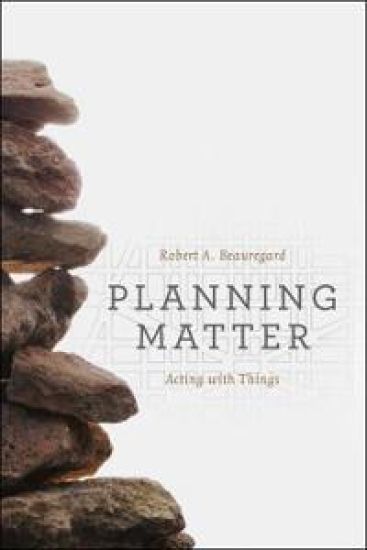
Planning Matter

Planning Matter

Robert A. Beauregard

University of Chicago Press
2015
nidottu
City and regional planners talk constantly about the things of the world-from highway interchanges and retention ponds to zoning documents and conference rooms-yet most seem to have a poor understanding of the materiality of the world in which they're immersed. Too often planners treat built forms, weather patterns, plants, animals, or regulatory technologies as passively awaiting commands rather than actively involved in the workings of cities and regions. In the ambitious and provocative Planning Matter, Robert A. Beauregard sets out to offer a new materialist perspective on planning practice that reveals the many ways in which the nonhuman things of the world mediate what planners say and do. Drawing on actor-network theory and science and technology studies, Beauregard lays out a framework that acknowledges the inevitable insufficiency of our representations of reality while also engaging more holistically with the world in all of its diversity-including human and nonhuman actors alike.
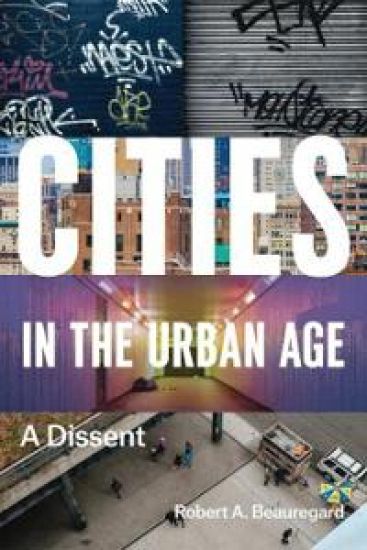
Cities in the Urban Age

Cities in the Urban Age

Robert A. Beauregard

University of Chicago Press
2018
pokkari
We live in a self-proclaimed Urban Age, where we celebrate the city as the source of economic prosperity, a nurturer of social and cultural diversity, and a place primed for democracy. We proclaim the city as the fertile ground from which progress will arise. Without cities, we tell ourselves, human civilization would falter and decay. In Cities in the Urban Age, Robert A. Beauregard argues that this line of thinking is not only hyperbolic—it is too celebratory by half. For Beauregard, the city is a cauldron for four haunting contradictions. First, cities are equally defined by both their wealth and their poverty. Second, cities are simultaneously environmentally destructive and yet promise sustainability. Third, cities encourage rule by political machines and oligarchies, even as they are essentially democratic and at least nominally open to all. And fourth, city life promotes tolerance among disparate groups, even as the friction among them often erupts into violence. Beauregard offers no simple solutions or proposed remedies for these contradictions; indeed, he doesn’t necessarily hold that they need to be resolved, since they are generative of city life. Without these four tensions, cities wouldn’t be cities. Rather, Beauregard argues that only by recognizing these ambiguities and contradictions can we even begin to understand our moral obligations, as well as the clearest paths toward equality, justice, and peace in urban settings.
Voices of Decline

Voices of Decline

Robert A. Beauregard

Routledge
2002
sidottu
[FOR HISTORY CATALOGS]Drawing on the pronouncements of public commentators, this book portrays the 20th century history of U.S. cities, focusing specifically on how commentators crafted a discourse of urban decline and prosperity peculiar to the post-World War II era. The efforts of these commentators spoke to the foundational ambivalence Americans have toward their cities and, in turn, shaped the choices Americans made as they created and negotiated the country's changing urban landscape. [FOR GEOG/URBAN CATALOGS]Freely crossing disciplinary boundaries, this book uses the words of those who witnessed the cities' distress to portray the postwar discourse on urban decline in the United States. Up-dated and substantially re-written in stronger historical terms, this new edition explores how public debates about the fate of cities drew from and contributed to the choices made by households, investors, and governments as they created and negotiated America's changing urban landscape.
Voices of Decline

Voices of Decline

Robert A. Beauregard

Routledge
2002
nidottu
[FOR HISTORY CATALOGS]Drawing on the pronouncements of public commentators, this book portrays the 20th century history of U.S. cities, focusing specifically on how commentators crafted a discourse of urban decline and prosperity peculiar to the post-World War II era. The efforts of these commentators spoke to the foundational ambivalence Americans have toward their cities and, in turn, shaped the choices Americans made as they created and negotiated the country's changing urban landscape. [FOR GEOG/URBAN CATALOGS]Freely crossing disciplinary boundaries, this book uses the words of those who witnessed the cities' distress to portray the postwar discourse on urban decline in the United States. Up-dated and substantially re-written in stronger historical terms, this new edition explores how public debates about the fate of cities drew from and contributed to the choices made by households, investors, and governments as they created and negotiated America's changing urban landscape.
When America Became Suburban

When America Became Suburban

Robert A. Beauregard

University of Minnesota Press
2006
nidottu
In the decades after World War II, the United States became the most prosperous nation in the world and a superpower whose dominance was symbolized by the American suburbs. Spurred by the decline of its industrial cities and by mass suburbanization, people imagined a new national identity—one that emphasized consumerism, social mobility, and a suburban lifestyle. The urbanity of the city was lost. In When America Became Suburban, Robert A. Beauregard examines this historic intersection of urban decline, mass suburbanization, domestic prosperity, and U.S. global aspirations as it unfolded from 1945 to the mid-1970s. Suburban expansion and the subsequent emergence of sprawling Sunbelt cities transformed every aspect of American society. Assessing the global implications of America's suburban way of life as evidence of the superiority of capitalist democracy, Beauregard traces how the suburban ideology enabled America to distinguish itself from both the Communist bloc and Western Europe, thereby deepening its claim of exceptionalism on the world-historical stage.Placing the decline of America's industrial cities and the rise of vast suburban housing and retail spaces into a cultural, political, and global context, Beauregard illuminates how these phenomena contributed to a changing notion of America's identity at home and abroad. When America Became Suburban brings to light the profound implications of de-urbanization: from the siphoning of investments from the cities and the effect on the quality of life for those left behind to a profound shift in national identity.Robert A. Beauregard is a professor in the Graduate School of Architecture, Planning, and Preservation at Columbia University. He is the author of Voices of Decline: The Postwar Fate of U.S. Cities and editor of Economic Restructuring and Political Response and Atop the Urban Hierarchy.
Voices of Decline

Voices of Decline

Robert A. Beauregard

Blackwell Publishers
1993
nidottu
As World War II faded into the past, urban decline emerged as the dominant motif in the public debate over the fate of the once-mighty cities of many Western industrial nations. Freely crossing disciplinary boundaries, this book uses the words of those who witnessed the cities' distress to portray the postwar discourse on urban decline in the United States. That discourse reshaped the ambivalence Americans have towards their cities, probed the nature of their moral responsibilities, offered advice as to how they should respond, and most importantly, sited in the cities the contradictions of society.
Advanced Introduction to Planning Theory

Advanced Introduction to Planning Theory

Robert A. Beauregard

Edward Elgar Publishing Ltd
2020
sidottu
Elgar Advanced Introductions are stimulating and thoughtful introductions to major fields in the social sciences and law, expertly written by the world's leading scholars. Designed to be accessible yet rigorous, they offer concise and lucid surveys of the substantive and policy issues associated with discrete subject areas. In this original approach to the world of planning theory, Robert A. Beauregard cuts across the many different ways to think about planning by organizing them around four core tasks: knowing, engaging, prescribing, and executing. In doing so, Beauregard explores how a basic concern with the relationship between knowledge and action has evolved into a complex discussion of democracy, inclusion, and justice. Key features include:a cross-national approach to the topica unique overview of key concepts centred on the profession of urban and regional planningcoverage of historical planning theory as well as recent developments in the fieldan accessible writing style suitable for both those studying urban and regional planning, as well as practicing planners.
Advanced Introduction to Planning Theory

Advanced Introduction to Planning Theory

Robert A. Beauregard

Edward Elgar Publishing Ltd
2020
nidottu
Elgar Advanced Introductions are stimulating and thoughtful introductions to major fields in the social sciences and law, expertly written by the world's leading scholars. Designed to be accessible yet rigorous, they offer concise and lucid surveys of the substantive and policy issues associated with discrete subject areas. In this original approach to the world of planning theory, Robert A. Beauregard cuts across the many different ways to think about planning by organizing them around four core tasks: knowing, engaging, prescribing, and executing. In doing so, Beauregard explores how a basic concern with the relationship between knowledge and action has evolved into a complex discussion of democracy, inclusion, and justice. Key features include:a cross-national approach to the topica unique overview of key concepts centred on the profession of urban and regional planningcoverage of historical planning theory as well as recent developments in the fieldan accessible writing style suitable for both those studying urban and regional planning, as well as practicing planners.
Robert A. Heinlein: In Dialogue with His Century, Volume 1: Learning Curve (1907-1948)
For the first time, the real story of the life of Robert A. Heinlein in the authorized biography Robert A. Heinlein (1907-1988) is generally considered the greatest American SF writer of the 20th century. A famous and bestselling author in later life, he started as a navy man and graduate of Annapolis who was forced to retire because of tuberculosis. A socialist politician in the 1930s, he became one of the sources of Libertarian politics in the USA in his later years. His most famous works include the Future History series (stories and novels collected in The Past Through Tomorrow and continued in later novels), Starship Troopers, Stranger in a Strange Land, and The Moon is a Harsh Mistress. Given his desire for privacy in the later decades of his life, he was both stranger and more interesting than one could ever have known. This is the first of two volumes of a major American biography. This volume is about Robert A. Heinlein's life up to the end of the 1940s and the mid-life crisis that changed him forever.
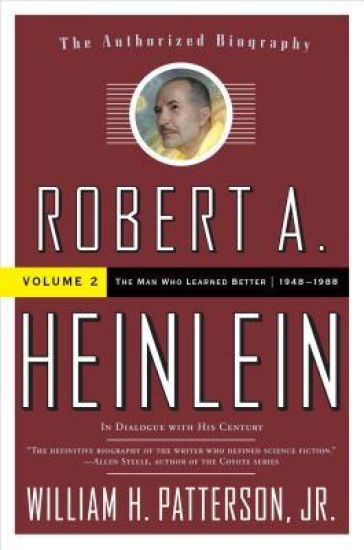
Robert A. Heinlein: In Dialogue with His Century, Volume 2: The Man Who Learned Better (1948-1988)
"Robert A. Heinlein: In Dialogue with his Century: 1948-1988 The Man Who Learned Better" The real-life story of Robert A. Heinlein in the second volume of the authorized biography by William H. Patterson Robert A. Heinlein (1907 1988) is generally considered the greatest American science fiction writer of the twentieth century. His most famous and widely influential works include the Future History series (stories and novels collected in "The Past Through Tomorrow" and continued in later novels), "Starship Troopers," "Stranger in a Strange Land," and "The Moon is a Harsh Mistress" all published in the years covered by this volume. He was a friend of admirals, bestselling writers, and artists; became committed to defending the United States during the Cold War; and was on the advisory committee that helped Ronald Reagan create the Star Wars Strategic Defense Initiative in the 1980s.Heinlein was also devoted to space flight and humanity's future in space, and he was a commanding presence to all around him in his lifetime. Given his desire for privacy in the later decades of his life, the revelations in this biography make for riveting reading."
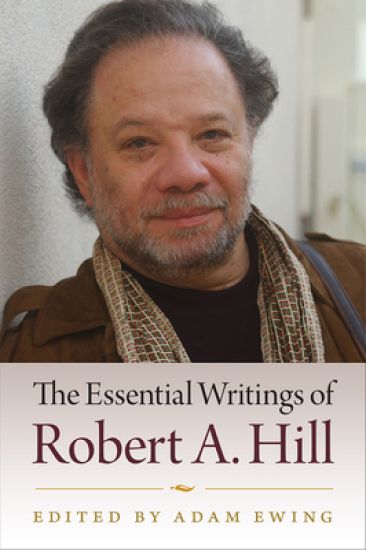
The Essential Writings of Robert a. Hill

The Essential Writings of Robert a. Hill

Robert A. Hill

University Press of Florida
2024
sidottu
Collected for the first time, the foundational contributions of a scholar and activist who shaped the study of Garveyism and pan-Africanism. This volume brings together Robert A. Hill's most important writings for the first time, highlighting his intellectual contributions to the history of pan-Africanism. A pioneering scholar and activist, a ground-breaking builder of pan-African archives, and the editor of the multivolume Marcus Garvey and Universal Negro Improvement Association Papers, Hill remains under-acknowledged for his influence on the field. This collection is a long-overdue testament to his legacy. Adam Ewing showcases Hill's ground-breaking writings on Garveyism, the pan-African, anticolonial movement that spread across the globe following World War I. Hill's essays trace Marcus Garvey's evolving thought and illuminate the resonance of the movement in the Caribbean and its diaspora, in the United States, and across sub-Saharan Africa. The volume also includes Hill's writings on diverse aspects of pan-Africanism, including the imposter figure in diaspora history, Cyril Briggs's African Blood Brotherhood, the Rastafarian movement, the fiction of George Schuyler, George Beckford and the Abeng collective in Jamaica, the theories of Walter Rodney, the life and thought of C.L.R. James, and the music of Bob Marley. This volume not only demonstrates Hill's intellectual praxis and its roots in his academic influences and personal experiences but also reveals the breadth, diversity, complexity, and centrality of the pan-African tradition in African diasporic politics and thought. Publication of this work made possible by a Sustaining the Humanities through the American Rescue Plan grant from the National Endowment for the Humanities.
Robert A. Woods, Champion of Democracy

Robert A. Woods, Champion of Democracy

Eleanor Howard Bush Woods

Hassell Street Press
2021
sidottu
This work has been selected by scholars as being culturally important and is part of the knowledge base of civilization as we know it.This work is in the public domain in the United States of America, and possibly other nations. Within the United States, you may freely copy and distribute this work, as no entity (individual or corporate) has a copyright on the body of the work.Scholars believe, and we concur, that this work is important enough to be preserved, reproduced, and made generally available to the public. To ensure a quality reading experience, this work has been proofread and republished using a format that seamlessly blends the original graphical elements with text in an easy-to-read typeface.We appreciate your support of the preservation process, and thank you for being an important part of keeping this knowledge alive and relevant.
Robert A. Woods, Champion of Democracy

Robert A. Woods, Champion of Democracy

Eleanor Howard Bush Woods

Hassell Street Press
2021
nidottu
This work has been selected by scholars as being culturally important and is part of the knowledge base of civilization as we know it.This work is in the public domain in the United States of America, and possibly other nations. Within the United States, you may freely copy and distribute this work, as no entity (individual or corporate) has a copyright on the body of the work.Scholars believe, and we concur, that this work is important enough to be preserved, reproduced, and made generally available to the public. To ensure a quality reading experience, this work has been proofread and republished using a format that seamlessly blends the original graphical elements with text in an easy-to-read typeface.We appreciate your support of the preservation process, and thank you for being an important part of keeping this knowledge alive and relevant.
Robert A. Dahl: an unended quest
This book is devoted to the work of Robert A. Dahl, who passed away in 2014. Dahl was one of the most important American political scientists and normative democratic theorists of the post-war era, and he was also an influential teacher who mentored some of the most significant academics of the next two generations of American political science. As an incredibly productive scholar he had a career that spanned more than half a century, his first book was published in 1950 his last was in 2007 at the age of 92. As a political scientist, he was respected even by those who were critical of his works. This theoretical significance and profound influence is reflected in the collection of chapters in this volume, which reads like a ‘who’s who’ of the contemporary US political science scene. His co-author Bruce Stinebrickner documents the evolution of his and Dahl’s seminal text, Modern Political Analysis and how it became the standard introduction to American political science for nearly fifty years. Katharine MacKinnon’s chapter is of significance for its insights upon Dahl and also represents a succinct statement of a feminist reading and critique of contemporary political science. Steven Lukes contributes a highly concise statement of the difference between one-dimensional and three-dimensional power.This work will be a standard reference work for any researchers or those interested in the work of Robert Dahl, among both established academics and students. This book was originally published as a special issue of the Journal of Political Power.
Robert A. Dahl
This book is devoted to the work of Robert A. Dahl, who passed away in 2014. Dahl was one of the most important American political scientists and normative democratic theorists of the post-war era, and he was also an influential teacher who mentored some of the most significant academics of the next two generations of American political science. As an incredibly productive scholar he had a career that spanned more than half a century, his first book was published in 1950 his last was in 2007 at the age of 92. As a political scientist, he was respected even by those who were critical of his works. This theoretical significance and profound influence is reflected in the collection of chapters in this volume, which reads like a ‘who’s who’ of the contemporary US political science scene. His co-author Bruce Stinebrickner documents the evolution of his and Dahl’s seminal text, Modern Political Analysis and how it became the standard introduction to American political science for nearly fifty years. Katharine MacKinnon’s chapter is of significance for its insights upon Dahl and also represents a succinct statement of a feminist reading and critique of contemporary political science. Steven Lukes contributes a highly concise statement of the difference between one-dimensional and three-dimensional power.This work will be a standard reference work for any researchers or those interested in the work of Robert Dahl, among both established academics and students. This book was originally published as a special issue of the Journal of Political Power.
A Life for the Confederacy: As Recorded in the Pocket Diaries of Robert A. Moore

A Life for the Confederacy: As Recorded in the Pocket Diaries of Robert A. Moore

Robert A. Moore; James W. Silver; Bell Irvin Wiley

Literary Licensing, LLC
2011
sidottu
""A Life For The Confederacy: As Recorded In The Pocket Diaries Of Robert A. Moore"" is a historical book written by Robert A. Moore. The book is a compilation of the personal diaries of Robert A. Moore, a soldier who fought for the Confederacy during the American Civil War. The diaries were discovered by the author's great-grandson and provide a unique insight into the daily life of a Confederate soldier.The book is divided into chapters that cover different periods of the war, from the early days of training to the final battles. The author provides historical context for each chapter, explaining the significance of the events that occurred during that time. The diaries themselves are presented in their original form, with annotations and explanations provided by the author.The book provides a vivid and detailed account of life as a Confederate soldier, including the hardships of camp life, the battles fought, and the relationships formed with fellow soldiers. It also offers a glimpse into the personal life of Robert A. Moore, including his thoughts on the war, his family, and his faith.Overall, ""A Life For The Confederacy: As Recorded In The Pocket Diaries Of Robert A. Moore"" is a valuable historical document that provides a unique perspective on the American Civil War. It is a must-read for anyone interested in this period of history, as well as for those interested in the personal experiences of soldiers during wartime.This scarce antiquarian book is a facsimile reprint of the old original and may contain some imperfections such as library marks and notations. Because we believe this work is culturally important, we have made it available as part of our commitment for protecting, preserving, and promoting the world's literature in affordable, high quality, modern editions, that are true to their original work.