Kirjojen hintavertailu. Mukana 11 699 587 kirjaa ja 12 kauppaa.

Kirjahaku

Etsi kirjoja tekijän nimen, kirjan nimen tai ISBN:n perusteella.

1000 tulosta hakusanalla Robert Bellarmine Sj

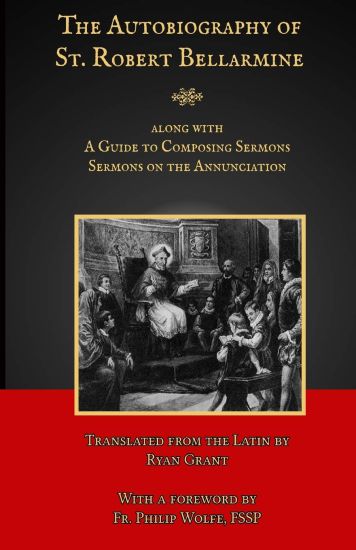
The Autobiography of St. Robert Bellarmine: Also Containing: A Guide to Composing Sermons - Sermons on the Annunciation
"During another chaotic time in the Church, St Philip Neri used to tell his directees that he didn't care what they read, as long as the author's name began with the letters ST. That advice is just as helpful today as it was then." -Fr. Philip Wolfe, FSSP, from the foreword.The first English translation of St. Robert Bellarmine's autobiography is the only account of the saint currently in print. Though Bellarmine never set out to compose any writings, he always did so out of obedience. He wrote this short autobiography for 2 of his brother Jesuits out of courtesy for their request to have an account of his life. It was never intended it for any eyes but theirs, nevertheless it was discovered and published in the 18th century, and became a great success. It is a brief and simple account of the life and travails of a great soul that loved Jesus Christ above all things.Also contained in this volume are St. Robert's advice philosophy for writing sermons, as well as his many sermons on the Gospel Missus est, exploring the depths of the mysteries contained in the Annunciation to the Blessed Virgin, taken from sermons that he preached in Italy while he was a Cardinal in Rome.Appendices have also been added to this addition to add some explanation of historical details that St. Robert relates that are not as clear to us today.
On the Church: On Councils, the Church Militant, on the Marks of the Church
St. Robert Bellarmine's treatises on the main controversies in Theology between Catholics and Protestants is unparalleled in its breadth and depth of scholarship and argumentation-4 centuries later. In the second installment of the Controversies, Bellarmine takes up the Controversies on Councils, the Church Militant, and the Marks of the Church so as to present the totality of the Catholic teaching on Ecclesiology and refute the arguments of the Protestants of his day, preeminently Luther, Calvin and Ochenius, and in addition, Greek Orthodox objections. Bellarmine's work in this area was not only standard reading, but the foundation of all subsequent treatises on Ecclesiology. For the first time, these treatises are available in English.
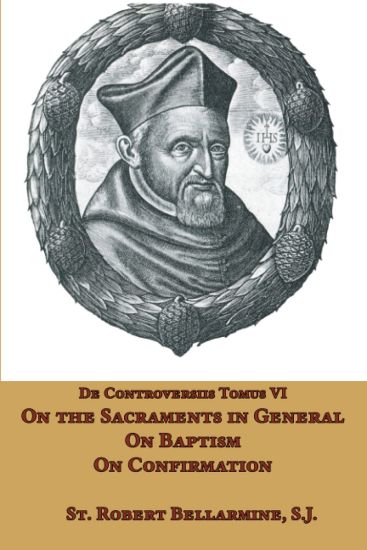
On the Sacraments in General, Baptism, and Confirmation
In the first volume on the Sacraments, St. Robert follows the order of teaching in the Council of Trent to defend Catholic truth against the teaching of early Protestants. In his work On the Sacraments in General, He defends the Catholic notion of Sacraments as well as their use. He looks to the definition of a Sacrament, and then the matter and form, the author of the Sacraments, the difference between the Sacraments used in the Old Testament and in the New, whether one can change the matter and form, as well as the notion of the minister of the Sacrament, and what he must intend to do for the Sacraments to be valid. According St. Robert's custom, he defends all of his argumentation first from Scripture, and then from Tradition, providing penetrating exegetical commentary combined with the consensus of the teaching of the Fathers in defense of the universal Catholic teaching upheld at Trent. He also adds argumentation from reason, and takes head on the arguments of the early Protestants at every turn, showing the contradictions of Luther, the misuse of Scripture of Calvin, and the foolishness of Martin Chemnitz. In book II, St. Robert defends their effects and their number, as well as the validity of ceremonies approved by the Church. St. Robert demonstrates, on the sure foundation of Scripture and the Fathers, that the Sacraments obtain their effect ex opere operato, what is meant by that term and how the Protestants misunderstood it. He also defends the Scholastics against attacks and abuses which Calvin and Chemnitz heap on them. Moving on to other matters, St. Robert defends that the effect of grace in the Sacraments is only found ex opere operato in the New Testament. Lastly, he proves that the Church has the power to effect new ceremonies for the Sacraments, and defends the use of the Latin language in the Western Church, or Greek and Aramaic in the Eastern Churches.In On Baptism and Confirmation, he defends the Catholic teaching on regeneration in Baptism, along with the existence and effects of Confirmation. As always, he draws his arguments from Scripture, and the Fathers, combining faithful exegesis with the witness of the Church in all ages. St. Robert defends the form and matter of Baptism, catches the Protestants in contradictions, and defends that it is necessary for salvation, whereas faith alone does not justify. He goes on to show that it can be administered to children against the Anabaptists, and the difference between the Baptism of Christ and that of John. Then, on Confirmation, St. Robert shows from Scripture and Tradition that Confirmation is attested to by the actions of the Apostles, and the teaching which they passed down to the Fathers, along with its effects, ceremonies, and refutation of Protestant arguments against it. Apart from Calvin, Bellarmine makes a systematic refutation of Martin Chemnitz's Examination of the Council of Trent on any subjects touching upon the Sacraments."For five years in Chablais, I preached with no books other than the Bible, and the Great Bellarmine." -St. Francis de Sales
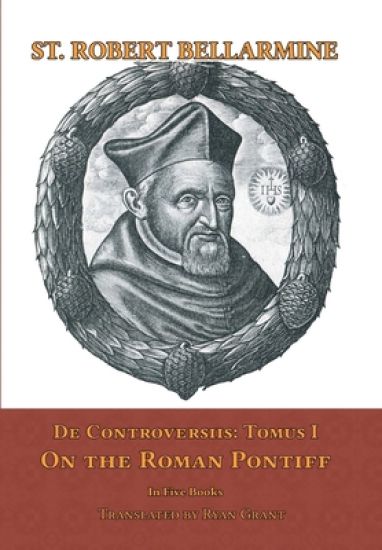
De Controversiis I

De Controversiis I

Ryan Grant (Translator); Sj St Robert Bellarmine

Lulu.com
2017
sidottu
In this Theological treatise St. Robert Bellarmine takes on Protestant as well as Greek Orthodox objections to the Papacy in five books. In the first, he argues that Christ established the Primacy of Peter by means of an Ecclesiastical Monarchy, why it is fitting that the Church's government should be a monarchy; Exegetical Commentary on the Lord's words in Matthew 16 and John 21, along with copious Patristic testimony. In Book 2 is whether Peter has successors in the Ecclesiastical Monarchy, wherein Bellarmine defends the Church's position on the true history of Peter; that Peter truly went to Rome; that Peter was truly a Bishop there. In Book 3 Bellarmine shows the Pope is not Antichrist. In Book 4, Bellarmine argues why the Pope is infallible when he defines a doctrine on faith and morals and proceeds to defend Popes whom Protestants and others argued had erred while defining faith. In book 5, Bellarmine takes up the question of the Popes' power in civil affairs.
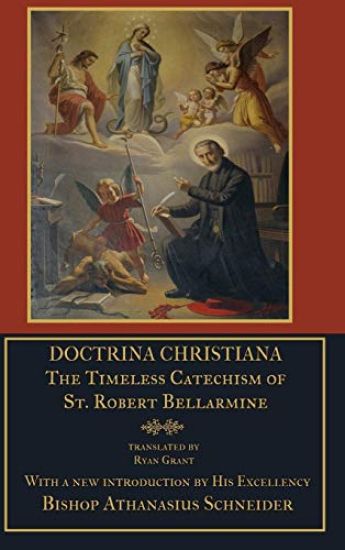
Doctrina Christiana: the Timeless Catechism of St. Robert Bellarmine

Doctrina Christiana: the Timeless Catechism of St. Robert Bellarmine

S.J. Bellarmine; Ryan Grant; Bishop Athanasius Schneider

Lulu.com
2016
sidottu
This catechism can be considered as a valid and effective catechetical tool for the work of the evangelization, a work which has to be realized with a new missionary zeal towards those who don't know the Catholic faith and as well towards those who know it defectively and insufficiently. May those who will read this catechism and those who will use it in the noble and meritorious work of teaching Christian doctrine, may be equipped with the sure and sacred doctrine of the Catholic faith, in order to stand, having their loins girt about with truth. -Bishop Athanasius Schneider This is the first English translation of St. Robert Bellarmine's Long Catechism, which follows a traditional question and answer model but gives deep meditations on the truths of faith. It was written for students with some education as well as for those who would teach Catechism. It was explicitly approved by Pope Clement VIII and praised by Pope Benedict XIV and Pius XI. St. Robert Bellarmine is a doctor of the Church.
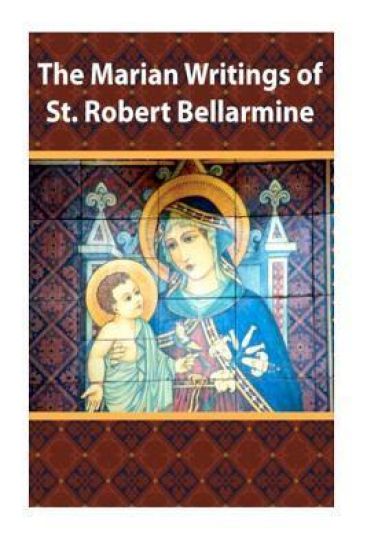
The Marian Writings of St. Robert Bellarmine

The Marian Writings of St. Robert Bellarmine

Robert Bellarmine

Createspace Independent Publishing Platform
2012
nidottu
"The Church of God has not his equal in learning." - Pope Clement VIII about St. Robert BellarmineBrilliant Saint and Doctor of the Church reveals his "Marian Method" to give Catholics the best one-two punch to skyrocket their devotion to Mary...and their skills in Marian apologeticsYour time's valuable, so I'll get right to the point.St. Robert Bellarmine was the most learned man in the Church during his lifetime.He was also known as the best teacher in Rome.People flocked to his classes. The Cardinals and Bishops in Rome sent others to his classes to takes notes for them.St. Robert's Marian writings are so easy to understand, that it'll be a breeze for you to absorb them. And it won't take you a lot of time.This collection includes his writings on Marian apologetics, his Marian sermons and sermon fragments.It also contains biographical material about him, which, until now, has never been translated. It's all focused on how he lived his own devotion to Mary.That's where he shows you "how to learn from the example of Mary."This is only place you'll find this material in English.Pope St. Pius X wrote about the Blessed Mother: "Hence nobody ever knew Christ so profoundly as she did, and nobody can ever be more competent as a guide and teacher of the knowledge of Christ."Hence it follows, as We have already pointed out, that the Virgin is more powerful than all others as a means for uniting mankind with Christ."That was true in St. Robert's life, because during the process of his canonization, the Church concluded that he'd never committed a deliberate venial sin. And since God grants all graces through Mary, that was a special grace that she obtained for him.Imagine what the Marian writings of someone who lived so close to Jesus and Mary will do for your spiritual life.Blessed Pope Pius IX stated: "God has committed to Mary the treasury of all good things, in order that everyone may know that through her are obtained every hope, every grace, and all salvation. For this is His will, that we obtain everything through Mary."Furthermore, Pope St. Paul VI wrote..."Mary is not only an example for the whole Church in the exercise of divine worship but is also, clearly, a teacher of the spiritual life for individual Christians" (Marialis Cultis, 21).That's why not growing closer to Mary is a guaranteed loss.Since God grants all graces through Mary, the only way to get close to Him is through her."The Marian Writings of St. Robert Bellarmine" is your practical handbook to help you deepen your relationship with Mary, so that she can draw you closer to God. If you like clear advice and simple practices you can start today, then you'll love St. Robert's life-changing guide.Buy "The Marian Writings of St. Robert Bellarmine" to start catapulting your devotion to Mary and your skills in Marian apologetics today
Doctrina Christiana: The Timeless Catechism of St. Robert Bellarmine
This catechism can be considered as a valid and effective catechetical tool for the work of the evangelization, a work which has to be realized with a new missionary zeal towards those who don't know the Catholic faith and as well towards those who know it defectively and insufficiently.May those who will read this catechism and those who will use it in the noble and meritorious work of teaching Christian doctrine, may be equipped with the sure and sacred doctrine of the Catholic faith, in order to stand, having their loins girt about with truth, and having on the breastplate of righteousness; and their feet shod with the preparation of the gospel of peace; above all, they shall take the shield of faith, wherewith they shall be able to quench all the fiery darts of the wicked (cf. Eph 6: 14-16). In this way they will be ready always to give an answer to every man that asks them the reason of their hope, with meekness and fear (cf. 1 Peter 3: 15-16).-Bishop Athanasius Schneider, from the ForewordFor the first time, St. Robert Bellarmine's long Catechism, written in the form of a dialogue, has been made available in the English Language.This Catechism was composed by St. Robert Bellarmine in 1598 and received Papal approbation from several Popes, most notably Pope Clement VIII and one of the greatest theologians to ever sit on the throne of St. Peter, Pope Benedict XIV. It was translated into Latin for use throughout the Church and has run through a number of editions throughout the centuries. Being written as a dialogue, it goes beyond the rote memorization of other catechisms (including that of Baltimore) by giving a deep explanation of the teachings of the faith with comparisons and parables.What is wholesome about this Catechism is not only the soundness of its doctrine, but the warmth that a great theologian that was accustomed to dealing with complicated matters of theology descends to lovingly explain the basic truths of faith in a manner that average laity can easily understand. It is not for nothing that St. Robert was made the Patron of all Catechists
Robert Bellarmine, Saint and Scholar

Robert Bellarmine, Saint and Scholar

James 1891-1973 Brodrick

Hassell Street Press
2021
sidottu
This work has been selected by scholars as being culturally important and is part of the knowledge base of civilization as we know it.This work is in the public domain in the United States of America, and possibly other nations. Within the United States, you may freely copy and distribute this work, as no entity (individual or corporate) has a copyright on the body of the work.Scholars believe, and we concur, that this work is important enough to be preserved, reproduced, and made generally available to the public. To ensure a quality reading experience, this work has been proofread and republished using a format that seamlessly blends the original graphical elements with text in an easy-to-read typeface.We appreciate your support of the preservation process, and thank you for being an important part of keeping this knowledge alive and relevant.
Robert Bellarmine, Saint and Scholar

Robert Bellarmine, Saint and Scholar

James 1891-1973 Brodrick

Hassell Street Press
2021
nidottu
This work has been selected by scholars as being culturally important and is part of the knowledge base of civilization as we know it.This work is in the public domain in the United States of America, and possibly other nations. Within the United States, you may freely copy and distribute this work, as no entity (individual or corporate) has a copyright on the body of the work.Scholars believe, and we concur, that this work is important enough to be preserved, reproduced, and made generally available to the public. To ensure a quality reading experience, this work has been proofread and republished using a format that seamlessly blends the original graphical elements with text in an easy-to-read typeface.We appreciate your support of the preservation process, and thank you for being an important part of keeping this knowledge alive and relevant.
St. Robert Bellarmine

St. Robert Bellarmine

Shaun McAfee

En Route Books Media
2019
nidottu
St. Robert Bellarmine (1542-1621) was a prolific author of the Counter Reformation and great defender of the Catholic Church. This book tells the story of the great saint who went from obscure title to become one of the most famous saints of his time.
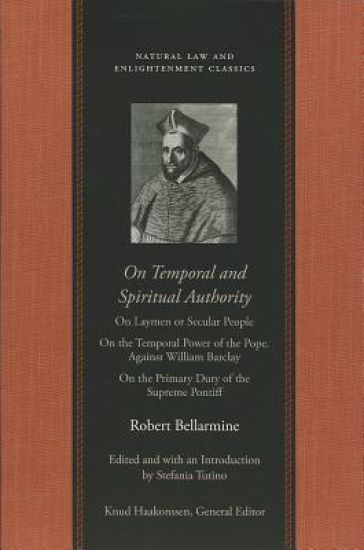
On Temporal & Spiritual Authority

On Temporal & Spiritual Authority

Robert Bellarmine

Liberty Fund Inc
2012
nidottu
Robert Bellarmine was one of the most original and influential political theorists of his time. He participated in several of the political debates that agitated early modern Europe, such as the controversy over the Oath of Allegiance in England. Bellarmine presents one of the clearest and most coherent definitions of the nature and aim of temporal authority and its relationship to spiritual authority. The king has jurisdiction over the body, the pope over the conscience. This distinction was crucial for the history of early modern monarchies: the conflict between state and church ceased to be concerned with physical persons and become a contest for the consciences of subjects. The political thought of Bellarmine was at the center of post-Reformation debates on the relationship between state and church; on the nature, aim, and limits of temporal government; and on the relation between religion and natural law. He posed in a novel, controversial manner the relationship between public and private spheres, thus opening up questions central to what we consider 'modernity'. This accessible edition of some of Ballarmine's most important works in fresh translations will be interesting for a wide readership of both scholars of political thought and the educated general public.
The Art of Dying Well: Large Print Edition

The Art of Dying Well: Large Print Edition

Robert Bellarmine

Createspace Independent Publishing Platform
2017
nidottu
Excerpt: CHAPTER I. HE WHO DESIRES TO DIE WELL, MUST LIVE WELL I NOW commence the rules to be observed in the Art of dying well. This art I shall divide into two parts: in the first I shall speak of the precepts we must follow whilst in good health; in the other of those we should observe when we are dangerously ill, or near death's door. We shall first treat of those precepts that relate to virtue; and afterwards of those which relate to the sacraments: for, by these two we shall be especially enabled both to live well, and to die well. But the general rule, " that he who lives well, will die well," must be mentioned before all others: for since death is nothing more than the end of life, it is certain that all who live well to the end, die well; nor can he die ill, who hath never lived ill; as, on the other hand, he who hath never led a good life, cannot die a good death. The same thing is observable in many similar cases: for all that walk along the right path, are sure to arrive at the place of their destination; whilst, on the contrary, they who wander from it, will never arrive at their journey's end. They also who diligently apply to study, will soon become learned doctors; but they who do not, will be ignorant. But, perhaps, some one may mention, as an objection, the example of the good thief, who lived ill and yet died well. This was not the case; for that good thief led a holy life, and therefore died a holy death. But, even supposing he had spent the greater part of his days in wickedness, yet the other part of his life was spent so well, that he easily repented of his former sins, and gained the greatest graces. For, burning with the love of God, he openly defended our Saviour from the calumnies of His enemies; and filled with the same charity towards his neighbour, he rebuked and admonished his blaspheming companion, and endeavoured to convert him. He was yet alive when he thus addressed him, saying: "Neither dost thou fear God, seeing thou art under the same condemnation? And we indeed justly, for we receive the due reward of our deeds: but this man hath done no evil." (St. Luke 23:40, 41.) Neither was he dead when, confessing and calling upon Christ, he uttered these noble words: "Lord, remember me when thou shalt come into thy kingdom." The good thief then appeared to "have been one of those who came last into the vineyard, and yet he received a reward greater than the first." True, therefore, is the sentence, " He who lives well, dies well;" and, "He who lives ill, dies ill." We must acknowledge that it is a most dangerous thing to deter till death our conversion from sin to virtue: far more happy are they who begin to carry the yoke of the Lord "from their youth," as Jeremiah saith; and exceedingly blessed are those, "who were not defiled with women, and in whose mouth there was found no lie: for they are without spot before the throne of God. These were purchased from among men, the first-fruits to God and to the Lamb." (Apoc. 14:4, 5.) Such were Jeremias, and St. John, "more than a prophet;" and above all, the Mother of our Lord, as well as many more whom God alone knoweth. This first great truth now remains established, that a good death depends upon a good life.