Kirjojen hintavertailu. Mukana 11 244 527 kirjaa ja 12 kauppaa.

Kirjahaku

Etsi kirjoja tekijän nimen, kirjan nimen tai ISBN:n perusteella.

1000 tulosta hakusanalla Robert Brown

The Miscellaneous Botanical Works of Robert Brown

The Miscellaneous Botanical Works of Robert Brown

Robert Brown

Cambridge University Press
2015
pokkari
The botanist Robert Brown (1773–1858) is regarded as one of the most significant figures in the advancement of plant science in the nineteenth century. After studying at Aberdeen and Edinburgh, he made the acquaintance of Sir Joseph Banks via William Withering, and in 1801 was appointed as naturalist on Matthew Flinders' expedition to Australia. Brown made extensive collections of animals and minerals, but his 3,400 plant specimens from Australia, Tasmania and Timor were the foundation of his work for the rest of his life, as an active member of the Linnean Society, as Banks's librarian, and as an under-librarian in the British Museum. This two-volume collection of his 'miscellaneous botanical works', edited by John J. Bennett, Brown's assistant at the British Museum, was published in 1866–7. It has not been possible to reissue the accompanying quarto volume of plates. Volume 1 contains 'Geographico-Botanical Memoirs' and 'Structural and Physiological Memoirs'.
The Miscellaneous Botanical Works of Robert Brown

The Miscellaneous Botanical Works of Robert Brown

Robert Brown

Cambridge University Press
2015
pokkari
The botanist Robert Brown (1773–1858) is regarded as one of the most significant figures in the advancement of plant science in the nineteenth century. After studying at Aberdeen and Edinburgh, he made the acquaintance of Sir Joseph Banks via William Withering, and in 1801 was appointed as naturalist on Matthew Flinders' expedition to Australia. Brown made extensive collections of animals and minerals, but his 3,400 plant specimens from Australia, Tasmania and Timor were the foundation of his work for the rest of his life, as an active member of the Linnean Society, as Banks's librarian, and as an under-librarian in the British Museum. This two-volume collection of his 'miscellaneous botanical works', edited by John J. Bennett, Brown's assistant at the British Museum, was published in 1866–7. It has not been possible to reissue the accompanying quarto volume of plates. Volume 2 contains 'Systematic Memoirs' and 'Contributions to Systematic Works'.
The miscellaneous botanical works of Robert Brown (Volume I)
This book has been considered by academicians and scholars of great significance and value to literature. This forms a part of the knowledge base for future generations. So that the book is never forgotten we have represented this book in a print format as the same form as it was originally first published. Hence any marks or annotations seen are left intentionally to preserve its true nature.
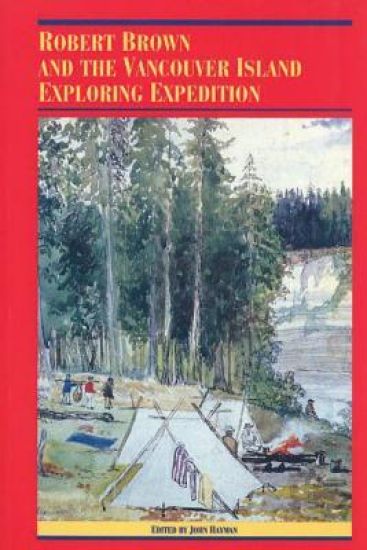
Robert Brown and the Vancouver Island Exploring Expedition
Robert Brown, a twenty-one-year-old Scotsman, arrived on Vancouver Island in 1863 for the purpose of collecting seeds, roots, and plants for the Botanical Association of Edinburgh. Relations with his employer quickly deteriorated, however, and when the opportunity arose in 1864 to head the Vancouver Island Exploring Expedition, Brown eagerly accepted the position as its commander.During the four and a half months of the expedition, Brown kept a journal which is published here for the first time. It is remarkable for its record of life on Vancouver Island over a century ago and its description of the island's pristine wilderness as well as for its proposals for future economic development. The accounts of agricultural settlements at Cowichan, Chemainus, and Comox and of the coal-mining town of Nanaimo are among the earliest available.The Vancouver Island Exploring Expedition did not venture north of Comox, but it crossed the island at several points, often by new routes, and in the process left its mark by giving place names to several locations. The expedition's most celebrated achievement was the discovery of gold at Leech River, named after the second-in-command, which resulted in a short but sensational gold rush.Robert Brown was exceptionally interested in the way of life of the native people. His entries on land reserve policies and on the failure to settle land claims are especially pertinent today. Excerpts from his related writings, among them one of the earliest records of a potlatch (at Alberni) and a collection of Indian myths and legends display an appreciation unusual at that time.Most of the known drawings of the expedition by Frederick Whymper, the travelling artist, are included in the book and give a contemporary view of many of the sites the expedition encountered. A checklist of Brown's other writings on the northwest coast completes the book.
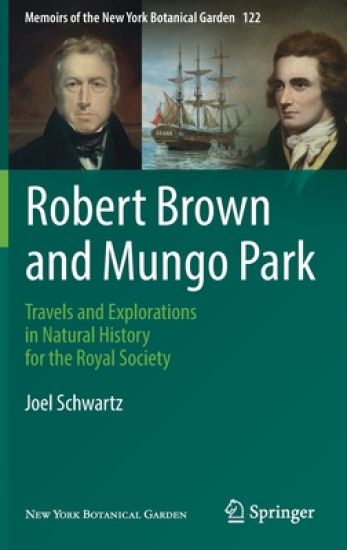
Robert Brown and Mungo Park

Robert Brown and Mungo Park

Joel Schwartz

Springer Nature Switzerland AG
2021
sidottu
Explorer-naturalists Robert Brown and Mungo Park played a pivotal role in the development of natural history and exploration in the late eighteenth and early nineteenth centuries. This work is a fresh examination of the lives and careers of Brown and Park and their impact on natural history and exploration. Brown and Park were part of a group of intrepid naturalists who brought back some of the flora and fauna they encountered, drawings of what they observed, and most importantly, their ideas. The educated public back home was able to gain an understanding of the diversity in nature. This eventually led to the development of new ways of regarding the natural world and the eventual development of a coherent theory of organic evolution. This book considers these naturalists, Brown, Park, and their contemporaries, from the perspective of the Scottish Enlightenment. Brown’s investigations in natural history created a fertile environment for breakthroughs in taxonomy, cytology, and eventually evolution. Brown’s pioneering work in plant taxonomy allowed biologists to look at the animal and plant kingdoms differently. Park’s adventures stimulated significant discoveries in exploration. Brown and Park’s adventures formed a bridge to such journeys as Charles Darwin’s voyage on H.M.S. Beagle, which led to a revolution in biology and full explication of the theory of evolution.
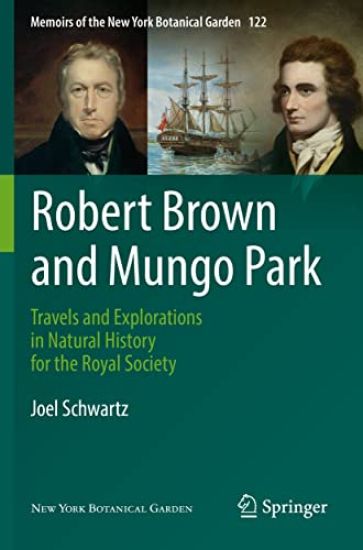
Robert Brown and Mungo Park

Robert Brown and Mungo Park

Joel Schwartz

Springer Nature Switzerland AG
2021
nidottu
Explorer-naturalists Robert Brown and Mungo Park played a pivotal role in the development of natural history and exploration in the late eighteenth and early nineteenth centuries. This work is a fresh examination of the lives and careers of Brown and Park and their impact on natural history and exploration. Brown and Park were part of a group of intrepid naturalists who brought back some of the flora and fauna they encountered, drawings of what they observed, and most importantly, their ideas. The educated public back home was able to gain an understanding of the diversity in nature. This eventually led to the development of new ways of regarding the natural world and the eventual development of a coherent theory of organic evolution. This book considers these naturalists, Brown, Park, and their contemporaries, from the perspective of the Scottish Enlightenment. Brown’s investigations in natural history created a fertile environment for breakthroughs in taxonomy, cytology, and eventually evolution. Brown’s pioneering work in plant taxonomy allowed biologists to look at the animal and plant kingdoms differently. Park’s adventures stimulated significant discoveries in exploration. Brown and Park’s adventures formed a bridge to such journeys as Charles Darwin’s voyage on H.M.S. Beagle, which led to a revolution in biology and full explication of the theory of evolution.
The Poetical Works of Robert Browning: Volume VII. The Ring and the Book, Books I-IV
Henry James described Browning's extended dramatic poem The Ring and the Book, over 20,000 lines in length, as `a great living thing', `a proportioned monstrous magnificence'. The story was developed from some old legal documents discovered by Browning concerning an actual murder which took place in Rome in 1698, and its writing was his major preoccupation in the 1860s, the early years of his widowerhood in London. This volume gives us the first third of the poems, Books I to IV. The Introduction draws on unpublished letters, journals, and working papers not examined by previous editors, to illuminate how the poem was conceived and researched, the range of people the poet consulted, and the five-year period of composition. The poem's complex publishing history is disentangled in the Text part of the Introduction, including a discussion of the corrections and revisions Browning made on sheets from volumes I, III, and IV of the second edition, which he later forgot and which never appeared in print. Appendix E gives these important variants in full. The annotation presents new contextual matter, including unpublished letters relating to `Lyric Love', Browning's famous invocation to his dead wife. The appendices give the original Italian text of Browning's second source, `Morte dell'Uxoricida Guido Franceschini Decapitato'; two previously unpublished autograph chronologies in which the poet worked out historical details of his story; and a new account of the biographical significance of the `Ring' image. The editors have made six substantive emendations to the text, ranging from inaccuracies in the original typesetting to changes made by Browning after publication. The evolution of the text from manuscript to copy text is also discussed, and an appendix is devoted to a set of corrected proofs preserved at Yale, a textual evolutionary dead end of great interest and significance.
The Poetical Works of Robert Browning: Volume III. Bells and Pomegranates I-VI
This volume contains six of the eight Bells and Pomegranates, modestly-priced pamphlets published by Edward Moxon in a bid to help Browning recover from the ridicule which greeted the first appearance of Sordello. It includes Pippa Passes, four other dramatic works, and Dramatic Lyrics, the first of the great collections of short poems with which Browning established his reputation. In addition, a version of a poem on the Pied Piper by Browning's father is here printed for the first time. All significant textual variants are recorded, and each of the Bells is accompanied by an introduction and by full annotation. New information throws further light on this most important period in Browning's poetic career.
The Poetical Works of Robert Browning: Volume IV
`Browning really comes back to life in the marvellous third volume of the new Oxford Browning', wrote John Bayley, choosing it as one of his Books of the Year for 1988. While Volume III included six of the eight Bells and Pomegranates pamphlets, the present volume completes the series and includes the most remarkable of all, Dramatic Romances and Lyrics. Here we find `Pictor Ignotus', `The Lost Leader', `The Bishop orders his Tomb', `The Laboratory', `The Boy and the Angel', and the first part of `Saul'. Also included are Christmas-Eve and Easter-Day and the essay on Shelley. As the Times Literary Supplement reviewer of the earlier volumes commented, `readers of a poet like this need all the help they can get; and Jack and Smith have provided it in abundance.' Each poem is fully annotated, and accompanied by a detailed introduction which provides information on the chronology of composition and on Browning's sources.
The Poetical Works of Robert Browning: Volume V. Men and Women
This is the first full scholarly edition of Browning's greatest and perhaps best-known collection of short poems, Men and Women. A comprehensive introduction shows how new research by Ian Jack an Robert Inglesfield has unearthed material which throws fresh light on the composition and dates of such famous pieces as 'Fra Lippo Lippi', 'Childe Roland to the Dark Tower Came', and 'One Word More: To E.B.B.'. This edition uses a critical text based on that of Browning's final collection, and has detailed introductions to the individual poems. It is the fifth volume in the highly praised Political Works of Robert Browning.