

Kirjahaku
Etsi kirjoja tekijän nimen, kirjan nimen tai ISBN:n perusteella.
1000 tulosta hakusanalla Robert Burson



The Prophecy The Prophecy is a story of the convergence of an ancient prophecy and modern terrorism. On November 2, 1148, Malachy, Archbishop of Amagh Ireland dies in France before he can complete his second pilgrimage to Rome thus fulfilling a prediction that he would die in the arms of a saint (St. Bernard). Though he didn't complete his journey he did manage to record his vision of 112 remaining Popes. The story opens with only two Popes remaining on that visionary list. When the Pope of many years dies, a new Pontiff is elected after an anything but smooth conclave. The Cardinals choose a young Palestinian bishop born in Israel and currently serving as the Patriarch of Jerusalem. Salim Ateek takes as his Papal name Peter II thus disturbing traditional church members while at the same time fulfilling Malachy's prophecy about the final Pope. In America religious revivalism has morphed into sectarian violence. An FBI task force lead by Sean Murphy is established to combat this turn of events which includes random hate crimes against various religious organizations. Joining Sean is a mysterious CIA agent, Amanda Chehwan, a soon to be murdered Lebanese national. At the same time Lukas Schafer, Murphy's parish priest, a charismatic leader creates a schismatic break from the Catholic Church by beginning a new and widely popular church luring converts from both the Catholic as well as other established religions. Murphy's investigation leads him to his discovery of a spy working for the National Security Agency, a turncoat high up in the CIA, a power hungry media mogul and a money trail leading to Middle Eastern interests. As the story moves towards its climactic conclusion the new Pope comes to American in hopes of repairing the ever-widening schism. However, other forces do not want this reconciliation to take place and plan to kill the Pope. Murphy learns of the plot and the book ends with Murphy's fight against time to save the Pontiff and the subsequent fallout from the assassination attempt.


Robert Burton: The Anatomy of Melancholy: Volume IV: Commentary up to Part 1, Section 2, Member 3, Subsection 15, 'Misery of Schollers'
J. B. Bamborough
Clarendon Press
1998
sidottu
This is the fourth volume of the Clarendon edition of Robert Burton's Anatomy of Melancholy and the first of three volumes of Commentary. It contains commentary on the text up to p. 327 of volume one - i.e. The Argument of the Frontispeice, Democritus to the Reader, and Partition 1 as far as the end of Section 2, Member 3, Subsection 15: 'Misery of Schollers'. In his study of morbid psychology as it was understood in his day, Burton cites many other writers. No previous edition of the Anatomy has identified all of these or verified all his quotations. In addition to explanatory notes and translations of all the passages in Latin, this edition attempts to locate all Burton's sources in the actual books he himself owned or to which he probably had access. The last of the three volumes of commentary will contain a Biobibliography listing over 1,500 authorities referred to by Burton, many very obscure, and will give not only bibliographical details but information about the writers.
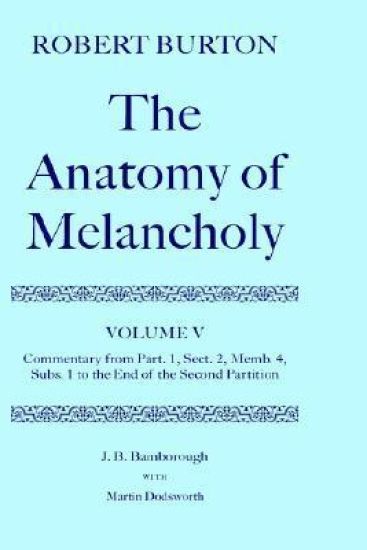
Robert Burton: The Anatomy of Melancholy: Volume V: Commentary from Part. 1, Sect. 2, Memb. 4, Subs. 1 to the End of the Second Partition
J. B. Bamborough; Martin Dodsworth
Clarendon Press
2000
sidottu
This, the fifth volume of the Clarendon Press edition of Robert Burton's Anatomy of Melancholy, contains commentary on the text from Partition 1, Section 2, Member 4, Subsection 1 until the end of Part. 1, and on the whole of the second Partition. It thus concludes Burton's account of the causes, the symptoms, and the prognosis of melancholy, and his examination of the remedies for the disease both spiritual and medical. As before, the aim of the commentary is to aid the reader to understand Burton's meaning (to which end all the passages in Latin are translated) and to identify the sources of his many quotations from and references to other authors. The third and last volume of the commentary, and of the edition, will contains a full Bibliography of these authors and brief biographical notes on them.

Robert Burton: The Anatomy of Melancholy: Volume VI: Commentary on the Third Partition, together with Biobibliographical and Topical Indexes
J. B. Bamborough; Martin Dodsworth
Clarendon Press
2000
sidottu
This, the final volume of the Clarendon Press edition of Burton's Anatomy of Melancholy, contains commentary on the Third Partition, in which Burton considers two especial forms of the disease, Love and Religious Melancholy. In treating of these Burton had fewer precedents to follow than in previous sections, but he was able to draw largely on his extensive knowledge of classical literature and also on his acquaintance with English drama and poetry (including popular verse). As ever his range of reference to other authors is wide, and the volume includes an index which gives biographical and bibliographical information concerning the more than 1550 authorities cited in the Anatomy, most of whom are little known today. Also included are an index of the major topics discussed in the Anatomy, and a complete bibliography of all the works mentioned in the commentary.
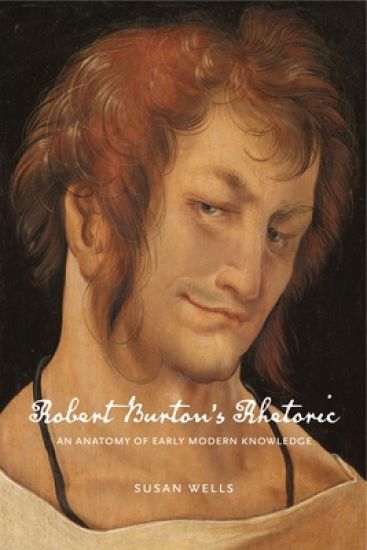
Published in five editions between 1621 and 1651, The Anatomy of Melancholy marks a unique moment in the development of disciplines, when fields of knowledge were distinct but not yet restrictive. In Robert Burton’s Rhetoric, Susan Wells analyzes the Anatomy, demonstrating how its early modern practices of knowledge and persuasion can offer a model for transdisciplinary scholarship today.In the first decades of the seventeenth century, Robert Burton attempted to gather all the existing knowledge about melancholy, drawing from professional discourses including theology, medicine, and philology as well as the emerging sciences. Examining this text through a rhetorical lens, Wells provides an account of these disciplinary exchanges in all their subtle variety and abundant wit, showing that questions of how knowledge is organized and how it is made persuasive are central to rhetorical theory. Ultimately, Wells argues that in addition to a book about melancholy, Burton’s Anatomy is a meditation on knowledge.A fresh interpretation of The Anatomy of Melancholy, this volume will be welcomed by scholars of early modern English and the rhetorics of health and medicine, as well as those interested in transdisciplinary work and rhetorical theory.
Published in five editions between 1621 and 1651, The Anatomy of Melancholy marks a unique moment in the development of disciplines, when fields of knowledge were distinct but not yet restrictive. In Robert Burton’s Rhetoric, Susan Wells analyzes the Anatomy, demonstrating how its early modern practices of knowledge and persuasion can offer a model for transdisciplinary scholarship today.In the first decades of the seventeenth century, Robert Burton attempted to gather all the existing knowledge about melancholy, drawing from professional discourses including theology, medicine, and philology as well as the emerging sciences. Examining this text through a rhetorical lens, Wells provides an account of these disciplinary exchanges in all their subtle variety and abundant wit, showing that questions of how knowledge is organized and how it is made persuasive are central to rhetorical theory. Ultimately, Wells argues that in addition to a book about melancholy, Burton’s Anatomy is a meditation on knowledge.A fresh interpretation of The Anatomy of Melancholy, this volume will be welcomed by scholars of early modern English and the rhetorics of health and medicine, as well as those interested in transdisciplinary work and rhetorical theory.

For more than a century after its initial publication in 1621, The Anatomy of Melancholy was extensively praised and almost as widely read as the Bible. A masterpiece of style and a unique compendium of insights and curious information, Burton's wide-ranging treatise on psychology and philosophy has earned a special place in English literature and continues to interest modern scholars. This new reference is the only complete and up-to-date bibliography of primary and secondary material devoted to Burton and his most famous work. Following a brief biography of Burton and an introductory discussion of The Anatomy of Melancholy and its history, Conn offers a list of important editions and reprints of the Anatomy, together with principal extracts editions. The second section is devoted to theses and dissertations on the subject and the third to other secondary sources. Entries are consecutively numbered and listed by author. Comprehensive indexes list citations by date, topic, and title. Thoroughly researched and painstakingly checked for errors, this volume represents a definitive update of earlier Burton bibliographies.

Few English books are as widely known, underread, and underappreciated as Robert Burton’s The Anatomy of Melancholy. Stephanie Shirilan laments that modern scholars often treat the Anatomy as an unmediated repository of early modern views on melancholy, overlooking the fact that Burton is writing a cento - an ancient form of satire that quotes and misquotes authoritative texts in often subversive ways - and that his express intent in so doing is to offer his readers literary therapy for melancholy. This book explores the ways in which the Anatomy dispenses both direct physic and more systemic medicine by encouraging readers to think of melancholy as a privileged mental and spiritual acuity that requires cultivation and management rather than cure. Refuting the prevailing historiography of anxious early modern embodiment that cites Burton as a key witness, Shirilan submits that the Anatomy rejects contemporary Neostoic and Puritan approaches to melancholy. She reads Burton’s erraticism, opacity, and theatricality as modes of resistance against demands for constancy, transparency, and plainness in the popular literature of spiritual and moral hygiene of his day. She shows how Burton draws on rhetorical, theological, and philosophical traditions that privilege the transformative powers of the imagination in order to celebrate melancholic impressionability for its capacity to inspire and engender empathy, charity, and faith.

Few English books are as widely known, underread, and underappreciated as Robert Burton’s The Anatomy of Melancholy. Stephanie Shirilan laments that modern scholars often treat the Anatomy as an unmediated repository of early modern views on melancholy, overlooking the fact that Burton is writing a cento - an ancient form of satire that quotes and misquotes authoritative texts in often subversive ways - and that his express intent in so doing is to offer his readers literary therapy for melancholy. This book explores the ways in which the Anatomy dispenses both direct physic and more systemic medicine by encouraging readers to think of melancholy as a privileged mental and spiritual acuity that requires cultivation and management rather than cure. Refuting the prevailing historiography of anxious early modern embodiment that cites Burton as a key witness, Shirilan submits that the Anatomy rejects contemporary Neostoic and Puritan approaches to melancholy. She reads Burton’s erraticism, opacity, and theatricality as modes of resistance against demands for constancy, transparency, and plainness in the popular literature of spiritual and moral hygiene of his day. She shows how Burton draws on rhetorical, theological, and philosophical traditions that privilege the transformative powers of the imagination in order to celebrate melancholic impressionability for its capacity to inspire and engender empathy, charity, and faith.

Robert Burton on the Melancholic Plague
Claudio Alexandre S. Carvalho
Ethics International Press Ltd
2024
sidottu


The Anatomy of Robert Burton's England: University of California Publications, English Studies, No. 2
William Randolph Mueller
Literary Licensing, LLC
2013
nidottu



Imagination in Robert Burton's "Anatomy of Melancholy" (1621) and in Renaissance Thought
Linda Schug
Grin Publishing
2009
pokkari

Sanity in Bedlam: A Study of Robert Burton's Anatomy of Melancholy
Lawrence Babb
Literary Licensing, LLC
2012
sidottu
Sanity In Bedlam: A Study Of Robert Burton's Anatomy Of Melancholy is a book written by Lawrence Babb. The book is a comprehensive study of Robert Burton's Anatomy of Melancholy, which is a medical treatise that focuses on the causes, symptoms, and treatment of various forms of melancholy. The book explores the themes of sanity, madness, and reason in Burton's work, and provides a detailed analysis of the text. Babb discusses the historical context in which the Anatomy of Melancholy was written, and examines the ways in which Burton's work reflects the cultural and intellectual climate of the time. The book also includes a discussion of the reception of the Anatomy of Melancholy over the centuries, and its influence on later writers and thinkers. Overall, Sanity In Bedlam is an insightful and engaging study of one of the most important medical treatises of the early modern period.This scarce antiquarian book is a facsimile reprint of the old original and may contain some imperfections such as library marks and notations. Because we believe this work is culturally important, we have made it available as part of our commitment for protecting, preserving, and promoting the world's literature in affordable, high quality, modern editions, that are true to their original work.