Kirjojen hintavertailu. Mukana 11 244 527 kirjaa ja 12 kauppaa.

Kirjahaku

Etsi kirjoja tekijän nimen, kirjan nimen tai ISBN:n perusteella.

1000 tulosta hakusanalla Robert C. Stalnaker

Context and Content

Context and Content

Robert C. Stalnaker

Clarendon Press
1999
nidottu
In Context and Content Robert Stalnaker develops a philosophical picture of the nature of speech and thought and the relations between them. Two themes in particular run through these collected essays: the role that the context in which speech takes place plays in accounting for the way language is used to express thought, and the role of the external environment in determining the contents of our thoughts. Stalnaker argues against the widespread assumption of the priority of linguistic over mental representation, which he suggests has had a distorting influence on our understanding. The first part of the book develops a framework for representing contexts and the way they interact with the interpretation of what is said in them. This framework is used to help to explain a range of linguistic phenomena concerning presupposition and assertion, conditional statements, the attribution of beliefs, and the use of names, descriptions, and pronouns to refer. Stalnaker then draws out the conception of thought and its content that is implicit in this framework. He defends externalism about thought--the assumption that our thoughts have the contents they have in virtue of the way we are situated in the world--and explores the role of linguistic action and linguistic structure in determining the contents of our thoughts. Context and Content offers philosophers and cognitive scientists a summation of Stalnaker's important and influential work in this area. His new introduction to the volume gives an overview of this work and offers a convenient way in for those who are new to it. The Oxford Cognitive Science series is a new forum for the best contemporary work in this flourishing field, where various disciplines--cognitive psychology, philosophy, linguistics, cognitive neuroscience, and computational theory--join forces in the investigation of thought, awareness, understanding, and associated workings of the mind. Each book constitutes an original contribution to its subject, but will be accessible beyond the ranks of specialists, so as to reach a broad interdisciplinary readership. The series will be carefully shaped and steered with the aim of representing the most important developments in the field and bringing together its constituent disciplines.
Context and Content

Context and Content

Robert C. Stalnaker

Clarendon Press
1999
sidottu
In Context and Content Robert Stalnaker develops a philosophical picture of the nature of speech and thought and the relations between them. Two themes in particular run through these collected essays: the role that the context in which speech takes place plays in accounting for the way language is used to express thought, and the role of the external environment in determining the contents of our thoughts. Stalnaker argues against the widespread assumption of the priority of linguistic over mental representation, which he suggests has had a distorting influence on our understanding. The first part of the book develops a framework for representing contexts and the way they interact with the interpretation of what is said in them. This framework is used to help to explain a range of linguistic phenomena concerning presupposition and assertion, conditional statements, the attribution of beliefs, and the use of names, descriptions, and pronouns to refer. Stalnaker then draws out the conception of thought and its content that is implicit in this framework. He defends externalism about thought--the assumption that our thoughts have the contents they have in virtue of the way we are situated in the world--and explores the role of linguistic action and linguistic structure in determining the contents of our thoughts. Context and Content offers philosophers and cognitive scientists a summation of Stalnaker's important and influential work in this area. His new introduction to the volume gives an overview of this work and offers a convenient way in for those who are new to it. The Oxford Cognitive Science series is a new forum for the best contemporary work in this flourishing field, where various disciplines--cognitive psychology, philosophy, linguistics, cognitive neuroscience, and computational theory--join forces in the investigation of thought, awareness, understanding, and associated workings of the mind. Each book constitutes an original contribution to its subject, but will be accessible beyond the ranks of specialists, so as to reach a broad interdisciplinary readership. The series will be carefully shaped and steered with the aim of representing the most important developments in the field and bringing together its constituent disciplines.
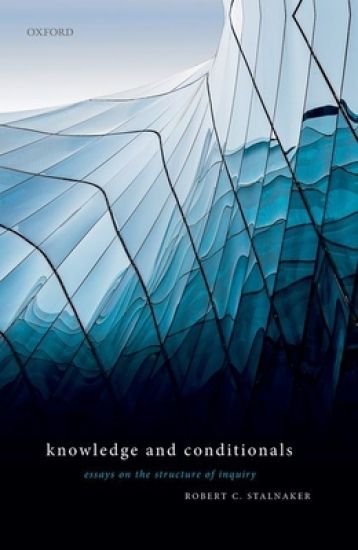
Knowledge and Conditionals

Knowledge and Conditionals

Robert C. Stalnaker

Oxford University Press
2019
sidottu
Robert C. Stalnaker presents a set of essays on the structure of inquiry. In the first part he focuses on the concepts of knowledge, belief, and partial belief, and on the rules and procedures we use - or ought to use - to determine what to believe, and what to claim that we know. In the second part he examines conditional statements and conditional beliefs, their role in epistemology, and their relations to causal and explanatory concepts, such as dispositions, objective chance, relations of dependence, and independence. A central concern of the book is the interaction of different cognitive perspectives - the ways in which the attitudes of rational agents are or should be influenced by critical reflection on their present cognitive situation, on their own cognitive situations at other times, and on the cognitive situations of others with whom they interact. The general picture that is developed is naturalistic, following Hume in rejecting a substantive role for pure reason in the defense of inductive rules, and in giving causal concepts a central role in the description and explanation of our cognitive practices. However, Stalnaker rejects the side of Hume that aims to reduce concepts involving natural necessity to more basic descriptive concepts. Instead, he argues that the development of inductive rules and practices takes place in interaction with the development of concepts for giving a theoretical description of the world.
Ways a World Might Be

Ways a World Might Be

Robert C. Stalnaker

Clarendon Press
2003
sidottu
Robert Stalnaker draws together in this volume his work in metaphysics. The central theme is the role of possible worlds in articulating our various metaphysical commitments. The book begins with reflections on the general idea of a possible world, and then uses the framework of possible worlds to formulate and clarify some questions about properties and individuals, reference, thought, and experience. The essays also reflect on the nature of metaphysics, and on the relation between questions about what there is and questions about how we talk and think about what there is.
Ways a World Might Be

Ways a World Might Be

Robert C. Stalnaker

Clarendon Press
2003
nidottu
Ways a World Might Be collects, and adds to, Robert Stalnaker's published papers on metaphysical issues. The central theme that runs throughout the book is the role of possible worlds in articulating our various metaphysical commitments. The essays contain both reflections on the general idea of a space of possibilities and attempts to use the framework of possible worlds to formulate and clarify semantic and metaphysical questions about properties and individuals, supervenience and essentialism, reference, thought and experience. The essays also reflect on the nature of metaphysics, and on the relation between metaphysical and semantic questions - questions about what there is and questions about how we talk and think about what there is. The book begins by asking what possible worlds are, and how we are able to represent and know about them. Stalnaker argues that we can take possibilities seriously without embracing the kind of modal realism that David Lewis defended, and can take them as fundamental without purporting to offer a reductive account of modality. He then turns to questions about the nature of properties and relations and their role in carving up a space of possibilities, and to questions about the nature of individuals, and the way they are identified across time and possible worlds. The essays in the last two sections of the book are concerned with the interaction of metaphysical and semantic issues, and with the place of subjective experience in our conception of an objective world as it is in itself. Two of the fourteen essays, plus an extensive introduction that sets the papers in context and makes explicit some of the essays' common threads, are published here for the first time.
Our Knowledge of the Internal World

Our Knowledge of the Internal World

Robert C. Stalnaker

Oxford University Press
2010
nidottu
On the traditional Cartesian picture, knowledge of one's own internal world -- of one's current thoughts and feelings -- is the unproblematic foundation for all knowledge. The philosophical problem is to explain how we can move beyond this knowledge, how we can form a conception of an objective world, and how we can know that the world answers to our conception of it. This book is in the anti-Cartesian tradition that seeks to reverse the order of explanation. Robert Stalnaker argues that we can understand our knowledge of our thoughts and feelings only by viewing ourselves from the outside, and by seeing our inner lives as features of the world as it is in itself. He uses the framework of possible worlds both to articulate a conception of the world as it is in itself, and to represent the relation between our objective knowledge and our knowledge of our place in the world. He explores an analogy between knowledge of one's own phenomenal experience and self-locating knowledge -- knowledge of who one is, and what time it is. He criticizes the philosopher's use of the notion of acquaintance to characterize our intimate epistemic relation to the phenomenal character of our experience, and explores the tension between an anti-individualist conception of the contents of thought and the thesis that we have introspective access to that content. The conception of knowledge that emerges is a contextualist and anti-foundationalist one but, it is argued, a conception that is compatible with realism about both the external and internal worlds.
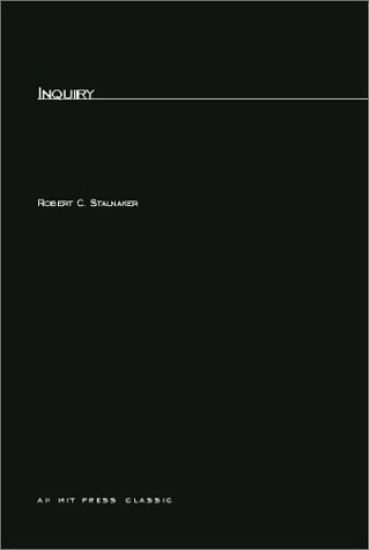
Inquiry

Inquiry

Robert C. Stalnaker

Bradford Books
1987
pokkari
The abstract structure of inquiry - the process of acquiring and changing beliefs about the world - is the focus of this book which takes the position that the "pragmatic" rather than the "linguistic" approach better solves the philosophical problems about the nature of mental representation, and better accounts for the phenomena of thought and speech. It discusses propositions and propositional attitudes (the cluster of activities that constitute inquiry) in general and takes up the way beliefs change in response to potential new information, suggesting that conditional propositions should be understood as projections of epistemic policies onto the world.A Bradford Book.
Robert C. Jackson Paintings

Robert C. Jackson Paintings

Philip Eliasoph

Schiffer Publishing Ltd
2012
sidottu
A monograph of contemporary American painter Robert C. Jackson. The paintings of Robert C. Jackson are introduced by Philip Eliasoph in the artist’s first monograph. Using paintings from artists as diverse as Andrew Wyeth and Jasper Johns, Eliasoph’s extensive knowledge of American art places Jackson’s artwork into a historical context. This beautifully illustrated book includes more than 130 images of the artist’s paintings with details, photographs of the artist at work, sketchbook reproductions, and an interview with the artist himself. Eliasoph colorfully proclaims, “The paintings we are about to examine are inescapably a bundle of contradictions, satirical complexities, and witty subterfuge. Essentially, Jackson is a uniquely self-realized painter. His feisty independence is fortified with healthy dosages of non-conforming eccentricity, with a small touch of screwball nuttiness.” The foreword by Professor Henry Adams reveals a similar sentiment, “Notably, this is also the sort of strange mix of sensibilities one finds in the best American novelists, such as Mark Twain.”
Robert C. Jackson

Robert C. Jackson

Robert C. Jackson

SCHIFFER PUBLISHING LTD
2025
sidottu
With over 525 images and photos that focus on his career from age 45 to 60, American still-life painter Jackson reveals his work methods, inspirations, and development. Featuring more than 525 paintings in Robert C. Jackson's iconic style of realism with a slyly irreverent twist, this beautiful book thoughtfully covers his midcareer works. Many of his signature themes are recognizable but now treated more deeply, the compelling nature of his art is intensified, and larger canvases prevail. Known especially for his realistic still-life paintings featuring objects such as soda crates, balloon dogs, and foods, Jackson creates playful, exuberant art that often makes impossible situations believable, one reason for its wide appeal. Learn more about: • His final college semester when he took Painting 101 to fill out his schedule. • The first time he ever quit anything. (It was a career as an engineer.) • How the concept of "seriously funny" motivates him. • The cleansing and growth that occurs with aging as a painter. • Zippy, the clown he keeps on retainer to make balloon dogs. Jackson's paintings have been featured in five solo museum exhibitions to date, and are in private, corporate, and museum collections worldwide, ranging from the Delaware Art Museum to the South Dakota Art Museum. Jackson's conversational insights begin each section and address how he built a successful art career. Jackson offers specific details of interest to collectors as well as to artists also striving for a full-time career in painting. For example, coming up with new source material year after year requires effort, and Jackson explains his processes for doing just that. He also shares how embracing commissioned artwork as a collaborative art process can be fulfilling for both the artist and client. Candid black-and-white photos of Jackson at work and play express the spirit he brings to his art. Understand why new fans and established collectors alike respond to this artist who has found his unique and identifiable voice within contemporary art.
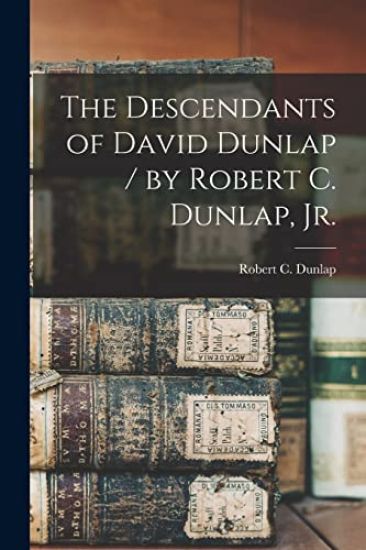
The Descendants of David Dunlap / by Robert C. Dunlap, Jr.

The Descendants of David Dunlap / by Robert C. Dunlap, Jr.

Robert C. (Robert Cleveland) Dunlap

Hassell Street Press
2021
nidottu
This work has been selected by scholars as being culturally important and is part of the knowledge base of civilization as we know it.This work is in the public domain in the United States of America, and possibly other nations. Within the United States, you may freely copy and distribute this work, as no entity (individual or corporate) has a copyright on the body of the work.Scholars believe, and we concur, that this work is important enough to be preserved, reproduced, and made generally available to the public. To ensure a quality reading experience, this work has been proofread and republished using a format that seamlessly blends the original graphical elements with text in an easy-to-read typeface.We appreciate your support of the preservation process, and thank you for being an important part of keeping this knowledge alive and relevant.