Kirjojen hintavertailu. Mukana 11 244 527 kirjaa ja 12 kauppaa.

Kirjahaku

Etsi kirjoja tekijän nimen, kirjan nimen tai ISBN:n perusteella.

1000 tulosta hakusanalla Robert F Vann

A Biblical Cognitive Relapse Prevention Support Group
ASBPM has designed a biblically strategic participant guide which assists individuals in taking an in-depth, individualized view of what they need to do to prevent them from returning to "sowing to the flesh (relapsing)." It also helps each individual to recognize their particular needs (spiritual, emotional, and mental) by identifying their strongholds, infirmities, set-up behaviors, and cravings, enabling them to select practical biblical solution to address those needs. It addresses every major area of "sowing to the flesh (relapse prevention)" that individuals in restoration from the effects of alcohol and other drugs encounter. The participant guide is extremely comprehensive and provides biblical insight into key principles necessary for relapse prevention.The Biblical Cognitive Relapse Prevention Support Group is a highly interactive open-ended group based on five phases of development. Each phase is designed to address a critical area in relapse prevention. The participant guide is designed to promote a biblical view of relapse prevention, fellowship with God, and for group participants to develop an understanding and faith in their identity in Christ, character development, and insight into overcoming the effects of addiction. Group members are required to complete exercises (self-checks, action steps, and self-ratings) at the end of each phase that are shared within the group. Fellowship with God is emphasized throughout the group process.ASBPM has also developed a group facilitators' training kit consisting of a facilitator's guide and PowerPoint presentation. The facilitator's guide is a strategic tool for instructing group facilitation in a small group setting. It is designed to provide pastors, chaplains, and ministry leaders with an effective training tool, and biblical insight for equipping ministry volunteers working with individuals being restored from addiction to drugs/alcohol.
The One Step with Jesus Restoration Program
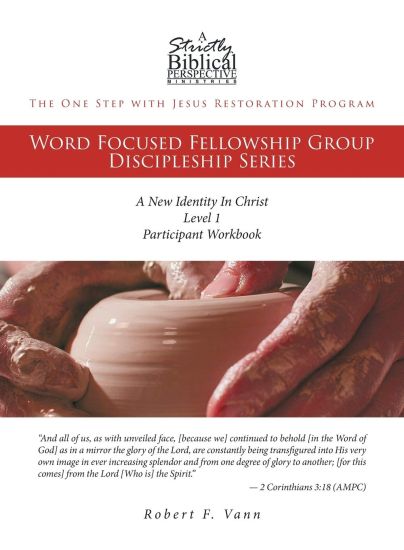
A Strictly Biblical Perspective MINISTRIES has developed the Word Focus Fellowship Group, as a Christian alternative to the world's recovery system, which addresses addiction by teaching individuals how to manage sin (addiction) through behavioral modification. Jesus Christ did not give His life on Calvary so a Christian could learn to manage sin but so that they could be set free from the penalty, power and eventually the presence of sin. God's plan for addressing addiction is far superior to man's plan because it not only restores a believer physically, socially and psychologically but it addresses the root cause of addiction, spiritual death. God's plan, salvation spiritually changes a person's nature and provides the potential for their soul to be restored (mind, will, and emotions) as well and addresses all of life's issues.A "Word Focused" Fellowship Group (Level 1) is a highly interactive, open-ended discipleship group based on 5 Biblical principles. To advance from one principle to the next the group process requires an individual to learn a memory verse and complete a designated exercise that must be shared within the group. It is a discipleship series that takes the "Body of Christ" back to biblical basics founded on the doctrines of salvation: repentance, rebirth, justification, and adoption, positional and progressive holiness (sanctification). Emphasis is placed on a believer understanding and accepting their "new identity" in Christ enabling them to "Walk in the Spirit." It is designed with a biblically strategic format with a five-fold in purpose. A Strictly Biblical Perspective MINISTRIES has developed a Facilitator Guide for use in conjunction with the "Word Focused" Fellowship Group. The Facilitator Guide is designed to assist counselors, lay counselors and mentors in facilitating the groups to assist participant in taking an in depth and personal view of the different factors in salvation which will assist them in developing an accurate view of their new identity in Christ.
Robert F. Kennedy and the 1968 Indiana Primary

Robert F. Kennedy and the 1968 Indiana Primary

Ray E. Boomhower

Indiana University Press
2017
pokkari
On April 4, 1968, Senator Robert F. Kennedy, Jr., arrived in Indiana to campaign for the Indiana Democratic presidential primary. As Kennedy prepared to fly from an appearance in Muncie to Indianapolis, he learned that civil rights leader Dr. Martin Luther King, Jr., had been shot outside his hotel in Memphis, Tennessee. Before his plane landed in Indianapolis, Kennedy heard the news that King had died. Despite warnings from Indianapolis police that they could not guarantee his safety, and brushing off concerns from his own staff, Kennedy decided to proceed with plans to address an outdoor rally to be held in the heart of the city's African American community. On that cold and windy evening, Kennedy broke the news of King's death in an impassioned, extemporaneous speech on the need for compassion in the face of violence. It has proven to be one of the great speeches in American political history. Marking the 40th anniversary of Kennedy's Indianapolis speech, this book explains what brought the politician to Indiana that day, and explores the characters and events of the 1968 Indiana Democratic presidential primary in which Kennedy, who was an underdog, had a decisive victory.
Robert F. Kennedy and the 1968 Indiana Primary

Robert F. Kennedy and the 1968 Indiana Primary

Ray E. Boomhower

Indiana University Press
2008
sidottu
On April 4, 1968, Senator Robert F. Kennedy, Jr., arrived in Indiana to campaign for the Indiana Democratic presidential primary. As Kennedy prepared to fly from an appearance in Muncie to Indianapolis, he learned that civil rights leader Dr. Martin Luther King, Jr., had been shot outside his hotel in Memphis, Tennessee. Before his plane landed in Indianapolis, Kennedy heard the news that King had died. Despite warnings from Indianapolis police that they could not guarantee his safety, and brushing off concerns from his own staff, Kennedy decided to proceed with plans to address an outdoor rally to be held in the heart of the city's African American community. On that cold and windy evening, Kennedy broke the news of King's death in an impassioned, extemporaneous speech on the need for compassion in the face of violence. It has proven to be one of the great speeches in American political history. Marking the 40th anniversary of Kennedy's Indianapolis speech, this book explains what brought the politician to Indiana that day, and explores the characters and events of the 1968 Indiana Democratic presidential primary in which Kennedy, who was an underdog, had a decisive victory.
Robert F. Kennedy and the Shaping of Civil Rights, 1960-1964
From the 1960 John F. Kennedy presidential campaign to the signing of the Civil Rights Act of 1964, Attorney General Robert F. Kennedy and the Department of Justice worked tirelessly to change the climate of civil rights in the nation. This book explores how the Kennedy brothers and leaders such as Martin Luther King, Jr., John Lewis and James Meredith, among others, pushed for change at a critical time. Through an analysis of White House memoranda, speeches, telephone conversations and recorded discussions as well as secondary sources, this study explores Robert Kennedy's role in key events of the civil rights movement, which include the Freedom Rides in 1961, the Ole Miss crisis in 1962 and the Birmingham campaign and March on Washington in 1963. The combined efforts of the Kennedys and these leaders helped change the atmosphere in the nation to one of acceptance and opportunity for African Americans and other minorities.
Robert F. Kennedy in the Stream of History

Robert F. Kennedy in the Stream of History

Terrence Edward Paupp

Routledge
2017
nidottu
This assessment of the statesmanship, principles, and policies of Robert F. Kennedy places him "in the stream of history," to assess what came before his time in political life, what happened during that time, and what happened to his legacy after his assassination. Terrence Edward Paupp evaluates the themes and issues RFK confronted, responded to, and for which he provided visionary solutions.Paupp first chronicles the influence of Franklin D. Roosevelt's legacy as a prologue to the New Frontier and Great Society. During Robert F. Kennedy's time in power both in his brother's administration and on his own in the US Senate he struggled with striking a balance between power and purpose. In the years after John F. Kennedy's assassination, RFK emphasized the need to unite power and purpose, national and international concerns, ideals and practice. Much of this has been ignored, Paupp argues, by what C. Wright Mills called "the power elite."In assessing RFK's statesmanship, Paupp examines his commitments to human and civil rights, which linked themes and ideals within the US to those struggles taking place outside the country. Robert F. Kennedy brought zeal and passion to these problems by discussing the moral necessity of honouring human dignity while articulating practical solutions, policies, and programs to structural injustice. His legacy remains a beacon of light, intelligence, and hope in today's world.