Kirjojen hintavertailu. Mukana 11 244 527 kirjaa ja 12 kauppaa.

Kirjahaku

Etsi kirjoja tekijän nimen, kirjan nimen tai ISBN:n perusteella.

1000 tulosta hakusanalla Robert Fogelin

Walking the Tightrope of Reason

Walking the Tightrope of Reason

Robert Fogelin

Oxford University Press Inc
2005
nidottu
Human beings are both supremely rational and deeply superstitious, capable of believing just about anything and of questioning just about everything. Indeed, just as our reason demands that we know the truth, our skepticism leads to doubts we can ever really do so. In Walking the Tightrope of Reason, Robert J. Fogelin guides readers through a contradiction that lies at the very heart of philosophical inquiry. Fogelin argues that our rational faculties insist on a purely rational account of the universe, yet at the same time, the inherent limitations of these faculties ensure that we will never fully satisfy that demand. As a result of being driven to this point of paradox, we either comfort ourselves with what Kant called "metaphysical illusions" or adopt a stance of radical skepticism. No middle ground seems possible and, as Fogelin shows, skepticism, even though a healthy dose of it is essential for living a rational life, "has an inherent tendency to become unlimited in its scope, with the result that the edifice of rationality is destroyed." In much Postmodernist thought, for example, skepticism takes the extreme form of absolute relativism, denying the basis for any value distinctions and treating all truth-claims as equally groundless. How reason avoids disgracing itself, walking a fine line between dogmatic belief and self-defeating doubt, is the question Fogelin seeks to answer. Reflecting upon the ancient Greek skeptics as well as such thinkers as Hume, Kant, Wittgenstein, Nietzsche, and Whitman, this book takes readers into--and through--some of philosophy's most troubling paradoxes.
Figuratively Speaking

Figuratively Speaking

Robert Fogelin

Oxford University Press Inc
2011
nidottu
In this updated edition of his brief, engaging book, Robert J. Fogelin examines figures of speech that concern meaning-irony, hyperbole, understatement, similes, metaphors, and others-to show how they work and to explain their attraction. Building on the ideas of Grice and Tversky, Fogelin contends that figurative language derives its power from its insistence that the reader participate in the text, looking beyond the literal meaning of the figurative language to the meanings that are implied. With examples ranging from Shakespeare, John Donne, and Jane Austen to e.e. cummings, Bessie Smith, and Monty Python, Fogelin demonstrates that the intellectual and aesthetic force of figurative language is derived from the opportunity it provides for unlimited elaboration. Fogelin presents a modern restatement of the view, first put forward by Aristotle, that metaphors are to be treated as elliptical similes. He then offers a detailed defense of this "comparativist" view of metaphors in response to criticisms that have been brought against it by a series of eminent philosophers. This new edition is updated to reflect more recent work on the topic and will interest philosophers, linguists, and literary theorists.
Wittgenstein-Arg Philosophers

Wittgenstein-Arg Philosophers

Robert Fogelin

Routledge
1999
sidottu
First Published in 1999. The purpose of this series is to provide a contemporary assessment and history of the entire course of philosophical thought. Each book constitutes a detailed, critical introduction to the work of a philosopher of major influence and significance. Except for the two closing chapters, this book is a careful examination of Wittgenstein's chief works: Part One considers the Tractatus Logico Philosophicus; Part Two considers the Philosophical Investigations.
Routledge Philosophy GuideBook to Berkeley and the Principles of Human Knowledge
George Berkeley is one of the most prominent philosophers of the eighteenth century. His Principles of Human Knowledge has become a focal point in the understanding of empiricist thought and the development of eighteenth century philosophy.This volume introduces and assesses:* Berkeley's life and the background to the Principles* The ideas and text in the Principles* Berkeley's continuing importance to philosophy.
Routledge Philosophy GuideBook to Berkeley and the Principles of Human Knowledge
George Berkeley is one of the most prominent philosophers of the eighteenth century. His Principles of Human Knowledge has become a focal point in the understanding of empiricist thought and the development of eighteenth century philosophy.This volume introduces and assesses:* Berkeley's life and the background to the Principles* The ideas and text in the Principles* Berkeley's continuing importance to philosophy.
Wittgenstein-Arg Philosophers

Wittgenstein-Arg Philosophers

Robert Fogelin

Routledge
2012
nidottu
First Published in 1999. The purpose of this series is to provide a contemporary assessment and history of the entire course of philosophical thought. Each book constitutes a detailed, critical introduction to the work of a philosopher of major influence and significance. Except for the two closing chapters, this book is a careful examination of Wittgenstein's chief works: Part One considers the Tractatus Logico Philosophicus; Part Two considers the Philosophical Investigations.
Cengage Advantage Books: Understanding Arguments

Cengage Advantage Books: Understanding Arguments

Walter Sinnott-Armstrong; Robert Fogelin

Wadsworth Publishing Co Inc
2014
nidottu
ADVANGEBOOKS - UNDERSTANDING ARGUMENTS: AN INTRODUCTION TO INFORMAL LOGIC, 9E shows readers how to construct arguments in everyday life, using everyday language. In addition, this easy-to-read textbook also devotes three chapters to the formal aspects of logic including forms of argument, as well as propositional, categorical, and quantificational logic. Plus, this edition helps readers apply informal logic to legal, moral, scientific, religious, and philosophical scenarios, too.
Cengage Advantage Books: Understanding Arguments, Concise Edition

Cengage Advantage Books: Understanding Arguments, Concise Edition

Walter Sinnott-Armstrong; Robert Fogelin

Wadsworth Publishing Co Inc
2014
nidottu
CENGAGE ADVANTAGE BOOKS: UNDERSTANDING ARGUMENTS, CONCISE EDITION, 1E uses everyday life experiences to teach the basics of informal logic. By taking out the non-essential instruction, this edition hones in on the "argument construction" involved in day-to-day life, and how to do it better. Plus, to round out the discussion, CENGAGE ADVANTAGE BOOKS: UNDERSTANDING ARGUMENTS, CONCISE EDITION, 1E includes a three-chapter overview of formal logic as well.
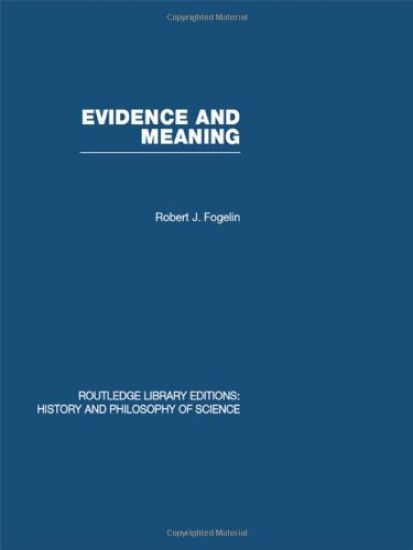
Evidence and Meaning

Evidence and Meaning

Robert J Fogelin

Routledge
2008
sidottu
Originally published in 1967. This is an examination of warrant statements – statements which indicated something about the grounds on behalf of some further judgement, choice or action. The first part of the study is concerned with the role of warrant statements in theoretical discourse; while the second part concerns their role in practical discourse. Also examined are necessity, probability, knowing, seeing and the complex of terms which allow us to introduce an argumentative structure into discourse.
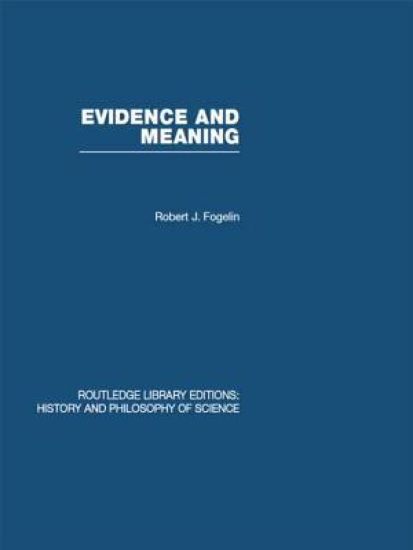
Evidence and Meaning

Evidence and Meaning

Robert J Fogelin

Routledge
2013
nidottu
Originally published in 1967. This is an examination of warrant statements – statements which indicated something about the grounds on behalf of some further judgement, choice or action. The first part of the study is concerned with the role of warrant statements in theoretical discourse; while the second part concerns their role in practical discourse. Also examined are necessity, probability, knowing, seeing and the complex of terms which allow us to introduce an argumentative structure into discourse.
Hume's Presence in The Dialogues Concerning Natural Religion

Hume's Presence in The Dialogues Concerning Natural Religion

Robert J. Fogelin

Oxford University Press Inc
2017
sidottu
Why did David Hume feel so deeply about publishing The Dialouges Concerning Natural Religion that he set aside funds in his will providing for its posthumous publication? Part of the answer is that it provided a literary, satirical work responding to his mean-spirited theological critics. In Hume's Presence Robert J. Fogelin provides a textual analysis that demonstrates the close relationship of The Dialogues with his central philosophical writings and its centrality to his relationship with skepticism. A striking feature of The Dialogues is that Cleanthes and Philo seem well versed in the works of the philosopher David Hume. Their arguments often echo in content--even wording--claims found in Hume's central philosophical writings. Beyond this, the overall dialectical structure of The Dialogues mirrors dialectical developments found in both The Treatise of Human Nature and the Enquiry Concerning Human Understanding: the naturalistic effort to provide a rational defense of religion ends in weakening religious commitments rather than in strengthening them. Nowhere in The Dialogues does Hume address his readers directly. As a result, it may not immediately be clear whether Hume is expressing his own opinions through one of his characters or is using a character to represent a position he wishes to examine, perhaps to reject. The Dialogues is a contest, and Hume, by not speaking directly in his own voice, leaves it-officially, at least-to his readers to judge who, if anyone, wins. The central problem of The Dialogues is to consider what Hume understood by skepticism. The second section of this book examines competing views of Hume's skepticism, concluding with his own remarks. In the Treatise and the Enquiry, Hume says, when consumed by skeptical arguments and reasoning, he finds philosophical nurture in rejoining the practices of everyday life. His famous, concluding remark in The Dialogues about skepticism being the basis for a believing Christian seems cut from the same cloth.
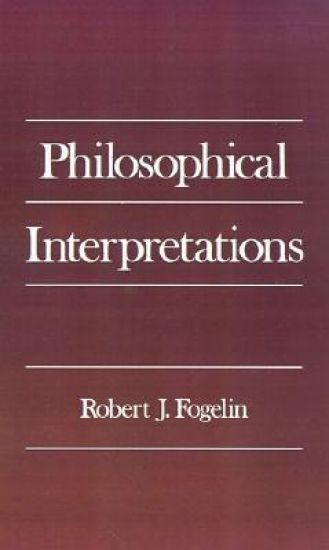
Philosophical Interpretations

Philosophical Interpretations

Robert J. Fogelin

Oxford University Press Inc
1992
sidottu
Robert Fogelin here collects fifteen of his essays, organized around the theme of interpreting philosophical texts. The book begins with an essay that lays down a set of principles governing the interpretation of difficult texts. Fogelin places particular emphasis on understanding the argumentative or dialectical role that passages play in the specific context in which they occur. The somewhat surprising result of taking this principle seriously is that certain traditional, well-worked texts are given a radical re-interpretation. Certain seemingly implausible positions are found to have more merit than has usually been attributed to them. Throughout the essays reprinted here, Fogelin argues that, when carefully read, the philosophical position under consideration has more merit than commonly believed. Included are essays dealing with texts from the works of Plato, Aquinas, Hume, Berkeley, Kant, Price, Hamilton, and Wittgenstein. With three exceptions, the selections were first published in major journals. Two appeared as part of collections, and one is new to this volume.
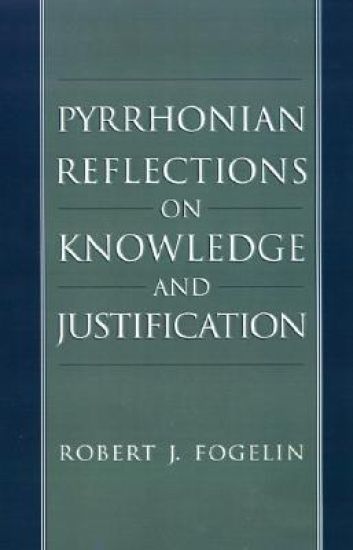
Pyrrhonian Reflections on Knowledge and Justification

Pyrrhonian Reflections on Knowledge and Justification

Robert J. Fogelin

Oxford University Press Inc
1994
sidottu
This work, written from a neo-Pyrrhonian perspective, is an examination of contemporary theories of knowledge and justification. It takes ideas primarily found in Sextus Empiricus's Outlines of Pyrrhonism, restates them in a modern idiom, and then asks whether any contemporary theory of knowledge meets the challenge they raise. The first part, entitled Gettier and the Problem of Knowledge, attempts to rescue our ordinary concept of knowledge from those philosophers who have assigned burdens to it that it cannot bear. Properly understood, Fogelin shows that the concept of knowledge is unproblematic. The second part of this study, called Agrippa and the Problem of Justification, examines Agrippa's contribution to Pyrrhonism, a systemizing of its procedures which came to be known as the Five Modes Leading to the Suspension of Belief. These modes present a completely general procedure for refuting any claim a dogmatist might make. Though largely unnoticed, there is an uncanny resembleance between problems posed by Agrippa's Five Modes and those that contemporary epistemologists address under the heading of a theory of justification. Fogelin examines the strongest contemporary theories of justification--in both foundationalist and anti-foundationalist forms. The Pyrrhonian conclusion is that recent philosophical writings on justification have made no significant progress in responding to the Pyrrhonian problems they have raised.
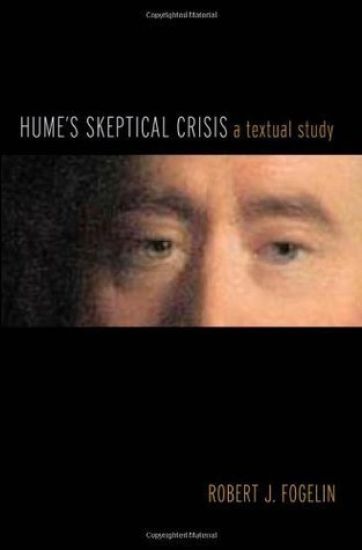
Hume's Skeptical Crisis

Hume's Skeptical Crisis

Robert J. Fogelin

Oxford University Press Inc
2009
sidottu
In Hume's Skeptical Crisis Robert Fogelin provides a textual study of the changes in perspective that emerged as Hume pursued his attempt to introduce the experimental method of reasoning into moral subjects--the subtitle of the Treatise of Human of Nature. In the process of giving an account of the operations of the human mind, Hume discovered that the mechanisms that create and sustain our beliefs are deeply unreliable and, in fact, capricious in their operations. Hume's crisis emerged when he recognized that the weaknesses that he ascribed to the operations of the human mind apply with equal force to the operations of his own mind. How, he asked himself, could he justify pursuing profoundly difficult investigations employing mental faculties that were manifestly not up to the task? His response was to trim back the ambitious program announced at the start of the Treatise. Hume returned to this topic in the opening section of the Enquiry Concerning Human Understanding, where, in a more circumspect mood, he weighed the reasons for and against pursuing what he calls abstruse philosophy. Given our limited capacities and the complexities of the subject, what, he asked, are the chances of success in pursing abstruse philosophical investigations? Hume answered that we could expect at least modest success by adopting the stance of a mitigated skeptic, where one cautiously examines only those topics suitable to our limited mental capacities. Hume held that this standpoint could be attained by counter-balancing radical Pyrrhonian doubt on one side with our non-rational instincts to believe on the other side. As a result, Hume's initial attempt to produce a "compleat system of the sciences" was transformed into "reflections of common life, methodized and corrected."
Hume's Skepticism in the Treatise of Human Nature
This work, first published in 1985, offers a general interpretation of Hume’s Treatise of Human Nature. Most Hume scholarship has either neglected or downplayed an important aspect of Hume’s position – his scepticism. This book puts that right, examining in close detail the sceptical arguments in Hume’s philosophy.
Hume's Skepticism in the Treatise of Human Nature
This work, first published in 1985, offers a general interpretation of Hume’s Treatise of Human Nature. Most Hume scholarship has either neglected or downplayed an important aspect of Hume’s position – his scepticism. This book puts that right, examining in close detail the sceptical arguments in Hume’s philosophy.
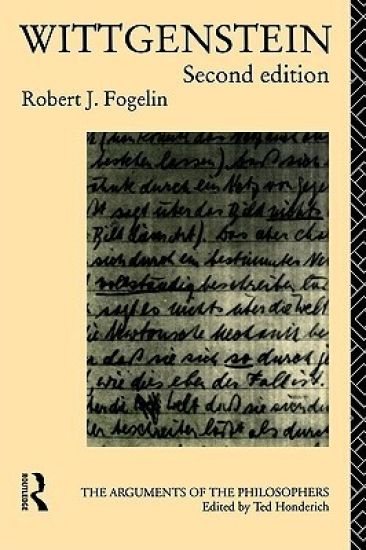
Wittgenstein

Wittgenstein

Robert J. Fogelin

Routledge
1987
nidottu
No serious philosopher or student of philosophy can afford to neglect Wittgenstein's work. Professor Fogelin provides an authoritative critical evaluation of both the Tractatus Logico-Philosophicus and Philosophical Investigations, enabling the reader to come to grips with these difficult yet key works.Fogelin explains Wittgenstein's attempt in the Tractatus to combine a picture theory of propositional structure, and also explores Wittgenstein's own criticisms of the Tractarian synthesis. He gives particular attention to topics in the philosophy of language, logic, psychology and the foundations of mathematics, examining Wittgenstein's work on these fields and arguing that Wittgenstein's criticisms in these areas form the basis for a radically new standpoint in philosophy.
A Defense of Hume on Miracles

A Defense of Hume on Miracles

Robert J. Fogelin

Princeton University Press
2005
pokkari
Since its publication in the mid-eighteenth century, Hume's discussion of miracles has been the target of severe and often ill-tempered attacks. In this book, one of our leading historians of philosophy offers a systematic response to these attacks. Arguing that these criticisms have--from the very start--rested on misreadings, Robert Fogelin begins by providing a narrative of the way Hume's argument actually unfolds. What Hume's critics (and even some of his defenders) have failed to see is that Hume's primary argument depends on fixing the appropriate standards of evaluating testimony presented on behalf of a miracle. Given the definition of a miracle, Hume quite reasonably argues that the standards for evaluating such testimony must be extremely high. Hume then argues that, as a matter of fact, no testimony on behalf of a religious miracle has even come close to meeting the appropriate standards for acceptance. Fogelin illustrates that Hume's critics have consistently misunderstood the structure of this argument--and have saddled Hume with perfectly awful arguments not found in the text. He responds first to some early critics of Hume's argument and then to two recent critics, David Johnson and John Earman. Fogelin's goal, however, is not to "bash the bashers," but rather to show that Hume's treatment of miracles has a coherence, depth, and power that makes it still the best work on the subject.
Taking Wittgenstein at His Word

Taking Wittgenstein at His Word

Robert J. Fogelin

Princeton University Press
2009
sidottu
Taking Wittgenstein at His Word is an experiment in reading organized around a central question: What kind of interpretation of Wittgenstein's later philosophy emerges if we adhere strictly to his claims that he is not in the business of presenting and defending philosophical theses and that his only aim is to expose persistent conceptual misunderstandings that lead to deep philosophical perplexities? Robert Fogelin draws out the therapeutic aspects of Wittgenstein's later work by closely examining his account of rule-following and how he applies the idea in the philosophy of mathematics. The first of the book's two parts focuses on rule-following, Wittgenstein's "paradox of interpretation," and his naturalistic response to this paradox, all of which are persistent and crucial features of his later philosophy. Fogelin offers a corrective to the frequent misunderstanding that the paradox of interpretation is a paradox about meaning, and he emphasizes the importance of Wittgenstein's often undervalued appeals to natural responses. The second half of the book examines how Wittgenstein applies his reflections on rule-following to the status of mathematical propositions, proofs, and objects, leading to remarkable, demystifying results. Taking Wittgenstein at His Word shows that what Wittgenstein claims to be doing and what he actually does are much closer than is often recognized. In doing so, the book underscores fundamental--but frequently underappreciated--insights about Wittgenstein's later philosophy.
Taking Wittgenstein at His Word

Taking Wittgenstein at His Word

Robert J. Fogelin

Princeton University Press
2020
pokkari
Taking Wittgenstein at His Word is an experiment in reading organized around a central question: What kind of interpretation of Wittgenstein's later philosophy emerges if we adhere strictly to his claims that he is not in the business of presenting and defending philosophical theses and that his only aim is to expose persistent conceptual misunderstandings that lead to deep philosophical perplexities? Robert Fogelin draws out the therapeutic aspects of Wittgenstein's later work by closely examining his account of rule-following and how he applies the idea in the philosophy of mathematics.The first of the book's two parts focuses on rule-following, Wittgenstein's "paradox of interpretation," and his naturalistic response to this paradox, all of which are persistent and crucial features of his later philosophy. Fogelin offers a corrective to the frequent misunderstanding that the paradox of interpretation is a paradox about meaning, and he emphasizes the importance of Wittgenstein's often undervalued appeals to natural responses. The second half of the book examines how Wittgenstein applies his reflections on rule-following to the status of mathematical propositions, proofs, and objects, leading to remarkable, demystifying results.Taking Wittgenstein at His Word shows that what Wittgenstein claims to be doing and what he actually does are much closer than is often recognized. In doing so, the book underscores fundamental—but frequently underappreciated—insights about Wittgenstein's later philosophy.