Kirjojen hintavertailu. Mukana 12 390 323 kirjaa ja 12 kauppaa.

Kirjahaku

Etsi kirjoja tekijän nimen, kirjan nimen tai ISBN:n perusteella.

1000 tulosta hakusanalla Robert G Lawson

Who Killed Betty Gail Brown?

Who Killed Betty Gail Brown?

Robert G Lawson

THE UNIVERSITY PRESS OF KENTUCKY
2022
nidottu
On October 26, 1961, after an evening of studying with friends on the campus of Transylvania University, nineteen-year-old student Betty Gail Brown got into her car around midnight – presumably headed for home. But she would never arrive. Three hours later, Brown was found dead in a driveway near the center of campus, strangled to death with her own brassiere. Kentuckians from across the state became engrossed in the proceedings as lead after lead went nowhere. Four years later, the police investigation completely stalled. In 1965, a drifter named Alex Arnold Jr. confessed to the killing while in jail on other charges in Oregon. Arnold was brought to Lexington, indicted for the murder of Betty Gail Brown, and put on trial, where he entered a plea of not guilty. Robert G. Lawson was a young attorney at a local firm when a senior member asked him to help defend Arnold, and he offers a meticulous record of the case in Who Killed Betty Gail Brown? During the trial, the courtroom was packed daily, but witnesses failed to produce any concrete evidence. Arnold was an alcoholic whose memory was unreliable, and his confused, inconsistent answers to questions about the night of the homicide did not add up. Since the trial, new leads have come and gone, but Betty Gail Brown's murder remains unsolved. A written transcript of the court proceedings does not exist; and thus Lawson, drawing upon police and court records, newspaper articles, personal files, and his own notes, provides an invaluable record of one of Kentucky's most famous cold cases.
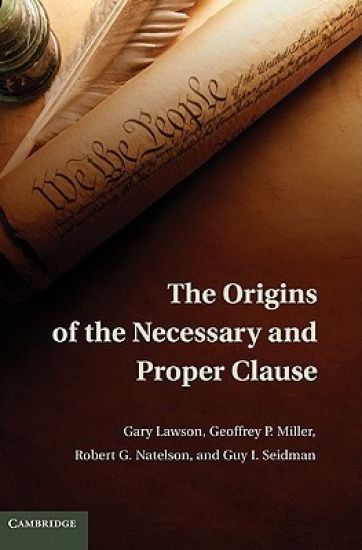
The Origins of the Necessary and Proper Clause

The Origins of the Necessary and Proper Clause

Gary Lawson; Geoffrey P. Miller; Robert G. Natelson; Guy I. Seidman

Cambridge University Press
2010
sidottu
The Necessary and Proper Clause is one of the most important parts of the US Constitution. Today this short thirty-nine-word paragraph is cited as the legal foundation for much of the modern federal government. Through three independent lines of research, the authors trace the lineage of the Necessary and Proper Clause to the everyday law of the Founding Era - the same law that American founders such as Madison, Hamilton, and Washington applied in their daily lives. Origins of the Necessary and Proper Clause are found in law-governing agencies, public administration, and corporations. Moreover, all of those areas were undergirded by common principles of fiduciary responsibility - reflecting the Founders' view that a public office is truly a public trust. This explains the choice of language in the clause and provides clues about its meaning. This book thus serves as a reference source for scholars seeking to understand the intellectual foundations of one of the Constitution's most important clauses.
The Origins of the Necessary and Proper Clause

The Origins of the Necessary and Proper Clause

Gary Lawson; Geoffrey P. Miller; Robert G. Natelson; Guy I. Seidman

Cambridge University Press
2013
pokkari
The Necessary and Proper Clause is one of the most important parts of the US Constitution. Today this short thirty-nine-word paragraph is cited as the legal foundation for much of the modern federal government. Through three independent lines of research, the authors trace the lineage of the Necessary and Proper Clause to the everyday law of the Founding Era - the same law that American founders such as Madison, Hamilton, and Washington applied in their daily lives. Origins of the Necessary and Proper Clause are found in law-governing agencies, public administration, and corporations. Moreover, all of those areas were undergirded by common principles of fiduciary responsibility - reflecting the Founders' view that a public office is truly a public trust. This explains the choice of language in the clause and provides clues about its meaning. This book thus serves as a reference source for scholars seeking to understand the intellectual foundations of one of the Constitution's most important clauses.
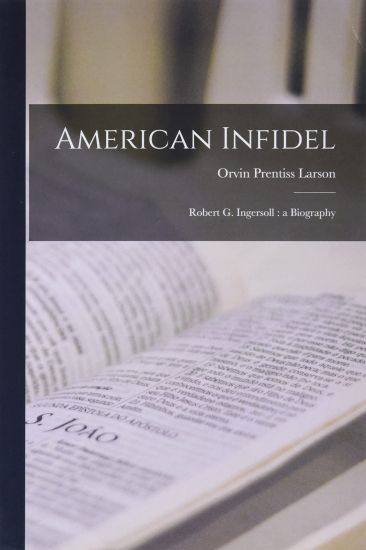
American Infidel: Robert G. Ingersoll, a Biography

American Infidel: Robert G. Ingersoll, a Biography

Orvin Larson

Literary Licensing, LLC
2011
sidottu
American Infidel: Robert G. Ingersoll, A Biography is a book written by Orvin Larson that provides a comprehensive account of the life of Robert G. Ingersoll, a prominent American lawyer, orator, and political figure of the late 19th century. The book delves into Ingersoll's childhood, education, and early career, as well as his rise to fame as a public speaker and advocate for free thought, secularism, and rationalism. Larson chronicles Ingersoll's controversial views on religion, including his rejection of traditional Christian beliefs and his advocacy for separation of church and state. The book also explores Ingersoll's political activities, including his involvement in the Republican Party and his support for women's suffrage and civil rights. Throughout the biography, Larson provides insight into Ingersoll's personal life, including his relationships with family and friends, as well as his struggles with depression and alcoholism. The book also includes numerous excerpts from Ingersoll's speeches and writings, allowing readers to gain a deeper understanding of his ideas and beliefs. Overall, American Infidel: Robert G. Ingersoll, A Biography is a compelling and informative account of one of America's most influential and controversial figures of the late 19th century.This scarce antiquarian book is a facsimile reprint of the old original and may contain some imperfections such as library marks and notations. Because we believe this work is culturally important, we have made it available as part of our commitment for protecting, preserving, and promoting the world's literature in affordable, high quality, modern editions, that are true to their original work.