Kirjojen hintavertailu. Mukana 11 213 693 kirjaa ja 12 kauppaa.

Kirjahaku

Etsi kirjoja tekijän nimen, kirjan nimen tai ISBN:n perusteella.

1000 tulosta hakusanalla Robert Graham Wade

Chess Tactics for Beginners

Chess Tactics for Beginners

Robert Graham Wade

Hassell Street Press
2021
nidottu
This work has been selected by scholars as being culturally important and is part of the knowledge base of civilization as we know it.This work is in the public domain in the United States of America, and possibly other nations. Within the United States, you may freely copy and distribute this work, as no entity (individual or corporate) has a copyright on the body of the work.Scholars believe, and we concur, that this work is important enough to be preserved, reproduced, and made generally available to the public. To ensure a quality reading experience, this work has been proofread and republished using a format that seamlessly blends the original graphical elements with text in an easy-to-read typeface.We appreciate your support of the preservation process, and thank you for being an important part of keeping this knowledge alive and relevant.
Iran (RLE Iran D)

Iran (RLE Iran D)

Robert Graham

Routledge
2011
sidottu
The sudden increase of oil prices in 1973 meant that the foreign revenues of Iran quadrupled in just over two months. As the first OPEC member to begin disbursing this extra revenue on a significant scale, Iran offers the first complete example of the social, economic and political problems this caused. This book examines the cycle of the boom and the years that led up to it – from the rural and essentially backward nature of the country to the euphoria of 1973 when the Shah seriously talked of Iran reaching the Great Civilisation, where by the 1990s Iran would be the world’s fifth power. And then finally through to the loss of control over expenditure, the cancellation of ambitious projects and eventual disillusionment with all the attendant problems of expectations and increased social and political tension. A comprehensive analysis of the system of government in Iran is provided in Part Three of the book, demonstrating that this has created a repressed stability, incapable of promoting social and economic progress.
Managerial Economics For Dummies

Managerial Economics For Dummies

Robert Graham

John Wiley Sons Inc
2013
nidottu
The easy way to make sense of managerial economics Does the study of Managerial Economics make your head spin? Relax! This hands-on, friendly guide helps you make sense of complex business concepts and explains to you in plain English how Managerial Economics enhances analytical skills, assists in rational configuration, and aids in problem-solving. Managerial Economics For Dummies gives you a better understanding of all the major concepts you'll encounter in the classroom: supply and demand, elasticity, decision-making, quantitative analysis of business situations, risk analysis, production analysis, pricing analysis, capital budgeting, critical thinking skills, and much more. Tracks to a typical Managerial Economics courseIncludes easy-to-understand explanations and examplesServes as a valuable classroom supplement If you're enrolled in business courses looking for a supplemental guide to aid your understand of the complex theories associated with this difficult topic, or a manager already in the corporate world looking for a refresher, Managerial Economics For Dummies has you covered.
How to Write A Short Story (And Think About It)
Short story publishing is flourishing in the 21st century and is no longer seen as a poor relation of the novel. But what is a short story? And how do you write one? Robert Graham takes you through everything you need to know, from how a writer works to crafting and editing your own fiction.This heavily revised edition features new chapters by contemporary fiction writers. Stressing the importance of reading broadly and deeply, the book includes a wide range of prompts and writing exercises. It teaches you how to read as a writer and write like somebody who has read. You will learn the elements of craft you need to produce short stories, and one of the key writer’s disciplines: reflecting on your own work. Whether you are a student or an experienced author, this book will teach you how to write short stories – and reflect on the creative processes involved. The book features chapters from writer-teachers James Friel, Rodge Glass, Ursula Hurley, Heather Leach, Helen Newall, Jenny Newman, James Rice and Tom Vowler.
How to Write A Short Story (And Think About It)
Short story publishing is flourishing in the 21st century and is no longer seen as a poor relation of the novel. But what is a short story? And how do you write one? Robert Graham takes you through everything you need to know, from how a writer works to crafting and editing your own fiction.This heavily revised edition features new chapters by contemporary fiction writers. Stressing the importance of reading broadly and deeply, the book includes a wide range of prompts and writing exercises. It teaches you how to read as a writer and write like somebody who has read. You will learn the elements of craft you need to produce short stories, and one of the key writer’s disciplines: reflecting on your own work. Whether you are a student or an experienced author, this book will teach you how to write short stories – and reflect on the creative processes involved. The book features chapters from writer-teachers James Friel, Rodge Glass, Ursula Hurley, Heather Leach, Helen Newall, Jenny Newman, James Rice and Tom Vowler.
How to Write Fiction (And Think About It)

How to Write Fiction (And Think About It)

Robert Graham

Red Globe Press
2006
sidottu
If you are a writer of fiction, this practical handbook will teach you how to acquire your own writer's tool-box. Here you will learn all about developing your craft. The wide-ranging exploration of fiction-writing skills contains many unique features, such as the focus on reflective learning and tuition on advanced skills including foreshadowing, transitions and producing short story cycles. Throughout, the approach is centred on three kinds of activity:- examining the theory of particular fiction writing skills- analysing the practice of these skills in examples of published work- practising the use of skills in fiction-writing exercises.What makes this guide so distinctive, though, is the way it consistently asks you to reflect on your work, and stresses the importance of being able to articulate the processes of writing.Packed with wisdom about the art of fiction and filled with writing exercises, How To Write Fiction (And Think About It) examines the work of today's finest authors to teach you everything you need to know about writing short stories or longer fiction. Whether you are a student, a would-be professional author, or a general reader who simply likes to write for pleasure, this guide will equip you with a portfolio of key fiction-writing skills.
How to Write Fiction (And Think About It)

How to Write Fiction (And Think About It)

Robert Graham

Red Globe Press
2006
nidottu
If you are a writer of fiction, this practical handbook will teach you how to acquire your own writer's tool-box. Here you will learn all about developing your craft. The wide-ranging exploration of fiction-writing skills contains many unique features, such as the focus on reflective learning and tuition on advanced skills including foreshadowing, transitions and producing short story cycles. Throughout, the approach is centred on three kinds of activity:- examining the theory of particular fiction writing skills- analysing the practice of these skills in examples of published work- practising the use of skills in fiction-writing exercises.What makes this guide so distinctive, though, is the way it consistently asks you to reflect on your work, and stresses the importance of being able to articulate the processes of writing.Packed with wisdom about the art of fiction and filled with writing exercises, How To Write Fiction (And Think About It) examines the work of today's finest authors to teach you everything you need to know about writing short stories or longer fiction. Whether you are a student, a would-be professional author, or a general reader who simply likes to write for pleasure, this guide will equip you with a portfolio of key fiction-writing skills.
Anarchism Volume Two – A Documentary History of Libertarian Ideas, Volume Two : The Emergence of a New Anarchism
Continuing where volume one left off, this anthology documents anarchist writings from World War II up until the present day. Many of the translations (from Africa, India, China, Latin America, and Europe) have never before been published in English.Contributors include Noam Chomsky, Murray Bookchin, Emma Goldman, George Woodcock, Marie Louise Berneri, Herbert Read, Alex Comfort, Martin Buber, Paul Goodman, Carole Pateman, Colin Ward, Paul Feyerabend, Pierre Clastres, Chaia Heller, Ivan Illich, Daniel Guerin, Luce Fabbri, and many more.Robert Graham is the editor of "Anarchism: A Documentary History of Libertarian Ideas, Volume One: From Anarchy to Anarchism (300CE to 1939)."
Anarchism Volume Three – A Documentary History of Libertarian Ideas, Volume Three – The New Anarchism
The trilogy ends with the new anarchism, which deals with the exciting developments in anarchist theory since the reemergence of social movements in the 1960s and 1970s."Anarchism: A Documentary History of Libertarian Ideas" documents various currents in anarchist thought, from eco-anarchism on, as well as the spread of anarchist social movements around the world. This volume features selections from many prominent writers, including Murray Bookchin, Noam Chomsky, Carole Pateman, Peter Marshall, David Graeber, Luce Fabbri, Mark Leier, C.George Benello, Daniel Colson, Rosella Di Leo, Todd May, Alan Carter, Ed Herman, Richard Sonn, Ashanti Alston, Ba Jin, Saul Newman, Jesse Cohn, Richard Day, Amedeo Bertolo, Chaia Heller, Brian Tokar, Uri Gordon, Howard J. Ehrlich, Mok Chiu Yo, Sharif Gemie, Luis Andres Edo, and many others.This volume in the series, as with those already published, goes well beyond all previous anthologies of anarchist writings in both theoretical and geographical scope, making the series an extraordinary accomplishment and an historical collection. Selections from many countries and contexts are included, some translated into English for the first time.In the afterword, Robert Graham surveys the many different currents in anarchist thought documented in all three volumes of this outstanding and definitive anthology, discussing the continuity and changes in anarchist ideas as they have evolved in their historical context and the importance of these ideas for the future.Robert Graham has been writing on the history of anarchist ideas and developments in contemporary anarchist theory for over twenty years.
Anarchism Volume Three – A Documentary History of Libertarian Ideas, Volume Three – The New Anarchism
Robert Graham's trilogy ends with The New Anarchism, which deals with the exciting developments in anarchist theory since the reemergence of social movements in the 1960s and 1970s. In his afterword, Graham surveys the many different currents in anarchist thought documented in all three volumes of this outstanding and definitive anthology, discussing the continuity and changes in anarchist ideas as they have evolved in their historical context and the importance of these ideas for the future. Anarchism: A Documentary History of Libertarian Ideas documents various currents in anarchist thought, from eco-anarchism on, as well as the spread of anarchist social movements around the world. Table of Contents Preface Acknowledgments Chapter 1: Toward an Anarchist Politics - David Graeber: The New Anarchists (2002) - Madrid Declaration: For a New Libertarianism (2001) - The Gaucho Anarchist Federation: Especifismo (2000) - Alfredo Errandonea: Anarchism in the 21st Century (2001) - Dimitri Roussopoulos: The Politics of Neo-Anarchism (2012) Chapter 2: Libertarian Democracy - David Graeber: Democracy and Consensus (2004) / 45 - Eduardo Colombo: On Voting / 49 - Amedeo Bertolo: Libertarian Democracy (1999) / 53 - Andrew Flood: Assemblies Are the Revolution (2011) / 61 Chapter 3: Revolutionary Action - Murray Bookchin: From Direct Action to Direct Democracy (1979-82) - Hakim Bey: Temporary Autonomous Zones (1985) - Luc Bonet: Beyond the Revolutionary Model (2005) - Andrea Papi: Violence and Anti-Violence (2004) - Benjamin Franks: The Direct Action Ethic (2003) - A.G. Schwarz: The Revolt in Greece (2010) - CrimethInc: The Egyptian Revolution (2012) Chapter 4: The State - Harold Barclay: Anarchy and State Formation (2003) / 99 - Alan Ritter: Anarchy, Law and Freedom (1980) / 113 - Alan Carter: The Logic of State Power (2000) / 119 - Jeff Ferrell: Against the Law: Anarchist Criminology (1998) / 130 - Uri Gordon: Israel, Palestine and Anarchist Dilemmas (2007) / 135 Chapter 5: Technology and Power - Campaign Against the Model West Germany: The Nuclear State (1979) / 139 - David Watson: Nuclear Power (1979) / 144 - C. George Benello: Putting the Reins on Technology (1982) / 151 - Brian Tokar: Biotechnology (2003) / 154 Chapter 6: Anarchy and Ecology - Murray Bookchin: Toward an Ecological Society (1974) / 161 - Noam Chomsky: Human Nature and Human Freedom (1975) / 169 - Graham Purchase: Anarchism and Bioregionalism (1997) / 171 - Chaia Heller: Ecology and Desire (1999) / 176 - Peter Marshall: Liberation Ecology (2007) / 180 Chapter 7: Personal Liberation - Alan Mandell: Anti-Psychiatry and the Search for Autonomy (1979) / 186 - Rossella Di Leo: On the Origins of Male Domination (1983) / 192 - Nicole Laurin-Frenette: The State Family/The Family State (1982) / 202 - Ariane Gransac: Women's Liberation (1984) / 212 - Carole Pateman: The Sexual Contract (1988) / 217 - Jamie Heckert: Erotic Anarchy (2006) / 224 Chapter 8: Anarchy and Culture - Ba Jin: Against the Powers that Be (1984) / 234 - Richard Sonn: Culture and Anarchy (1994) / 238 - Max Blechman: Toward an Anarchist Aesthetic (1994) /239 - Edward S. Herman: The Propaganda Model--A Retrospective (2003) Chapter 9: Anti-Capitalism - Brian Martin: Capitalism and Violence (2001) / 253 - Normand Baillargeon: Free Market Libertarianism (2001) / 261 - Peter Marshall: Anarchism and Capitalism (1993) / 266 - Interprofessional Workers' Union: Russian Capitalism (1999) / 270 Chapter 10: Libertarian Alternatives - Graham Purchase: Green Anarcho-Syndicalism (1995) / 283 - Murray Bookchin: Municipal Control (1986) / 289 - Kevin Carson: Mutualism Reconsidered (2007) / 292 - Adam Buick and John Crump: The Alternative to Capitalism (1986) / 297 - Luciano Lanza: Settling Accounts with Economics (2003) / 307 Chapter 11: Beyond the Borders - Sharif Gemie: Beyond the Borders (2003) / 318 - An African Anarchist Manifesto (1981) / 324 - Sam Mbah and I.E. Igariwey: African Anarchism (1997) / 326 - Mok Chiu Yu: An Anarchist in Hong Kong (2001) / 334 - Mihara Yoko: Anarchism in Japan (1993) / 339 - The Cuban Libertarian Syndicalist Association: Anarchism and the - Cuban Revolution (1960/2003) / 343 - Ruben G. Prieto: Anarchism in Uruguay (2001) / 351 - Marina Sitrin: Horizontalidad in Argentina (2003) / 357 - Andrew Flood: What is Different About the Zapatistas (2001) / 362 - CIPO-RFM: Enemies of Injustice / 375 - Colectivo Alas de Xue: Strengthening the Anarcho-Indian Alliance (1997) - Kurdistan: Anarchism and Confederalism (1999-2011) - Bas Umali: Archipelagic Confederation - an Anarchist Alternative for the Philippines (2006) - Ashanti Alston: Black Anarchism (2003) - Harsha Walia: No One is Illegal (2006) Chapter 12: New Directions in Anarchist Theory - Todd May: Post-Structuralism and Anarchism (1989) - Saul Newman: The Politics of Post-Anarchism (2003) - Jesse Cohn: Anarchism and Essentialism (2003) - Mark Leier: Bakunin, Class and Post-Anarchism (2009) - Schmidt & Van Der Walt: Black Flame (2009) - Daniel Colson: Belief and Modernity (2005) - Richard Day: Groundless Solidarity and Infinite Responsibility (2005) Afterword Robert Graham: The Anarchist Current: Continuity and Change in Anarchist Thought Index 530 pages, Bibliography, Index
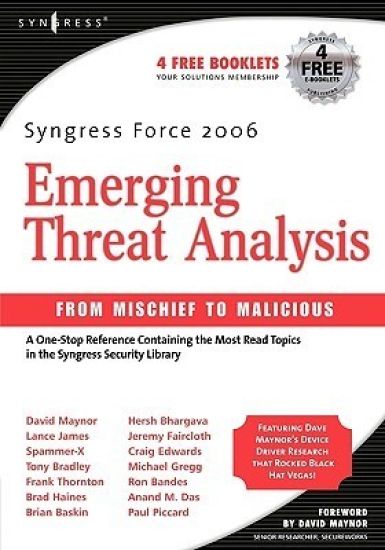
Syngress Force Emerging Threat Analysis

Syngress Force Emerging Threat Analysis

Robert Graham

Syngress Media,U.S.
2006
nidottu
A One-Stop Reference Containing the Most Read Topics in the Syngress Security Library This Syngress Anthology Helps You Protect Your Enterprise from Tomorrow’s Threats Today This is the perfect reference for any IT professional responsible for protecting their enterprise from the next generation of IT security threats. This anthology represents the “best of? this year’s top Syngress Security books on the Human, Malware, VoIP, Device Driver, RFID, Phishing, and Spam threats likely to be unleashed in the near future.. * From Practical VoIP Security, Thomas Porter, Ph.D. and Director of IT Security for the FIFA 2006 World Cup, writes on threats to VoIP communications systems and makes recommendations on VoIP security. * From Phishing Exposed, Lance James, Chief Technology Officer of Secure Science Corporation, presents the latest information on phishing and spam. * From Combating Spyware in the Enterprise, Brian Baskin, instructor for the annual Department of Defense Cyber Crime Conference, writes on forensic detection and removal of spyware. * Also from Combating Spyware in the Enterprise, About.com’s security expert Tony Bradley covers the transformation of spyware. * From Inside the SPAM Cartel, Spammer-X shows how spam is created and why it works so well. * From Securing IM and P2P Applications for the Enterprise, Paul Piccard, former manager of Internet Security Systems' Global Threat Operations Center, covers Skype security. * Also from Securing IM and P2P Applications for the Enterprise, Craig Edwards, creator of the IRC security software IRC Defender, discusses global IRC security. * From RFID Security, Brad “Renderman? Haines, one of the most visible members of the wardriving community, covers tag encoding and tag application attacks. * Also from RFID Security, Frank Thornton, owner of Blackthorn Systems and an expert in wireless networks, discusses management of RFID security. * From Hack the Stack, security expert Michael Gregg covers attacking the people layer. * Bonus coverage includes exclusive material on device driver attacks by Dave Maynor, Senior Researcher at SecureWorks.