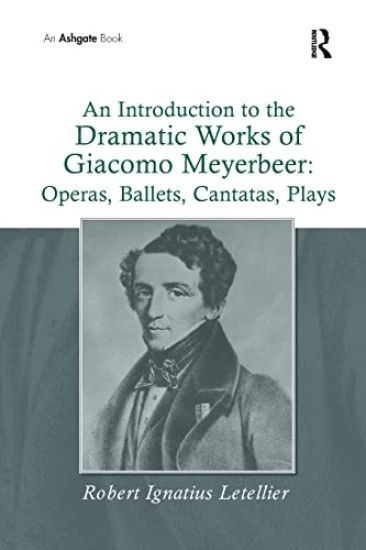
Giacomo Meyerbeer (1791-1864) was a great musical dramatist in his own right. The fame of his operas rests on his radical treatment of form, his development of scenic complexes and greater plasticity of structure and melody, his dynamic use of the orchestra, and close attention to all aspects of presentation and production, all of which set new standards in Romantic opera and dramaturgy. This book carries forward the process of rediscovery and reassessment of Meyerbeer’s art ”including not just his famous French operas, but also his German and Italian ones”placing them in the context of his entire dramatic oeuvre, including his ballets, oratorios, cantatas and incidental music. From Meyerbeer’s first stage presentation in 1810 to his great posthumous accolade in 1865, some 24 works mark the unfolding of this life lived for dramatic music. The reputation of the famous four grand operas may well live on in the public consciousness, but the other works remain largely unknown. This book provides an approachable introduction to them. The works have been divided into their generic types for quick reference and helpful association, and placed within the context of the composer’s life and artistic development. Each section unfolds a brief history of the work’s origins, an account of the plot, a critical survey of some of its musical characteristics, and a record of its performance history. Robert Letellier examines each work from a dramaturgical view point, including the essential”often challenging”philosophical and historical elements in the scenarios, and how these concepts were translated musically onto the stage. A series of portraits and stage iconography assist in bringing the works to life.
Giacomo Meyerbeer (1791-1864) was a great musical dramatist in his own right. The fame of his operas rests on his radical treatment of form, his development of scenic complexes and greater plasticity of structure and melody, his dynamic use of the orchestra, and close attention to all aspects of presentation and production, all of which set new standards in Romantic opera and dramaturgy. This book carries forward the process of rediscovery and reassessment of Meyerbeer’s art ”including not just his famous French operas, but also his German and Italian ones”placing them in the context of his entire dramatic oeuvre, including his ballets, oratorios, cantatas and incidental music. From Meyerbeer’s first stage presentation in 1810 to his great posthumous accolade in 1865, some 24 works mark the unfolding of this life lived for dramatic music. The reputation of the famous four grand operas may well live on in the public consciousness, but the other works remain largely unknown. This book provides an approachable introduction to them. The works have been divided into their generic types for quick reference and helpful association, and placed within the context of the composer’s life and artistic development. Each section unfolds a brief history of the work’s origins, an account of the plot, a critical survey of some of its musical characteristics, and a record of its performance history. Robert Letellier examines each work from a dramaturgical view point, including the essential”often challenging”philosophical and historical elements in the scenarios, and how these concepts were translated musically onto the stage. A series of portraits and stage iconography assist in bringing the works to life.
Daniel-François-Esprit Auber (1782–1871), the most amiable French composer of the 19th century, came to his abilities late in life. After a stalled commercial career, he studied with Cherubini. His first works were not a success, but La Bergère Châteleine (1820), written at the age of 38, established him as an operatic composer. He then met the librettist Eugène Scribe (1791–1861), with whom he developed a working partnership, one of the most successful in musical history, that lasted until Scribe's death. After Le Maçon (1825) and La Muette de Portici (1828), Auber's life was filled with success. In 1829 he was appointed a member of the Institut, in 1839 Director of Concerts at Court, in 1842 Director of the Conservatoire, in 1852 Musical Director of the Imperial Chapel, and in 1861 Grand Officer of the Légion d'Honneur.Auber's famous historical grand opera La Muette de Portici (also known by its hero's name as Masaniello) is a key work in operatic history, and helped to inspire the 1830 revolution in Brussels that led to the separation of Belgium from Holland. Auber himself experienced four French Revolutions (1789, 1830, 1848, 1870). The latter (the Commune) hastened the end of his life. He died on 12 May 1871, at the advanced old age of 89, and in the pitiful conditions of civil strife, after a long and painful illness which worsened during the Siege of Paris. He had refused to leave the city he had always loved despite the dangers and privation, even after his house had been set on fire by the petroleurs et petroleuses. By some irony a mark had been placed against the house of the composer of Masaniello, the very voice of Romantic liberty!Auber's overtures were once known everywhere, a staple of the light Classical repertoire. The influence of his gracious melodies and dance rhythms on piano and instrumental music, and on the genre of Romantic comic opera, especially in Germany, was overwhelming. The operas themselves, apart from Fra Diavolo (1830), have virtually passed out of the repertoire, since Auber's elegant and restrained art now has little appeal for the world of music, attuned as it is to the meatier substance of verismo, high Wagnerian transcendentalism, and 20th-century experimentalism.L'Ambassadrice, an opéra-comique in three acts with libretto by Eugène Scribe, had its first performance at the Opéra-Comique (Salle de la Place de la Bourse) on 21 December 1836.This tale of social intrigue and artistic integrity centres around the lives of two opera singers in Munich, Henriette and Charlotte. Henriette is wooed by the Prussian ambassador, Count Benedict de Valberg, and is persuaded by her aunt, Mme Barnek, a social climber, to accept him. In Berlin, where Henriette awaits the sovereign's consent to the marriage, she and her aunt pass themselves off as Bavarian aristocrats, but when the Munich opera company arrives in Berlin, Charlotte, recognizing her old rival, betrays her. Henriette then finds a compromising note in Charlotte's handwriting addressed to the Count, and vows revenge on both of them. Henriette takes Charlotte's place on the stage, and after the performance, she tears up the marriage contract, vowing to devote her life to the stage rather than to continue aristocratic pretence with an unfaithful husband.This work is one of the composer's best. The libretto is ingenious and charming. The score was written especially for Laure Cinti-Damoreau, and is rich in vocal display, fitting for a prima donna. The original success of this opera was later augmented in 1850 by topical developments, when the famous singer Henriette Sontag left the stage to marry the Sardinian diplomat the Comte de Rossi. The whole scenario is buoyed by the perennial and resonant folk motif of personal victory over challenge, optimally realized in professional success combined with social advancement. The scale and structure of the opera reflects a more intimate dramaturgy. Auber's music is by turns lively, touching, playful and tender. There are some fascinating touches, especially in the variety and subtly demanding nature of the heroine's vocal line.The opera was created by Laure Cinti-Damoreau (Henriette), Jenny Colon (Charlotte), Théodore-Étienne Moreau-Sainti (Valberg), Marie-Julienne Boulanger (Madame Barnek), Roy (Fortunatus), Mlle Mousel (Countess Augusta de Fierschemberg), and Joseph-Antoine-Charles Couderc (Bénédict).L'Ambassadrice was in the repertoire from 1836–73. There were 417 performances altogether, and the work was translated into German, Danish, English, Swedish and Spanish.
Vasco de Gama was the last collaboration between Giacomo Meyerbeer and Eugène Scribe, the famous playwright and librettist. The work had intermittently preoccupied them both since 1838, and it had become legendary as L’Africaine years before its completion. The first version of the opera became known as the Vecchia Africana of the long years of Meyerbeer’s anxious labours on this most troublesome of his operas An adoring public gave Meyerbeer a tumultuous posthumous accolade on the première of L'Africaine on 28 April 1865, a year after his death. This opera which involved Meyerbeer and Scribe’s creative energies for so long includes in one last and splendid achievement many of the elements that had hitherto featured in varying degrees in all their other joint creations. Both composer and librettist were men of immense imagination and genius. Between them, they created four works of great power and beauty that radically affected the history of opera. This study examines the origins and creation of the opera, its dramaturgy and musical style, the history of its astonishing reception around the world until the 1930s, its revival in more recent times. One of the special features of the book is the collection of iconography associated with the work, and its interpretation by many of the greatest singers of the Golden Age of opera. This imagery and many musical examples help to bring out the themes explored in this work more fully.
The integrity of the human being made in the image and likeness of God (Genesis 1:26) has been a challenge confronting not just the theologian, but great rulers, politicians, reformers, scientists, poets, artists, composers and novelists over centuries. The Orthodox Tradition might note that our human condition in time and space is shaped and challenged by this journey from likeness to image. Biblically we journey to see the face of God. Less theologically, the human condition is shaped by the tensions and contradictions as we journey to seek 'freedom'. Paradigms of Freedom explores, in the context of the unfolding of modern history, how this challenge has been compounded and enriched by the people and institutions who have sought to find and promote the concept of freedom (and issues of personal liberty) in the face of contrary or oppressive circumstances and systems. Importantly, it will examine the contribution of the artist to various models of freedom, some of which may be identified as vectors of transcendence; when image becomes likeness. The nature of human society, the sense of social harmony and paternalistic control that characterized society for centuries, and especially the emergence of Western culture, began to crumble in the fourteenth century with the cataclysmic onslaught of the Black Death; the challenge to the monolithic power of the Church and the nature of feudalism; the growth of new philosophical and political theories; and overall crumbling of authority. In the fifteenth century new developments like the invention of printing; the standardization of modern languages; and the global expansion of exploration, mercantilism and colonization presented unprecedented horizons of growth and challenges to the place and meaning of humanity in the world. These challenges are embodied in the Renaissance and Reformation, where the very foundations of belief and knowledge were questioned in new processes of discovery in both the world and the cosmos. The nature of freedom to search, to question and to discover new things brought about political and intellectual developments in an ever-expanding series of movements and interrogations. Moved by the annals of the times, individuals have sought to understand and perpetuate the heroic struggles through their own creative power. This in turn can draw us to share in those lost or sorrowful times, and reflect on the sacrifice and vision of those who have been prepared to witness fearlessly to the indomitable spirit of mankind, and his slow but inexorable movement or journey into the light. This exposition will examine various types/paradigms that have proposed and embodied concepts of freedom. These have tried, and often succeeded, in serving as vectors of transcendence, meditating on and mediating human aspiration. Such reflective movements of mind and heart are embodied both contemporaneously and retrospectively in various historical movements, political gestures and artistic creativity that have provoked thoughts on human liberty: political actions, decrees, philosophy, books, pictorial art, novels, poetry, theatre, opera and film. Representatives and examples (in words and imagery) of all these modes are exemplified in the chapters that explore certain iconic movements and personalities in some of the key historical and social events of the past six centuries. The process is of necessity selective. Religious conflict, freedom of thought and denomination, the wars fought over faith and control of the land, the desire for liberty of choice, challenging new discoveries in science and geography, cosmology, colonialism and slavery, Enlightenment, revolution and the search for national identity and independence-these are all areas that have absorbed human thought, knowledge and aspiration, and resulted in inevitable artistic reflection. This is not a history but a consideration of mankind's search to be free, and how this striving is embodied in the poetry of liberation.
The subject is historical and cultural, and focuses on the unfolding of the big movements and people that have shaped Western History from Roman times to the late 17th century. It would be informative and exploratory in asking questions, and suitable for all students of history and political philosophy at postgraduate level, as well as for a wider readership. The history of Western Europe from the fall of the Roman Empire (478 AD) until the end of the 17th century saw a process of discontinuity, deconstruction and loss turn, through the various reengagements and regroupings of the former barbarian invaders, into increasingly self-defined and viable national groupings. Over the centuries of the Dark Ages and early medieval period, these would consolidate further into ever-more closely defined nation states. The Renaissance, Reformation and Age of Discovery carried the process further and through colonialism and mercantilism saw the restitution of concepts of empire spread globally.
An aspect of dying in opera, rarely observed or commented on, is Sudden Unexpected Death. There are many deaths in this melodramatic genre: most follow expected causes like murder, suicide, or old age. This book explores those deaths which occur without obvious natural causes. These are often central to the overall drama of the opera, representing denouements forming the epiphany of the story and the apotheosis for the audience. The book identifies 50 operas where such events occur, exploring the role of the dramatis personae, the circumstances of their dying, and specific themes that emerge. These include a preponderance of females, especially in the 19th century, who die mainly at the end of the operas, often in the context of tragedy. It charts the growing awareness in the medical sciences of the unconscious forces driving human behaviour, including liminal mental states and trances, which influenced these operas and continue to affect human behaviour to the present day. In addition, the changing philosophies that are intertwined with operatic narratives, in particular stemming from Kant, Hegel, Schopenhauer and Nietzsche, are important in the book’s exegesis, as is the special role of Wagner’s compositions. This leads to the exploration of recurrent concepts such as the Liebestod, the ewig Weibliche and redemption itself.
In this volume, a panoramic history of medieval Valencia continues to unfold, as the noted scholar Robert Burns presents a new set of documents from the registers of Jaume the Conqueror at the Crown Archives in Barcelona. Here Burns focuses on 500 government charters covering the years 1264 to 1270, the culmination of the king's warrior fame in Christendom, and places these documents within the context of Jaumes's pan-Mediterranean military and political exploits. The most impressive archives of its kind outside the papal series, this collection is invaluable to medievalists as well as to historians interested in topics ranging from colonialism to rhetoric to economics during the Crusade period. Together the five Diplomatarium volumes will reconstruct the thousands of charters describing the daily business of Jaumes's kingdom and will provide detailed paraphrases of each document to aid scholars with little or no Latin. The third volume describes Jaume distributing public baths and taverns and artisans' quarters, constructing irrigation networks and castles, licensing butchers and physicians, noticing even dovecotes and beehives and oranges, operating on credit and on charismatic itinerant presence, interacting with his many Jewish and Muslim communities, and leading his armies to battle. Meanwhile, Jaumes's bureaucrats are at work elaborating a Roman law framework, shaping an institutional and commercial system, and defining the kingdom's religious identity. In a kaleidoscope of human detail, these documents open a window on an exotic past that medievalists and all historians can enjoy.
This fourth volume in Robert Burns's celebrated series on the warrior King Jaume the Conqueror's Kingdom of Valencia describes the crucial years of 1270 to 1273, a period during which Jaume continued his consolidation of political power for future territorial expansion. Here in the colonial kingdom that he carved out from the Islamic Mediterranean regions of coastal Spain, Jaume presided over a society more complex than any in Christendom. This lively frontier was home to semiautonomous communities of Muslims, Jews, and Christian settlers. Jaume's pioneering exploitation of Valencia's Islamic paper mills left behind thousands of charters--records in the king's registers--that provide a wealth of detailed information about every aspect of these parallel cultures. Burns's Diplomatarium volumes represent the first systematic exploration of this massive deployment of paper in the West. They open up to readers the rich humanistic panorama of medieval life as seen from the traveling court of a conqueror king. The 500 charters collected in this book cover a kaleidoscope of topics, including public baths, castles, the renaissance of law, irrigation, mosques and monasteries, hospitals and banks, even exotic women. There are records on crossbow manufacture, riot and fire control, ship launchers, dogs of war, crime, slavery, prisons, and pardons. This critical edition includes reconstructions of each charter in its original Latin or Romance language with a corresponding translation in English, making it invaluable for students and scholars alike.
This work is the introduction to a series of volumes that will make available over 2,000 documents from the registers of Jaume the Conqueror at the Crown Archives in Barcelona the most impressive archives of this kind outside the papal series, and the first extensive use of paper by a European government. Originally published in 1985. The Princeton Legacy Library uses the latest print-on-demand technology to again make available previously out-of-print books from the distinguished backlist of Princeton University Press. These editions preserve the original texts of these important books while presenting them in durable paperback and hardcover editions. The goal of the Princeton Legacy Library is to vastly increase access to the rich scholarly heritage found in the thousands of books published by Princeton University Press since its founding in 1905.
This work presents the first five hundred of the over 2,000 documents that Robert I. Burns will make available from the registers of Jaume the Conqueror at the Crown Archives in Barcelona--the most impressive archives of this kind outside the papal series, and the first extensive use of paper by a European government. Volume II begins the four planned volumes of documents, which, along with the introduction that makes up Volume I, will constitute a unique corpus of material on Valencia, its place in an expanding Europe, and its status, after its conquest by Jaume of Aragon-Catalonia, as a colonialist world of Christian settlers ruling a Muslim majority and a large Jewish population. Volume II provides a wealth of information on this frontier society during the six years of its final pacification and incipient Europeanization (1257-1263). Affording numerous insights into the military, religious, economic, legal, bureaucratic, and social evolution of the area, the documents are made accessible to a wide readership by extended paraphrases that Originally published in 1991. The Princeton Legacy Library uses the latest print-on-demand technology to again make available previously out-of-print books from the distinguished backlist of Princeton University Press. These editions preserve the original texts of these important books while presenting them in durable paperback and hardcover editions. The goal of the Princeton Legacy Library is to vastly increase access to the rich scholarly heritage found in the thousands of books published by Princeton University Press since its founding in 1905.
The thirteenth-century monarch Alfonso the Learned of Castile and his contemporary rival James the Conqueror, of Aragon-Catalonia, are key figures who made enduring contributions to Western civilization--although neither is well known to American students. This book explores the contrasts and convergences not only of the kings but of the scholarly-cultural with the military-commercial society. Originally published in 1985. The Princeton Legacy Library uses the latest print-on-demand technology to again make available previously out-of-print books from the distinguished backlist of Princeton University Press. These editions preserve the original texts of these important books while presenting them in durable paperback and hardcover editions. The goal of the Princeton Legacy Library is to vastly increase access to the rich scholarly heritage found in the thousands of books published by Princeton University Press since its founding in 1905.
This first major study of tax structure in pre-Renaissance Spain gives new insight into the condition of the conquered people of postcrusade Valencia. Drawing on tax records, it provides the reader with a fascinating glimpse of life among the thirteenth century Mudejars. By showing the financial links between a medieval ethnic enclave and the dominant society, the author illuminates aspects of intergroup relations that have previously been neglected. This volume is the second in the author's trilogy on Muslim society in Eastern Spain. Originally published in 1976. The Princeton Legacy Library uses the latest print-on-demand technology to again make available previously out-of-print books from the distinguished backlist of Princeton University Press. These editions preserve the original texts of these important books while presenting them in durable paperback and hardcover editions. The goal of the Princeton Legacy Library is to vastly increase access to the rich scholarly heritage found in the thousands of books published by Princeton University Press since its founding in 1905.
The struggle between Islam and the Crusaders comprised a dialogue of cultures on a broad geographic scale and a wide expanse of time, a perennial seesaw of conquest in the West as in the East. Father Burns' pioneering work on Valencia has demonstrated that the inner reality of this sustained confrontation lies as much in the colonial interims as in the battles. Originally published in 1974. The Princeton Legacy Library uses the latest print-on-demand technology to again make available previously out-of-print books from the distinguished backlist of Princeton University Press. These editions preserve the original texts of these important books while presenting them in durable paperback and hardcover editions. The goal of the Princeton Legacy Library is to vastly increase access to the rich scholarly heritage found in the thousands of books published by Princeton University Press since its founding in 1905.
This work is the introduction to a series of volumes that will make available over 2,000 documents from the registers of Jaume the Conqueror at the Crown Archives in Barcelona the most impressive archives of this kind outside the papal series, and the first extensive use of paper by a European government. Originally published in 1985. The Princeton Legacy Library uses the latest print-on-demand technology to again make available previously out-of-print books from the distinguished backlist of Princeton University Press. These editions preserve the original texts of these important books while presenting them in durable paperback and hardcover editions. The goal of the Princeton Legacy Library is to vastly increase access to the rich scholarly heritage found in the thousands of books published by Princeton University Press since its founding in 1905.
This work presents the first five hundred of the over 2,000 documents that Robert I. Burns will make available from the registers of Jaume the Conqueror at the Crown Archives in Barcelona--the most impressive archives of this kind outside the papal series, and the first extensive use of paper by a European government. Volume II begins the four planned volumes of documents, which, along with the introduction that makes up Volume I, will constitute a unique corpus of material on Valencia, its place in an expanding Europe, and its status, after its conquest by Jaume of Aragon-Catalonia, as a colonialist world of Christian settlers ruling a Muslim majority and a large Jewish population. Volume II provides a wealth of information on this frontier society during the six years of its final pacification and incipient Europeanization (1257-1263). Affording numerous insights into the military, religious, economic, legal, bureaucratic, and social evolution of the area, the documents are made accessible to a wide readership by extended paraphrases that Originally published in 1991. The Princeton Legacy Library uses the latest print-on-demand technology to again make available previously out-of-print books from the distinguished backlist of Princeton University Press. These editions preserve the original texts of these important books while presenting them in durable paperback and hardcover editions. The goal of the Princeton Legacy Library is to vastly increase access to the rich scholarly heritage found in the thousands of books published by Princeton University Press since its founding in 1905.