
Kirjahaku
Etsi kirjoja tekijän nimen, kirjan nimen tai ISBN:n perusteella.
1000 tulosta hakusanalla Robert James
An Outline of the Mineralogy of the Shetland Islands, and of the Island of Arran. Illustrated With Copper-plates. With an Appendix; Containing Observations on Peat, Kelp, and Coal. By Robert Jameson,
Robert Jameson
Gale Ecco, Print Editions
2018
sidottu
The 18th century was a wealth of knowledge, exploration and rapidly growing technology and expanding record-keeping made possible by advances in the printing press. In its determination to preserve the century of revolution, Gale initiated a revolution of its own: digitization of epic proportions to preserve these invaluable works in the largest archive of its kind. Now for the first time these high-quality digital copies of original 18th century manuscripts are available in print, making them highly accessible to libraries, undergraduate students, and independent scholars.Medical theory and practice of the 1700s developed rapidly, as is evidenced by the extensive collection, which includes descriptions of diseases, their conditions, and treatments. Books on science and technology, agriculture, military technology, natural philosophy, even cookbooks, are all contained here.++++The below data was compiled from various identification fields in the bibliographic record of this title. This data is provided as an additional tool in helping to insure edition identification: ++++British LibraryT147048Edinburgh: printed for William Creech; - and T. Cadell, jun. and W. Davies, London, 1798. 4], xiv,202p., plates: map; 8


Nominations of Robert James Huggett, William A. Nitze, Kay Collett Goss, Terrence L. Bracy, Billy J. Anotubby, David Matt James, and Norma G. Udall
Palala Press
2018
pokkari
This work has been selected by scholars as being culturally important, and is part of the knowledge base of civilization as we know it. This work was reproduced from the original artifact, and remains as true to the original work as possible. Therefore, you will see the original copyright references, library stamps (as most of these works have been housed in our most important libraries around the world), and other notations in the work.This work is in the public domain in the United States of America, and possibly other nations. Within the United States, you may freely copy and distribute this work, as no entity (individual or corporate) has a copyright on the body of the work.As a reproduction of a historical artifact, this work may contain missing or blurred pages, poor pictures, errant marks, etc. Scholars believe, and we concur, that this work is important enough to be preserved, reproduced, and made generally available to the public. We appreciate your support of the preservation process, and thank you for being an important part of keeping this knowledge alive and relevant.
From The Dead Sea Scrolls: The Books of I Enoch and Jubilees: Re-Presented by Robert James Bagley
Eric Rovelto; Robert James Bagley Ma
Createspace Independent Publishing Platform
2017
nidottu
Essay on the Theory of the Earth. Translated ... by Robert Kerr ... with Mineralogical Notes, and an Account of Cuvier's Geological Discoveries, by Professor Jameson.
Georges Cuvier; Robert Jameson; Robert Kerr
British Library, Historical Print Editions
2011
pokkari

The motive of love in the book-to-film adaptations by Somerset Maugham, Robert James Waller and Nicholas Sparks
Marta Zapa¿A-Kraj
GRIN Verlag
2020
nidottu
The Affidavits and Proceedings of Walter Baker, Administrator to the Late Baron Schwanberg, Upon his Petition to Vacate the Patent Obtained by Dr. Robert James for Schwanberg's Powder, Upon the Hearing, the Sixth of December, 1752
Walter Baker
Gale Ecco, Print Editions
2018
sidottu
The 18th century was a wealth of knowledge, exploration and rapidly growing technology and expanding record-keeping made possible by advances in the printing press. In its determination to preserve the century of revolution, Gale initiated a revolution of its own: digitization of epic proportions to preserve these invaluable works in the largest archive of its kind. Now for the first time these high-quality digital copies of original 18th century manuscripts are available in print, making them highly accessible to libraries, undergraduate students, and independent scholars.This collection reveals the history of English common law and Empire law in a vastly changing world of British expansion. Dominating the legal field is the Commentaries of the Law of England by Sir William Blackstone, which first appeared in 1765. Reference works such as almanacs and catalogues continue to educate us by revealing the day-to-day workings of society.++++The below data was compiled from various identification fields in the bibliographic record of this title. This data is provided as an additional tool in helping to insure edition identification: ++++British LibraryT066417At head of title: ' Fit to be bound with Dr. James's essay on fevers, &c.]'.London: printed, and there published for physicians, surgeons, and apothecaries, and all others whom it may concern, 1754. xv, 1],96p.; 12


Memoirs Of The Life Of The Right Honorable Sir James Mackintosh
Robert James (EDT) Mackintosh
Kessinger Pub
2007
pokkari
Medallic Portraits of Matthew Boulton and James Watt.
Robert James Eidlitz
Hassell Street Press
2021
nidottu
This work has been selected by scholars as being culturally important and is part of the knowledge base of civilization as we know it.This work is in the public domain in the United States of America, and possibly other nations. Within the United States, you may freely copy and distribute this work, as no entity (individual or corporate) has a copyright on the body of the work.Scholars believe, and we concur, that this work is important enough to be preserved, reproduced, and made generally available to the public. To ensure a quality reading experience, this work has been proofread and republished using a format that seamlessly blends the original graphical elements with text in an easy-to-read typeface.We appreciate your support of the preservation process, and thank you for being an important part of keeping this knowledge alive and relevant.
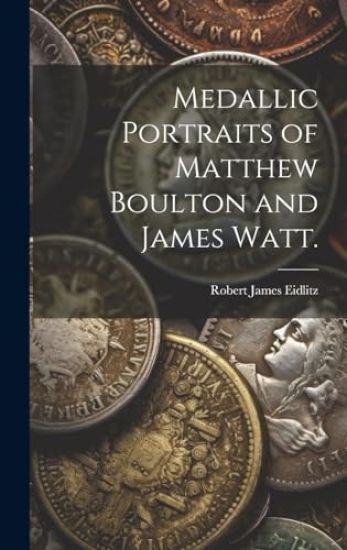
Medallic Portraits of Matthew Boulton and James Watt.
Robert James Eidlitz
Hassell Street Press
2023
sidottu
This book is a detailed study of the medallic portraits of Matthew Boulton and James Watt, two of the most prominent figures in the development of the steam engine and the industrial revolution. The author, Robert James Eidlitz, provides a thorough analysis of the medals' designs, meanings, and historical contexts, as well as the artists who created them. This book will be of interest to anyone interested in the history of technology, art, or the intersection of science and society.This work has been selected by scholars as being culturally important, and is part of the knowledge base of civilization as we know it.This work is in the "public domain in the United States of America, and possibly other nations. Within the United States, you may freely copy and distribute this work, as no entity (individual or corporate) has a copyright on the body of the work.Scholars believe, and we concur, that this work is important enough to be preserved, reproduced, and made generally available to the public. We appreciate your support of the preservation process, and thank you for being an important part of keeping this knowledge alive and relevant.

Memoirs of the Life of the Right Honourable Sir James Mackintosh
Robert James Mackintosh
Antigonos Verlag
2025
nidottu

Memoirs of the Life of the Right Honourable Sir James Mackintosh
Robert James Mackintosh
Antigonos Verlag
2025
nidottu
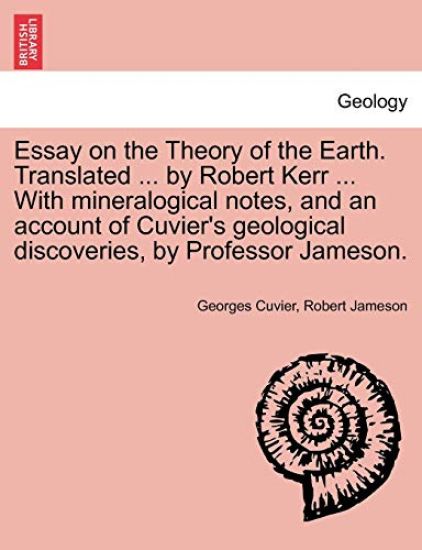
Essay on the Theory of the Earth. Translated ... by Robert Kerr ... with Mineralogical Notes, and an Account of Cuvier's Geological Discoveries, by PR
Georges Baron Cuvier; Robert Jameson
British Library, Historical Print Editions
2011
pokkari
Title: Essay on the Theory of the Earth. Translated ... by Robert Kerr ... With mineralogical notes, and an account of Cuvier's geological discoveries, by Professor Jameson.Publisher: British Library, Historical Print EditionsThe British Library is the national library of the United Kingdom. It is one of the world's largest research libraries holding over 150 million items in all known languages and formats: books, journals, newspapers, sound recordings, patents, maps, stamps, prints and much more. Its collections include around 14 million books, along with substantial additional collections of manuscripts and historical items dating back as far as 300 BC.The GEOLOGY collection includes books from the British Library digitised by Microsoft. The works in this collection contain a number of maps, charts, and tables from the 16th to the 19th centuries documenting geological features of the natural world. Also contained are textbooks and early scientific studies that catalogue and chronicle the human stance toward water and land use. Readers will further enjoy early historical maps of rivers and shorelines demonstrating the artistry of journeymen, cartographers, and illustrators. ++++The below data was compiled from various identification fields in the bibliographic record of this title. This data is provided as an additional tool in helping to insure edition identification: ++++ British Library Cuvier, Georges; Jameson, Robert; 1827. xxiv. 550 p.; 8 . 07105.f.20.

Who Won?!? an Irreverent Look at the Oscars, Volume 1: 1927-1943
Robert James
Imagination Archives
2014
nidottu
Who Should Have Won the Oscars?If you've ever wondered why the Oscars seem to go to the wrong movies, WHO Won? ? is the book for you. Beginning with the first Oscar ceremony, Robert James looks at all the major categories, slashing and burning his way through the bad, praising the good, and offering the best for your consideration. A comic, biting analysis of hundreds of films, WHO Won? ? is a guide to the wonderful movies you missed - and a warning against the ones you should never have seen in the first place. Volume One, 1927-1943 covers the Golden Age of Hollywood, from the death of the silent picture to the heights of studio Hollywood. Year by year, the author considers and discusses the Academy's choices, as well as those which should have been nominated, finishing each category with those which should have won. He often includes some of the history behind the making of the films, as well as how the movies reflect on America. More than just an examination of the choices the Academy made (or should have made), WHO Won? ? provides a yearbook of American cinema, both glorious and disastrous. Deftly switching from the ridiculous to the sublime and back again, WHO Won? ? will leave you both laughing and thinking.

Who Won?!? an Irreverent Look at the Oscars, Volume 2: 1944-1952
Robert James
Imagination Archives
2014
nidottu
If you've ever wondered why the Oscars seem to go to the wrong movies, WHO Won? ? is the book for you. Robert James looks at all the major categories, slashing and burning his way through the bad, praising the good, and offering the best for your consideration. A comic, biting analysis of hundreds of films, WHO Won? ? is a guide to the wonderful movies you missed - and a warning against the ones you should never have seen in the first place.As Norma Desmond says in Sunset Blvd., in here, it's "...just us, the cameras, and those wonderful people out there in the dark "This time around, we take up the moonlit shadows and night terrors of Hollywood from 1944-1952, as the studio system begins collapsing and the censorship boards show their first fracturing. Hollywood dimmed the lights as film noir emerged, along with more serious, adult pictures. Sadly, the arrival of television also pushed Hollywood into producing more Big Dumb Movies, although the rise of spectacle could sometimes pay off. The Supreme Court would break up the studios. Congress would do even more damage by launching an investigation of Hollywood, driving the studios to stop making more than a handful of pictures for mature minds while they frantically searched for some new way to bring people back into the theaters. At the same time, Hollywood would begin its own persecution with the blacklist, driving many out of work, even as it drove itself into a corner with little room to do anything but play it safe.Don't miss the early years of film history in Volume 1 of WHO Won? ? covering 1927-1943.

Who Won?!? an Irreverent Look at the Oscars, Volume 3: 1953-1963
Robert James
Imagination Archives
2014
nidottu
Who Should Have Won the Oscars?If you've ever wondered why the Oscars seem to go to the wrong movies, WHO Won? ? is the book for you. Beginning with the first Oscar ceremony, Robert James looks at all the major categories, slashing and burning his way through the bad, praising the good, and offering the best for your consideration. A comic, biting analysis of hundreds of films, WHO Won? ? is a guide to the wonderful movies you missed - and a warning against the ones you should never have seen in the first place.Volume Three welcomes us to the funeral for studio Hollywood, complete with a drunken wake, talented visitors from foreign lands, and all the excess that grieving alcohol, money, and terror can provide