Kirjojen hintavertailu. Mukana 11 213 693 kirjaa ja 11 kauppaa.

Kirjahaku

Etsi kirjoja tekijän nimen, kirjan nimen tai ISBN:n perusteella.

1000 tulosta hakusanalla Robert James Merrett

Imperial Paradoxes

Imperial Paradoxes

Robert James Merrett

McGill-Queen's University Press
2021
sidottu
At war for sixty years, eighteenth-century Britain and France experienced demographic, social, and economic exchanges despite their imperial rivalry. Paradoxically, this rivalry spurred their participation in scientific and industrial developments. Their shared interest in standards of living and cultural practices was fuelled by migration and philosophical exchanges that reciprocally transmitted the values of urban geography, medicine, teaching, and the industrial and fine arts.In Imperial Paradoxes Robert Merrett compares British and French literature on those topics. He explains how food, wine, fashion, and tourism were channels of interdisciplinary relations and shows why authors in both nations turned the notion of empire from commercial and military expansion into a metaphor for exploring self-knowledge and pleasure. Although cognitive science has come to the fore only in the past two generations, eighteenth-century writers tested problems in the dualist and faculty psychology of Western rationalism. Themes of embodiment and embodied thought drawn from recent theorists are applied throughout this book, along with dialectics and models of the senses operating together.Imperial Paradoxes avoids the limitations of strict chronology, weaving together multiple narratives for a more complete picture. Applying major works in the fields of cognitive science, cognitive psychology, and pedagogical theory to prose, poetry, and drama from the eighteenth century, Merrett shows how attention to eating, drinking, dressing, and travelling gives important insights into individual literary works and literary history.
Imperial Paradoxes

Imperial Paradoxes

Robert James Merrett

McGill-Queen's University Press
2021
nidottu
At war for sixty years, eighteenth-century Britain and France experienced demographic, social, and economic exchanges despite their imperial rivalry. Paradoxically, this rivalry spurred their participation in scientific and industrial developments. Their shared interest in standards of living and cultural practices was fuelled by migration and philosophical exchanges that reciprocally transmitted the values of urban geography, medicine, teaching, and the industrial and fine arts.In Imperial Paradoxes Robert Merrett compares British and French literature on those topics. He explains how food, wine, fashion, and tourism were channels of interdisciplinary relations and shows why authors in both nations turned the notion of empire from commercial and military expansion into a metaphor for exploring self-knowledge and pleasure. Although cognitive science has come to the fore only in the past two generations, eighteenth-century writers tested problems in the dualist and faculty psychology of Western rationalism. Themes of embodiment and embodied thought drawn from recent theorists are applied throughout this book, along with dialectics and models of the senses operating together.Imperial Paradoxes avoids the limitations of strict chronology, weaving together multiple narratives for a more complete picture. Applying major works in the fields of cognitive science, cognitive psychology, and pedagogical theory to prose, poetry, and drama from the eighteenth century, Merrett shows how attention to eating, drinking, dressing, and travelling gives important insights into individual literary works and literary history.
Proper Words in Proper Places

Proper Words in Proper Places

Robert James Merrett

Friesenpress
2024
pokkari
Proper Words in Proper Places: Dialectical Explication and English Literary History explores how literary history intertwines cultural, political, philosophical, religious, and commercial influences with literary production to create new ways of reading, meaning, and understanding. The text provides a delightful and surprising mix of canonical and non-canonical texts that merge many genres and literary allusions to highlight the complexities of literary historiography. Simultaneously, Proper Words in Proper Places digests the challenges of literary history and prepares readers to formulate for themselves the multiplicity of its nature and function.Drawing from texts published between 1670 and 1920, Robert J. Merrett demonstrates how the mixing and involvement of literary forms with such influences as painting, music, theatre, natural history, and notions of civility and spirituality erode simplistic ideas about the nature of narrative. His keen analysis of the traditional and experimental rhetoric of the texts serves to illustrate the double vision of the humanities and shows how the liberal arts enlighten contemporary moral issues. Additionally, the chapters probe, through their diverse models of reading, how mixed literary genres oblige us to create textual memories as our readings unfold. Merrett's linguistic and contextual analyses heighten cognitive, psychological, and aesthetic processes, thereby demonstrating that poems, plays, novels, and other literary forms mix lexical registers and interdisciplinary discourses to counter literal-mindedness. Proper Words in Proper Places is a unique work, unsettling notions of periodicity, promoting interdisciplinarity, and countering educational indifference toward literary and aesthetic cultures. Its explanations of the diversity of literary historiography could easily inform new design models for survey courses and help prepare those about to enter teaching professions, who are expected to be familiar with the philosophical and contextual problems that motivate literary texts. It promises stimulating and thought-provoking study and invites readers to develop a sense of how literature operates as a system based on philosophical contraries and logical paradoxes.
Proper Words in Proper Places

Proper Words in Proper Places

Robert James Merrett

Friesenpress
2024
sidottu
Proper Words in Proper Places: Dialectical Explication and English Literary History explores how literary history intertwines cultural, political, philosophical, religious, and commercial influences with literary production to create new ways of reading, meaning, and understanding. The text provides a delightful and surprising mix of canonical and non-canonical texts that merge many genres and literary allusions to highlight the complexities of literary historiography. Simultaneously, Proper Words in Proper Places digests the challenges of literary history and prepares readers to formulate for themselves the multiplicity of its nature and function.Drawing from texts published between 1670 and 1920, Robert J. Merrett demonstrates how the mixing and involvement of literary forms with such influences as painting, music, theatre, natural history, and notions of civility and spirituality erode simplistic ideas about the nature of narrative. His keen analysis of the traditional and experimental rhetoric of the texts serves to illustrate the double vision of the humanities and shows how the liberal arts enlighten contemporary moral issues. Additionally, the chapters probe, through their diverse models of reading, how mixed literary genres oblige us to create textual memories as our readings unfold. Merrett's linguistic and contextual analyses heighten cognitive, psychological, and aesthetic processes, thereby demonstrating that poems, plays, novels, and other literary forms mix lexical registers and interdisciplinary discourses to counter literal-mindedness. Proper Words in Proper Places is a unique work, unsettling notions of periodicity, promoting interdisciplinarity, and countering educational indifference toward literary and aesthetic cultures. Its explanations of the diversity of literary historiography could easily inform new design models for survey courses and help prepare those about to enter teaching professions, who are expected to be familiar with the philosophical and contextual problems that motivate literary texts. It promises stimulating and thought-provoking study and invites readers to develop a sense of how literature operates as a system based on philosophical contraries and logical paradoxes.
Daniel Defoe, Contrarian

Daniel Defoe, Contrarian

Robert James Merrett

University of Toronto Press
2013
sidottu
A highly conscious wordsmith, Daniel Defoe used expository styles in his fiction and non-fiction that reflected his ability to perceive material and intellectual phenomena from opposing, but not contradictory perspectives. Moreover, the boundaries of genre within his wide-ranging oeuvre can prove highly fluid. In this study, Robert James Merrett approaches Defoe’s body of work using interdisciplinary methods that recognize dialectic in his verbal creativity and cognitive awareness. Examining more than ninety of Defoe’s works, Merrett contends that this author’s literariness exploits a conscious dialogue that fosters the reciprocity of traditional and progressive authorial procedures. Along the way, he discusses Defoe’s lexical and semantic sensibility, his rhetorical and aesthetic theories, his contrarian theology, and more. Merrett proposes that Defoe’s contrarian outlook celebrates a view of consciousness that acknowledges the brain’s bipartite structure, and in so doing illustrates how cognitive science may be applied to further explorations of narrative art.
Nominations of Robert James Huggett, William A. Nitze, Kay Collett Goss, Terrence L. Bracy, Billy J. Anotubby, David Matt James, and Norma G. Udall
This work has been selected by scholars as being culturally important, and is part of the knowledge base of civilization as we know it. This work was reproduced from the original artifact, and remains as true to the original work as possible. Therefore, you will see the original copyright references, library stamps (as most of these works have been housed in our most important libraries around the world), and other notations in the work.This work is in the public domain in the United States of America, and possibly other nations. Within the United States, you may freely copy and distribute this work, as no entity (individual or corporate) has a copyright on the body of the work.As a reproduction of a historical artifact, this work may contain missing or blurred pages, poor pictures, errant marks, etc. Scholars believe, and we concur, that this work is important enough to be preserved, reproduced, and made generally available to the public. We appreciate your support of the preservation process, and thank you for being an important part of keeping this knowledge alive and relevant.
The Affidavits and Proceedings of Walter Baker, Administrator to the Late Baron Schwanberg, Upon his Petition to Vacate the Patent Obtained by Dr. Robert James for Schwanberg's Powder, Upon the Hearing, the Sixth of December, 1752
The 18th century was a wealth of knowledge, exploration and rapidly growing technology and expanding record-keeping made possible by advances in the printing press. In its determination to preserve the century of revolution, Gale initiated a revolution of its own: digitization of epic proportions to preserve these invaluable works in the largest archive of its kind. Now for the first time these high-quality digital copies of original 18th century manuscripts are available in print, making them highly accessible to libraries, undergraduate students, and independent scholars.This collection reveals the history of English common law and Empire law in a vastly changing world of British expansion. Dominating the legal field is the Commentaries of the Law of England by Sir William Blackstone, which first appeared in 1765. Reference works such as almanacs and catalogues continue to educate us by revealing the day-to-day workings of society.++++The below data was compiled from various identification fields in the bibliographic record of this title. This data is provided as an additional tool in helping to insure edition identification: ++++British LibraryT066417At head of title: ' Fit to be bound with Dr. James's essay on fevers, &c.]'.London: printed, and there published for physicians, surgeons, and apothecaries, and all others whom it may concern, 1754. xv, 1],96p.; 12
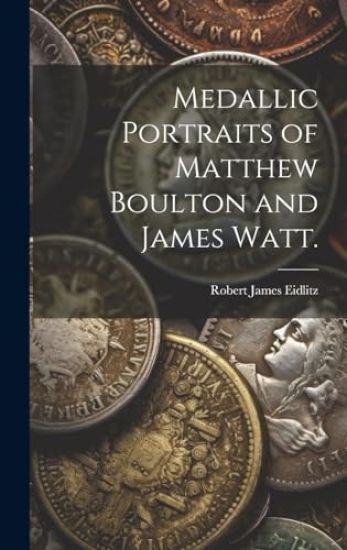
Medallic Portraits of Matthew Boulton and James Watt.

Medallic Portraits of Matthew Boulton and James Watt.

Robert James Eidlitz

Hassell Street Press
2021
nidottu
This work has been selected by scholars as being culturally important and is part of the knowledge base of civilization as we know it.This work is in the public domain in the United States of America, and possibly other nations. Within the United States, you may freely copy and distribute this work, as no entity (individual or corporate) has a copyright on the body of the work.Scholars believe, and we concur, that this work is important enough to be preserved, reproduced, and made generally available to the public. To ensure a quality reading experience, this work has been proofread and republished using a format that seamlessly blends the original graphical elements with text in an easy-to-read typeface.We appreciate your support of the preservation process, and thank you for being an important part of keeping this knowledge alive and relevant.
Medallic Portraits of Matthew Boulton and James Watt.

Medallic Portraits of Matthew Boulton and James Watt.

Robert James Eidlitz

Hassell Street Press
2023
sidottu
This book is a detailed study of the medallic portraits of Matthew Boulton and James Watt, two of the most prominent figures in the development of the steam engine and the industrial revolution. The author, Robert James Eidlitz, provides a thorough analysis of the medals' designs, meanings, and historical contexts, as well as the artists who created them. This book will be of interest to anyone interested in the history of technology, art, or the intersection of science and society.This work has been selected by scholars as being culturally important, and is part of the knowledge base of civilization as we know it.This work is in the "public domain in the United States of America, and possibly other nations. Within the United States, you may freely copy and distribute this work, as no entity (individual or corporate) has a copyright on the body of the work.Scholars believe, and we concur, that this work is important enough to be preserved, reproduced, and made generally available to the public. We appreciate your support of the preservation process, and thank you for being an important part of keeping this knowledge alive and relevant.