Kirjojen hintavertailu. Mukana 12 390 323 kirjaa ja 12 kauppaa.

Kirjahaku

Etsi kirjoja tekijän nimen, kirjan nimen tai ISBN:n perusteella.

1000 tulosta hakusanalla Robert K. Teske Jr

A Pocket Guide To Writing an eBook & eBook Marketing

A Pocket Guide To Writing an eBook & eBook Marketing

Robert K. Teske Jr

Createspace Independent Publishing Platform
2012
nidottu
Have you ever wanted to write and publish a digital book? Here's a basic pocket handbook to writing and marketing an eBook that doesn't take a Ph.D to understand. It's in simple, easy to understand English. It's not true that everything that has been said has already been written. Since that unfortunate axiom came into use, the whole universe has changed. Technology has changed, ideas have changed, and the mindsets of entire nations have changed. The fact is that this is the perfect time to write an eBook. What the publishing industry needs are people who can tap into the world as it is today - innovative thinkers who can make the leap into the new millennium and figure out how to solve old problems in a new way. Within the contents of this Pocket Guide is everything your really need to know if you've ever want to create a Digital Book, presently known as an eBook: * Why Write an eBook? * How to Write an eBook * Overcoming Writer's Block * Choosing an eBook Compiler * Rating eBook Compilers * Steps to Publishing Success * How to Price Your eBook * Bonus: eBooks are Promotional Powerhouses
Robert K. Merton

Robert K. Merton

Columbia University Press
2010
sidottu
Robert K. Merton (1910-2003) was one of the most influential sociologists of the twentieth century, producing clear theories and innovative research that continue to shape multiple disciplines. Merton's reach can be felt in the study of social structure, social psychology, deviance, professions, organizations, culture, and science. Yet for all his fame, Merton is only partially understood. He is treated by scholars as a functional analyst, when in truth his contributions transcend paradigm. Gathering together twelve major sociologists, Craig Calhoun launches a thorough reconsideration of Merton's achievements and inspires a renewed engagement with sociological theory. Merton's work addressed the challenges of integrating research and theory. It connected different fields of empirical research and spoke to the importance of overcoming divisions between allegedly pure and applied sociology. Merton also sought to integrate sociology with the institutional analysis of science, each informing the other. By bringing together different aspects of his work in one volume, Calhoun illuminates the interdisciplinary--and unifying--dimensions of Merton's approach, while also advancing the intellectual agenda of an increasingly vital area of study. Contributors: Aaron L. Panofsky, University of California; Alan Sica, Pennsylvania State University; Alejandro Portes, Princeton University; Charles Camic, Northwestern University; Charles Tilly, Columbia University; Craig Calhoun, Social Science Research Council and New York University; Cynthia Fuchs Epstein, City University of New York; Harriet Zuckerman, Mellon Foundation; Peter Simonson, University of Colorado; Ragnvald Kalleberg, University of Oslo; Robert J. Sampson, Harvard University; Thomas F. Gieryn, Indiana University; Viviana A. Zelizer, Princeton University
Robert K. Merton

Robert K. Merton

Columbia University Press
2017
pokkari
Robert K. Merton (1910-2003) was one of the most influential sociologists of the twentieth century, producing clear theories and innovative research that continue to shape multiple disciplines. Merton's reach can be felt in the study of social structure, social psychology, deviance, professions, organizations, culture, and science. Yet for all his fame, Merton is only partially understood. He is treated by scholars as a functional analyst, when in truth his contributions transcend paradigm. Gathering together twelve major sociologists, Craig Calhoun launches a thorough reconsideration of Merton's achievements and inspires a renewed engagement with sociological theory. Merton's work addressed the challenges of integrating research and theory. It connected different fields of empirical research and spoke to the importance of overcoming divisions between allegedly pure and applied sociology. Merton also sought to integrate sociology with the institutional analysis of science, each informing the other. By bringing together different aspects of his work in one volume, Calhoun illuminates the interdisciplinary--and unifying--dimensions of Merton's approach, while also advancing the intellectual agenda of an increasingly vital area of study. Contributors: Aaron L. Panofsky, University of California; Alan Sica, Pennsylvania State University; Alejandro Portes, Princeton University; Charles Camic, Northwestern University; Charles Tilly, Columbia University; Craig Calhoun, Social Science Research Council and New York University; Cynthia Fuchs Epstein, City University of New York; Harriet Zuckerman, Mellon Foundation; Peter Simonson, University of Colorado; Ragnvald Kalleberg, University of Oslo; Robert J. Sampson, Harvard University; Thomas F. Gieryn, Indiana University; Viviana A. Zelizer, Princeton University
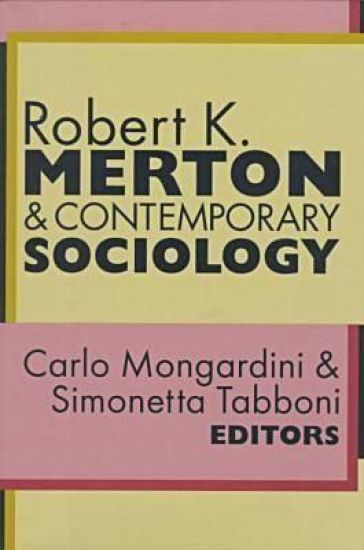
Robert K. Merton and Contemporary Sociology
This volume offers scholars of sociology and allied areas the fruits of an international conference on the contributions of the eminent Robert K. Merton. The assessment, as good in content as well as in participants, took place in Amalfi, Italy, with the participation of Merton himself and under the auspices of the Italian Sociology Association. Carlo Mongardini aptly summarizes the unique impact of Merton on the social theory of our century. "His strength as a classic writer lies in his balance, unveiling complexity, and in his humanism which looks beyond the apparent simplicity and coherence of social reality."A special treat is the final chapter by Merton reviewing "Unanticipated Conse-quences and Kindred Sociological Ideas." In it, he ranges from the historical an-tecedents of the concept to his own evolution in the use and expansion of the idea. Merton approaches the development of his thought as installments rather than sim-ple evolution, and in so doing gives us unique insight into how he built upon his originating notions in the context of social science as it existed in the United States. Tensions between integrating scholarship and reaching the general public provide a special insight into Merton that might prove new even to those who know his work well.Contributors to this original volume include: Volker Meja, Nico Stehr, Paolo Ammassari, Gianni Statera, Birgitta Nedelmann, Harriet Zuckerman, Piotr Sztompka, Peter Gerlich, Charles Crothers, Elena Besozzi, and Arnold Zongerle, among others. The chapters address the full range of Merlon's work, with special emphasis on such areas as anomie, structural analysis, the relationship of theory to research, patterns of latent and manifest influence, and even the application of Mertonian concepts to the analysis of Merton as a scholar. This unusual compendium, translated from the Italian, will interest social researchers across the academic spectrum.
Robert K. Merton and Contemporary Sociology

Robert K. Merton and Contemporary Sociology

Carlo Mongardini

Transaction Publishers
1997
sidottu
This volume offers scholars of sociology and allied areas the fruits of an international conference on the contributions of the eminent Robert K. Merton. The assessment, as good in content as well as in participants, took place in Amalfi, Italy, with the participation of Merton himself and under the auspices of the Italian Sociology Association. Carlo Mongardini aptly summarizes the unique impact of Merton on the social theory of our century. "His strength as a classic writer lies in his balance, unveiling complexity, and in his humanism which looks beyond the apparent simplicity and coherence of social reality."A special treat is the final chapter by Merton reviewing "Unanticipated Conse-quences and Kindred Sociological Ideas." In it, he ranges from the historical an-tecedents of the concept to his own evolution in the use and expansion of the idea. Merton approaches the development of his thought as installments rather than sim-ple evolution, and in so doing gives us unique insight into how he built upon his originating notions in the context of social science as it existed in the United States. Tensions between integrating scholarship and reaching the general public provide a special insight into Merton that might prove new even to those who know his work well.Contributors to this original volume include: Volker Meja, Nico Stehr, Paolo Ammassari, Gianni Statera, Birgitta Nedelmann, Harriet Zuckerman, Piotr Sztompka, Peter Gerlich, Charles Crothers, Elena Besozzi, and Arnold Zongerle, among others. The chapters address the full range of Merlon's work, with special emphasis on such areas as anomie, structural analysis, the relationship of theory to research, patterns of latent and manifest influence, and even the application of Mertonian concepts to the analysis of Merton as a scholar. This unusual compendium, translated from the Italian, will interest social researchers across the academic spectrum.
Robert K. Mertons Theorie der self-fulfilling prophecy
Robert K. Mertons Theorie der self-fulfilling prophecy wird unter massgeblicher Berucksichtigung aktueller kommunikationswissenschaftlicher Erkenntnisse an die Strukturen moderner Mediengesellschaften adaptiert. Dabei interessiert insbesondere die Frage, inwieweit Phanomene der self-fulfilling prophecy als Folge von Medienwirkung denkbar sind. Es wird gezeigt, dass die mannigfachen Selektions- und Darstellungseffekte der Massenmedien sich nahezu ideal in den Wirkmechanismus der self-fulfilling prophecy fugen. Am Fallbeispiel der Hamburger Mody-Bank werden Interventionsmoeglichkeiten fur die von Berichterstattung betroffenen Akteure diskutiert.