Kirjojen hintavertailu. Mukana 11 244 527 kirjaa ja 12 kauppaa.

Kirjahaku

Etsi kirjoja tekijän nimen, kirjan nimen tai ISBN:n perusteella.

1000 tulosta hakusanalla Robert M. Groves

The Collected Works of Robert M. Groves, 6 Book Set

The Collected Works of Robert M. Groves, 6 Book Set

Robert M. Groves

John Wiley Sons Inc
2009
nidottu
This set features: Survey Methodology, Second Edition by Robert M. Groves, Floyd J. Fowler, Jr., Mick P. Couper, James M. Lepkowski, Eleanor Singer, Roger Tourangeau (978-0-470-46546-2) Nonresponse in Household Interview Surveys by Robet M. Groves and Mick P. Couper (978-0-471-18245-0) Telephone Survey Methodology by Robert M. Groves, Paul P. Biemer, Lars E. Lyberg, James T. Massey, William L. Nicholls, II, and Joseph Waksberg (Editors) (978-0-471209560) Survey Nonresponse by Robert M. Groves, Don A. Dillman, John L. Eltinge, Roderick J. A. Little (978-0-471396277) Survey Errors and Survey Costs by Robert M. Groves (978-0-471-67851-9) Measurement Errors in Surveys by Paul P. Biemer, Robert M. Groves, Lars E. Lyberg, Nancy A. Mathiowetz, and Seymour Sudman (Editors) (978-0-471-69280-5)
Survey Errors and Survey Costs

Survey Errors and Survey Costs

Robert M. Groves

John Wiley Sons Inc
2004
nidottu
The Wiley-Interscience Paperback Series consists of selected books that have been made more accessible to consumers in an effort to increase global appeal and general circulation. With these new unabridged softcover volumes, Wiley hopes to extend the lives of these works by making them available to future generations of statisticians, mathematicians, and scientists. "Survey Errors and Survey Costs is a well-written, well-presented, and highly readable text that should be on every error-conscious statistician’s bookshelf. Any courses that cover the theory and design of surveys should certainly have Survey Errors and Survey Costs on their reading lists." –Phil Edwards MEL, Aston University Science Park, UK Review in The Statistician, Vol. 40, No. 3, 1991 "This volume is an extremely valuable contribution to survey methodology. It has many virtues: First, it provides a framework in which survey errors can be segregated by sources. Second, Groves has skillfully synthesized existing knowledge, bringing together in an easily accessible form empirical knowledge from a variety of sources. Third, he has managed to integrate into a common framework the contributions of several disciplines. For example, the work of psychometricians and cognitive psychologists is made relevant to the research of econometricians as well as the field experience of sociologists. Finally, but not least, Groves has managed to present all this in a style that is accessible to a wide variety of readers ranging from survey specialists to policymakers." –Peter H. Rossi University of Massachusetts at Amherst Review in Journal of Official Statistics, January 1991
Survey Methodology

Survey Methodology

Robert M. Groves; Floyd J. Fowler; Mick P. Couper; James M. Lepkowski; Eleanor Singer; Roger Tourangeau

John Wiley Sons Inc
2009
nidottu
Praise for the First Edition: "The book makes a valuable contribution by synthesizing current research and identifying areas for future investigation for each aspect of the survey process." —Journal of the American Statistical Association "Overall, the high quality of the text material is matched by the quality of writing . . ." —Public Opinion Quarterly ". . . it should find an audience everywhere surveys are being conducted." —Technometrics This new edition of Survey Methodology continues to provide a state-of-the-science presentation of essential survey methodology topics and techniques. The volume's six world-renowned authors have updated this Second Edition to present newly emerging approaches to survey research and provide more comprehensive coverage of the major considerations in designing and conducting a sample survey. Key topics in survey methodology are clearly explained in the book's chapters, with coverage including sampling frame evaluation, sample design, development of questionnaires, evaluation of questions, alternative modes of data collection, interviewing, nonresponse, post-collection processing of survey data, and practices for maintaining scientific integrity. Acknowledging the growing advances in research and technology, the Second Edition features: Updated explanations of sampling frame issues for mobile telephone and web surveys New scientific insight on the relationship between nonresponse rates and nonresponse errors Restructured discussion of ethical issues in survey research, emphasizing the growing research results on privacy, informed consent, and confidentiality issues The latest research findings on effective questionnaire development techniques The addition of 50% more exercises at the end of each chapter, illustrating basic principles of survey design An expanded FAQ chapter that addresses the concerns that accompany newly established methods Providing valuable and informative perspectives on the most modern methods in the field, Survey Methodology, Second Edition is an ideal book for survey research courses at the upper-undergraduate and graduate levels. It is also an indispensable reference for practicing survey methodologists and any professional who employs survey research methods.
Nonresponse in Household Interview Surveys

Nonresponse in Household Interview Surveys

Robert M. Groves; Mick P. Couper

John Wiley Sons Inc
1998
sidottu
A comprehensive framework for both reduction of nonresponse and postsurvey adjustment for nonresponse This book provides guidance and support for survey statisticians who need to develop models for postsurvey adjustment for nonresponse, and for survey designers and practitioners attempting to reduce unit nonresponse in household interview surveys. It presents the results of an eight-year research program that has assembled an unprecedented data set on respondents and nonrespondents from several major household surveys in the United States. Within a comprehensive conceptual framework of influences on nonresponse, the authors investigate every aspect of survey cooperation, from the influences of household characteristics and social and environmental factors to the interaction between interviewers and householders and the design of the survey itself. Nonresponse in Household Interview Surveys: *Provides a theoretical framework for understanding and studying household survey nonresponse *Empirically explores the individual and combined influences of several factors on nonresponse *Presents chapter introductions, summaries, and discussions on practical implications to clarify concepts and theories *Supplies extensive references for further study and inquiry Nonresponse in Household Interview Surveys is an important resource for professionals and students in survey methodology/research methods as well as those who use survey methods or data in business, government, and academia. It addresses issues critical to dealing with nonresponse in surveys, reducing nonresponse during survey data collection, and constructing statistical compensations for the effects of nonresponse on key survey estimates.
Justice Takes a Recess

Justice Takes a Recess

Scott E. Graves; Robert M. Howard

Lexington Books
2009
sidottu
The Constitution allows the president to “fill up all Vacancies that may happen during the Recess of the Senate, by granting Commissions which shall expire at the End of their next Session.” In Justice Takes a Recess, Scott E. Graves and Robert M. Howard address how presidents have used recess appointments over time and whether the independence of judicial recess appointees is compromised. They argue that these appointments can upset the separation of powers envisioned by the Framers, shifting power away from one branch of government and toward another. Examining every judicial recess appointment from 1789 to 2005, the authors discover that presidents are conditionally strategic when they unilaterally appoint federal judges during Senate recesses. Such appointments were made cautiously for most of the twentieth century, leading to a virtual moratorium for several decades, until three recent recess appointments to the courts in the face of Senate obstruction revived the controversy. These appointments suggest the beginning of a more assertive use of recess appointments in the increasingly politicized activity of staffing the federal courts. The authors argue that the recess appointment clause, as it pertains to the judiciary, is no longer necessary or desirable. The strategic use of such appointments by strong presidents to shift judicial ideology, combined with the lack of independence exhibited by judicial recess appointments, results in recess power that threatens constitutional features of the judicial branch.
Justice Takes a Recess

Justice Takes a Recess

Scott E. Graves; Robert M. Howard

Lexington Books
2010
nidottu
The Constitution allows the president to Ofill up all Vacancies that may happen during the Recess of the Senate, by granting Commissions which shall expire at the End of their next Session.O In Justice Takes a Recess, Scott E. Graves and Robert M. Howard address how presidents have used recess appointments over time and whether the independence of judicial recess appointees is compromised. They argue that these appointments can upset the separation of powers envisioned by the Framers, shifting power away from one branch of government and toward another. Examining every judicial recess appointment from 1789 to 2005, the authors discover that presidents are conditionally strategic when they unilaterally appoint federal judges during Senate recesses. Such appointments were made cautiously for most of the twentieth century, leading to a virtual moratorium for several decades, until three recent recess appointments to the courts in the face of Senate obstruction revived the controversy. These appointments suggest the beginning of a more assertive use of recess appointments in the increasingly politicized activity of staffing the federal courts. The authors argue that the recess appointment clause, as it pertains to the judiciary, is no longer necessary or desirable. The strategic use of such appointments by strong presidents to shift judicial ideology, combined with the lack of independence exhibited by judicial recess appointments, results in recess power that threatens constitutional features of the judicial branch.
Progress in Drug Research/Fortschritte der Arzneimittelforschung/Progrès des recherches pharmaceutiques

Progress in Drug Research/Fortschritte der Arzneimittelforschung/Progrès des recherches pharmaceutiques

Norman K. Hollenberg; Steven W. Graves; Robert B. McCall; William T. Jackson; Jerome H. Fleisch; M. Margaglione; E. Grandone; F. P. Mancini; G. Di Minno; N. Seiler; A. Hardy; J. P. Moulinoux; James Claghorn; Michael D. Lesem; Eric J. Lien; Arima Das; Linda L. Lien

Springer Basel
2011
nidottu
Volume 46 of "Progress in Drug Research" contains seven reviews and the various indexes which facilitate its use and establish the connection with the previous volumes. The articles in this volume deal with endo- genous sodium pump inhibition, with neurotransmitters involved in the central regulation of the cardiovascular system, with leukotrienes and development of novel anti-inflammatory agents, with antithrombotic stra- tegies and drugs affecting the plasma fibrinogen levels, with natural ami- noglycosides and polyamines and their effects in the mammalian orga- nism, with the latest developments in antidepressant agents and with immunopharmacological and biochemical bases of Chinese herbal medi- cine. These reviews provide valuable information on several new deve- lopments in the complex domain of drug research. In the 37 years that PDR has existed, the Editor has enjoyed the valua- ble help and advice of many colleagues. Readers, the authors of the reviews and, last but not least, the reviewers have all contributed greatly to the success of this series of monographs. Although the comments received so far have generally been favorable, it is nevertheless necessary to analyze and to reassess the current position and the future direction of such publi- cations.
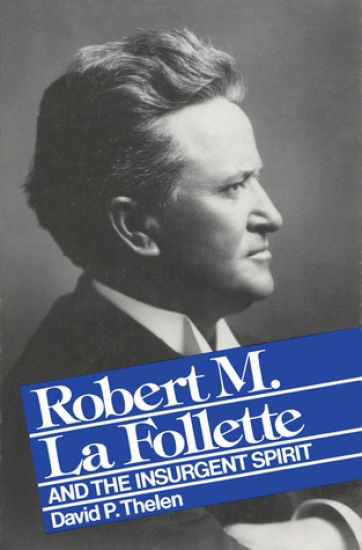
Robert M.La Follette and the Insurgent Spirit
Robert M. La Follette and the Insurgent Spirit is a closely argued, lively, and readable biography of the central figure in the American Progressive movement. Wisconsin's "Fighting Bob" La Follette embodied the heart of Progressive sentiment and principle. He was a powerful force in shaping national political events between the eras of Populism and the New Deal
Robert M. La Follette, Sr.

Robert M. La Follette, Sr.

Carl R. Burgchardt

Greenwood Press
1992
sidottu
This reference is the only book-length work to analyze all of the major speeches of one of the most significant politicians of the first part of the twentieth century, Robert La Follette, Sr. His speeches offer historic snapshots into the Progressive era and of the thinking of an outstanding governor of Wisconsin, U.S. senator, and social agitator. This rhetorical biography analyzes key speeches and provides texts demonstrating how Senator La Follette used melodramatic scenarios to enlist citizens in his reform crusade against the gravest danger that he saw in this country. This reference also provides texts of his most important speeches, a chronology of his major orations, and a lengthy bibliography. This unique volume is designed for students and specialists in political communication, rhetorical criticism, and American studies.This systematical analysis of Senator La Follette's public speeches is a short and highly readable history of the Progressive era, World War I and its aftermath, and the early 1920s from the perspective of a leading political figure of the times. The analysis of La Follette's rhetorical strategy illuminates his use of confrontational tactics, such as the filibuster in Congress to educate the voter and to plead for reforms that he considered essential. This reference provides the texts of five seminal orations and the most complete bibliography of speeches available to date.
Robert M. Young

Robert M. Young

McFarland Co Inc
2005
pokkari
Robert Young began his prolific filmmaking career while a student at Harvard University, where he majored in English literature, founded the Harvard Film Society, and, with the help of several colleagues, put together his first film (about a Boston factory worker). His reputation as a documentary filmmaker earned him a prestigious position with NBC, and he has since worked within and without the Hollywood production system for five decades. At age 80, Robert M. Young continues to be actively involved in a variety of projects as a commercially successful filmmaker and an independent artist. In this compilation of 15 essays, scholars of both English literature and film analyze the aesthetic and thematic elements of Young's many works. Among the films examined are Nothing But a Man, Triumph of the Spirit, Cortile Cascino, ALAMBRISTA!, Short Eyes, Ballad of Gregorio Cortez, Extremities, Dominick and Eugene, Talent for the Game, Roosters, Caught, and Human Error. The book includes an extensive interview with Young that provides a retrospect of Young's life as a director, cinematographer, writer and producer. A filmography of Young's work and a chronology of his life are also provided.
Robert M. Richards' Inspired Collection Vol. 1

Robert M. Richards' Inspired Collection Vol. 1

Kat Turner

Asylum Publications, Inc.
2019
pokkari
This is the first Volume of the Robert M. Richards' Inspired Collection, highlighting his photography work for the DeadWorld Zombie Soda brand. This collection of incredible photos includes some of the best models in the business, as well as highlighting the mind-blowing work of special fx makeup artists. Take a look behind the scenes to see life on the set of a Robert M. Richards' photoshoot as well as looks at the raw photos before they underwent his rigorous artistic editing process. A true collector's item for horror fans