
Kirjahaku
Etsi kirjoja tekijän nimen, kirjan nimen tai ISBN:n perusteella.
1000 tulosta hakusanalla Robert Morris

Lectures on Architecture. Consisting of Rules Founded Upon Harmonick and Arithmetical Proportions in Building, ... by Robert Morris. the Second Edition.
Robert Morris
Gale Ecco, Print Editions
2010
pokkari
Lectures on Architecture. Consisting of Rules Founded Upon Harmonick and Arithmetical Proportions in Building, ... By Robert Morris. The Second Edition
Robert Morris
Gale Ecco, Print Editions
2018
sidottu
The 18th century was a wealth of knowledge, exploration and rapidly growing technology and expanding record-keeping made possible by advances in the printing press. In its determination to preserve the century of revolution, Gale initiated a revolution of its own: digitization of epic proportions to preserve these invaluable works in the largest archive of its kind. Now for the first time these high-quality digital copies of original 18th century manuscripts are available in print, making them highly accessible to libraries, undergraduate students, and independent scholars.The eighteenth-century fascination with Greek and Roman antiquity followed the systematic excavation of the ruins at Pompeii and Herculaneum in southern Italy; and after 1750 a neoclassical style dominated all artistic fields. The titles here trace developments in mostly English-language works on painting, sculpture, architecture, music, theater, and other disciplines. Instructional works on musical instruments, catalogs of art objects, comic operas, and more are also included. ++++The below data was compiled from various identification fields in the bibliographic record of this title. This data is provided as an additional tool in helping to insure edition identification: ++++British LibraryT091318London: printed for R. Sayer, 1759. 16],132p., plates; 8
Confidential Correspondence Of Robert Morris, The Great Financier Of The Revolution
Robert Morris
KESSINGER PUBLISHING CO
2005
pokkari


The Confidential Correspondence of Robert Morris, the Great Financier of the Revolution
Robert Morris
Kessinger Pub
2005
sidottu
The Confidential Correspondence Of Robert Morris, The Great Financier Of The Revolution
Robert Morris
Literary Licensing, LLC
2014
nidottu

This book is a volume in the Penn Press Anniversary Collection. To mark its 125th anniversary in 2015, the University of Pennsylvania Press rereleased more than 1,100 titles from Penn Press's distinguished backlist from 1899-1999 that had fallen out of print. Spanning an entire century, the Anniversary Collection offers peer-reviewed scholarship in a wide range of subject areas.
Robert Morris' tombstone states that he was "The Financier"; officially, however, he was Superintendent of Finance. Whatever his title, Robert Morris played an integral role in financing the American Revolution, and Yale Prof WILLIAM GRAHAM SUMNER was a professor of political and social science at Yale University and became known as a Social Darwinist and advocate of the laissez faire principle in economics. Besides writing a number of books on sociology, history, and econo

Robert Morris' tombstone states that he was "The Financier"; officially, however, he was Superintendent of Finance. Whatever his title, Robert Morris played an integral role in financing the American Revolution, and Yale Prof WILLIAM GRAHAM SUMNER was a professor of political and social science at Yale University and became known as a Social Darwinist and advocate of the laissez faire principle in economics. Besides writing a number of books on sociology, history, and econo
On Robert Morris' final sculptural works, which express a shift toward more baroque and allegorical elementsDocumenting the first exhibition dedicated to American conceptualist Robert Morris (1931-2018) since his death, Monumentum 2015-2018 presents a series of works produced in the final years of the artist's life. Both series are comprised of sculptures depicting human figures: the first, MOLTINGSEXOSKELETONSSHROUDS, are made of Belgian linen soaked in resin and placed over models to take on their form; the second series, Boustrophedons, consists of works rendered in carbon fiber, and were exhibited respectively in 2015 and 2017 at the Castelli Gallery in New York. The spatial design of the two series as they were exhibited at the Galleria Nazionale of Rome was agreed with Morris himself before his death. Morris' last sculptural works mark a shift in his formal vocabulary, free from the imperatives of order and abstraction typical of the American avant-garde of his time.
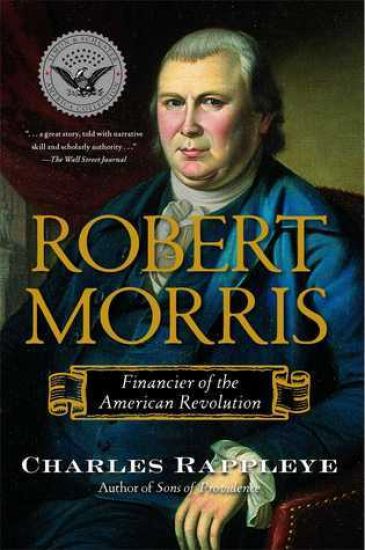
In this biography, the acclaimed author of Sons of Providence, winner of the 2007 George Wash- ington Book Prize, recovers an immensely important part of the founding drama of the country in the story of Robert Morris, the man who financed Washington's armies and the American Revolution. Morris started life in the colonies as an apprentice in a counting house. By the time of the Revolution he was a rich man, a commercial and social leader in Philadelphia. He organized a clandestine trading network to arm the American rebels, joined the Second Continental Congress, and financed George Washington's two crucial victories--Valley Forge and the culminating battle at Yorktown that defeated Cornwallis and ended the war. The leader of a faction that included Benjamin Franklin, Alexander Hamilton, James Madison, and Washington, Morris ran the executive branches of the revolutionary government for years. He was a man of prodigious energy and adroit management skills and was the most successful businessman on the continent. He laid the foundation for public credit and free capital markets that helped make America a global economic leader. But he incurred powerful enemies who considered his wealth and influence a danger to public "virtue" in a democratic society. After public service, he gambled on land speculations that went bad, and landed in debtors prison, where George Washington, his loyal friend, visited him. This once wealthy and powerful man ended his life in modest circumstances, but Rappleye restores his place as a patriot and an immensely important founding father.

Robert Morris, Revolutionary Financier: With an Analysis of His Earlier Career
Clarence L. Ver Steeg
ACLS History E-Book Project
2006
sidottu
Robert Morris, Revolutionary Financier: With an Analysis of His Earlier Career
Clarence L. Ver Steeg
ACLS History E-Book Project
2008
nidottu
Robert Morris: the Financier and the Finances of the American Revolution
William Graham Sumner
Beard Books
2000
pokkari
Robert Morris: the Financier and the Finances of the American Revolution
William Graham Sumner
Beard Books
2000
pokkari
Robert Morris (1892). By: William Graham Sumner: Robert Morris, Jr. (January 20, 1734 - May 8, 1806), a Founding Father of the United States.
William Graham Sumner
Createspace Independent Publishing Platform
2017
nidottu
Robert Morris, Jr. ((January 20, 1734 - May 8, 1806), a Founding Father of the United States, was a Liverpool-born American merchant who financed the American Revolution and signed the Declaration of Independence, the Articles of Confederation, and the United States Constitution. Along with Alexander Hamilton and Albert Gallatin, he is widely regarded as one of the founders of the financial system of the United States. Born in Liverpool, Morris migrated to the United States in his teens, quickly becoming a successful businessman. In the aftermath of the French and Indian War, Morris became a prominent opponent of unpopular British policies like the Stamp Act. He was elected to the Pennsylvania Assembly, became the Chairman of the Pennsylvania Committee of Safety, and was chosen as a delegate to the Second Continental Congress. He served as chairman of the "Secret Committee of Trade" and as a member of the Committee of Correspondence. Though reluctant to break with Britain, he ultimately came to support the independence movement and emerged as an important financier of the American Revolutionary War. From 1781 to 1784, he served as the Superintendent of Finance of the United States, a forerunner to the position of Secretary of the Treasury. As the central civilian in the government, Morris was, next to General George Washington, "the most powerful man in America." 1] His successful administration led to the sobriquet, "Financier of the Revolution." At the same time he was Agent of Marine, a position he took without pay, and from which he controlled the Continental Navy. He successfully proposed numerous reforms including the creation of a national bank, but many of his ideas were not enacted. In 1787, he was elected as a delegate to the Philadelphia Convention, which created a more powerful federal government.................. William Graham Sumner (October 30, 1840 - April 12, 1910) was a classical liberal (now a branch of "libertarianism" in American political philosophy) American social scientist. He taught social sciences at Yale, where he held the nation's first professorship in sociology. He was one of the most influential teachers at Yale or any major schools. Sumner was a polymath with numerous books and essays on American history, economic history, political theory, sociology, and anthropology. He supported laissez-faire economics, free markets, and the gold standard. He adopted the term "ethnocentrism" to identify the roots of imperialism, which he strongly opposed. He was a spokesman against imperialism and in favor of the "forgotten man" of the middle class, a term he coined. He had a long-term influence on conservatism in the United States.Sumner wrote an autobiographical sketch for the fourth of the histories of the Class of 1863 Yale College. In 1925, Rev. Harris E. Starr, class of 1910 Yale Department of Theology, published the first full length biography of Sumner. A second full length biography by Bruce Curtis was published in 1981. Other authors have included biographical information about Sumner as shown by citations in this "Biography" section.Sumner was born in Paterson, New Jersey, on October 30, 1840. His father, Thomas Sumner, was born in England and immigrated to the United States in 1836. His mother, Sarah Graham, was also born in England. She was brought to the United States in 1825 by her parents. Sumner's mother died when he was eight.In 1841, Sumner's father went prospecting as far west as Ohio, but came back east to New England and settled in Hartford, Connecticut, in about 1845. Sumner wrote about his high regard for his father: "His principles and habits of life were the best possible." Earlier in his life, Sumner said, that he accepted from others "views and opinions" different from his father's. However, "at the present time," Sumner wrote, "in regard to those matters, I hold with him and not with the others." Sumner did not name the "matters"....