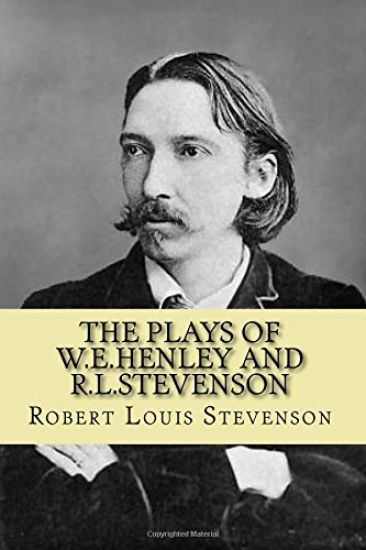
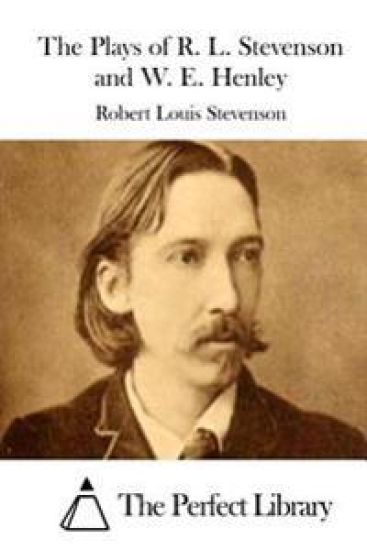
Robert Louis Balfour Stevenson (13 November 1850 - 3 December 1894) was a Scottish novelist, poet, essayist, and travel writer. His most famous works are Treasure Island, Kidnapped, Strange Case of Dr Jekyll and Mr Hyde, and A Child's Garden of Verses. A literary celebrity during his lifetime, Stevenson now ranks as the 26th most translated author in the world. His works have been admired by many other writers, including Jorge Luis Borges, Bertolt Brecht, Marcel Proust, Arthur Conan Doyle, Henry James, Cesare Pavese, Emilio Salgari, Ernest Hemingway, Rudyard Kipling, Jack London, Vladimir Nabokov, J. M. Barrie, and G. K. Chesterton, who said of him that he "seemed to pick the right word up on the point of his pen, like a man playing spillikins"............ Gordon Frederick Browne (15 April 1858 - 27 May 1932) was an English artist and children's book illustrator in the late 19th century and early 20th century. He was born in Banstead, the younger son of notable book illustrator Hablot Knight Browne (who as "Phiz" illustrated books by Charles Dickens). He studied art at the Heatherley School of Fine Art and South Kensington Schools and started to receive professional commissions while still at college. From the 1880s, Browne was one of Britain's most prolific illustrators, his work appearing in newspapers, magazines and many books by children's authors including Frederic William Farrar, G.A. Henty, Juliana Horatia Ewing, Andrew Lang, Talbot Baines Reed, L. T. Meade, Catherine Christian and E. Nesbit........ WILLIAM HATHERELL (1855-1928) William Hatherell was a Victorian era illustrator who worked for magazines such as The Graphic, Harpers, Scribner's and the Century. Today he is mostly remembered for crudely printed images such as these: he printing technology in Hatherell's day was pretty primitive. Combined with cheap paper stock, it stripped Hatherell's work of much of its sensitivity and expressiveness. Of course, like all resourceful artists Hatherell made the best of his limitations; he emphasized strong compositions and high contrasts that could survive the publication process.Hatherell might easily have used the disadvantages of his medium as an excuse for dashing off fast, limited work. Many artists did. In fact, his employers encouraged him to do so, in order to increase productivity and profits. Instead, Hatherell worked carefully and deliberately, crafting sensitive pictures with subtle features that were undetectable to his larger audience. As one contemporary noted, Hatherell stubbornly refused to lower his standards: Hatherell became noted for his refusal to be pressured into hasty work. For illustrating current events, for instance, he used models, often carefully posed in his backyard....
Extract: TABLEAU I. The Double Life. The Stage represents a room in the Deacon's house, furnished partly as a sitting-, partly as a bed-room, in the style of an easy burgess of about 1780. C., a door; L. C., a second and smaller door; R. C., practicable window; L., alcove, supposed to contain bed; at the back, a clothes-press and a corner cupboard containing bottles, etc. Mary Brodie at needlework; Old Brodie, a paralytic, in wheeled chair, at the fireside, L. SCENE I To these Leslie, C. Leslie. May I come in, Mary? Mary. Why not? Leslie. I scarce knew where to find you. Mary. The dad and I must have a corner, must we not? So when my brother's friends are in the parlour he allows us to sit in his room. 'Tis a great favour, I can tell you; the place is sacred. Leslie. Are you sure that 'sacred' is strong enough? Mary. You are satirical Leslie. I? And with regard to the Deacon? Believe me, I am not so ill-advised. You have trained me well, and I feel by him as solemnly as a true-born Brodie. Mary. And now you are impertinent Do you mean to go any further? We are a fighting race, we Brodies. Oh, you may laugh, sir But 'tis no child's play to jest us on our Deacon, or, for that matter, on our Deacon's chamber either. It was his father's before him: he works in it by day and sleeps in it by night; and scarce anything it contains but is the labour of his hands. Do you see this table, Walter? He made it while he was yet a 'prentice. I remember how I used to sit and watch him at his work. It would be grand, I thought, to be able to do as he did, and handle edge-tools without cutting my fingers, and getting my ears pulled for a meddlesome minx He used to give me his mallet to keep and his nails to hold; and didn't I fly when he called for them and wasn't I proud to be ordered about with them And then, you know, there is the tall cabinet yonder; that it was that proved him the first of Edinburgh joiners, and worthy to be their Deacon and their head. And the father's chair, and the sister's workbox, and the dear dead mother's footstool-what are they all but proofs of the Deacon's skill, and tokens of the Deacon's care for those about him?... Robert Louis Balfour Stevenson (13 November 1850 - 3 December 1894) was a Scottish novelist, poet, essayist, and travel writer. His most famous works are Treasure Island, Kidnapped, Strange Case of Dr Jekyll and Mr Hyde and A Child's Garden of Verses. A literary celebrity during his lifetime, Stevenson now ranks as the 26th most translated author in the world. His works have been admired by many other writers, including Jorge Luis Borges, Bertolt Brecht, Marcel Proust, Arthur Conan Doyle, Henry James, Cesare Pavese, Emilio Salgari, Ernest Hemingway, Rudyard Kipling, Jack London, Vladimir Nabokov, J. M. Barrie, and G. K. Chesterton, who said of him that he "seemed to pick the right word up on the point of his pen, like a man playing spillikins Stevenson was born at 8 Howard Place, Edinburgh, Scotland, on 13 November 1850 to Thomas Stevenson (1818-87), a leading lighthouse engineer, and his wife Margaret Isabella (n e Balfour; 1829-97). He was christened Robert Lewis Balfour Stevenson. At about age 18, Stevenson was to change the spelling of "Lewis" to "Louis", and in 1873 he dropped "Balfour". Lighthouse design was the family's profession: Thomas's father (Robert's grandfather) was the famous Robert Stevenson, and both of Thomas's brothers (Robert's uncles) Alan and David, were in the same field. Indeed, even Thomas's maternal grandfather, Thomas Smith, had been in the same profession. However, Robert's mother's family were not of the same profession. Margaret's natal family, the Balfours, were gentry, tracing their lineage back to a certain Alexander Balfour who had held the lands of Inchyra in Fife in the fifteenth century.
Reproduction of the original. The publishing house Megali specialises in reproducing historical works in large print to make reading easier for people with impaired vision.
Reproduction of the original. The publishing house Megali specialises in reproducing historical works in large print to make reading easier for people with impaired vision.
The Young Captives: A Story of Judah and Babylon, stands as a beacon in the world of books, bridging the gap between past and present. Once considered among the old books, this classic work-like so many forgotten and ancient books-has shaped our understanding of culture and history. It's a remarkable example of history books that have influenced generations, and now, through the dedication of Alpha Editions-your trusted book publisher-it's reborn in a fresh, elegant format. We've carefully retyped, redesigned, and improved this book so it's much more than just another title to read. Now you can enjoy clear, easy-to-read pages without any blurry scans or faded text. By choosing this edition, you're investing in more than a book-you're safeguarding a legacy. Your support keeps a remarkable piece of human heritage alive, ensuring its lessons and inspirations continue to resonate well into the future.
Title: Kidnapped ... With sixteen illustrations by W. B. Hole ... Forty-fifth thousand.Publisher: British Library, Historical Print EditionsThe British Library is the national library of the United Kingdom. It is one of the world's largest research libraries holding over 150 million items in all known languages and formats: books, journals, newspapers, sound recordings, patents, maps, stamps, prints and much more. Its collections include around 14 million books, along with substantial additional collections of manuscripts and historical items dating back as far as 300 BC.The FICTION & PROSE LITERATURE collection includes books from the British Library digitised by Microsoft. The collection provides readers with a perspective of the world from some of the 18th and 19th century's most talented writers. Written for a range of audiences, these works are a treasure for any curious reader looking to see the world through the eyes of ages past. Beyond the main body of works the collection also includes song-books, comedy, and works of satire. ++++The below data was compiled from various identification fields in the bibliographic record of this title. This data is provided as an additional tool in helping to insure edition identification: ++++ British Library Stevenson, Robert Louis; 1895. vi. 319 p.; 8 . 012621.h.10.
Title: Kidnapped ... With sixteen illustrations by W. B. Hole ... Forty-fifth thousand.Publisher: British Library, Historical Print EditionsThe British Library is the national library of the United Kingdom. It is one of the world's largest research libraries holding over 150 million items in all known languages and formats: books, journals, newspapers, sound recordings, patents, maps, stamps, prints and much more. Its collections include around 14 million books, along with substantial additional collections of manuscripts and historical items dating back as far as 300 BC.The FICTION & PROSE LITERATURE collection includes books from the British Library digitised by Microsoft. The collection provides readers with a perspective of the world from some of the 18th and 19th century's most talented writers. Written for a range of audiences, these works are a treasure for any curious reader looking to see the world through the eyes of ages past. Beyond the main body of works the collection also includes song-books, comedy, and works of satire. ++++The below data was compiled from various identification fields in the bibliographic record of this title. This data is provided as an additional tool in helping to insure edition identification: ++++ British Library Stevenson, Robert Louis; 1898. vi. 319 p.; 8 . 012625.k.30.

![The Suicide Club and the Rajah's Diamond. ... a New Edition, with Eight Illustrations by W. J. Hennessy. [Extracted from New Arabian Nights.]](/covers/9781241240189.jpg)