

Kirjahaku
Etsi kirjoja tekijän nimen, kirjan nimen tai ISBN:n perusteella.
1000 tulosta hakusanalla Robert W. Millner





Western Horse Behavior and Training
Robert W. Miller
Bantam Doubleday Dell Publishing Group
1975
pokkari
An expert shares his insights and applies them to the handling of young horses and their early training--from first bridling to turning on the rearhand--an essential reference for every Western-style rider.

In preparing the Handbook, the editors and principal authors sought to provide administrators with assistance in planning, controlling, directing, organizing, staffing, and coordinating within their organization. Basic areas such as general administration, motivation, personnel, program development and evaluation, finances, public relations, communications, development of students, programs of instruction, faculty unionism, women in administration, and learning resources are covered. The authors believe that present and future educational administrators must identify emerging problems and issues and provide leadership in decision making that will resolve them.
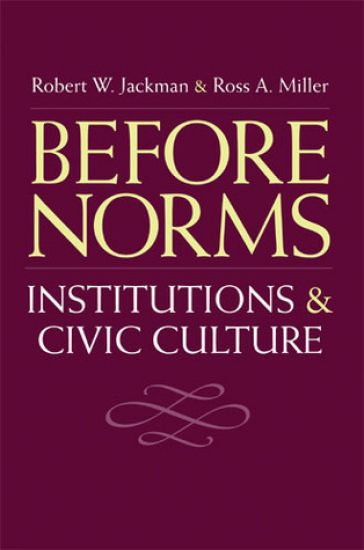
The potato famines of the nineteenth century were long attributed to Irish indolence. The Stalinist system was blamed on a Russian proclivity for autocracy. Muslim men have been accused of an inclination to terrorism. Is political behavior really the result of cultural upbringing, or does the vast range of human political action stem more from institutional and structural constraints? This important new book carefully examines the role of institutions and civic culture in the establishment of political norms. Jackman and Miller methodically refute the Weberian cultural theory of politics and build in its place a persuasive case for the ways in which institutions shape the political behavior of ordinary citizens. Their rigorous examination of grassroots electoral participation reveals no evidence for even a residual effect of cultural values on political behavior, but instead provides consistent support for the institutional view. Before Norms speaks to urgent debates among political scientists and sociologists over the origins of individual political behavior. Robert W. Jackman is Professor of Political Science at the University of California, Davis. Ross A. Miller is Associate Professor of Political Science at Santa Clara University.

Listening to the Parables of Jesus
Robert W. Funk; Edward F. Beutner; Lane C. McGaughy; Robert J. Miller; Bernard Brandon Scott; Paul Verhoeven
Polebridge Press
2007
nidottu
"What if the purpose or function of a parable is not to instruct but to haunt?" So begins Listening to the Parables of Jesus, edited by Edward F. Beutner, who suggests that, from time to time, even scholars scratch their heads in puzzlement over the yin and yang of Jesus' parables. This concise, well-edited book brings together insights from world-renowned scholars into the interpretation of parables. Lane McGaughy's opening essay provides high fidelity earphones that let readers hear the vivid and distinctive nature of the language of parable. Robert Miller offers an original treatment of two parables from the gospels of Matthew and Thomas, parables that he renames, "The Overpriced Pearl" and "The Treasure of Immorality." With his eye for narrative structure, film Director Paul Verhoeven identifies fault lines in Matthew's version of the Vineyard Laborers and proposes an alternative version in which the first will be first. In his essay on the Leased Vineyard, Brandon Scott demonstrates how rabbinic parables can illuminate the otherwise shadowy nooks and crannies of a dark parable of violence found in Mark's gospel. The final three essays describe the parables globally as artful language events as fulcrums, so to speak, upon which our understanding of the world gets overturned and undermined. According to Robert Funk, Jesus parables are a knothole in the cosmic fence through which we glimpse the world as Jesus saw it. In Listening to the Parables of Jesus, leading scholars of the parables help readers find the knothole. The rest is up to them.

Once and Future Faith
Robert W. Funk; Karen Armstrong; Don Cupitt; Arthur J. Dewey; Lloyd Geering; Roy W. Hoover; Robert J. Miller; Bernard Brandon Scott; John Shelby Spong
Polebridge Press
2001
nidottu
Many ideas once thought to be foundational to Christianity are now known to be false due to scientific discoveries regarding the nature of the universe and historical findings about how Christianity began. Is Christianity doomed to irrelevance or even extinction? How might Christianity reinvent itself so that it can address the real concerns of people in today's world? This collection of essays from such leading thinkers as Karen Armstrong and John Shelby Spong addresses questions such as life after death, the meaning of God, apocalypticism, and the significance of Jesus' death.Contributors: Karen Armstrong, Don Cupitt, Arthur J. Dewey, Robert W. Funk, Lloyd Geering, Roy W. Hoover, Robert J. Miller, Stephen J. Patterson, Bernard Brandon Scott, John Shelby Spong
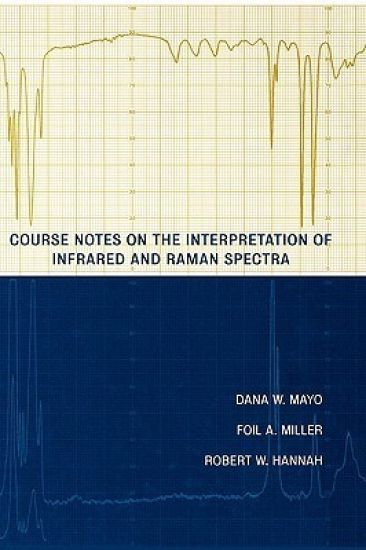
Course Notes on the Interpretation of Infrared and Raman Spectra
Dana W. Mayo; Foil A. Miller; Robert W. Hannah
John Wiley Sons Inc
2004
sidottu
Interpretation of IR and Raman Spectra provides the fundamentals ofinterpreting IR and Raman spectra of complex molecules primarilyorganic molecules. Examinations of theory provide a basis forpredicting functional group frequency location in new molecularstructures. * Generously enriched with sample exercises to help rapidlydevelop powerful interpretive skills. * Includes appendices with fourteen bibliographies by subjectarea.
![A Supplementary Letter to the Correspondence Between the Rev. M. H. Miller, A.M., Vicar of Scarborough, and the Rev. R. Howard ... Addressed to the Vicar. [on the Appointment of Dr. Bosworth to the Curacy of Christ Church, Scarborough.] by W. Prynne.](/covers/9781241057039.jpg)
A Supplementary Letter to the Correspondence Between the Rev. M. H. Miller, A.M., Vicar of Scarborough, and the Rev. R. Howard ... Addressed to the Vicar. [on the Appointment of Dr. Bosworth to the Curacy of Christ Church, Scarborough.] by W. Prynne.
William Prynne; Robert Howard; Michael Hodsoll Miller
British Library, Historical Print Editions
2011
pokkari

VE NORTHSTAR 4E R/W L5 ETEXT+M VOIR 466211 338250
Robert Cohen; Judith Miller
Pearson Education (US)
2014
lisenssiavain
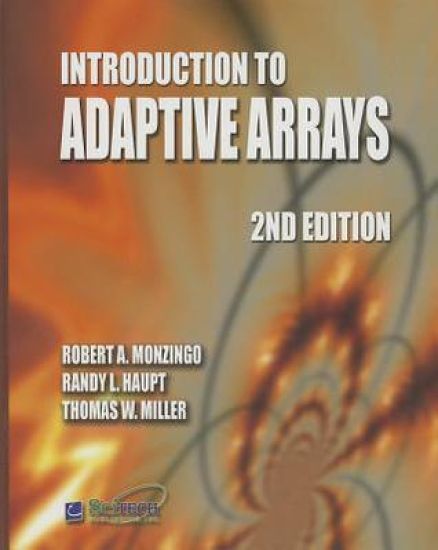
Introduction to Adaptive Arrays
Monzingo Robert A.; Haupt Randy L.; Miller Thomas W.
SciTech Publishing Inc
2010
sidottu
This second edition is an extensive modernization of the bestselling introduction to the subject of adaptive array sensor systems. With the number of applications of adaptive array sensor systems growing each year, this look at the principles and fundamental techniques that are critical to these systems is more important than ever before. Introduction to Adaptive Arrays, 2nd Edition is organized as a tutorial, taking the reader by the hand and leading them through the maze of jargon that often surrounds this highly technical subject. It is easy to read and easy to follow, as fundamental concepts are introduced with examples before more current developments and techniques are introduced. Problems at the end of each chapter serve both instructors and professional readers by illustrating and extending the material presented in the text. Both students and practicing engineers will easily gain familiarity with the modern contribution that adaptive arrays have to offer practical signal reception systems.

Hitler's Counterfeit Reich: Behind the Scenes of Nazi Economy
Karl Robert; M. W. Fodor; Douglas Miller
Literary Licensing, LLC
2011
sidottu
Hitler's Counterfeit Reich: Behind The Scenes Of Nazi Economy is a non-fiction book written by Karl Robert, which provides a detailed and comprehensive analysis of the Nazi economy during the reign of Adolf Hitler. The book explores the various economic policies and strategies implemented by the Nazi regime, including the production of counterfeit currency, which was used to finance their war efforts.The author delves into the inner workings of the Nazi economy, examining the role of key players such as Hermann Goering, the Reichsmarschall, and Walther Funk, the Minister of Economics. The book also explores the role of the SS in the Nazi economy, including their involvement in the production of counterfeit currency.The book provides a fascinating insight into the Nazi economy, including the use of slave labor, the plundering of occupied territories, and the exploitation of resources in the occupied territories. The author also examines the impact of the war on the Nazi economy, including the devastating effects of Allied bombing campaigns.Overall, Hitler's Counterfeit Reich: Behind The Scenes Of Nazi Economy is a meticulously researched and insightful book that provides a unique perspective on the Nazi regime and their economic policies. It is a must-read for anyone interested in the history of World War II and the Nazi regime.This scarce antiquarian book is a facsimile reprint of the old original and may contain some imperfections such as library marks and notations. Because we believe this work is culturally important, we have made it available as part of our commitment for protecting, preserving, and promoting the world's literature in affordable, high quality, modern editions, that are true to their original work.

Hitler's Counterfeit Reich: Behind the Scenes of Nazi Economy
Karl Robert; M. W. Fodor; Douglas Miller
Literary Licensing, LLC
2011
nidottu

Studies in Schizophrenia
Robert G Heath; Hal C Becker; Leona Bersadsky; Robert M Corrigan; Arthur W Epstein; Warren L Founds; Francisco Garcia Bengochea; Charles D Hendley; Robert Hodes; Charles Hogan; H E King; Byron E Leach; Raeburn C Llewellyn; Walter A Mickle; William H Miller; Frederick F Millsaps; Russell R Monroe; Samuel M Peacock; T Duane Price; Ernest Sachs; Florence B Strohmeyer; John J Weber; Kathleen M Young
Harvard University Press
1954
sidottu
The Closed-Loop Planning System for Weapon System Readiness
Richard Hillestad; Robert Kerchner; Louis W Miller; Adman Resnick; Hyman L Shulman
RAND
2006
pokkari
Because the U.S. Air Force does not have an effective way of allocating limited funding for depot-level repair across weapon systems and calculating the readiness implications of such allocations, this report describes a methodology, the Closed-Loop Planning System, that estimates the effect of depot repair funding allocations on aircraft availability.

The Mystic Warrior Jethro Dumont was a jaded, rich American who hungered to find purpose in this world. His search for self-knowledge and fulfillment led him to a secluded Buddhist monastery high in the Tibetan Himalayas. There Dumont studied the mysteries of the orient at the same time learning to accept the non-violent tenets of this ancient and venerated philosophy. By the time he returned to America, he was a changed man; one possessed with mental clarity and unique, mystic abilities beyond the understanding of normal men. Now, with the aid of his Buddhist companion, Tsarong, he assumes the identity of a new, eerie crime-fighter, The Green Lama For years the exploits of Green Lama have thrilled pulp fans both in his own magazine, in comics and on radio. Now he returns to pulp action in this collection featuring two previous issued classics by Peter Miller and Kevin Noel Olson and two brand new, never before printed adventures by Nick Ahlhelm and Robert Craig. From confronting Nazis in his beloved Tibet to investigating bizarre murders in a Hollywood movie studio, Jethro Dumont's new career is one filled with plenty of action and adventure as the Mystic Warrior strikes again

Flexible Software Design
Bruce Johnson; Walter W. Woolfolk; Robert Miller; Cindy Johnson
CRC Press
2019
nidottu
A developer's knowledge of a computing system's requirements is necessarily imperfect because organizations change. Many requirements lie in the future and are unknowable at the time the system is designed and built. To avoid burdensome maintenance costs developers must therefore rely on a system's ability to change gracefully-its flexibility. Flexible Software Design: Systems Development for Changing Requirements demonstrates the design principles and techniques that enable the design of software that empowers business staff to make functional changes to their systems with little or no professional IT intervention. The book concentrates on the design aspects of system development, the area with the most flexibility leverage. Divided into four parts, the text begins by introducing the fundamental concepts of flexibility, explaining the reality of imperfect knowledge and how development participants must change their thinking to implement flexible software. The second part covers design guidelines, stable identifiers, stable information structures, the Generic Entity Cloud concept, and regulatory mechanisms that give business staff control over system modifications. Part three relates strategic information systems planning to flexible systems. It examines the elicitation of requirements and the relevance of agile methods in a flexible systems environment. It also discusses practical aspects of stable identifier design and compares the testing of traditional and flexible software. In part four, the book concludes with details of the flexible UniverSIS system and an explanation of the applications and extensions of the Generic Entity Cloud tools. The combination of smart design and smart work offered in Flexible Software Design can materially benefit your organization by radically reducing the systems maintenance burden.