Kirjojen hintavertailu. Mukana 11 244 527 kirjaa ja 12 kauppaa.

Kirjahaku

Etsi kirjoja tekijän nimen, kirjan nimen tai ISBN:n perusteella.

1000 tulosta hakusanalla Rodney Stark; Charles Y. Glock

American Piety

American Piety

Rodney Stark; Charles Y. Glock

University of California Press
1970
pokkari
How religious are Americans these days? How many still believe in God, in Biblical miracles, in heaven and hell? Do people pray? How much money is being given to churches, by Episcopalians, Presbyterians, Roman Catholics, Lutherans, and other groups? American Piety, the first of a three-volume study of religious commitment, answers these and a host of other questions about the contemporary religious scene. Particularly startling are the contrasts in beliefs, practices, and experiences revealed among the eleven major Christian denominations whose membership is compared.
Shirley Temple, Judy Garland, and Mickey Rooney: Hollywood's Child Stars of the 1930s

Shirley Temple, Judy Garland, and Mickey Rooney: Hollywood's Child Stars of the 1930s

Charles River

Createspace Independent Publishing Platform
2018
nidottu
*Includes pictures. *Includes the child stars' quotes about their own lives and careers. *Includes bibliographies for further reading. Shirley Temple remains the most famous child star of all time, but even this designation fails to reflect the magnitude of her popularity during the era in which she worked. While it is true that she was not the first child actor to reach Hollywood fame, she was the first - and to this day, perhaps the only - star who rose to the very pinnacle of the Hollywood elite before she even turned 10 years old. For this reason, it is no exaggeration to view Shirley as the progenitor for all of the child actors that succeeded her. Moreover, her cultural importance constitutes an even more important barometer through which to measure her overall significance. Not only was Shirley a film star, but she had a monumental impact on a generation of children who grew up during the Great Depression, with her plucky optimism emotionally uplifting an American public struggling both financially and emotionally. She was not only a young actress but also a brand name, someone who offered fathers and mothers hope for their children to achieve the same success as the famous child star. Yet, for all of Shirley Temple's fame, it is no doubt surprising to many that her actual films received scant critical acclaim. Her films were never mentioned on critical "best of" lists, nor did they regularly appear on the list of nominees for the Academy Awards. In many ways, Judy Garland's rise to fame seems almost predestined. Not only was she a national sensation at a young age, but her parents and sisters were all vaudeville entertainers. On top of that, Garland's parents owned and operated a movie theater, making it all the easier to draw the conclusion that singing and acting were simply professions which she was born into by virtue of her pedigree. Judy's early childhood quickly demonstrated that she had a gifted voice that developed well beyond its years and seemingly did not require any formal training in order to achieve success; her first performance before a public audience came when she was still a toddler, and she would continue to act up until her death, never pausing for more than a few months at a time. That Garland was able to secure starring roles almost immediately after signing a contract with MGM in 1935 only corroborates the belief that Garland was practically born with the ability to succeed in show business and the motion picture industry. Of course, Garland might be known today based more on her demise than anything else, and there's no denying that one of the most fascinating (and tragic) aspects of her life story is the manner in which her downward spiral occurred with the same rapid progression as her meteoric ascent. Garland died in 1969 at the age of 47, but she had lost control over her life years earlier and was actually fortunate to live as long as she did. Alongside Shirley Temple and Judy Garland, with whom he acted in a series of films, Mickey Rooney was one of America's most beloved child stars during the 1930s. Rooney had already made his mark in A Family Affair (1937), but he was the face of the incredibly successful Andy Hardy series, which produced several box office hits and featured Rooney in 13 movies, several alongside Judy Garland, who shot to fame as a teen in The Wizard of Oz. At the same time, the fact that the peak of his success came when he was so young has helped obscure the fact that he has acted in 10 different decades. Rooney is one of the only actors still alive who worked in the silent film era, yet he recently appeared in 2012's Last Will and Embezzlement. In the process, Rooney has been awarded a Juvenile Academy Award, an Honorary Academy Award, two Golden Globes and an Emmy Award.
Das Marktmodell von Rodney Stark - Ein Schlüssel zum Verstehen der Religionsökonomie
Studienarbeit aus dem Jahr 2008 im Fachbereich Soziologie - Klassiker und Theorierichtungen, Note: 2,3, Europa-Universit t Viadrina Frankfurt (Oder), Sprache: Deutsch, Abstract: Rodney Stark- Klassiker der amerikanischen Religionssoziologe, zurzeit Professor f r Soziologie an der Universit t Baylor ( Texas), President of the Society for the Scientific Study of Religion, hat 27 B cher und zirka 140 Artikeln ver ffentlicht, wobei der gr te Teil von seinen Arbeiten ber Religion handelt. Im Studium "A Theory of religion" bringt er (zusammen mit einem Kulturanthropologen Williams Sims Bainbridge) die Theorie der rationalen Entscheidung in die Religionssoziologie ein. Der zufolge entscheidet man sich generell f r eine Religion, weil man positive Ergebnisse daraus erwartet( zum Beispiel ewiges Leben nach dem Tod). Die Theorie ist nicht nur ein Versuch des Verstehens des religi sen Verhaltens eines Menschen. Sie bestreitet die Aussage der S kularisierungsthese, wonach mit fortschreitender Modernisierung Religion und Religiosit t an Bedeutung verliert (Finke/Stark 1996: 249). Ihr Augenmerk wird dagegen auf die Angebotsseite der Religionen, auf die Religionsgemeinschaften und Kirchen. Ob es zur S kularisierung in der Gesellschaft komme oder nicht, h nge von der Beschaffenheit des Marktes der Religionen ab. In der religi sen konomie funktionieren "die Firmen," also Konfessionen, Gemeinschaften entweder auf dem freien Markt oder in Umstanden des Monopols und der allgemeinen staatlichen Regulierung des religi sen Marktes. Das Vorhandensein einer Vielzahl von Religionsgemeinschaften innerhalb einer Gesellschaft zwinge die religi sen Anbieter, ihre Ware m glichst attraktiv zu gestalten und f hre damit zu einem Aufbl hen der Religiosit t insgesamt. Die leeren Kirchen In der Schweiz, wo der Lutheranismus die staatliche Religion ist, stehen im Gegensatz zu den vollen Kirchen in den USA, wo der Staat von aller Festlegung jeglicher Konfession zur ckgetreten hat. Die Theorie der r
The Rise of Christianity

The Rise of Christianity

Rodney Stark

HarperSanFrancisco
1997
nidottu
A study of the early history of Christianity reveals that it attracted members of the upper class, that many of the early converts were women and marginalized Jews, and that it helped converts achieve happier lives. Reprint. LJ. PW.
The Triumph of Christianity

The Triumph of Christianity

Rodney Stark

HarperOne
2012
nidottu
Celebrated religious and social historian Rodney Starktraces the extraordinary rise of Christianity through its most pivotal andcontroversial moments to offer fresh perspective on the history of the world'slargest religion. In The Triumph of Christianity, the author of God'sBattalions and The Rise of Christianity gathers and refines decadesof powerful research and discovery into one concentrated, concise, and highlyreadable volume that explores Christianity's most crucial episodes. The uniqueformat of Triumph of Christianity allows Stark to avoid densechronologies and difficult back stories, bringing readers right to the heart ofChristian history's most vital controversies and enduring lessons.
The Rise of Mormonism

The Rise of Mormonism

Rodney Stark

Columbia University Press
2005
sidottu
Will Mormonism be the next world faith, one that will rival Catholicism, Islam, and other major religions in terms of numbers and global appeal? This was the question Rodney Stark addressed in his much-discussed and much-debated article, "The Rise of a New World Faith" (1984), one of several essays on Mormonism included in this new collection. Examining the religion's growing appeal, Rodney Stark concluded that Mormons could number 267 million members by 2080. In what would become known as "the Stark argument," Stark suggested that the Mormon Church offered contemporary sociologists and historians of religion an opportunity to observe a rare event: the birth of a new world religion. In the years following that article, Stark has become one of the foremost scholars of Mormonism and the sociology of religion. This new work, the first to collect his influential writings on the Mormon Church, includes previously published essays, revised and rewritten for this volume. His work sheds light on both the growth of Mormonism and on how and why certain religions continue to grow while others fade away. Stark examines the reasons behind the spread of Mormonism, exploring such factors as cultural continuity with the faiths from which it seeks converts, a volunteer missionary force, and birth rates. He explains why a demanding faith like Mormonism has such broad appeal in today's world and considers the importance of social networks in finding new converts. Stark's work also presents groundbreaking perspectives on larger issues in the study of religion, including the nature of revelation and the reasons for religious growth in an age of modernization and secularization.
Bearing False Witness

Bearing False Witness

Rodney Stark

SPCK Publishing
2017
pokkari
The following historical statements all appear in well-established textbooks, and have become part of our common culture. Which of them would you say are true? * The Catholic Church incited and actively colluded in nearly two millennia of anti-Semitic violence, and Pope Pius XII is still rightfully known as ‘Hitler’s Pope’. * Only recently have we become aware of ancient and remarkably enlightened Christian gospels, which narrow-minded Catholic authorities tried to suppress. * Once in power as the official Church of Rome, Christians quickly and brutally persecuted paganism out of existence. * The fall of Rome and the ascendancy of the Church precipitated Europe’s decline into a millennium of ignorance and backwardness, which lasted until the Renaissance. * Initiated by the pope, the Crusades were but the first bloody chapter in the history of unprovoked and brutal Christian colonialism. * The Spanish Inquisition tortured and murdered huge numbers of innocent people for ‘imaginary’ crimes, such as witchcraft and blasphemy. * The Catholic Church persecuted and tried to suppress scientists such as Galileo, and the Scientific ‘Revolution’ therefore occurred mainly in more tolerant Protestant societies. * Being entirely comfortable with slavery, the Catholic Church did nothing to oppose its introduction in the New World, or to make it more humane. * Until very recently, Catholicism’s hierarchical view of the ideal state has resulted in its bitter resistance to all efforts to establish more liberal governments and its eager support for right-wing dictators. * It was the Protestant Reformation that broke the repressive Catholic grip on progress and ushered in capitalism, religious freedom and the modern world. In this powerful and persuasive book Rodney Stark subjects these and other widely-held beliefs to a rigorous historical assessment. He gives a compelling account of how each of them became accepted as the conventional wisdom, how egotism and ideology often worked together to create false or highly distorted pictures of people and events, and how we need to work hard to recover the truth if we’re to undo the cultural damage that centuries of anti-Catholic history has done.
Reformation Myths

Reformation Myths

Rodney Stark

SPCK Publishing
2017
pokkari
What has the Reformation ever done for us? A lot less than you might think, as Rodney Stark shows in this enlightening and entertaining antidote to recent books about the rise of Protestantism and its legacy. ‘Rodney Stark takes no prisoners as he charges through five hundred years of history, upsetting apple carts left and right. Almost everything you thought you knew about the Reformation turns out to be a false narrative. . . In future, anyone who makes sweeping claims about the benefits of Protestantism ought to check their assumptions against Stark’s research first.’ Clifford Longley, author and journalist ‘Stark brings the insights of a distinguished sociologist of religion to bear on a range of inherited assumptions about the impact of the Reformation . . . The result makes for salutary reading in this year of commemoration and (not always justified) celebration.’ Peter Marshall, Professor of History, University of Warwick ‘Stark changed the way we think about the early Church and this book may change the way you think about Protestantism . . . Reformation Myths cuts through pious certainties and challenges us to think again about our cultural history.’ Linda Woodhead MBE DD, Professor of Sociology of Religion, Lancaster University
The Rise of Christianity

The Rise of Christianity

Rodney Stark

Princeton University Press
1996
sidottu
The idea that Christianity started as a clandestine movement among the poor is a widely accepted notion. Yet it is one of many myths that must be discarded if we are to understand just how a tiny messianic movement on the edge of the Roman Empire became the dominant faith of Western civilization. In a fast-paced, highly readable book that addresses beliefs as well as historical facts, Rodney Stark brings a sociologist's perspective to bear on the puzzle behind the success of early Christianity. He comes equipped not only with the logic and methods of social science but also with insights gathered firsthand into why people convert and how new religious groups recruit members. He digs deep into the historical evidence on many issues--such as the social background of converts, the mission to the Jews, the status of women in the church, the role of martyrdom--to provide a vivid and unconventional account of early Christianity. The author plots the most plausible curve of Christian growth from the year 40 to 300. By the time of Constantine, Christianity had become a considerable force, with growth patterns very similar to those of modern-day successful religious movements. An unusual number of Christian converts, for example, came from the educated, cosmopolitan classes. Because it offered a new perspective on familiar concepts and was not linked to ethnicity, Christianity had a large following among persons seeking to assimilate into the dominant culture, mainly Hellenized Jews. The oversupply of women in Christian communities--due partly to the respect and protection they received--led to intermarriages with pagans, hence more conversions, and to a high fertility rate. Stark points out, too, the role played by selflessness and faith. Amidst the epidemics, fires, and other disasters that beleaguered Greco-Roman cities, Christian communities were a stronghold of mutual aid, which resulted in a survival rate far greater than that of the pagans. In the meantime, voluntary martyrdom, especially a generation after the death of Christ, reinforced the commitment of the Christian rank and file. What Stark ultimately offers is a multifaceted portrait of early Christianity, one that appeals to practical reasoning, historical curiosity, and personal reflection.
One True God

One True God

Rodney Stark

Princeton University Press
2003
pokkari
Western history would be unrecognizable had it not been for people who believed in One True God. There would have been wars, but no religious wars. There would have been moral codes, but no Commandments. Had the Jews been polytheists, they would today be only another barely remembered people, less important, but just as extinct as the Babylonians. Had Christians presented Jesus to the Greco-Roman world as "another" God, their faith would long since have gone the way of Mithraism. And surely Islam would never have made it out of the desert had Muhammad not removed Allah from the context of Arab paganism and proclaimed him as the only God. The three great monotheisms changed everything. With his customary clarity and vigor, Rodney Stark explains how and why monotheism has such immense power both to unite and to divide. Why and how did Jews, Christians, and Muslims missionize, and when and why did their efforts falter? Why did both Christianity and Islam suddenly become less tolerant of Jews late in the eleventh century, prompting outbursts of mass murder? Why were the Jewish massacres by Christians concentrated in the cities along the Rhine River, and why did the pogroms by Muslims take place mainly in Granada? How could the Jews persist so long as a minority faith, able to withstand intense pressures to convert? Why did they sometimes assimilate? In the final chapter, Stark also examines the American experience to show that it is possible for committed monotheists to sustain norms of civility toward one another. A sweeping social history of religion, One True God shows how the great monotheisms shaped the past and created the modern world.
For the Glory of God

For the Glory of God

Rodney Stark

Princeton University Press
2004
pokkari
Rodney Stark's provocative new book argues that, whether we like it or not, people acting for the glory of God have formed our modern culture. Continuing his project of identifying the widespread consequences of monotheism, Stark shows that the Christian conception of God resulted--almost inevitably and for the same reasons--in the Protestant Reformation, the rise of modern science, the European witch-hunts, and the Western abolition of slavery. In the process, he explains why Christian and Islamic images of God yielded such different cultural results, leading Christians but not Muslims to foster science, burn "witches," and denounce slavery. With his usual clarity and skepticism toward the received wisdom, Stark finds the origins of these disparate phenomena within monotheistic religious organizations. Endemic in such organizations are pressures to maintain religious intensity, which lead to intense conflicts and schisms that have far-reaching social results. Along the way, Stark debunks many commonly accepted ideas. He interprets the sixteenth-century flowering of science not as a sudden revolution that burst religious barriers, but as the normal, gradual, and direct outgrowth of medieval theology. He also shows that the very ideas about God that sustained the rise of science led also to intense witch-hunting by otherwise clear-headed Europeans, including some celebrated scientists. This conception of God likewise yielded the Christian denunciation of slavery as an abomination--and some of the fiercest witch-hunters were devoted participants in successful abolitionist movements on both sides of the Atlantic. For the Glory of God is an engrossing narrative that accounts for the very different histories of the Christian and Muslim worlds. It fundamentally changes our understanding of religion's role in history and the forces behind much of what we point to as secular progress.
The Rise of Christianity

The Rise of Christianity

Rodney Stark

PRINCETON UNIVERSITY PRESS
2023
pokkari
A landmark reinterpretation of why Christianity became the dominant faith of the WestThe idea that Christianity started as a clandestine movement among the poor is a widely accepted notion. Yet it is one of many myths that must be discarded if we are to understand just how a tiny messianic movement on the edge of the Roman Empire became the dominant faith of Western civilization. In a fast-paced, highly readable book that addresses beliefs as well as historical facts, Rodney Stark brings a sociologist's perspective to bear on the puzzle behind the success of early Christianity. He comes equipped not only with the logic and methods of social science but also with insights gathered firsthand into why people convert and how new religious groups recruit members. He digs deep into the historical evidence on many issues—such as the social background of converts, the mission to the Jews, the status of women in the church, the role of martyrdom—to provide a vivid and unconventional account of early Christianity.The author plots the most plausible curve of Christian growth from the year 40 to 300. By the time of Constantine, Christianity had become a considerable force, with growth patterns very similar to those of modern-day successful religious movements. An unusual number of Christian converts, for example, came from the educated, cosmopolitan classes. Because it offered a new perspective on familiar concepts and was not linked to ethnicity, Christianity had a large following among persons seeking to assimilate into the dominant culture, mainly Hellenized Jews. The oversupply of women in Christian communities—due partly to the respect and protection they received—led to intermarriages with pagans, hence more conversions, and to a high fertility rate. Stark points out, too, the role played by selflessness and faith. Amidst the epidemics, fires, and other disasters that beleaguered Greco-Roman cities, Christian communities were a stronghold of mutual aid, which resulted in a survival rate far greater than that of the pagans. In the meantime, voluntary martyrdom, especially a generation after the death of Christ, reinforced the commitment of the Christian rank and file. What Stark ultimately offers is a multifaceted portrait of early Christianity, one that appeals to practical reasoning, historical curiosity, and personal reflection.
Exploring the Religious Life

Exploring the Religious Life

Rodney Stark

Johns Hopkins University Press
2004
sidottu
Though religion is for most people one of the most important aspects of their lives, social scientists and other observers of human society too often misunderstand and misrepresent the nature and role of religion in history and in daily life. From the supposed decline of religious attitudes in Western Europe and the venal motivations attributed to the Christian Crusaders to the very definition of religion, personal biases and an inadequate grasp of relevant data have led to the formulation and propagation of unsupportable views on the sacred. In Exploring the Religious Life, Rodney Stark boldly overturns much received wisdom within the social sciences about religion, drawing on a wide range of sources to reassess a diverse selection of topics in the study of religion. In his first essay, Stark addresses the carelessness with which scholars use the term religion and the conviction that the belief in divinity evolved from the practice of magic in primitive cultures.In subsequent chapters, he challenges the widespread attitude among social scientists that religion is nothing more than a mask for material realities and examines the effectiveness of religious doctrines in attracting converts and influencing individuals; uncovers the surprising prevalence of upper-class asceticism in medieval Christianity; and explores the relationship between gender, piety, and criminal activity. Divine revelation is a central aspect of many religions, and Stark next applies empirical research to the phenomenon to assess its meaning in Judaism, Christianity, Islam, and Mormonism. He then turns to the confusion between faith and practice in debates over the secularization of the developed world before investigating the validity of the classic proposition within the social sciences that religion functions to sustain the moral order. He does so, examining the correlation between criminal behavior and depth of religious belief.Stark concludes with an essay on the ingenious methods he uses to unearth data about the popularity of new religions in California and northern Europe, the decline of Christian Science in America, the spread of Christianity in the Roman world, and the execution patterns during the antiwitchcraft frenzy of Enlightenment Europe. Together, the essays that constitute Exploring the Religious Life offer an engaging introduction to Rodney Stark's provocative insights and a fearless challenge to academic perceptions about religion's place in history, society, and private life.
The Victory of Reason

The Victory of Reason

Rodney Stark

Random House USA Inc
2006
pokkari
A critical analysis of the important role of Christianity in the history of the West argues that the Christian faith's emphasis on reason, progress, moral equality, and freedom led to technological innovation, the rise of science, open political institutions, democracy, and capitalism, paving the way to Western success. Reprint. 25,000 first printing.
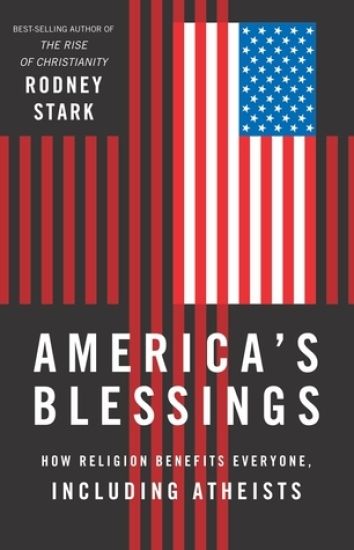
America's Blessings

America's Blessings

Rodney Stark

TEMPLETON FOUNDATION PRESS,U.S.
2013
pokkari
A few years ago, a debate between atheists and religious believers spilled out from the halls of academia and the pews of America’s churches and into the public spotlight. A crop of atheist manifestos led the charge, surmounting and holding the tops of the nonfiction bestseller lists. This debate brought on an outpouring of religious rebuttals as both sides exchanged spirited volleys, accusations were leveled; myths, stereotypes, and strawmen arguments were perpetuated; and bitter hostility filled the air. Today many of these misconceptions and myths linger on, along with the generally acrimonious spirit of the debate. In America’s Blessings, distinguished researcher Rodney Stark seeks to clear the air of this hostility and debunk many of the debate’s most widely perpetuated misconceptions by drawing from an expansive pool of sociological findings. Stark rises above the fray and focuses exclusively on facts by examining the measurable effects of religious faith and practice on American society. His results may surprise many atheists and believers alike. Starting with a historical overview, Stark traces America’s religious roots from the country’s founding to the present day, showing that religiosity in America has never been consistent, static, or monolithic. Interestingly, he finds that religious practice is now more prevalent than ever in America, despite any claims to the contrary. From here, Stark devotes whole chapters to unpacking the latest research on how religion affects the different facets of modern American life, including crime, family life, sexuality, mental and physical health, sophistication, charity, and overall prosperity. The cumulative effect is that when translated into comparisons with western European nations, the United States comes out on top again and again. Thanks in no small part to America’s rich religious culture, the nation has far lower crime rates, much higher levels of charitable giving, better health, stronger marriages, and less suicide, to note only a few of the benefits. In the final chapter, Stark assesses the financial impact of these religious realities. It turns out that belief benefits the American economy-and all 300 million citizens, believers, and nonbelievers alike-by a conservative estimate of $2.6 trillion a year. Despite the atheist outcry against religion, the remarkable conclusion is clear: all Americans, from the most religious among us to our secular neighbors, really ought to count our blessings.