Kirjojen hintavertailu. Mukana 11 244 527 kirjaa ja 12 kauppaa.

Kirjahaku

Etsi kirjoja tekijän nimen, kirjan nimen tai ISBN:n perusteella.

1000 tulosta hakusanalla Roger G. Newton

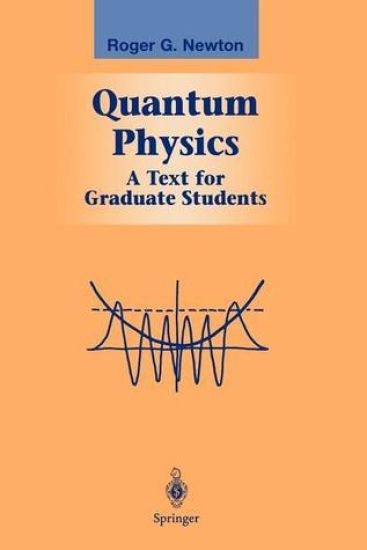
Quantum Physics

Quantum Physics

Roger G. Newton

Springer-Verlag New York Inc.
2002
sidottu
The combination of quantum mechanics and quantum ?eld theory cons- tutesthemostrevolutionaryandin?uentialphysicaltheoryofthetwentieth century. Itsimpactisfeltnotonlyinalmostallothersciences,butthefruits of its application are ubiquitous in everyday life. This textbook is designed to teach graduate students the underlying quantum-physical ideas, their mathematical formulations, and the basic problem-solving techniques of the discipline. It assumes they have taken at least one introductory course in quantum mechanics as undergraduates and are familiar with the history of the subject and the basic experimental evidence that led to its adoption, as well as with many of its fundamental notions. In contrast to most other authors, I am therefore not introducing the quantum theory via an hist- ical survey of its early successes. Instead, following the models of books on classsical mechanics or electromagnetism, I develop the theory from its basic assumptions, beginning with statics, followed by the dynamics and details of its speci?c areas of use as well as the needed mathematical te- niques. Although this book, inevitably, deals largely with the behavior of point particles under various conditions, I do not regard particles as the fun- mental entities of the universe: the most basic object is the quantum ?eld, with theobserved particlesarising from the?eld asitsquanta. For thisr- son I introduce quantum ?elds right from the beginning and demonstrate, in the ?rst chapter, how particles originate.
The Truth of Science

The Truth of Science

Roger G. Newton

Harvard University Press
2000
nidottu
It's not a scientific truth that has come into question lately but the truth--the very notion of scientific truth. Bringing a reasonable voice to the culture wars that have sprung up around this notion, this book offers a clear and constructive response to those who contend, in parodies, polemics and op-ed pieces, that there really is no such thing as verifiable objective truth--without which there could be no such thing as scientific authority.A distinguished physicist with a rare gift for making the most complicated scientific ideas comprehensible, Roger Newton gives us a guided tour of the intellectual structure of physical science. From there he conducts us through the understanding of reality engendered by modern physics, the most theoretically advanced of the sciences. With its firsthand look at models, facts, and theories, intuition and imagination, the use of analogies and metaphors, the importance of mathematics (and now, computers), and the "virtual" reality of the physics of micro-particles, The Truth of Science truly is a practicing scientist's account of the foundations, processes, and value of science.To claims that science is a social construction, Newton answers with the working scientist's credo: "A body of assertions is true if it forms a coherent whole and works both in the external world and in our minds." The truth of science, for Newton, is nothing more or less than a relentless questioning of authority combined with a relentless striving for objectivity in the full awareness that the process never ends. With its lucid exposition of the ideals, methods, and goals of science, his book performs a great feat in service of this truth.
Galileo’s Pendulum

Galileo’s Pendulum

Roger G. Newton

Harvard University Press
2005
nidottu
Bored during Mass at the cathedral in Pisa, the seventeen-year-old Galileo regarded the chandelier swinging overhead—and remarked, to his great surprise, that the lamp took as many beats to complete an arc when hardly moving as when it was swinging widely. Galileo’s Pendulum tells the story of what this observation meant, and of its profound consequences for science and technology.The principle of the pendulum’s swing—a property called isochronism—marks a simple yet fundamental system in nature, one that ties the rhythm of time to the very existence of matter in the universe. Roger Newton sets the stage for Galileo’s discovery with a look at biorhythms in living organisms and at early calendars and clocks—contrivances of nature and culture that, however adequate in their time, did not meet the precise requirements of seventeenth-century science and navigation. Galileo’s Pendulum recounts the history of the newly evolving time pieces—from marine chronometers to atomic clocks—based on the pendulum as well as other mechanisms employing the same physical principles, and explains the Newtonian science underlying their function.The book ranges nimbly from the sciences of sound and light to the astonishing intersection of the pendulum’s oscillations and quantum theory, resulting in new insight into the make-up of the material universe. Covering topics from the invention of time zones to Isaac Newton’s equations of motion, from Pythagoras’s theory of musical harmony to Michael Faraday’s field theory and the development of quantum electrodynamics, Galileo’s Pendulum is an authoritative and engaging tour through time of the most basic all-pervading system in the world.
From Clockwork to Crapshoot

From Clockwork to Crapshoot

Roger G. Newton

The Belknap Press
2009
nidottu
Science is about 6000 years old while physics emerged as a distinct branch some 2500 years ago. As scientists discovered virtually countless facts about the world during this great span of time, the manner in which they explained the underlying structure of that world underwent a philosophical evolution. From Clockwork to Crapshoot provides the perspective needed to understand contemporary developments in physics in relation to philosophical traditions as far back as ancient Greece.Roger Newton, whose previous works have been widely praised for erudition and accessibility, presents a history of physics from the early beginning to our day--with the associated mathematics, astronomy, and chemistry. Along the way, he gives brief explanations of the scientific concepts at issue, biographical thumbnail sketches of the protagonists, and descriptions of the changing instruments that enabled scientists to make their discoveries. He traces a profound change from a deterministic explanation of the world--accepted at least since the time of the ancient Greek and Taoist Chinese civilizations--to the notion of probability, enshrined as the very basis of science with the quantum revolution at the beginning of the twentieth century. With this change, Newton finds another fundamental shift in the focus of physicists--from the cause of dynamics or motion to the basic structure of the world. His work identifies what may well be the defining characteristic of physics in the twenty-first century.
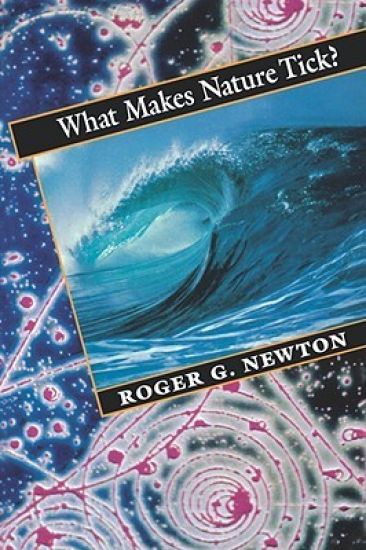
What Makes Nature Tick?

What Makes Nature Tick?

Roger G. Newton

Harvard University Press
1998
nidottu
For many of us, the physical sciences are as obscure as the phenomena they explain. We see the wonders of nature but miss the symmetry beneath, framed as it is in ever stranger symbols and concepts. Roger Newton's accessible account of how physicists understand the world allows the expert and novice alike to explore both the mysteries of the universe and the beauty of the science that gives shape to the unseeable.In What Makes Nature Tick? we find engaging discussions of solitons and superconductors, quarks and strings, phase space, tachyons, time, chaos, and indeterminacy, as well as the investigations that have led to their elucidation. But Roger Newton does not limit this volume to late-breaking discoveries and startling facts. He presents physics as an expanding intellectual structure, a network of very human ideas that stretches back three hundred years from our present frontier of knowledge. Where does our unidirectional sense of time come from? What makes a particle elementary? How can forces be transmitted through empty space? In addition to providing these answers, and a host of others at the very heart of physics, Newton shows us how physicists formulate the questions--a process in which intuition, imagination, and aesthetics have a powerful influence.
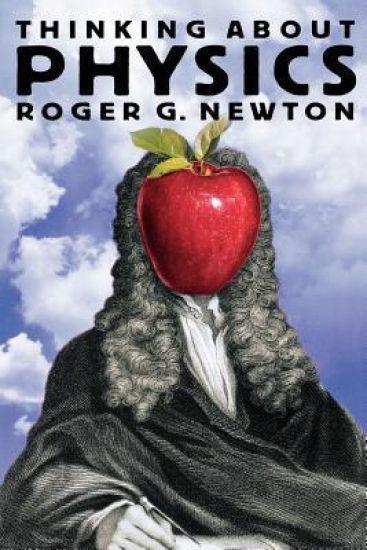
Thinking about Physics

Thinking about Physics

Roger G. Newton

Princeton University Press
2002
pokkari
Physical scientists are problem solvers. They are comfortable "doing" science: they find problems, solve them, and explain their solutions. Roger Newton believes that his fellow physicists might be too comfortable with their roles as solvers of problems. He argues that physicists should spend more time thinking about physics. If they did, he believes, they would become even more skilled at solving problems and "doing" science. As Newton points out in this thought-provoking book, problem solving is always influenced by the theoretical assumptions of the problem solver. Too often, though, he believes, physicists haven't subjected their assumptions to thorough scrutiny. Newton's goal is to provide a framework within which the fundamental theories of modern physics can be explored, interpreted, and understood. "Surely physics is more than a collection of experimental results, assembled to satisfy the curiosity of appreciative experts," Newton writes. Physics, according to Newton, has moved beyond the describing and naming of curious phenomena, which is the goal of some other branches of science. Physicists have spent a great part of the twentieth century searching for explanations of experimental findings. Newton agrees that experimental facts are vital to the study of physics, but only because they lead to the development of a theory that can explain them. Facts, he argues, should undergird theory. Newton's explanatory sweep is both broad and deep. He covers such topics as quantum mechanics, classical mechanics, field theory, thermodynamics, the role of mathematics in physics, and the concepts of probability and causality. For Newton the fundamental entity in quantum theory is the field, from which physicists can explain the particle-like and wave-like properties that are observed in experiments. He grounds his explanations in the quantum field. Although this is not designed as a stand-alone textbook, it is essential reading for advanced undergraduate students, graduate students, professors, and researchers. This is a clear, concise, up-to-date book about the concepts and theories that underlie the study of contemporary physics. Readers will find that they will become better-informed physicists and, therefore, better thinkers and problem solvers too.
Quantum Physics

Quantum Physics

Roger G. Newton

Springer-Verlag New York Inc.
2011
nidottu
The combination of quantum mechanics and quantum ?eld theory cons- tutesthemostrevolutionaryandin?uentialphysicaltheoryofthetwentieth century. Itsimpactisfeltnotonlyinalmostallothersciences,butthefruits of its application are ubiquitous in everyday life. This textbook is designed to teach graduate students the underlying quantum-physical ideas, their mathematical formulations, and the basic problem-solving techniques of the discipline. It assumes they have taken at least one introductory course in quantum mechanics as undergraduates and are familiar with the history of the subject and the basic experimental evidence that led to its adoption, as well as with many of its fundamental notions. In contrast to most other authors, I am therefore not introducing the quantum theory via an hist- ical survey of its early successes. Instead, following the models of books on classsical mechanics or electromagnetism, I develop the theory from its basic assumptions, beginning with statics, followed by the dynamics and details of its speci?c areas of use as well as the needed mathematical te- niques. Although this book, inevitably, deals largely with the behavior of point particles under various conditions, I do not regard particles as the fun- mental entities of the universe: the most basic object is the quantum ?eld, with theobserved particlesarising from the?eld asitsquanta. For thisr- son I introduce quantum ?elds right from the beginning and demonstrate, in the ?rst chapter, how particles originate.
Inverse Schrödinger Scattering in Three Dimensions

Inverse Schrödinger Scattering in Three Dimensions

Roger G. Newton

Springer-Verlag Berlin and Heidelberg GmbH Co. K
2011
nidottu
Most of the laws of physics are expressed in the form of differential equations; that is our legacy from Isaac Newton. The customary separation of the laws of nature from contingent boundary or initial conditions, which has become part of our physical intuition, is both based on and expressed in the properties of solutions of differential equations. Within these equations we make a further distinction: that between what in mechanics are called the equations of motion on the one hand and the specific forces and shapes on the other. The latter enter as given functions into the former. In most observations and experiments the "equations of motion," i. e. , the structure of the differential equations, are taken for granted and it is the form and the details of the forces that are under investigation. The method by which we learn what the shapes of objects and the forces between them are when they are too small, too large, too remote, or too inaccessi­ ble for direct experimentation, is to observe their detectable effects. The question then is how to infer these properties from observational data. For the theoreti­ cal physicist, the calculation of observable consequences from given differential equations with known or assumed forces and shapes or boundary conditions is the standard task of solving a "direct problem. " Comparison of the results with experiments confronts the theoretical predictions with nature.
How Physics Confronts Reality: Einstein Was Correct, But Bohr Won The Game

How Physics Confronts Reality: Einstein Was Correct, But Bohr Won The Game

Roger G Newton

World Scientific Publishing Co Pte Ltd
2009
sidottu
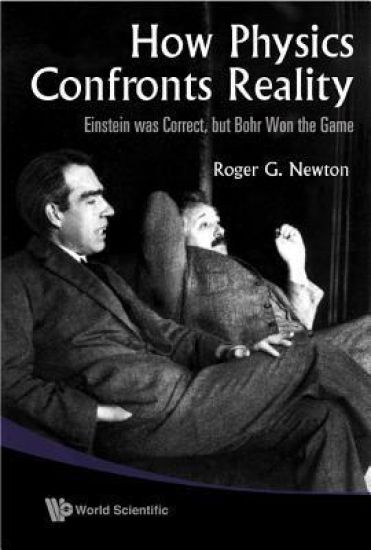
This book recalls, for nonscientific readers, the history of quantum mechanics, the main points of its interpretation, and Einstein's objections to it, together with the responses engendered by his arguments. Most popular discussions on the strange aspects of quantum mechanics ignore the fundamental fact that Einstein was correct in his insistence that the theory does not directly describe reality. While that fact does not remove the theory's counterintuitive features, it casts them in a different light.Context is provided by following the history of two central aspects of physics: the elucidation of the basic structure of the world made up of particles, and the explanation, as well as the prediction, of how objects move. This history, prior to quantum mechanics, reveals that whereas theories and discoveries concerning the structure of nature became increasingly realistic, the laws of motion, even as they became more powerful, became more and more abstract and remote from intuitive notions of reality. Newton's laws of motion gained their abstract power by sacrificing direct and intuitive contact with real experience. Arriving 250 years after Newton, the break with a direct description of reality embodied in quantum mechanics was nevertheless profound.
How Physics Confronts Reality: Einstein Was Correct, But Bohr Won The Game

How Physics Confronts Reality: Einstein Was Correct, But Bohr Won The Game

Roger G Newton

World Scientific Publishing Co Pte Ltd
2009
nidottu
This book recalls, for nonscientific readers, the history of quantum mechanics, the main points of its interpretation, and Einstein's objections to it, together with the responses engendered by his arguments. Most popular discussions on the strange aspects of quantum mechanics ignore the fundamental fact that Einstein was correct in his insistence that the theory does not directly describe reality. While that fact does not remove the theory's counterintuitive features, it casts them in a different light.Context is provided by following the history of two central aspects of physics: the elucidation of the basic structure of the world made up of particles, and the explanation, as well as the prediction, of how objects move. This history, prior to quantum mechanics, reveals that whereas theories and discoveries concerning the structure of nature became increasingly realistic, the laws of motion, even as they became more powerful, became more and more abstract and remote from intuitive notions of reality. Newton's laws of motion gained their abstract power by sacrificing direct and intuitive contact with real experience. Arriving 250 years after Newton, the break with a direct description of reality embodied in quantum mechanics was nevertheless profound.
Why Science?: To Know, To Understand, And To Rely On Results

Why Science?: To Know, To Understand, And To Rely On Results

Roger G Newton

World Scientific Publishing Co Pte Ltd
2012
nidottu
This book aims to describe, for readers uneducated in science, the development of humanity's desire to know and understand the world around us through the various stages of its development to the present, when science is almost universally recognized — at least in the Western world — as the most reliable way of knowing. The book describes the history of the large-scale exploration of the surface of the earth by sea, beginning with the Vikings and the Chinese, and of the unknown interiors of the American and African continents by foot and horseback. After the invention of the telescope, visual exploration of the surfaces of the Moon and Mars were made possible, and finally a visit to the Moon. The book then turns to our legacy from the ancient Greeks of wanting to understand rather than just know, and why the scientific way of understanding is valued. For concreteness, it relates the lives and accomplishments of six great scientists, four from the nineteenth century and two from the twentieth. Finally, the book explains how chemistry came to be seen as the most basic of the sciences, and then how physics became the most fundamental.
Science Of Energy, The

Science Of Energy, The

Roger G Newton

World Scientific Publishing Co Pte Ltd
2012
nidottu
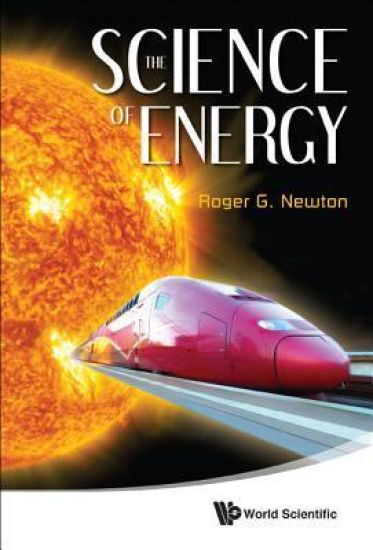
This book aims to describe the scientific concepts of energy. Accessible to readers with no scientific education beyond high-school chemistry, it starts with the basic notion of energy and the fundamental laws that govern it, such as conservation, and explains the various forms of energy, such as electrical, chemical, and nuclear. It then proceeds to describe ways in which energy is stored for very long times in the various fossil fuels (petroleum, gas, coal) as well as for short times (flywheels, pumped storage, batteries, fuel cells, liquid hydrogen). The book also discusses the modes of transport of energy, especially those of electrical energy via lasers and transmission lines, as well as why the latter uses alternating current at high voltages. The altered view of energy introduced by quantum mechanics is also discussed, as well as how almost all the Earth's energy originates from the Sun. Finally, the history of the forms of energy in the course of development of the universe is described, and how this form changed from pure radiation in the aftermath of the Big Bang to the creation of all the chemical elements in the world.
Waves And Particles: Two Essays On Fundamental Physics

Waves And Particles: Two Essays On Fundamental Physics

Roger G Newton

World Scientific Publishing Co Pte Ltd
2014
nidottu
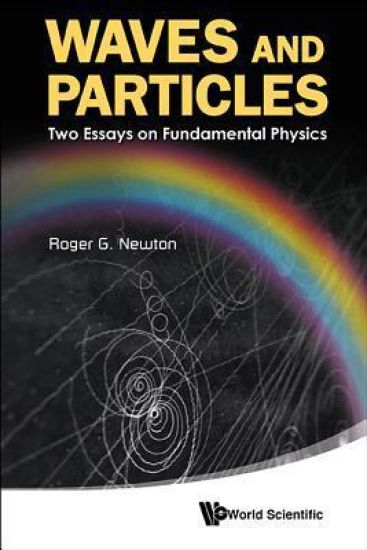
The book consists of two separate parts, the first part is on waves and the second part on particles. In part 1, after describing the awesome power of tsunami and the history of their occurrences, the book turns to the history of explaining phenomena by means of mathematical equations. Then it describes other wave phenomena and the laws governing them: the vibration of strings and drums in musical instruments, the sound waves making them audible, ultrasound and its uses, sonar, and shock waves; electromagnetic waves: light waves, refraction, diffraction, why the sky is blue, the rainbow, and the glory; microwaves and radio waves: radar, radio astronomy, the discovery of the cosmic microwave background radiation, microwave ovens and how a radio works, lasers and masers; waves in modern physics: the Schrödinger wave function and gravitational waves in general relativity; water waves in the ocean, tides and tidal waves, and the quite different solitary waves, solitons discovered in canals. Finally we return to tsunami and the question of what laws govern them. We conclude that the answer to that question is not quite known yet, but there is ongoing research to solve the riddle.In part 2, the history of the idea of atoms is reviewed, and then the scientific evidence for their existence, with Rutherford's discovery of the atomic nucleus. The investigation of what the nucleus is like follows, including the discovery of the neutron, followed by that of the neutrino — of which there are several different kinds — and the muon as well as the pion. The important work of Paul Dirac is described, as well as the discovery of the positron and other antiparticles. The ways by which particles are discovered, by cloud chambers, bubble chambers, etc. are all explained, followed by the invention of the various machines to accelerate particles to high speeds: the cyclotron, the synchrotron, and the bigger and bigger machines, in the US as well as in Switzerland, including their storage rings. The new terminology of fermions and bosons are explained, followed by the remarkable use of group theory and group representations by matrices, whose unfamiliar algebra is carefully explained.
The Warriors of Harvey House: An Experiment in Recovery
A true story, that many years ago brought a number of alcoholic veterans together to learn to live sober with love, sacrifice, honesty and spirituality.They came from the farms, the towns, skid-row, one of them was even living in an abandoned service station, sleeping in one of the restrooms. It all began at a special place in a special time with a way of being that had never been before and will never be again. Take the toughest of the tough, the most hopeless of the hopeless, and have them live together. No discipline, no lectures, just a bunch of flunkees in life trying to learn a new way. This is their incredible story written with warmth, humor, and compassion. "The warriors of Havrey House". written by Roger G. one of the last of the warriors
Experiment In Recovery: The Spirtual Journey of Eddy and the Harvey House Vets
"Experiment in Recovery" is a story of a spiritual journey of a fellow veteran named Eddy and me in the formation and management of a recovery home in Fresno, CA. several years ago. It is about attracting a number of addicted veterans and providing them shelter and sustenance. It is funny, sad and according to Dr. Claudia Black, "powerful".
Burr, Hamilton, and Jefferson

Burr, Hamilton, and Jefferson

Roger G. Kennedy

Oxford University Press Inc
2002
nidottu
This book restores Aaron Burr to his place as a central figure in the founding of the American Republic. Abolitionist, proto-feminist, friend to such Indian leaders as Joseph Brant, Burr was personally acquainted with a wider range of Americans, and of the American continent, than any other Founder except George Washington. He contested for power with Hamilton and then with Jefferson on a continental scale. The book does not sentimentalize any of its three protagonists, neither does it derogate their extraordinary qualities. They were all great men, all flawed, and all three failed to achieve their full aspirations. But their struggles make for an epic tale. Written from the perspective of a historian and administrator who, over nearly fifty years in public life, has served six presidents, this book penetrates into the personal qualities of its three central figures. In telling the tale of their shifting power relationships and their antipathies, it reassesses their policies and the consequences of their successes and failures. Fresh information about the careers of Hamilton and Burr is derived from newly-discovered sources, and a supporting cast of secondary figures emerges to give depth and irony to the principal narrative. This is a book for people who know how political life is lived, and who refuse to be confined within preconceptions and prejudices until they have weighed all the evidence, to reach their own conclusions both as to events and character. This is a controversial book, but not a confrontational one, for it is written with sympathy for men of high aspirations, who were disappointed in much, but who succeeded, in all three cases, to a degree not hitherto fully understood.
Bioseparations Science and Engineering

Bioseparations Science and Engineering

Roger G. Harrison; Paul W. Todd; Scott R. Rudge; Demetri P. Petrides

Oxford University Press Inc
2015
sidottu
Designed for undergraduates, graduate students, and industry practitioners, Bioseparations Science and Engineering fills a critical need in the field of bioseparations. Current, comprehensive, and concise, it covers bioseparations unit operations in unprecedented depth. In each of the chapters, the authors use a consistent method of explaining unit operations, starting with a qualitative description noting the significance and general application of the unit operation. They then illustrate the scientific application of the operation, develop the required mathematical theory, and finally, describe the applications of the theory in engineering practice, with an emphasis on design and scaleup. Unique to this text is a chapter dedicated to bioseparations process design and economics, in which a process simular, SuperPro Designer® is used to analyze and evaluate the production of three important biological products. New to this second edition are updated discussions of moment analysis, computer simulation, membrane chromatography, and evaporation, among others, as well as revised problem sets. Unique features include basic information about bioproducts and engineering analysis and a chapter with bioseparations laboratory exercises. Bioseparations Science and Engineering is ideal for students and professionals working in or studying bioseparations, and is the premier text in the field.
Human Factors for Pilots

Human Factors for Pilots

Roger G. Green

Avebury Technical
1996
nidottu
This book has two functions. The first is to provide a comprehensive and concise outline of the available human factors knowledge for the practicing pilot. The second function is to provide this knowledge in a way that follows very closely the syllabus of the UK Civil Aviation Authority's (CAA) Human Performance and Limitations examinations for both professional and private pilots. Although the private pilot's syllabus requires a narrower range of subjects to be studied, and in less detail, than the professional syllabus, this handbook covers both requirements, with syllabus variations being indicated in the contents page. The book is divided into four major sections containing material from psychology, physiology and medicine.