Kirjojen hintavertailu. Mukana 11 627 616 kirjaa ja 12 kauppaa.

Kirjahaku

Etsi kirjoja tekijän nimen, kirjan nimen tai ISBN:n perusteella.

1000 tulosta hakusanalla Rolf G. Kuehni

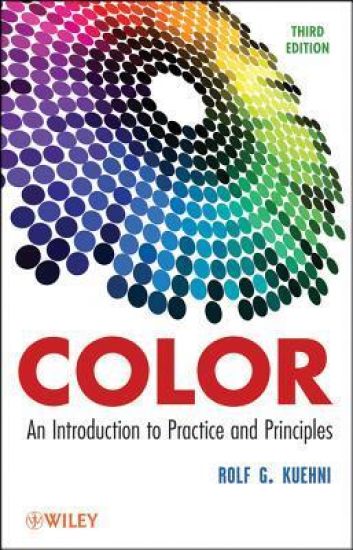
Color

Color

Rolf G. Kuehni

John Wiley Sons Inc
2012
sidottu
The one-stop reference to the essentials of color science and technology—now fully updated and revised The fully updated Third Edition of Color: An Introduction to Practice and Principles continues to provide a truly comprehensive, non-mathematical introduction to color science, complete with historical, philosophical, and art-related topics. Geared to non-specialists and experts alike, Color clearly explains key technical concepts concerning light, human vision, and color perception phenomena. It covers color order systems in depth, examines color reproduction technologies, and reviews the history of color science as well as its relationship to art and color harmony. Revised throughout to reflect the latest developments in the field, the Third Edition: Features many new color illustrations, now fully incorporated into the textOffers new perspectives on what color is all about, diverging from conventional thinkingIncludes new information on perception phenomena, color order, and technological advancesUpdates material on such topics as the CIE colorimetric system and optimal object colorsExtends coverage of color reproduction to display systems, photography, and color managementContains a unique timetable of color in science and art, plus a glossary of important terms Praise for the previous editions: “A nice bridge to areas usually not covered in academic visual science programs … outstanding.” —Joel Pokorny, visual scientist at The University of Chicago “A good addition to any library, this should be useful for the color interests of artists, designers, craftsmen, philosophers, psychologists, color technologies, and students in related fields.” —CHOICE

Color Ordered

Color Ordered

Rolf G. Kuehni; Andreas Schwarz

Oxford University Press Inc
2008
sidottu
Since antiquity, people have searched for a way to understand the colours we see-what they are, how many there are, and how they can be systematically identified and arranged in some kind of order. How to order colours is not merely a philosophical question, it also has many practical applications in art, design, and commerce. Our intense interest in colour and its myriad practical applications have led people throughout history to develop many systems to characterize and order it. The number of colour order systems developed throughout history is unknown but ranges in the hundreds. Many are no longer used, but continue to be of historical interest. Despite wrong turns and slow progress, our understanding of colour and its order has improved steadily. Although full understanding continues to elude us, it seems clear that it will ultimately come from research in neurobiology, perception and consciousness. Color Ordered is a comprehensive, in-depth compendium of 165 systems, dating from antiquity to the present. In it, Rolf Kuehni and Andreas Schwarz present a history and categorization of colour systems, describe each one using original figures and schematic drawings, and provide a broad review of the underlying theory. Included are a brief overview of colour vision and a synthesis of the various systems.
Pioneers of Color Science

Pioneers of Color Science

Renzo Shamey; Rolf G. Kuehni

Springer International Publishing AG
2020
sidottu
This book provides a comprehensive overview of the historical development of color science, told through the stories of more than 90 of the most prominent figures in the field and their contributions.The text comprises an extensive set of biographical essays about pioneering scientists in the field of color science, describing their most significant achievements and explaining how their findings influenced the general understanding of color. Grouped by historical period, each part is prefaced with a short introduction that sets the essays into context and helps the reader appreciate the background and the importance of the contributions made.Beginning with classical Greece and the works of Plato and Aristotle, the book goes on in the second part to describe the advances made by Islamic scholars such as Ibn al-Haytham between the 10th and 15th centuries. The third part covers contributions from Roger Bacon and Theodoric of Freiberg in the same period. Part four includes discussions on color formation and visual perception for a time period from about the 16th to the 18th centuries encompassing the Age of Enlightenment. This part addresses the works of nineteen pioneers including Descartes, Boyle, Newton, Goethe, Lambert, Purkynje, Runge, Dalton, Young and Chevreul.The final part is the largest section of the book and covers the most recent discoveries and contributions from pioneers born after 1800 and includes over 60 essays. Among the pioneers listed in this chapter are Nobel laureates, vision scientists including Helmholtz, and Hering, and many other notable color pioneers such as Munsell and Land. This part of the book also includes essays on contemporary figures in color science including Adams, Boynton, Crawford, Hardy, MacAdam, Ostwald and Wyszecki and reviews their contributions to this dynamic field.A useful reference for color scientists, science historians, artists and others, Pioneers of Color Science offers a fascinating insight into the development of color science and the nature of scientific advancement.
Insect Morphology and Phylogeny

Insect Morphology and Phylogeny

Rolf G. Beutel; Frank Friedrich; Xing-Ke Yang; Si-Qin Ge

De Gruyter
2013
sidottu
In the last decades a remarkable renaissance has materialized in insect morphology, mainly triggered by the development of new cutting-edge technologies. This is an exciting time for biological synthesis where the mysteries and data derived from genomes can be combined with centuries of data from morphology and development. And, now, more than ever, detailed knowledge of morphology is essential to understanding the evolution of all groups of organisms. In this “age of phylogenomics” researchers rely on morphological data to support molecular findings, test complex evolutionary scenarios, and for placing fossil taxa. This textbook provides an in-depth treatment of the structures and the phylogeny of the megadiverse Hexapoda. The first part presents an up-to-date overview of general insect morphology with detailed drawings, scanning electron micrographs, and 3-D reconstructions. Also included is a chapter covering innovative morphological techniques (e.g., µ-computer tomography, 3-D modeling), brief treatments of insect development and phylogenetic methods, and a comprehensive morphological glossary. The second part is of a modern synthesis of insect systematics that includes taxon-specific morphological information for all Orders. The work is an invaluable reference for students and researchers working in all facets of biology and is a must for evolutionary biologists. A detailed understanding of morphology is essential in unraveling phylogenetic relationships and developing complex evolutionary scenarios. Increasingly researchers in phylogenomics are re/turning to morphological data to support their findings, while the development of new cutting-edge technologies has further increased interest in this growing field. This definitive handbook provides an in-depth treatment of insect morphology. The first part presents an up-to-date overview of insect morphology with detailed drawings, brilliant scanning electron micrographs and 3-D reconstructions as interactive PDFs. This is complemented by a chapter on innovative morphological techniques (e.g., µ-computer tomography, 3-D modeling) and a comprehensive morphological glossary. The second part treats the state of the art in insect systematics and includes taxon-specific morphological information for all orders. Systematics are treated formally, with for example the arguments for relationships (“apomorphies”) always listed explicitly. The work is a useful reference for students and researchers working in different fields of biology and a must for those dealing with insects from an evolutionary perspective.
Die blockierte Gesellschaft

Die blockierte Gesellschaft

Rolf G. Heinze

Vs Verlag Fur Sozialwissenschaften
1998
nidottu
Der gesellschaftliche Wandel in Deutschland ist eingebettet in Institutionen, die in massive Orientierungskrisen geraten und in ihrem Bestand gefährdet sind. Die Gewerkschaften, vor allem aber die Arbeitgeberverbände gehören dazu, aber auch traditionelle Institutionen wie die Kirchen, Parteien oder auch klassische Sozialverbände. Die in solchen Situationen übliche Selbstvergewisserung durch stärkere Selbstbeschäftigung blockiert nicht nur die Institutionen selbst, sondern auch deren Sensibilität für den sozial- und wirtschaftsstrukturellen Wandel, mit dem diese gesellschaftlichen Instanzen eigentlich eng verbunden sein sollten. Am Beispiel des Arbeitsmarktes, der Arbeitsbeziehungen sowie der Wohlfahrtsstaats-Debatte werden solche Blockaden analysiert und Möglichkeiten diskutiert, wie sie aufgebrochen werden könnten.
Wandel wider Willen

Wandel wider Willen

Rolf G. Heinze

Springer Fachmedien Wiesbaden
2006
nidottu
Der Wirtschafts- und Sozialstandort Deutschland zeichnet sich durch eine ausgeprägte Koexistenz von faktischer Stagnation auf dem Arbeitsmarkt, sozialen Marginalisierungsprozessen und erfolgreichen betrieblichen Umstrukturierungen aus. In diesem Buch werden der Stagnationsprozess und die Zersplitterungen in den verschiedenen Dimensionen aus wirtschafts- und arbeitssoziologischer Sicht analysiert und historisch eingeordnet.
Information und Dokumentation

Information und Dokumentation

Rolf G. Henzler

Springer-Verlag Berlin and Heidelberg GmbH Co. K
1992
nidottu
Im Gegensatz zum langweiligen Dokumentar der Vergangenheit hat heute das Berufsbild der Dokumentare ein mehrdimensionales Spektrum: Es hat Beziehungen zu Fachwissenschaftlern aller Berufszweige, Unternehmensberatern, Informatikern und Bibliothekaren. Ein Dokumentar steht auch im Zentrum der Kommunikation zwischen extern und intern: Er muß den Informationsstrom von draußen (externe Informationsstellen, Verlage, Hosts) gezielt in die eigene Institution hereinholen, um die Informationen entweder direkt an die anfragenden Endbenutzer weiterzugeben oder in einem eigenen Speicher zu sammeln. Deshalb sind soziale, politische und rechtliche Kenntnisse des Informationsmarkts sowie die Kenntnis der Zugriffs- und Nutzungsmodalitäten und der damit verbundenen Begleitumstände unbedingt erforderlich. Nur auf dieser Grundlage können Informationen zwischen externen Systemen und internem Bedarf, aber auch umgekehrt, zwischen intern verfügbarem Wissen und von außen herangetragenen Wünschen, vermittelt werden, was durch die zunehmende Verflechtung vieler Firmen miteinander immer wichtiger wird. Dieses Lehrbuch behandelt traditionelle und moderne Formen der Informationsaufbereitung für Datenbanken und Wissensspeicher, die alle Aspekte der Dokumentationspraxis umfassen. Es gibt eine aktuelle Darstellung der für Recherchen und Informationsvermittlung wichtigen Dokumentationsszene und -technik. Das Buch ist ein Leitfaden für Studenten aller mit Dokumentation befaßten Fachrichtungen, z.B. Bibliothekare, Archivare, Buchhändler sowie aller Fachrichtungen, in denen Datenbankrecherchen durchgeführt werden. Es vermittelt dokumentarische Methoden, Fachbegriffe und Zusammenhänge.
Quintessenz des Supply Chain Managements

Quintessenz des Supply Chain Managements

Rolf G. Poluha

Springer-Verlag Berlin and Heidelberg GmbH Co. K
2010
sidottu
Der Wettbewerb findet zukünftig zwischen Supply Chains statt. Das vorliegende Buch zeigt, was hinter dieser Aussage steckt, und macht deutlich, welche Konsequenzen sich daraus für Unternehmen ergeben. Ein durchdachtes Supply Chain Management trägt wesentlich dazu bei, die eigene Wettbewerbsposition nachhaltig zu verbessern und auszubauen. Prägnant und nachvollziehbar vermittelt der Autor die wesentlichen Grundlagen dieses komplexen Themas und zeigt, was Entscheidungsträger wirklich über ihre Prozesse in Beschaffung, Fertigung, Lagerung und Logistik wissen müssen. Zahlreiche Beispiele und Schaubilder verdeutlichen Zusammenhänge und Auswirkungen. Darüber hinaus gibt das Buch wertvolle Informationen darüber, wie sich eine Lieferkette analysieren und bewerten lässt, um sie anschließend zielgerichtet strukturieren und optimieren zu können. "Rolf Poluhas Buch enthält eine kompakte Einführung in das Supply Chain Management und gibt eine klare Übersicht zuden neuesten Entwicklungen."Dr. Paul Hofmann,Vice President Research, SAP Labs Über die Reihe: Die Quintessenz-Reihe vermittelt wesentliches Wissen anschaulich und kompakt. Dabei richtet sie sich primär an Anwender, unabhängig davon, ob sie Experten oder Laien sind. Markenzeichen der Reihe sind die sorgfältige Auswahl von Themen und Autoren sowie das handliche Format.
Gesellschaftsgestaltung durch Neujustierung von Zivilgesellschaft, Staat und Markt
Die Coronakrise wirkt als Seismograph der gegenwärtigen Gesellschaft. Die Widersprüche und Pathologien werden unmittelbar sichtbar und insbesondere die gesellschaftsprägende Kraft der Digitalisierung führt deutlich vor Augen, dass Gestaltung das Gebot der Stunde ist. Durch die Pandemie werden Verunsicherungen gesteigert, ökonomisch-soziale Verwerfungen verschärft und individuelle Enttäuschungen produziert. Der neue Blickwinkel kann aber auch positive Funktionen haben und den Diskurs zu sozialen Innovationen beleben. Hierzu gehört die Revitalisierung staatlicher Interventionen, die ebenfalls bei Transformationsprojekten wie der Energiewende oder den demografischen Herausforderungen gefordert ist. Die Pandemie kann so als Beschleuniger von Prozessen gesehen werden, die sich bereits im Wandel befinden. Hierzu zählt auch der Wertigkeitsverlust marktlicher Regulierungen. Die Zukunftsfähigkeit einer Gesellschaft wie auch wirtschaftliche Wertschöpfungen hängen von einerfunktionierenden staatlichen Infrastruktur und öffentlicher Daseinsvorsorge ab. Die Relevanz eines schützenden Staates und zivilgesellschaftlicher Organisationsformen, wie sie sich etwa in den solidarischen Hilfen manifestierten, sind als Narrative anerkannt. Deshalb dürften Neujustierungen der zentralen Steuerungsressourcen Zivilgesellschaft, Staat und Markt Auftrieb erfahren.