Kirjojen hintavertailu. Mukana 11 699 587 kirjaa ja 12 kauppaa.

Kirjahaku

Etsi kirjoja tekijän nimen, kirjan nimen tai ISBN:n perusteella.

1000 tulosta hakusanalla Rosemarie Garland-Thomson

Staring

Staring

Rosemarie Garland-Thomson

Oxford University Press Inc
2009
sidottu
From a very young age we are told not to stare, and one hallmark of maturation is the ability to resist (or at least hide) our staring behavior. And yet, rarely do we master the impulse. Despite the complicated role it plays in our development, and its unique brand of visual enticement, staring has not been considered before as a suitable object for socio-cultural analysis. What is it about certain kinds of people that makes it impossible to take our eyes off them? Why are some visual stimuli irresistible? Why does staring produce so much anxiety? Drawing on examples from art, media, fashion, history and memoir, Garland-Thomson defines staring, explores the factors that motivate it, and considers the targets and the effects of the stare. A bodily inventory then enumerates how stares actually operate in daily life. A section on "Bodies" focuses on the question of size and scale as key indicators of normalcy, while certain body parts show themselves to be disproportionately arresting, as passages on "Faces" "Hands" and "Breasts" reveal. A concluding chapter on "Beholding" considers the frisson at play between starer and staree and offers an alternative way of understanding visual communication between people. Featuring over forty illustrations, Staring captures the stimulating combination of symbolic, material and emotional factors that make staring so irresistible while endeavoring to shift the usual response to staring, shame, into an engaged self-consideration. Elegant and provocative, this book advances new ways of thinking about visuality and the body that will appeal to readers who are interested in the overlap between the humanities and human behaviors.
Staring

Staring

Rosemarie Garland-Thomson

Oxford University Press Inc
2009
nidottu
From a very young age we are told not to stare, and one hallmark of maturation is the ability to resist (or at least hide) our staring behavior. And yet, rarely do we master the impulse. Despite the complicated role it plays in our development, and its unique brand of visual enticement, staring has not been considered before as a suitable object for socio-cultural analysis. What is it about certain kinds of people that makes it impossible to take our eyes off them? Why are some visual stimuli irresistible? Why does staring produce so much anxiety? Drawing on examples from art, media, fashion, history and memoir, Garland-Thomson defines staring, explores the factors that motivate it, and considers the targets and the effects of the stare. A bodily inventory then enumerates how stares actually operate in daily life. A section on "Bodies" focuses on the question of size and scale as key indicators of normalcy, while certain body parts show themselves to be disproportionately arresting, as passages on "Faces" "Hands" and "Breasts" reveal. A concluding chapter on "Beholding" considers the frisson at play between starer and staree and offers an alternative way of understanding visual communication between people. Featuring over forty illustrations, Staring captures the stimulating combination of symbolic, material and emotional factors that make staring so irresistible while endeavoring to shift the usual response to staring, shame, into an engaged self-consideration. Elegant and provocative, this book advances new ways of thinking about visuality and the body that will appeal to readers who are interested in the overlap between the humanities and human behaviors.
Extraordinary Bodies

Extraordinary Bodies

Rosemarie Garland Thomson

Columbia University Press
2017
sidottu
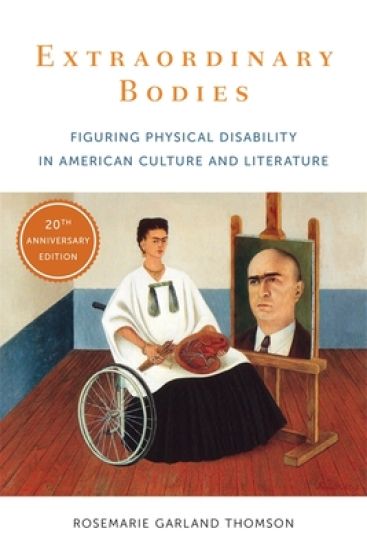
Extraordinary Bodies is a cornerstone text of disability studies, establishing the field upon its publication in 1997. Framing disability as a minority discourse rather than a medical one, the book added depth to oppressive narratives and revealed novel, liberatory ones. Through her incisive readings of such texts as Harriet Beecher Stowe's Uncle Tom's Cabin and Rebecca Harding Davis's Life in the Iron Mills, Rosemarie Garland-Thomson exposed the social forces driving representations of disability. She encouraged new ways of looking at texts and their depiction of the body and stretched the limits of what counted as a text, considering freak shows and other pop culture artifacts as reflections of community rites and fears. Garland-Thomson also elevated the status of African-American novels by Toni Morrison and Audre Lorde. Extraordinary Bodies laid the groundwork for an appreciation of disability culture and an inclusive new approach to the study of social marginalization.
Extraordinary Bodies

Extraordinary Bodies

Rosemarie Garland Thomson

Columbia University Press
2017
pokkari
Extraordinary Bodies is a cornerstone text of disability studies, establishing the field upon its publication in 1997. Framing disability as a minority discourse rather than a medical one, the book added depth to oppressive narratives and revealed novel, liberatory ones. Through her incisive readings of such texts as Harriet Beecher Stowe's Uncle Tom's Cabin and Rebecca Harding Davis's Life in the Iron Mills, Rosemarie Garland-Thomson exposed the social forces driving representations of disability. She encouraged new ways of looking at texts and their depiction of the body and stretched the limits of what counted as a text, considering freak shows and other pop culture artifacts as reflections of community rites and fears. Garland-Thomson also elevated the status of African-American novels by Toni Morrison and Audre Lorde. Extraordinary Bodies laid the groundwork for an appreciation of disability culture and an inclusive new approach to the study of social marginalization.
Imaging and Imagining Illness

Imaging and Imagining Illness

Rosemarie Garland-Thomson

Cascade Books
2018
sidottu
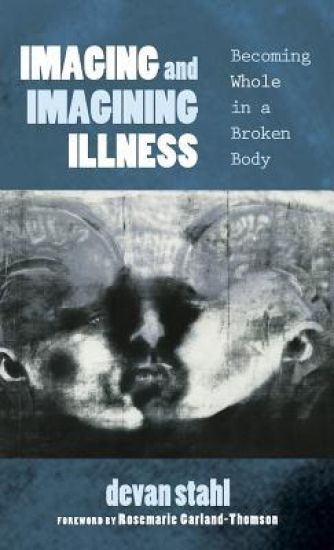
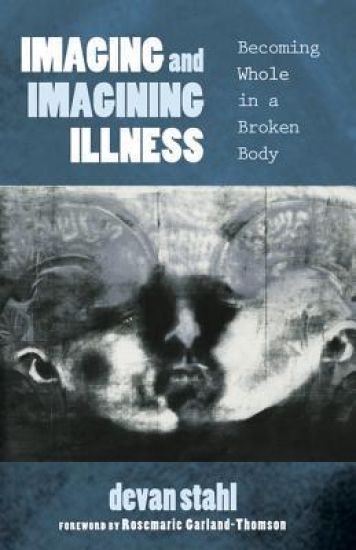
Medical imaging technologies can help diagnose and monitor patients' diseases, but they do not capture the lived experience of illness. In this volume, Devan Stahl shares her story of being diagnosed with multiple sclerosis with the aid of magnetic resonance images (MRIs). Although clinically useful, Stahl did not want these images to be the primary way she or anyone else understood her disease or what it is like to live with MS. With the help of her printmaker sister, Darian Goldin Stahl, they were able to reframe these images into works of art. The result is an altogether different image of the ill body. Now, the Stahls open up their project to four additional scholars to help shed light on the meaning of illness and the impact medical imaging can have on our cultural imagination. Using their insights from the medical humanities, literature, visual culture, philosophy, and theology, the scholars in this volume advance the discourse of the ill body, adding interpretations and insights from their disciplinary fields. ""In this fascinating and quite unique book, Devan Stahl and some of those who love her offer a deep, rich, and at points quite moving insight into what it means to live into enduring forms of illness. The interdisciplinary approach is powerful in the way that it allows us to see Devan's illness experiences from a variety of perspectives. . . .I commend this book and I pray that it both informs and changes people's views on what it means to live humanly in the company of enduring illness."" --John Swinton, Professor, School of Divinity, King's College University of Aberdeen ""In Imaging and Imagining Illness, Devan Stahl breaks new ground in the now well-populated field of illness writing. Combining personal memoir, artwork, rigorous analyses from bioethics and medical humanities, and philosophical reflection, it offers fresh interdisciplinary insights into the experience of illness and disability in a technologized medical world. More than anything else I have read, Stahl's book shows the reader how the person in illness interweaves multiple perspectives to give meaning to their experience."" --Jackie Leach Scully, Executive Director, Policy Ethics and Life Sciences Research Centre ""This transcendentally lyrical work is about relationships: between a woman and her body; between her-self and evolving life with an unpredictable illness; between a printmaker--her sister--and her materials; and between two sisters in narrative and graphic counterpoint. . . . Other voices--a literary scholar, a theologian, and a physician-philosopher--enhance the complexity and texture of the artistic pas-de-deux at the center of the book. Above all it reminds us of the potential, in Devan Stahl's words, that 'resistant acts of creation' have for humanity and emancipation."" --Arno K. Kumagai, Professor and Vice Chair for Education, Women's College Hospital, University of Toronto ""Blending the verbal and the visual, the personal and the scholarly, this unique volume takes us on a wondrous journey from patient to print and icon that will make readers look at medical images with an entirely fresh eye. The result is proof that illness narrative is an invitation to share vulnerability with others and of the transformative power of imaginative and collaborative perspectives on the ill body. It deserves to be widely read."" --Stella Bolaki, Author of Illness as Many Narratives: Arts, Medicine and Culture Devan Stahl is Assistant Professor of Clinical Ethics in the Center for Ethics and Humanities in the Life Sciences at Michigan State University.
Plough Quarterly No. 41 - Freedom

Plough Quarterly No. 41 - Freedom

Jordan Castro; Rosemarie Garland-Thomson

PLOUGH PUBLISHING HOUSE
2024
nidottu
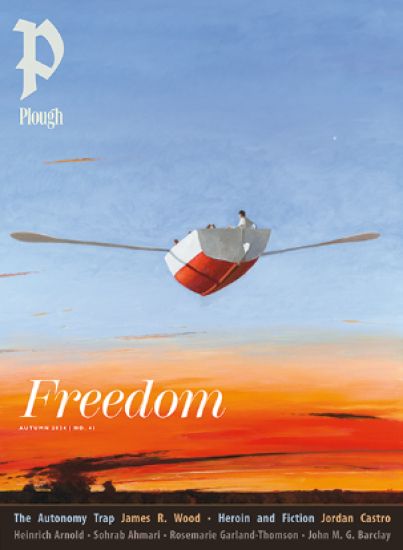
In an election season, all political parties claim to champion freedom, which highlights the very different ways people think about what it means to be free. This issue of Plough Quarterly explores many dimensions of freedom: not only what people need to be freed from, but what we are set free to do. Contributors look at freedom in light of addiction, disability, asylum, religious liberty, modern slavery, dictatorship, conversion, workers' rights, theology, the fine arts, and more.On this theme: Sohrab Ahmari reminds Christians of their long tradition of defending workers' rights.Robert Donnelly reports on the welcome asylum seekers receive on the US southern border.Rosemarie Garland-Thomson considers the terrible freedom of choice a pregnant woman faces.John Barclay looks at freedom and slavery, metaphorical and literal, in the writings to Paul.Daniel J. Sims uncovers his own complicity and compromise in the global aid industry.Santiago Ramos realizes people living under dictatorship value books more than free people doJordan Castro recalls how he sought freedom in fiction and heroin, but found it elsewhere.Joonas Sildre shows how Arvo P rt remained true to his art under Soviet rule.Pan Yongguang recounts how his church community escaped China together.Plough Quarterly features stories, ideas, and culture for people eager to apply their faith to the challenges we face. Each issue includes in-depth articles, interviews, poetry, book reviews, and art.
My Warped Italian Catholic Childhood: Little Rosemarie of the 50's is Confessing Sins at the Gossip Window
My Warped Italian Catholic Childhood is a comedic throwback to the fifties era. Little Rosemarie is a misplaced ward of the times. Her attempt to adapt to the traditions of her culture, coupled with the dogma of the Catholic church is overwhelming. Because the tale is narrated through the eyes of an innocent child; her recollections are even funnier and engaging. Little Rosemarie trudges through her daily life questioning her puzzling existence. Guilt, sin, the devil, the lack of sex education, and the unmerciful instruction of The Sisters Of Mercy befuddle the sprite. She implores Jesus to submit to her wiles by bribing Him The Blessed Mother is her go-to-Jesus-ally. The devil is her comrade when it fits her situation. She realizes that her family is dysfunctional, but can't figure out the definitive answers or origination of the flaws. Her grandfather must have been the culprit-he was a mean, angry man. He initiated the craziness. The gossip window is the predominant and popular form of communication of the times. Come sit at the window. Lend her your ear. Little Rosemarie is about to confess her innermost secrets. If you don't care to laugh and enjoy a fun tale of the times. Stop reading. On the other hand, if you can relate or have lived the experience with the Italian/Catholic tradition, continue on and purchase the narrative. If you like history and are curious about past eras to compare and contrast; and have a laugh sensor in your brain; this story is for you. It is refreshing, unique, and at times shocking Disappointed, you will not be. Scroll down and click the purchase button.
Rosemarie Beck: Letters to a Young Painter and Other Writings
Rosemarie Beck (1923–2003) emerged from the second generation of Abstract Expressionists, though her tenure as an abstract painter was brief. By 1958, she had moved completely away from non-objective painting into figuration, a decision that would alter the course of her career. In addition to her five decades of visual work, Beck left behind volumes of letters, journals, and essays on art—ranging from formal analysis of the canon, her own work, and the works of her peers to Letters to a Young Painter, an epistolary lecture project. In the writings gathered here, Beck approaches her subjects in the same manner as she would have approached a complex narrative painting: through a richly textured combination of literary allusion, metaphor, direct observation, and autobiography. Rosemarie Beck: Letters to a Young Painter and Other Writings brings together a selection of Beck's writings for the first time, situating her distinctive voice within the milieu of mid-century artist-writers.