

Kirjahaku
Etsi kirjoja tekijän nimen, kirjan nimen tai ISBN:n perusteella.
1000 tulosta hakusanalla Ross King

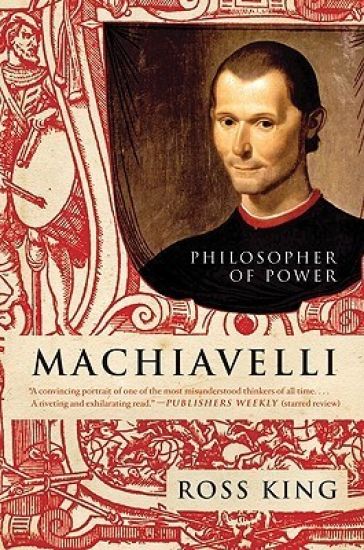
Part of the acclaimed Eminent Lives series, Machiavelli is a superb portrait of the brilliant and revolutionary political philosopher--history's most famous theorist of "warfare, terror, murder, and bloodshed"--and the age he embodied. Ross King, the New York Times bestselling author of Brunelleschi's Dome, argues that the author of The Prince was a far more complex and sympathetic character than is often portrayed.

A cryptic summons to a remote country house launches Isaac Inchbold, a London bookseller and antiquarian, on an odyssey through seventeenth-century Europe. Charged with the task of restoring a magnificent library destroyed by the war, Inchbold moves between Prague and the Tower Bridge in London, his fortunes--and his life--hanging on his ability to recover a missing manuscript. Yet the lost volume is not what it seems, and his search is part of a treacherous game of underworld spies and smugglers, ciphers, and forgeries. Inchbold's adventure is compelling from beginning to end as Ross King vividly recreates the turmoil of Europe in the seventeenth century--the sacks of great cities; Raleigh's final voyage; the quest for occult knowledge; and a watery escape from three mysterious horsemen.A Book Sense 76 pick
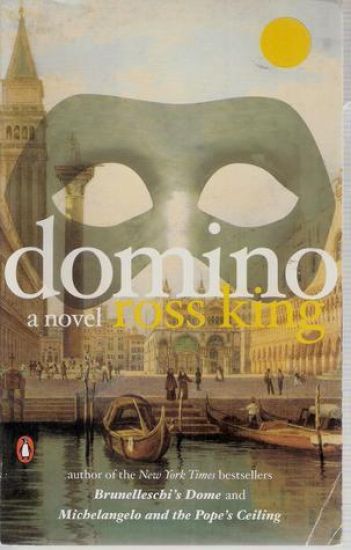
Ross King's delightful, Rabelaisian novel recounts the adventures of young George Cautley, an aspiring artist who, as he makes his way through London's high society, finds that nothing is as it seems and everyone wears a disguise. Moving from masquerade balls in London to the magnificent and mysterious opera houses of Venice, Cautley is drawn into a web of intrigue and murder spun by the seductive and tempestuous Lady Beauclair. Suspenseful, menacing, and laced with black humor, King's picaresque tale is full of surprisesand suspense, told at the pace of a thriller and with the richness of a restored painting.
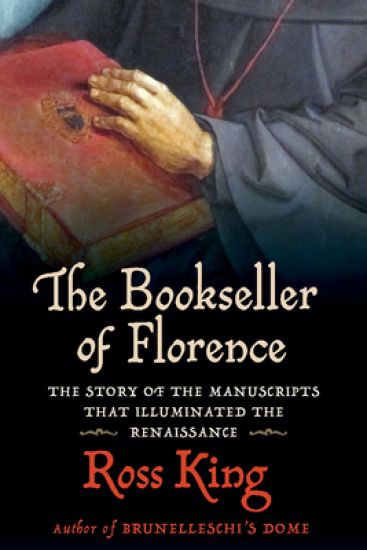
The Renaissance in Florence conjures images of beautiful frescoes and elegant buildings--the dazzling handiwork of the city's skilled artists and architects. But equally important for the centuries to follow were geniuses of a different sort: Florence's manuscript hunters, scribes, scholars, and booksellers, who blew the dust off a thousand years of history and, through the discovery and diffusion of ancient knowledge, imagined a new and enlightened world. At the heart of this activity, which bestselling author Ross King relates in his exhilarating new book, was a remarkable man: Vespasiano da Bisticci. Born in 1422, he became what a friend called "the king of the world's booksellers." At a time when all books were made by hand, over four decades Vespasiano produced and sold many hundreds of volumes from his bookshop, which also became a gathering spot for debate and discussion. Besides repositories of ancient wisdom by the likes of Plato, Aristotle, and Quintilian, his books were works of art in their own right, copied by talented scribes and illuminated by the finest miniaturists. His clients included a roll-call of popes, kings, and princes across Europe who wished to burnish their reputations by founding magnificent libraries. Vespasiano reached the summit of his powers as Europe's most prolific merchant of knowledge when a new invention appeared: the printed book. By 1480, the king of the world's booksellers was swept away by this epic technological disruption, whereby cheaply produced books reached readers who never could have afforded one of Vespasiano's elegant manuscripts. A thrilling chronicle of intellectual ferment set against the dramatic political and religious turmoil of the era, Ross King's brilliant The Bookseller of Florence is also an ode to books and bookmaking that charts the world-changing shift from script to print through the life of an extraordinary man long lost to history--one of the true titans of the Renaissance.
The Renaissance in Florence conjures images of beautiful frescoes and elegant buildings--the dazzling handiwork of the city's skilled artists and architects. But equally important for the centuries to follow were geniuses of a different sort: Florence's manuscript hunters, scribes, scholars, and booksellers, who blew the dust off a thousand years of history and, through the discovery and diffusion of ancient knowledge, imagined a new and enlightened world.At the heart of this activity, which bestselling author Ross King relates in his exhilarating new book, was a remarkable man: Vespasiano da Bisticci. Born in 1422, he became what a friend called "the king of the world's booksellers." At a time when all books were made by hand, over four decades Vespasiano produced and sold many hundreds of volumes from his bookshop, which also became a gathering spot for debate and discussion. Besides repositories of ancient wisdom by the likes of Plato, Aristotle, and Quintilian, his books were works of art in their own right, copied by talented scribes and illuminated by the finest miniaturists. His clients included a roll-call of popes, kings, and princes across Europe who wished to burnish their reputations by founding magnificent libraries.Vespasiano reached the summit of his powers as Europe's most prolific merchant of knowledge when a new invention appeared: the printed book. By 1480, the king of the world's booksellers was swept away by this epic technological disruption, whereby cheaply produced books reached readers who never could have afforded one of Vespasiano's elegant manuscripts.A thrilling chronicle of intellectual ferment set against the dramatic political and religious turmoil of the era, Ross King's brilliant The Bookseller of Florence is also an ode to books and bookmaking that charts the world-changing shift from script to print through the life of an extraordinary man long lost to history--one of the true titans of the Renaissance.
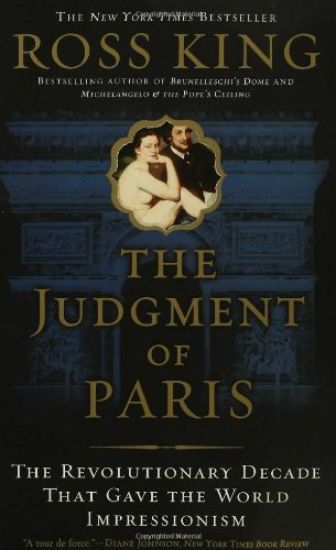
The Judgment of Paris: The Revolutionary Decade That Gave the World Impressionism
Ross King
Bloomsbury USA
2006
nidottu
With a novelist's skill and the insight of an historian, bestselling author Ross King recalls a seminal period when Paris was the artistic center of the world, and the rivalry between Meissonier and Manet. While the Civil War raged in America, another revolution took shape across the Atlantic, in the studios of Paris: The artists who would make Impressionism the most popular art form in history were showing their first paintings amidst scorn and derision from the French artistic establishment. Indeed, no artistic movement has ever been quite so controversial. The drama of its birth, played out on canvas and against the backdrop of the Franco-Prussian War and the Commune, would at times resemble a battlefield; and as Ross King reveals, it would reorder both history and culture, and resonate around the world.
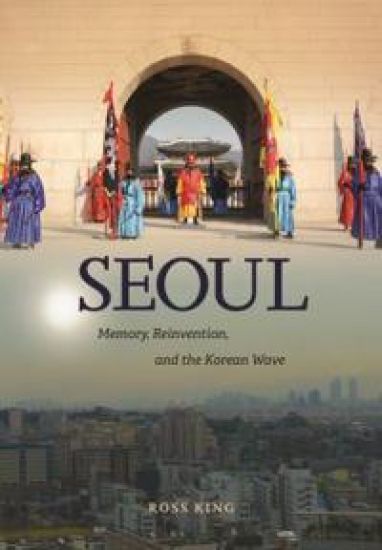
Seoul is a colossus both in its physical presence and the demand it places on any intellectual effort to understand it. How did it come to be? How can a city this immense work? Underlying its spectacle and incongruities is a city that might be described as ill at ease with its own past. The bitter rifts of Japanese colonization persist, as does the troubled aftermath of the Korean War and its divisions; the economic “Miracle on the Han” that followed is crosscut by memories of the violent dictatorship that drove it.In Seoul, author Ross King interrogates this contested history and its physical remnants, tacking between the city’s historiography and architecture, with attention to monuments, streets, and other urban spaces. The book’s structuring device is the dichotomy of erasure and memory as necessary preconditions for reinvention. King traces this phenomenon from the old dynasties to the Japanese regime and wartime destruction; he then follows the equally destructive reinvention of Korea under dictatorship to the brilliant city of the present with its extraordinary explosion of creativity and ideas—the post-1991 Hallyu, the Korean Wave. The final chapter returns to questions of forgetting and memory, but now as “conditions of possibility” for what would seem to underlie the present trajectory of this extraordinary city and culture.Seoul can be read, King suggests, in the context of the hybrid ideas that have characterized Korean cultural history. It may be their present eruption that accounts for the city of contradictions that confronts the contemporary observer and that most extraordinary of Korean phenomena: the rise of an alternative, virtual world, eclipsing both city and nation. Has the very idea of Korea been reinvented even as the weakly defined nation-state slips away?

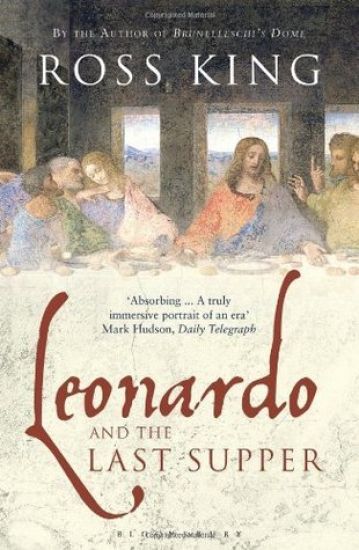
For more than five centuries The Last Supper has been an artistic, religious and cultural icon. The art historian Kenneth Clark called it 'the keystone of European art', and for a century after its creation it was regarded as nothing less than a miraculous image. And yet there is a very human story behind this artistic 'miracle'. Ross King's Leonardo and the Last Supper is both a 'biography' of one of the most famous works of art ever painted and a record of Leonardo da Vinci's last five years in Milan.

Claude Monet’s water lily paintings are among the most iconic and beloved works of art of the past century. Yet these entrancing images were created at a time of terrible private turmoil and sadness for the artist. The dramatic history behind these paintings is little known; Ross King’s Mad Enchantment tells the full story for the first time and, in the process, presents a compelling and original portrait of one of our most popular and cherished artists.By the outbreak of war in 1914, Monet, then in his mid-seventies, was one of the world’s most famous and successful painters, with a large house in the country, a fleet of automobiles and a colossal reputation. However, he had virtually given up painting following the death of his wife Alice in 1911 and the onset of blindness a year later. Nonetheless, it was during this period of sorrow, ill health and creative uncertainty that – as the guns roared on the Western Front – he began the most demanding and innovative paintings he had ever attempted. Encouraged by close friends such as Georges Clemenceau, France’s dauntless prime minister, Monet would work on these magnificent paintings throughout the war years and then for the rest of his life. So obsessed with his monumental task that the village barber was summoned to clip his hair as he worked beside his pond, he covered hundreds of yards of canvas with shimmering layers of pigment. As his ambitions expanded with his paintings, he began planning what he intended to be his legacy to the world: the ‘Musée Claude Monet’ in the Orangerie in Paris.Drawing on letters and memoirs and focusing on this remarkable period in the artist’s life, Mad Enchantment gives an intimate portrayal of Claude Monet in all his tumultuous complexity, and firmly places his water lily paintings among the greatest achievements in the history of art.
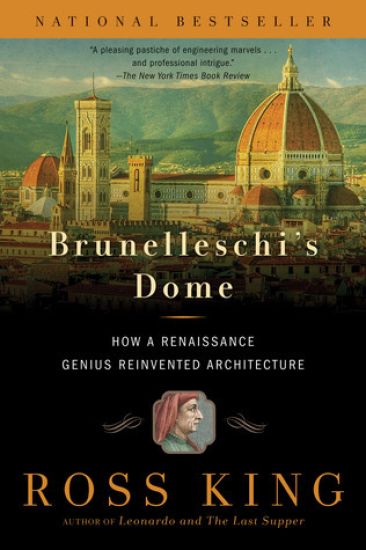
Brunelleschi's Dome: How a Renaissance Genius Reinvented Architecture
Ross King
Bloomsbury USA
2013
nidottu
The New York Times bestselling, award winning story of the construction of the dome of Santa Maria del Fiore in Florence and the Renaissance genius who reinvented architecture to build it. On August 19, 1418, a competition concerning Florence's magnificent new cathedral, Santa Maria del Fiore was announced: "Whoever desires to make any model or design for the vaulting of the main Dome....shall do so before the end of the month of September." The proposed dome was regarded far and wide as all but impossible to build: not only would it be enormous, but its original and sacrosanct design shunned the flying buttresses that supported cathedrals all over Europe. The dome would literally need to be erected over thin air. Of the many plans submitted, one stood out--a daring and unorthodox solution to vaulting what is still the largest dome in the world. It was offered not by a master mason or carpenter, but by a goldsmith and clockmaker named Filippo Brunelleschi, then forty-one, who would dedicate the next twenty-eight years to solving the puzzles of the dome's construction. In the process, he reinvented the field of architecture. Brunelleschi's Dome is the story of how a Renaissance genius bent men, materials, and the very forces of nature to build an architectural wonder we continue to marvel at today. Award-winning, bestselling author Ross King weaves this drama amid a background of the plagues, wars, political feuds, and the intellectual ferments of Renaissance Florence to bring the dome's creation to life in a fifteenth-century chronicle with twenty-first-century resonance.
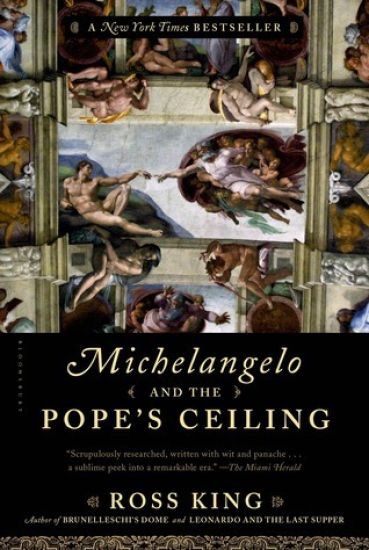
From the acclaimed author of Brunelleschi's Dome and Leonardo and the Last Supper, the riveting story of how Michelangelo, against all odds, created the masterpiece that has ever since adorned the ceiling of the Sistine Chapel. In 1508, despite strong advice to the contrary, the powerful Pope Julius II commissioned Michelangelo Buonarroti to paint the ceiling of the newly restored Sistine Chapel in Rome. Despite having completed his masterful statue David four years earlier, he had little experience as a painter, even less working in the delicate medium of fresco, and none with challenging curved surfaces such as the Sistine ceiling's vaults. The temperamental Michelangelo was himself reluctant: He stormed away from Rome, incurring Julius's wrath, before he was eventually persuaded to begin. Michelangelo and the Pope's Ceiling recounts the fascinating story of the four extraordinary years he spent laboring over the twelve thousand square feet of the vast ceiling, while war and the power politics and personal rivalries that abounded in Rome swirled around him. A panorama of illustrious figures intersected during this time-the brilliant young painter Raphael, with whom Michelangelo formed a rivalry; the fiery preacher Girolamo Savonarola and the great Dutch scholar Desiderius Erasmus; a youthful Martin Luther, who made his only trip to Rome at this time and was disgusted by the corruption all around him. Ross King blends these figures into a magnificent tapestry of day-to-day life on the ingenious Sistine scaffolding and outside in the upheaval of early-sixteenth-century Italy, while also offering uncommon insight into the connection between art and history.
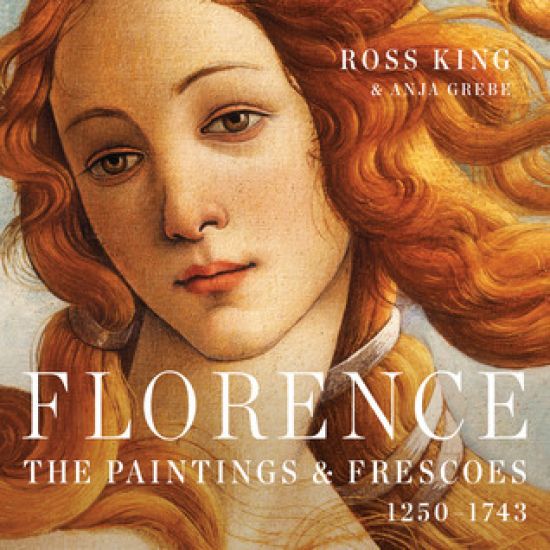
Every painted work that is on display in the Uffizi Gallery, The Pitti Palace, the Accademia, and the Duomo is included in the book, plus many or most of the works from 28 of the city's other magnificent museums and churches. The research and text are by Ross King (best-selling author), Anja Grebe (author or The Louvre and The Vatican), Cristina Acidini (former Superintendent of the public museums of Florence) and Msgr. Timothy Verdon (Director of the artworks for the Archdiocese of Florence).
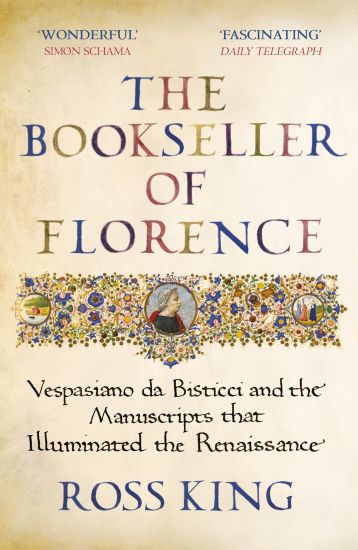
'A marvel of storytelling and a masterclass in the history of the book' WALL STREET JOURNALThe Renaissance in Florence conjures images of beautiful frescoes and elegant buildings - the dazzling handiwork of the city's artists and architects. But equally important were geniuses of another kind: Florence's manuscript hunters, scribes, scholars and booksellers. At a time where all books were made by hand, these people helped imagine a new and enlightened world. At the heart of this activity was a remarkable bookseller: Vespasiano da Bisticci. His books were works of art in their own right, copied by talented scribes and illuminated by the finest miniaturists. With a client list that included popes and royalty, Vespasiano became the 'king of the world's booksellers'. But by 1480 a new invention had appeared: the printed book, and Europe's most prolific merchant of knowledge faced a formidable new challenge.'A spectacular life of the book trade's Renaissance man' JOHN CAREY, SUNDAY TIMES
In 1863, the French painter Ernest Meissonier was one of the most famous artists in the world and the darling of the 'Salon' - that all important public art exhibition held biannually in Paris. Manet, on the other hand, was struggling in obscurity. Beginning with the year that Manet exhibited his ground-breaking Déjeuner Sur L'Herbe and ending in 1974 with the first 'Impressionist' exhibition, Ross King plunges into Parisian life during a ten-year period full of social and political ferment with his usual narrative brillliance.These were the years in which Napoleon III's autocratic and pleasure-seeking Second Empire fell from its heights into the ignominy of the Franco-Prussian war and the ensuing Paris Commune of 1871. But it was also a period in which a group of artists, with Manet in the vanguard began to challenge the establishment by turning to the landscapes and ordinary people they saw around them. The struggle between Meissonier and Manet to get their paintings exhibited in pride of place at the Salon was not just about art, it was about how to see the world.
In 1508, Pope Julius II commissioned Michelangelo to paint the ceiling of the Sistine Chapel. The thirty-three-year-old Michelangelo had very little experience of the physically and technically taxing art of fresco; and, at twelve thousand square feet, the ceiling represented one of the largest such projects ever attempted. Nevertheless, for the next four years he and a hand-picked team of assistants laboured over the vast ceiling, making thousands of drawings and spending back-breaking hours on a scaffold fifty feet above the floor. The result was one of the greatest masterpieces of all time. This fascinating book tells the story of those four extraordinary years and paints a magnificent picture of day-to-day life on the Sistine scaffolding - and outside, in the upheaval of early sixteenth-century Rome.

Monet: The Water-Lily Pond (One Painting, One Story)
Ross King
NATIONAL GALLERY COMPANY LTD
2025
pokkari
In 1893 Claude Monet, a keen gardener, bought a plot of land next to his house in Giverny, where he wanted to create a water garden ‘both for the pleasure of the eye and for the purpose of having subjects to paint’. He filled the pond with water lilies and built a bridge at one end, inspired by examples he had seen in Japanese prints. This water garden became the focus of Monet’s later career and the subject of some 250 paintings. Alongside an overview of the painter’s life, Ross King considers the profound impact of Japanese art on Monet’s working practice, the historical events of the time, the artist’s fascination with painting bridges, and the personal tragedy that led to his ultimate desire to capture and immortalise on canvas a succession of ever-changing moments in his garden.Published by National Gallery Global/Distributed by Yale University Press