Kirjojen hintavertailu. Mukana 11 244 527 kirjaa ja 12 kauppaa.

Kirjahaku

Etsi kirjoja tekijän nimen, kirjan nimen tai ISBN:n perusteella.

1000 tulosta hakusanalla Russell Hardin

David Hume: Moral and Political Theorist

David Hume: Moral and Political Theorist

Russell Hardin

Oxford University Press
2007
sidottu
Russell Hardin presents a new explication of David Hume's moral and political theory. With Hume, he holds that our normative views can be scientifically explained but they cannot be justified as true. Hume argued for the psychological basis of such views. In particular, he argued for sympathy as the mirroring of the psychological sensations and emotions of others. By placing Hume in the developing tradition of social science, as a strong forerunner of his younger friend Adam Smith, Hardin demonstrates Hume's strong strategic sense, his nascent utilitarianism, his powerful theory of convention as a main source of social and political order, and his recognition of moral and political theory as a single enterprise.

Liberalism, Constitutionalism, and Democracy

Liberalism, Constitutionalism, and Democracy

Russell Hardin

Oxford University Press
2003
nidottu
In his ground-breaking book, the leading political philosopher Russell Hardin develops a new theory of liberal constitutional democracy. Arguing against the standard consensus theories, the author shows how social co-ordination on limited, sociological mutual advantage lies at the heart of liberal constitutionalism when it works to produce stable government. The book argues that liberalism, constitutionalism, and democracy are co-ordination theories. They work only in societies in which co-ordination of the important power groups for mutual advantage is feasible. It then goes on to examine and interpret the US constitution as motivated centrally by the concern with creating a government to enable commerce. In addition, the book addresses the nature of the problems that the newly democratic, newly market-oriented states face. The analysis of constitutionalism is based on its workability, not on its intrinsic, normative, or universal appeals. Hardin argues, similarly, there are harsh limits on the possibilities of democracy. In general, democracy works only on the margins of great issues. Indeed, it is inherently a device for regulating marginal political conflicts.
David Hume

David Hume

Russell Hardin

Oxford University Press
2009
nidottu
Russell Hardin presents a new explication of David Hume's moral and political theory. With Hume, he holds that our normative views can be scientifically explained but they cannot be justified as true. Hume argued for the psychological basis of such views. In particular, he argued for sympathy as the mirroring of the psychological sensations and emotions of others. By placing Hume in the developing tradition of social science, as a strong forerunner of his younger friend Adam Smith, Hardin demonstrates Hume's strong strategic sense, his nascent utilitarianism, his powerful theory of convention as a main source of social and political order, and his recognition of moral and political theory as a single enterprise.

Morality within the Limits of Reason

Morality within the Limits of Reason

Russell Hardin

University of Chicago Press
1990
nidottu
This provocative, lucidly written reconstruction of utilitarianism focuses on the practical constraints involved in ethical choice: information may be inadequate, and understanding of causes and effects may be limited. Good decision making may be especially constrained if other people are closely involved in determining an outcome. Hardin demonstrates that many of these structural issues can and should be distinguished from the thornier problems of utilitarian value theory, and he is able to show what kinds of moral conclusions we can reach within the limits of reason.
One for All

One for All

Russell Hardin

Princeton University Press
1997
pokkari
In a book that challenges the most widely held ideas of why individuals engage in collective conflict, Russell Hardin offers a timely, crucial explanation of group action in its most destructive forms. Contrary to those observers who attribute group violence to irrationality, primordial instinct, or complex psychology, Hardin uncovers a systematic exploitation of self-interest in the underpinnings of group identification and collective violence. Using examples from Mafia vendettas to ethnic violence in places such as Bosnia and Rwanda, he describes the social and economic circumstances that set this violence into motion. Hardin explains why hatred alone does not necessarily start wars but how leaders cultivate it to mobilize their people. He also reveals the thinking behind the preemptive strikes that contribute to much of the violence between groups, identifies the dangers of "particularist" communitarianism, and argues for government structures to prevent any ethnic or other group from having too much sway. Exploring conflict between groups such as Serbs and Croats, Hutu and Tutsi, Northern Irish Catholics and Protestants, Hardin vividly illustrates the danger that arises when individual and group interests merge. In these examples, groups of people have been governed by movements that managed to reflect their members' personal interests--mainly by striving for political and economic advances at the expense of other groups and by closing themselves off from society at large. The author concludes that we make a better and safer world if we design our social institutions to facilitate individual efforts to achieve personal goals than if we concentrate on the ethnic political makeup of our respective societies.
Indeterminacy and Society

Indeterminacy and Society

Russell Hardin

Princeton University Press
2005
pokkari
In simple action theory, when people choose between courses of action, they know what the outcome will be. When an individual is making a choice "against nature," such as switching on a light, that assumption may hold true. But in strategic interaction outcomes, indeterminacy is pervasive and often intractable. Whether one is choosing for oneself or making a choice about a policy matter, it is usually possible only to make a guess about the outcome, one based on anticipating what other actors will do. In this book Russell Hardin asserts, in his characteristically clear and uncompromising prose, "Indeterminacy in contexts of strategic interaction ...Is an issue that is constantly swept under the rug because it is often disruptive to pristine social theory. But the theory is fake: the indeterminacy is real." In the course of the book, Hardin thus outlines the various ways in which theorists from Hobbes to Rawls have gone wrong in denying or ignoring indeterminacy, and suggests how social theories would be enhanced--and how certain problems could be resolved effectively or successfully--if they assumed from the beginning that indeterminacy was the normal state of affairs, not the exception. Representing a bold challenge to widely held theoretical assumptions and habits of thought, Indeterminacy and Society will be debated across a range of fields including politics, law, philosophy, economics, and business management.
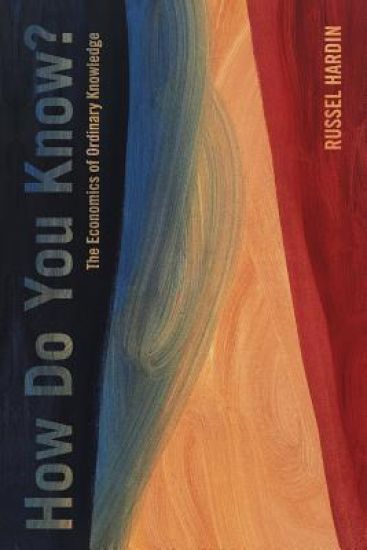
How Do You Know?

How Do You Know?

Russell Hardin

Princeton University Press
2009
sidottu
How do ordinary people come to know or believe what they do? We need an account of this process to help explain why people act as they do. You might think I am acting irrationally--against my interest or my purpose--until you realize that what you know and what I know differ significantly. My actions, given my knowledge, might make eminently good sense. Of course, this pushes our problem back one stage to assess why someone knows or believes what they do. That is the focus of this book. Russell Hardin supposes that people are not usually going to act knowingly against their interests or other purposes. To try to understand how they have come to their knowledge or beliefs is therefore to be charitable in assessing their rationality. Hardin insists on such a charitable stance in the effort to understand others and their sometimes objectively perverse actions. Hardin presents an essentially economic account of what an individual can come to know and then applies this account to many areas of ordinary life: political participation, religious beliefs, popular knowledge of science, liberalism, culture, extremism, moral beliefs, and institutional knowledge. All of these can be enlightened by the supposition that people are attempting reasonable actions under the severe constraints of acquiring better knowledge when they face demands that far outstretch their possibilities.
How Do You Know?

How Do You Know?

Russell Hardin

Princeton University Press
2014
pokkari
How do ordinary people come to know or believe what they do? We need an account of this process to help explain why people act as they do. You might think I am acting irrationally--against my interest or my purpose--until you realize that what you know and what I know differ significantly. My actions, given my knowledge, might make eminently good sense. Of course, this pushes our problem back one stage to assess why someone knows or believes what they do. That is the focus of this book. Russell Hardin supposes that people are not usually going to act knowingly against their interests or other purposes. To try to understand how they have come to their knowledge or beliefs is therefore to be charitable in assessing their rationality. Hardin insists on such a charitable stance in the effort to understand others and their sometimes objectively perverse actions. Hardin presents an essentially economic account of what an individual can come to know and then applies this account to many areas of ordinary life: political participation, religious beliefs, popular knowledge of science, liberalism, culture, extremism, moral beliefs, and institutional knowledge. All of these can be enlightened by the supposition that people are attempting reasonable actions under the severe constraints of acquiring better knowledge when they face demands that far outstretch their possibilities.
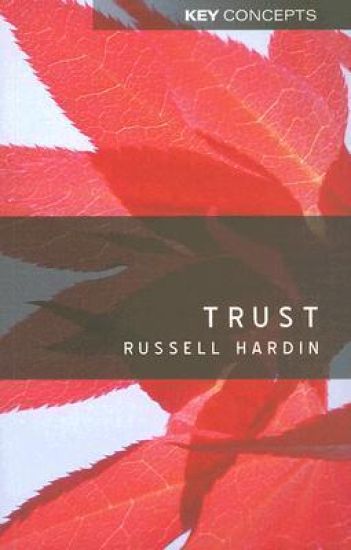
Trust

Trust

Russell Hardin

Polity Press
2006
sidottu
Can we trust our elected representatives or is public life so corrupted that we can no longer rely on governments to protect our interests or even our civil liberties? Is the current mood of public distrust justified or do we need to re-evaluate our understanding of trust in the global age? In this wide-ranging book, Russell Hardin sets out to dispel the myths surrounding the concept of trust in contemporary society and politics. He examines the growing literature on trust to analyze public concerns about declining levels of trust, both in our fellow citizens and in our governments and their officials. Hardin explores the various manifestations of trust and distrust in public life – from terrorism to the internet, social capital to representative democracy. He shows that while today’s politicians may well be experiencing a decline in public confidence, this is nothing new; distrust in government characterized the work of leading liberal thinkers such as David Hume and James Madison. Their views, he contends, are as relevant today as they were in the eighteenth and nineteenth centuries and we should not, therefore, be distressed at the apparent distrust of twenty-first century government. On a personal level, Hardin contends that the world in which we live is much more diverse and interconnected than that of our forebears and this will logically result in higher levels of personal trust and distrust between individuals. Written by one of the world's leading authorities on trust, this book will be a valuable resource for students of government and politics, sociology and philosophy.
Trust

Trust

Russell Hardin

Polity Press
2006
nidottu
Can we trust our elected representatives or is public life so corrupted that we can no longer rely on governments to protect our interests or even our civil liberties? Is the current mood of public distrust justified or do we need to re-evaluate our understanding of trust in the global age? In this wide-ranging book, Russell Hardin sets out to dispel the myths surrounding the concept of trust in contemporary society and politics. He examines the growing literature on trust to analyze public concerns about declining levels of trust, both in our fellow citizens and in our governments and their officials. Hardin explores the various manifestations of trust and distrust in public life – from terrorism to the internet, social capital to representative democracy. He shows that while today’s politicians may well be experiencing a decline in public confidence, this is nothing new; distrust in government characterized the work of leading liberal thinkers such as David Hume and James Madison. Their views, he contends, are as relevant today as they were in the eighteenth and nineteenth centuries and we should not, therefore, be distressed at the apparent distrust of twenty-first century government. On a personal level, Hardin contends that the world in which we live is much more diverse and interconnected than that of our forebears and this will logically result in higher levels of personal trust and distrust between individuals. Written by one of the world's leading authorities on trust, this book will be a valuable resource for students of government and politics, sociology and philosophy.
Collective Action

Collective Action

Russell Hardin

CRC Press
2016
sidottu
Public choice, an important subdiscipline in the field of political theory, seeks to understand how people and societies make decisions affecting their collective lives. Relying heavily on theoretical models of decision making, public choice postulates that people act in their individual interests in making collective decisions. As it happens, however, reality does not mirror theory, and people often act contrary to what the principal public choice models suggest. In this book, Russell Hardin looks beyond the models to find out why people choose to act together in situations that the models find quite hopeless. He uses three constructs of modern political economy--public goods, the Prisoner's Dilemma, and game theory--to test public choice theories against real world examples of collective action. These include movements important in American society in the past few decades--civil rights, the Vietnam War, women's rights, and environmental concerns. This classic work on public choice will be of interest to theoreticians and graduate students in the fields of public choice, political economy, or political theory--and to those in other disciplines who are concerned with the problem of collective action in social contexts.
Cooperation Without Trust?

Cooperation Without Trust?

Karen S Cook; Russell Hardin; Margaret Levi

Russell Sage Foundation
2007
pokkari
Some social theorists claim that trust is necessary for the smooth functioning of a democratic society. Yet many recent surveys suggest that trust is on the wane in the United States. Does this foreshadow trouble for the nation? In Cooperation Without Trust? Karen Cook, Russell Hardin, and Margaret Levi argue that a society can function well in the absence of trust. Though trust is a useful element in many kinds of relationships, they contend that mutually beneficial cooperative relationships can take place without it. Cooperation Without Trust? employs a wide range of examples illustrating how parties use mechanisms other than trust to secure cooperation. Concerns about one's reputation, for example, could keep a person in a small community from breaching agreements. State enforcement of contracts ensures that business partners need not trust one another in order to trade. Similarly, monitoring worker behavior permits an employer to vest great responsibility in an employee without necessarily trusting that person. Cook, Hardin, and Levi discuss other mechanisms for facilitating cooperation absent trust, such as the self-regulation of professional societies, management compensation schemes, and social capital networks. In fact, the authors argue that a lack of trust--or even outright distrust--may in many circumstances be more beneficial in creating cooperation. Lack of trust motivates people to reduce risks and establish institutions that promote cooperation. A stout distrust of government prompted America's founding fathers to establish a system in which leaders are highly accountable to their constituents, and in which checks and balances keep the behavior of government officials in line with the public will. Such institutional mechanisms are generally more dependable in securing cooperation than simple faith in the trustworthiness of others. Cooperation Without Trust? suggests that trust may be a complement to governing institutions, not a substitute for them. Whether or not the decline in trust documented by social surveys actually indicates an erosion of trust in everyday situations, this book argues that society is not in peril. Even if we were a less trusting society, that would not mean we are a less functional one. A Volume in the Russell Sage Foundation Series on Trust
Collective Action

Collective Action

Hardin Russell

Johns Hopkins University Press
1982
nidottu
Public choice, an important subdiscipline in the field of political theory, seeks to understand how people and societies make decisions affecting their collective lives. Relying heavily on theoretical models of decision making, public choice postulates that people act in their individual interests in making collective decisions. As it happens, however, reality does not mirror theory, and people often act contrary to what the principal public choice models suggest. In this book, Russell Hardin looks beyond the models to find out why people choose to act together in situations that the models find quite hopeless. He uses three constructs of modern political economy--public goods, the Prisoner's Dilemma, and game theory--to test public choice theories against real world examples of collective action. These include movements important in American society in the past few decades--civil rights, the Vietnam War, women's rights, and environmental concerns. This classic work on public choice will be of interest to theoreticians and graduate students in the fields of public choice, political economy, or political theory--and to those in other disciplines who are concerned with the problem of collective action in social contexts.
Lift the Ear of the Nautilus

Lift the Ear of the Nautilus

Gillian Harding-Russell

Turnstone Press
2026
nidottu
Elegiac and lyrical, Lift the Ear of a Nautilus marks the bond between two poets. Traced in emails, phone calls and a love of mules, Gillian Harding-Russel honours her friend's memory; a memory filled with a life of treasures in books and broken shells.
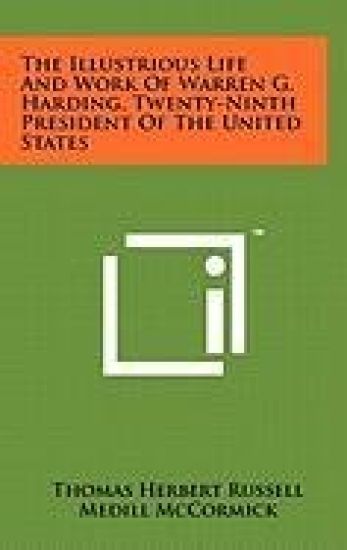
The Illustrious Life and Work of Warren G. Harding, Twenty-Ninth President of the United States

The Illustrious Life and Work of Warren G. Harding, Twenty-Ninth President of the United States

Thomas Herbert Russell; Medill McCormick

Literary Licensing, LLC
2011
sidottu
The Illustrious Life And Work Of Warren G. Harding, Twenty-Ninth President Of The United States is a book written by Thomas Herbert Russell. It is a comprehensive biography of Warren G. Harding, who served as the President of the United States from 1921 to 1923. The book covers Harding's early life, his political career, and his presidency. It also delves into Harding's personal life, including his marriage, affairs, and scandals. The author provides a detailed analysis of Harding's policies and their impact on the country. The book offers a fascinating insight into the life and work of one of America's most controversial presidents. It is an engaging read for anyone interested in American history, politics, and leadership.This scarce antiquarian book is a facsimile reprint of the old original and may contain some imperfections such as library marks and notations. Because we believe this work is culturally important, we have made it available as part of our commitment for protecting, preserving, and promoting the world's literature in affordable, high quality, modern editions, that are true to their original work.
The Court and the Charter

The Court and the Charter

Thomas Bateman; Mark S. Harding; Rainer Knopff; Peter Russell

UNIVERSITY OF TORONTO PRESS
2026
pokkari
Canada’s Constitution cannot be understood without a thorough foundation in the judicial interpretation of its provisions and principles. This collection of leading decisions by the relevant high courts – the Judicial Committee of the Privy Council until 1949 and the Supreme Court of Canada thereafter – provides that grounding. The third edition of this seminal text is updated to include the most salient, enduring, and influential high court decisions to date. It introduces students to trends and nuances in jurisprudence affecting the major dimensions of the Canadian Constitution, including the federal division of powers, the Canadian Charter of Rights and Freedoms, Indigenous rights, and constitutional change. Each of the 58 decisions in this collection features an introductory essay and discussion questions . The book contains a comprehensive essay on the institutional and historical determinants of judicial interpretation of the Constitution and a bibliography for further reading. Readers will acquire an appreciation of both the legal and political influences on judicial interpretation, the complexity of our constitutional structures, and the influences of the personalities and predilections of Canada’s senior jurists. Proceeding from the conviction that history and institutions matter, this collection will give readers a sophisticated understanding of the Constitution, the work of Canada’s courts, and the development of the Canadian liberal democratic regime.