Kirjojen hintavertailu. Mukana 11 699 587 kirjaa ja 12 kauppaa.

Kirjahaku

Etsi kirjoja tekijän nimen, kirjan nimen tai ISBN:n perusteella.

1000 tulosta hakusanalla S. J. Heyworth

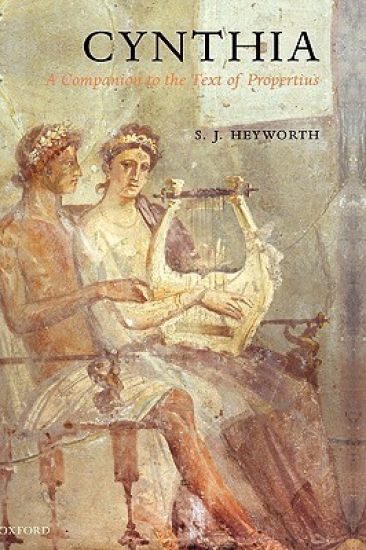
Cynthia

Cynthia

S. J. Heyworth

Oxford University Press
2007
sidottu
Propertius is a poet of the Augustan period, a successor of the great Hellenistic elegiac poets Callimachus and Philitas, and a precursor of Ovid. His account of his fictionalized affair with his beloved alter ego Cynthia is the purest expression of the spirit of love elegy, setting them as a pair against war, epic, and (apparently) Augustus himself. This is an author read by virtually all students of Classical Latin. Cynthia provides a lucid attempt to understand and correct the many difficulties in the transmitted text. It consists of a commentary on the whole corpus, together with a prose translation (including alternative versions of ambiguous phrasing). In its clear exposition of technical problems, the book will serve as an introduction to Latin textual criticism in the modern age, and to elegiac poetic style.
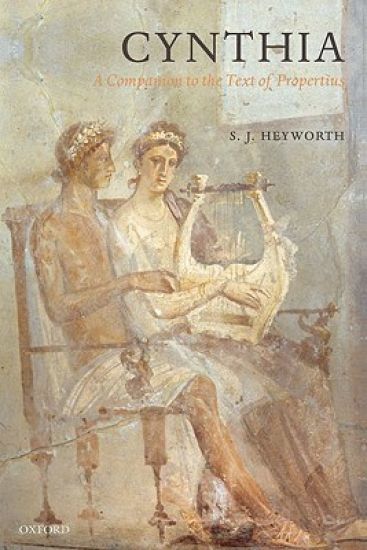
Cynthia

Cynthia

S. J. Heyworth

Oxford University Press
2009
nidottu
Propertius is a poet of the Augustan period, a successor of the great Hellenistic elegiac poets Callimachus and Philitas, and a precursor of Ovid. His account of his fictionalized affair with his beloved alter ego Cynthia is the purest expression of the spirit of love elegy, setting them as a pair against war, epic, and (apparently) Augustus himself. This is an author read by virtually all students of Classical Latin. Cynthia provides a lucid attempt to understand and correct the many difficulties in the transmitted text. It consists of a commentary on the whole corpus, together with a prose translation (including alternative versions of ambiguous phrasing). In its clear exposition of technical problems, the book will serve as an introduction to Latin textual criticism in the modern age, and to elegiac poetic style.
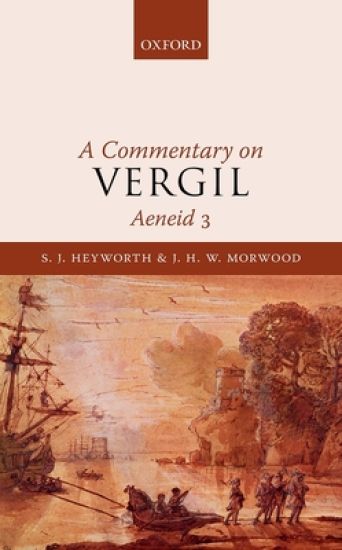
A Commentary on Vergil, Aeneid 3

A Commentary on Vergil, Aeneid 3

S. J. Heyworth; J. H. W. Morwood

Oxford University Press
2017
sidottu
The Aeneid, generally considered the greatest poem of Roman literature, is a story of migration, and Book 3 is at the heart of this story-the arrestingly dramatic account that Aeneas gives to the Carthaginian Queen Dido of his people's journey from the sacked city of Troy. This journey sees them encounter a series of brilliantly characterized individuals and visit some of the most extraordinary places in the central Mediterranean, both real and imaginary: shrines and volcanoes, floating islands and monsters. Yet though it is on one level a thrilling traveller's tale, it is also a profound story of a voyage from a dead past to an uncertain, but ultimately glorious, future in Augustan Rome. This new edition contains an introduction, the Latin text, and a detailed commentary, as well as an extensive Appendix illustrating the rich variety of texts that Vergil used as his models through an ample collection of relevant passages: from the heroic voyages described in the Odyssey and the Argonautica, to tragic explorations of the aftermath of Troy's fall (especially Euripides' Hecuba, Troades, and Andromache) and texts on Delos and Etna. The introduction grounds the book in its historical and literary contexts, while the commentary itself aims to bring out the poet's artistry and learning, keeping the dramatic situation of Aeneas' story-telling in view throughout. Translations of all cited Latin and Greek and regular references to Roman history will provide readers new and old with a clear understanding not only of the original text, but also of the poet's vision of Rome, history, and humanity.
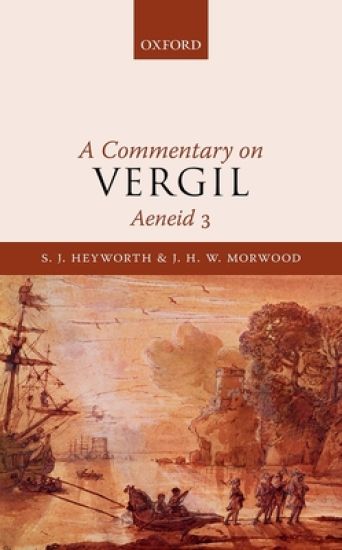
A Commentary on Vergil, Aeneid 3

A Commentary on Vergil, Aeneid 3

S. J. Heyworth; J. H. W. Morwood

Oxford University Press
2017
nidottu
The Aeneid, generally considered the greatest poem of Roman literature, is a story of migration, and Book 3 is at the heart of this story-the arrestingly dramatic account that Aeneas gives to the Carthaginian Queen Dido of his people's journey from the sacked city of Troy. This journey sees them encounter a series of brilliantly characterized individuals and visit some of the most extraordinary places in the central Mediterranean, both real and imaginary: shrines and volcanoes, floating islands and monsters. Yet though it is on one level a thrilling traveller's tale, it is also a profound story of a voyage from a dead past to an uncertain, but ultimately glorious, future in Augustan Rome. This new edition contains an introduction, the Latin text, and a detailed commentary, as well as an extensive Appendix illustrating the rich variety of texts that Vergil used as his models through an ample collection of relevant passages: from the heroic voyages described in the Odyssey and the Argonautica, to tragic explorations of the aftermath of Troy's fall (especially Euripides' Hecuba, Troades, and Andromache) and texts on Delos and Etna. The introduction grounds the book in its historical and literary contexts, while the commentary itself aims to bring out the poet's artistry and learning, keeping the dramatic situation of Aeneas' story-telling in view throughout. Translations of all cited Latin and Greek and regular references to Roman history will provide readers new and old with a clear understanding not only of the original text, but also of the poet's vision of Rome, history, and humanity.
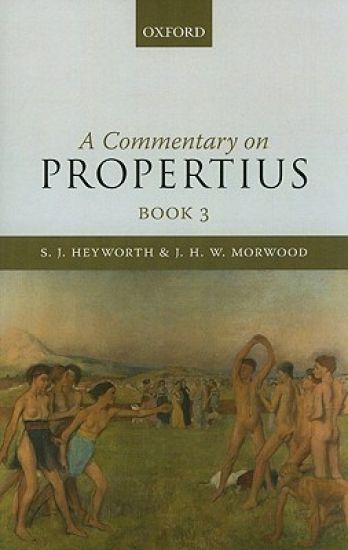
A Commentary on Propertius, Book 3

A Commentary on Propertius, Book 3

S. J. Heyworth; J. H. W. Morwood

Oxford University Press
2010
sidottu
The most passionate, individual, and controversial of the Latin love elegists, Propertius in Book 3 covers a broad range of subject matter and a vast geographical reach. After books focused on his mistress Cynthia, he maintains his elegiac role but expands his range to provide a lover's commentary on life, discussing luxury, nudity, art, the empire, and the dangers of travel for profit and war. This detailed commentary uses the text recently published in the Oxford Classical Texts series, and sets out to build on the richness of the material in the book by providing clear introductions to the genres the poems explore - the Greek elegy of Callimachus, epic, tragedy, hymn and epigram - and to topics such as patronage, philosophy, and the images of love as slavery and as warfare.
A Commentary on Propertius, Book 3

A Commentary on Propertius, Book 3

S. J. Heyworth; J. H. W. Morwood

Oxford University Press
2010
nidottu
The most passionate, individual, and controversial of the Latin love elegists, Propertius in Book 3 covers a broad range of subject matter and a vast geographical reach. After books focused on his mistress Cynthia, he maintains his elegiac role but expands his range to provide a lover's commentary on life, discussing luxury, nudity, art, the empire, and the dangers of travel for profit and war. This detailed commentary uses the text recently published in the Oxford Classical Texts series, and sets out to build on the richness of the material in the book by providing clear introductions to the genres the poems explore - the Greek elegy of Callimachus, epic, tragedy, hymn and epigram - and to topics such as patronage, philosophy, and the images of love as slavery and as warfare.
S. J. Peploe

S. J. Peploe

Alice Strang; Frances Fowle; Elizabeth Cumming

Yale University Press
2012
sidottu
Samuel John Peploe (1871-1935) was the eldest of the four artists popularly known as "The Scottish Colourists." Born in Edinburgh, he was drawn to France and returned to paint there frequently, moving in 1910 to Paris, where he moved in artistic avant-garde circles. His painting style gave way to a more contemporary and expressive approach, and he used rich colors applied with more structured brushstrokes. In 1912 Peploe returned to Edinburgh and slowly began to build a successful career as an exhibiting artist. From around 1914 until his death, he sought to paint the perfect still life. A modest selection of props, including roses or tulips, fans, books, fruits, and Chinese vases, were carefully placed in infinite varieties on patterned drapery. In 1929 he explained: "There is so much in mere objects, flowers, leaves, jugs, what not—colors, forms, relation—I can never see mystery coming to an end." This beautifully illustrated book accompanies a major exhibition devoted to the artist in his home town of Edinburgh, and throws fascinating new light on Peploe's life, on the influence of France on his work, and on his posthumous reputation.Published in association with The National Galleries of ScotlandExhibition Schedule:Scottish National Gallery of Modern Art, Edinburgh(11/03/12-06/23/13)
S. J. Perelman
First published in 1985, this bibliography focuses on the works of S. J. Perelman as a humorist, author, and screenwriter. It is divided into two major sections: "Works by S. J. Perelman" and "Critical Responses". Within each section, there are subdivisions which focus on various areas of S. J. Perelman’s work, including his novel, published plays and film scripts.
S. J. Perelman
First published in 1985, this bibliography focuses on the works of S. J. Perelman as a humorist, author, and screenwriter. It is divided into two major sections: "Works by S. J. Perelman" and "Critical Responses". Within each section, there are subdivisions which focus on various areas of S. J. Perelman’s work, including his novel, published plays and film scripts.
S. J. Perelman
First published in 1992, this book focuses on the oeuvre of S. J. Perelman. Taken together, the essays included serve as an introduction to this important humorist’s work, both in terms of the specific short prose pieces, plays, and films examined and as an overview of his lengthy professional career. They provide insightful and in-depth literary analyses as well. The work encourages a better appreciation for Perelman’s contributions to American literary history.
S. J. Perelman
First published in 1992, this book focuses on the oeuvre of S. J. Perelman. Taken together, the essays included serve as an introduction to this important humorist’s work, both in terms of the specific short prose pieces, plays, and films examined and as an overview of his lengthy professional career. They provide insightful and in-depth literary analyses as well. The work encourages a better appreciation for Perelman’s contributions to American literary history.
S.j. Perelman: Writings (loa #346)

S.j. Perelman: Writings (loa #346)

S. J. Perelman; Adam Gopnik

The Library of America
2021
sidottu
Adam Gopnik presents the very best of S. J. Perelman, America's zaniest humorist. S. J. Perelman (1904-1979) wrote for the Marx Brothers films Horse Feathers and Monkey Business and won an Oscar for his screenwriting on Around the World in Eighty Days, but he remains best known for his many sketches and essays penned for The New Yorker during its golden age of humor. In these short comic pieces--Perelman called them feuilletons--his penchant for wordplay, witticism, spoofery, self-deprecation, and plain zaniness are on full display. The New York Times once noted his ability in these magazine pieces to transform the common clich or figure of speech into an exploding cigar. Author and New Yorker staff writer Adam Gopnik has selected the very best of them, including his parodies of books and films, his biting social satire, autobiographical pieces, and a selection from the celebrated Cloudland Revisited series, in which Perelman reminisces nostalgically about books and movies encountered in youth before describing in his inimitable hyperkinetic style the rude shock of revisiting them as an adult. Also included in this volume are the acclaimed play The Beauty Part (1963) from Perelman's Broadway career; profiles of the Marx Brothers, Dorothy Parker, and his brother-in-law Nathanael West; a selection of letters written to correspondents such as Groucho Marx and Paul Theroux; and a garland of Perelman's witticisms strung together by Adam Gopnik.
CJ's Big Moment A story by C.J. Watson

CJ's Big Moment A story by C.J. Watson

C J Watson

Quiet Storm 32 LLC
2020
pokkari
In book three of the series, CJ is captain of his basketball team and everyone looks up to him, well everyone except the school bully. When one of CJ's teammates keeps getting picked on, it's up to CJ to come up with a solution and be the leader. Will CJ help his friend and stand up to the bully once and for all? Find out in CJ's Big Moment.
Paul's Letter to the Colossians: Commentary by J. Mike Byrd
This is a layman's understanding of what God was communicating through Paul to the church at Colossae, and by extension to the church at large including that of our time. The approach taken is to attempt to let the Word of God speak for itself, letting scripture interpret scripture. That means being intentional about relying upon the Spirit of God to enlighten the understanding, as opposed to dependence upon men. It means challenging presuppositions and previous indoctrination, including more mainstream (whatever that may mean) interpretations. Rather than looking to Commentaries by other men to find out what a passage means, this author looks to other passages of scripture to provide the necessary commentary to explain a passage. This explains the virtual absence of references to other works of men, and the extensive use of scripture quotations. Of course, the reader needs to take the same approach, with dependence upon the Holy Spirit in critically evaluating this author's interpretations and understandings - let God speak
Trump's Second Term: What if President Donald J. Trump Had Won Reelection in 2020
America is in crisis. The country is locked down with a pandemic. The economy is deteriorating. Businesses are going bankrupt. 40 million people are unemployed. The country's health system is in tatters. There are protests and rioting around the country. Relations with China are at an all-time low. It also is a presidential election year. The country is divided. Despite the myriad of problems the country faces, the race is very close. Within this context of America at a turning point, what if Trump had won reelection in 2020. What would happen?From Trump's reelection in 2020 until the time he leaves office, this story of America is played out in graphic detail with some good, some bad, some horrible, and some redemption. It is told through the eyes of both the President's supporters and detractors. During his second term, Trump will aggressively promote his vision and agenda. Some will try anything to stop him, but will they succeed?This is a story of a troubled America and its political leadership. People must follow their consciences or their party. Everything that happens in this book is plausible but not predictable.In Trump's America, no one can sit on the sidelines.
Paul's Letter to the Galatians: Commentary by J. Mike Byrd
This is an in depth verse by verse study of the Paul's letter to the Galatians. It begins with a thorough examination of what is actually written there, including studying the key words in the original Greek. Emphasis is placed on keeping every word and every verse in context, both the immediate context and the broader context of all the rest of scripture. That involves a study of cross-references for every subject addressed, in the interest of letting scripture interpret scripture. It involves a painstaking effort to examine this author's own presuppositions and biases, coming largely from previous indoctrination. It also begins with the assumption (presuppositions) that what is written in the original Greek text is verbally inspired by God, and is supernaturally revealed infallible truth. That means that what we find there must be allowed to speak for itself, taken literally in the most natural sense - the assumption being that God was fully capable of choosing the exact words that best convey what He was trying to communicate, and He did so perfectly. The works of men, including renown and highly respected Theologians and Bible scholars, are examined critically - especially when they resort to very unnatural, often forced interpretations, even changing the literal wording of scripture, or manipulating the meaning of words to conform to their doctrinal presuppositions.However, accurate understanding and appropriate application of these truth articulated therein, does involve the disciplined application of objective rules of interpretation (Hermeneutics), exegesis, and logic. Insights into not only the meaning of some truths articulated in this letter, but also the essential significance of those truth, is facilitated by an understanding of psychology - that based on objective observation of human traits and behavior (not secular theories which abound). Theologians tend to develop interpretations of scripture to fit their templates and models, which reflect their virtual ignorance of the psychological power of some of the supernatural truths revealed in this amazing treatise. Truths which have to be taken by faith that goes beyond our understanding, are often reduced to fit the limited understanding of such men. This is one of the problems with relying on such men, their commentaries and teachings, to determine what God is saying. A very central element in the approach taken in this study is to rely only on the Holy Spirit to guide and enlighten, depending solely on scripture as the source, letting God's Word speak for itself, and letting scripture interpret scripture. The reader needs to take the same approach, with dependence upon the Holy Spirit in critically evaluating this author's interpretations and understandings - let God speak