Kirjojen hintavertailu. Mukana 11 244 527 kirjaa ja 12 kauppaa.

Kirjahaku

Etsi kirjoja tekijän nimen, kirjan nimen tai ISBN:n perusteella.

1000 tulosta hakusanalla S. L. Sidelinger

S. L. Frank

S. L. Frank

D. Philip Boobbyer

Ohio University Press
1995
sidottu
"There are many reasons for writing a biography of Semyon Frank. Quite apart from his philosophy, he lived a remarkable life. Born in Moscow in 1877, he was exiled from Soviet Russia in 1922 and died in London in 1950. The son of a Jewish doctor, he became a revolutionary Social Democrat in his teens and finished his life as a Neoplatonist Christian. One of the Russian revisionist Marxists, he was then involved in the Kadet Party during the 1905 revolution before breaking with active political activity and turning to philosophy. He lived in Petrograd through the First World War until September 1917, after which he went to Saratov, where he experienced the chaos of the Russian Civil War. Living in Germany after his exile, he witnessed the rise of Hitler in Berlin, left for France in a hurry in 1937, and spent part of the war hiding from the Gestapo in the Grenoble mountains. It was a life that encompassed a lot of history. "Yet along with this, Frank was arguably Russia's greatest twentieth-century philosopher. Indeed, V.V. Zen'kovskii, the historian of Russian philosophy, considered Frank 'in strength of philosophic vision … the most outstanding among Russian philosophers generally — not merely among those who share his ideas.' For its lucidity, conciseness, systematic character, and unity, Zen'kovskii considered Frank's system ' the highest achievement … of Russian philosophy.' Doubtless, Zen'kovskii's assessment is disputable, but his remarks emphasize Frank's stature in the Russian tradition. In the style of German idealism, Frank constructed a comprehensive philosophical system, which he believed offered a coherent alternative to materialism. He was deeply worried by the implications of epistemological relativism and constructed a system of metaphysics designed to link epistemology and ontology, to bridge the gulf between thought and being. In addition, he attempted to express the idea of a personal God in philosophical language. His system also embraced social philosophy, anthropology, and ethics." — from the Introduction by the author
S? L?a

S? L?a

Lulu.com
2020
pokkari
"... T i nhớ đ nghe ở đ u c u chuyện cổ t ch n y. Phải rồi, t c giả ch nh l ng bạn gi ch thiết của t i. Th ra người m t i mong đợi kh ng phải l một tr ng sĩ m l ng bạn gi . T i nghĩ đến ng với một tấm l ng th nh k nh. Nếu ở đời n y c một người m tất cả l trong sạch, trong sạch trong y u thương cũng như trong o n cừu, v trong sạch trong cả tội lỗi nữa th người đ phải l ng bạn t i. Mặc cho trần thế ngả nghi ng, mặc cho người đời sốt nổi, ng cứ một lối sống hiền h a như một triết nh n, ung dung đi tr n con đường hoa đ vạch... " (Tr ch NGUYỄN SỸ TẾ, "Đề Từ")
S'Investir Dans Son Travail: Les Enjeux de l'Activité Enseignante
L'activite de l'enseignant mobilise de maniere importante sa personne, son histoire, ses affects. La notion d'investissement subjectif permet de rendre compte de ces aspects, en se focalisant sur les interactions de la subjectivite de l'enseignant avec son environnement de travail et ses activites. Cet ouvrage se fonde sur une etude clinique de seize entretiens d'auto confrontation, lors desquels les enseignants ont commente les traces de leur activite prealablement enregistree sous forme video. Comprendre ce qui est au coeur de cet investissement subjectif est un enjeu important, specialement dans une periode d'intensification et de complexification du metier d'enseignant. Cet ouvrage est destine a un public pluriel: l'enseignant qui souhaite mettre des mots sur son activite; le formateur d'enseignants qui cherche a rejoindre les preoccupations de ceux qu'il forme; les acteurs ayant une fonction de soutien ou d'encadrement dans les ecoles; et finalement le sociologue interesse par les enjeux du travail.
S. L. Rubinštejn and the Philosophical Foundations of Soviet Psychology
This work is intended as an introduction to the study of Soviet psy­ chology. In it we have tried to present the main lines of Soviet psycho­ logical theory, in particular, the philosophical principles on which that theory is founded. There are surprisingly few books in English on Soviet psychology, or, indeed, in any Western European language. The works that exist usually take the form of symposia or are collections of articles translated from Soviet periodicals. The most important of these are Psychology in the Soviet Union (ed. by Brian Simon), Recent Soviet Psychology (ed. by Neil O'Connor) and Soviet Psychology, A Symposium (ed. by Ralf Winn). Raymond Bauer has also edited an interesting symposium entitled Some Views on Soviet Psychology. Only two systematic studies of Soviet psychology have been published to date: Joseph Wortis' Soviet Psychiatry and Raymond Bauer's The New Man in Soviet Psychology. Both are valuable introductions to Soviet psychology; Bauer's book, in particular, gives a good account of the debates on psychological theory in the Soviet Union in the nineteen­ twenties and -thirties. Both, however, are somewhat out of date. There are also a number of interesting articles written by Ivan D. London and Gregory Razran, which give general surveys of particular periods or aspects of Soviet psychology. These have been listed in the bibliography.
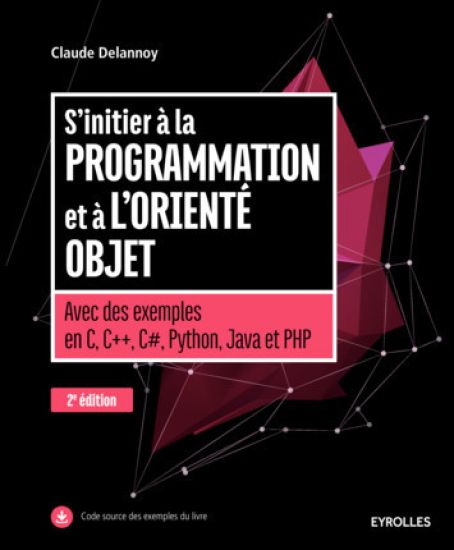
S'initier à la programmation et à l'orienté objet
Acqu rir rapidement une parfaite ma trise des techniques de programmation et savoir s'adapter facilement tout nouveau langageCon u pour les d butants en programmation, cet ouvrage commence par un apprentissage progressif et rigoureux des notions de programmation proc durale communes tous les langages (types de donn es, variables, op rateurs, instructions de contr le, fonctions, tableaux...), avant d'aborder les notions propres aux langages orient s objet.L'auteur utilise, pour faciliter l'assimilation des concepts, un pseudo-code complet mais simple d'acc s, qui vite de se perdre dans les sp cificit s de tel ou tel langage. Chaque notion est d'abord pr sent e l'aide du pseudocode, avant d' tre illustr e d'exemples d'impl mentation en langages C, C++, C#, Java, PHP et, nouveaut de cette 2e dition, en langage Python. De nombreux exercices corrig s permettent au lecteur de contr ler ses connaissances chaque tape de l'apprentissage. qui s'adresse ce livre ?Aux tudiants en 1 re ann e de cursus informatique (BTS, DUT, licences, coles d'ing nieur).Aux autodidactes ou professionnels de tous horizons souhaitant s'initier la programmation.A tous ceux qui ont appris un langage "sur le tas" et ressentent le besoin d'approfondir leurs connaissances pour gagner en efficacit et en qualit et s'adapter plus facilement de nouveaux langages.Aux enseignants et formateurs la recherche d'une m thode p dagogique et d'un support de cours structur pour enseigner la programmation des d butants.Sur le site www.editions-eyrolles.comDialoguez avec l'auteurT l chargez le code source des exemples du livre