Sherwood Anderson's first and most autobiographical novel and the only one set in Illinois, Windy McPherson's Son received uniformly high praise from literary critics when it was first published. It tells the story of an Iowa newsboy who fights his way to fortune in Chicago, then questions the meaning of his success. It was republished in 1922 with a different ending, which appears as an appendix in this edition.
The opening engagement of the battle of Gettysburg was crucial in determining the outcome of the battle three days later. In what is often seen as the Civil War's Waterloo, the early contest for the wooded McPherson's Ridge is considered by many to be the battle's most crucial stage.Da Capo's new "Battleground America" series offers a unique approach to the battles and battlefields of America. Each book in the series highlights a small American battlefield-sometimes a small portion of a much larger battlefield-and tells the story of the brave soldiers who fought there. Using soldiers' memoirs, letters and diaries, as well as contemporary illustrations, the human ordeal of battle comes to life on the page.All of the units, important individuals, and actions of each engagement on the battlefield are described in a clear and concise narrative. Detailed maps complement the text and illustrate small unit action at each stage of the battle. Then-and-now photographs tie the dramatic events of the past to the modern battlefield site and highlight the importance of terrain in battle. The present-day historical site of the battle is described in detail with suggestions for touring.
Windy McPherson’s Son (1916) is a novel by Sherwood Anderson. Both fictional and autobiographical, Anderson’s debut novel is a coming of age story that explores themes of unhappiness and infidelity while illustrating the frustrations of the son of an abusive father. Although he is known today for his story collection Winesburg, Ohio, a pioneering work of Modernist fiction admired for its plainspoken language and psychological detail, Anderson’s Windy McPherson’s Son is a powerful work of fiction that helped establish him as a leading realist writer of his generation. “At the beginning of the long twilight of a summer evening, Sam McPherson, a tall big-boned boy of thirteen, with brown hair, black eyes, and an amusing little habit of tilting his chin in the air as he walked, came upon the platform of the little corn-shipping town of Caxton in Iowa.” With a cigar in his hand and a bundle of newspapers under his arm, the young Sam McPherson appears both overly proud and ambitious for his age. Those that know him, however, understand that he has no choice. Left to fend for himself by an alcoholic father, Sam dreams of making a name for himself and escaping the small town of his birth. When an ill-fated affair with an older teacher leaves him disgraced, McPherson abandons his father for Chicago, where he finds work as a purchaser of farming equipment. Soon, he falls in love with his boss’ daughter, the beautiful Sue Rainey. Windy McPherson’s Son is a story of the American Dream, for all of its difficult truths and convenient fictions. With a beautifully designed cover and professionally typeset manuscript, this edition of Sherwood Anderson’s Windy McPherson’s Son is a classic of American literature reimagined for modern readers.
Windy McPherson’s Son (1916) is a novel by Sherwood Anderson. Both fictional and autobiographical, Anderson’s debut novel is a coming of age story that explores themes of unhappiness and infidelity while illustrating the frustrations of the son of an abusive father. Although he is known today for his story collection Winesburg, Ohio, a pioneering work of Modernist fiction admired for its plainspoken language and psychological detail, Anderson’s Windy McPherson’s Son is a powerful work of fiction that helped establish him as a leading realist writer of his generation. “At the beginning of the long twilight of a summer evening, Sam McPherson, a tall big-boned boy of thirteen, with brown hair, black eyes, and an amusing little habit of tilting his chin in the air as he walked, came upon the platform of the little corn-shipping town of Caxton in Iowa.” With a cigar in his hand and a bundle of newspapers under his arm, the young Sam McPherson appears both overly proud and ambitious for his age. Those that know him, however, understand that he has no choice. Left to fend for himself by an alcoholic father, Sam dreams of making a name for himself and escaping the small town of his birth. When an ill-fated affair with an older teacher leaves him disgraced, McPherson abandons his father for Chicago, where he finds work as a purchaser of farming equipment. Soon, he falls in love with his boss’ daughter, the beautiful Sue Rainey. Windy McPherson’s Son is a story of the American Dream, for all of its difficult truths and convenient fictions. With a beautifully designed cover and professionally typeset manuscript, this edition of Sherwood Anderson’s Windy McPherson’s Son is a classic of American literature reimagined for modern readers.
It's hard to imagine any great author producing stories that do not contain autobiographical material, and surely Sherwood Anderson is no exception, if anything he proves the rule. So much of the content in Windy McPherson's Son is drawn from personal experience. Biographers have made great strides in digging up Sherwood Anderson's past and showing how his life and personal struggles unfold through the characters in his works. His writing is not only highly original and creative but therapeutic and cathartic. Sherwood had this obsession to create and explore his own psyche as he described the world about him. He would lock himself away in a small, sparsely furnished room and write away, working to get at the truth as he struggled to understand it. Once he had a vision of it, he refused to be a propagandist and espouse political or economic opinions, though as a writer he could not ignore the effects of politics, business, and industry on American life, in particular on small town middle America and middle class life. Upton Sinclair, after reading Windy McPherson's Son, wrote Sherwood a letter aiming "to make a socialist out of him." Anderson replied that he did not wish to see writers as propagandists, taking a socialist or conservative position, or any political position for that matter. Their role was to stay in life not in politics. They could not take sides, else they would only be dealing in half truths. He explains in his letter to Sinclair: "I want them to be something of a brother to the poor brute who runs the sweatshop as well as to the equally unfortunate brutes who work for him." For Anderson getting at the truth demanded avoiding stereotypes and setting forth doctrine. He wished to depict real people facing the real difficulties of their times and leave it to the reader to judge. This meant living among the people and breathing in life as they did while examining and understanding his own mood before attempting to imagine theirs. Understanding Anderson requires understanding his less apparent feelings towards the events and characters in his novels, and this can be aided by, I believe, familiarity with key events in his own life that most likely contributed to forming his various perspectives. Which brings me to the point of why I have decided to edit and add biographical footnotes to the present edition of Windy McPherson's Son. First, by editing this edition, I am intending to provide a more readable text. The edition that I'm working from contains many formatting errors, silly typos, or slips of the pen, and misspellings, which I have tried to remedy. The numerous punctuation infelicities, which I felt hesitant to address, remain. I feel that they do not get in the way of the reading. Secondly, I believe that adding biographical footnotes may help us understand and appreciate the impact that Sherwood Anderson's life might have had on his writing, while opening a small door that could shed a splinter of light on what his personal feelings might have been towards the events he depicts and the characters he fashions. The aforementioned being said, certainly, Sherwood Anderson would want us to give much more attention to his work than to his life if we wish to take from his writing any real thing of lasting literary value. However, information about his life could very well offer us a richer understanding of his personal feelings towards his subjects, the changing times he lived through, and significant personal events that inspired his writing. And for those who do not wish to read full biographies about the author, the biographical footnotes are a pleasant and helpful way of getting to know a little more about this remarkable man's life.
Windy McPherson's Son is a 1916 novel by American author Sherwood Anderson. It was published by John Lane as part of a three book contract. Windy McPherson's Son is Sherwood Anderson's first novel. In September 1907, the Anderson family (at that time just Sherwood, his wife Cornelia and son Robert) moved from Cleveland to Elyria, Ohio, where Anderson became head of the Anderson Manufacturing Company (name changed to American Merchants Company after 1911). As part of the family's new home, Anderson set aside an attic where he would escape the stresses of business and family life. It was during one winter between 1907 and 1912 that both this room and his office (where Frances Shute, his secretary, would sometimes stay late typing drafts of his first two novels) served as the settings in which Windy McPherson's Sons was composed. Though it is likely that most of his first novel was composed in Elyria, there is some evidence pointing to possible edits made between those early years and the novel's publication in 1916. Obvious parallels can be drawn between the plot of Anderson's own life and that of his first novel. The beginning section of the novel is inspired by his youth, the second "...combined the ways he had tried to make money in Chicago and Ohio..." and the marriage between Sam and Sue resembles the one between Sherwood and Cornelia. The characters of Mary Underwood and Janet Eberly were likely inspired by Trillena White, a high school teacher that befriended Anderson while he attended the Wittenberg Academy in Springfield, Ohio between 1899 and June 4, 1900, and stayed for a time with the Andersons in Elyria. In addition to the personal connections between Windy McPherson's Son and the author's life made by biographers and critics, the influence of other writers is also seen in the book. Anderson himself said of his early writing that he had, "come to novel writing by novel reading." In particular, William Dean Howells (whose writing Anderson disliked), Arnold Bennett, Thomas Hardy, Henry Fuller, Frank Norris, Theodore Dreiser, and George Borrow, are all mentioned by Anderson biographer Kim Townsend as authors Anderson would have been reading and discussing at the time he wrote Windy McPherson's Son. In his 1951 biography of Anderson, Irving Howe disagrees with Townsend and even Anderson's own statement, arguing that other than the "early social novels of H.G. Wells and the radical-adventure stories of Jack London...Anderson's early novels were all too much his own, reflecting in their style the natural inclination of a poorly educated writer to strain for the literary and lapse into the colloquial."
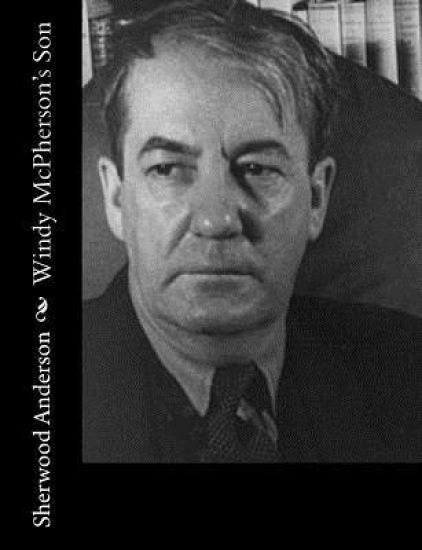
"Nothing quite like it has ever been done in America. . . . It is so vivid, so full of insight, so shiningly life-like and glowing, that the book is lifted into a category all its own," wrote H.L. Mencken, speaking of Anderson's "Winesburg, Ohio." Anderson, he said, is "America's Most Distinctive Novelist." "Windy McPherson's Son," Anderson's 1916 first novel, concerns a boy's life in Iowa. Like all of Anderson's tales, it's an important social commentary, and not to be overlooked....... Sherwood Anderson (September 13, 1876 - March 8, 1941) was an American novelist and short story writer, known for subjective and self-revealing works. Self-educated, he rose to become a successful copywriter and business owner in Cleveland and Elyria, Ohio. In 1912, Anderson had a nervous breakdown that led him to abandon his business and family to become a writer. At the time, he moved to Chicago and was eventually married three more times. His most enduring work is the short-story sequence Winesburg, Ohio, which launched his career. Throughout the 1920s, Anderson published several short story collections, novels, memoirs, books of essays, and a book of poetry. Though his books sold reasonably well, Dark Laughter (1925), a novel inspired by Anderson's time in New Orleans during the 1920s, was the only bestseller of his career. Early life Sherwood Berton Anderson was born on September 13, 1876 in Camden, Ohio, a farming town with a population of around 650 (according to the 1870 census). He was the third of seven children born to Emma Jane (n e Smith) and former Union soldier and harness-maker Irwin McLain Anderson. Considered reasonably well-off financially-Anderson's father was seen as an up-and-comer by his Camden contemporaries, the family left town just before Sherwood's first birthday. Reasons for the departure are uncertain; most biographers note rumors of debts incurred by either Irwin or his brother Benjamin. The Andersons headed north to Caledonia by way of a brief stay in a village of a few hundred called Independence (now Butler). Four or five years were spent in Caledonia, years which formed Anderson's earliest memories. This period later inspired his semi-autobiographical novel Tar: A Midwest Childhood (1926). In Caledonia Anderson's father began drinking excessively, which led to financial difficulties, eventually causing the family to leave the town. With each move, Irwin Anderson's prospects dimmed; while in Camden he was the proprietor of a successful shop and could employ an assistant; by the time the Andersons finally settled down in Clyde, Ohio in 1884, a frontier town, Irwin could only get work as a hired man to harness manufacturers. That job was short-lived, and for the rest of Sherwood Anderson's childhood, his father barely supported the family as an occasional sign-painter and paperhanger, while his mother took in washing to make ends meet. Partly as a result of these misfortunes, young Sherwood became adept at finding various odd jobs to help his family, earning the nickname "Jobby." Though he was a decent student, Anderson's attendance at school declined as he began picking up work, and he finally left school for good at age 14 after about nine months of high school. From the time he began to cut school to the time he left town, Anderson worked as a "...newsboy, errand boy, waterboy, cow-driver, stable groom, and perhaps printer's devil, not to mention assistant to Irwin Anderson, Sign Painter..." in addition to assembling bicycles for the Elmore Manufacturing Company. Even in his teens, Anderson's talent for selling was evident, a talent he would later draw on it in a successful career in advertising. As a newsboy he was said to have convinced a tired farmer in a saloon to buy two copies of the same evening paper. With the exception of work, Anderson's childhood resembled that of other boys his age....