Kirjojen hintavertailu. Mukana 11 342 296 kirjaa ja 12 kauppaa.

Kirjahaku

Etsi kirjoja tekijän nimen, kirjan nimen tai ISBN:n perusteella.

222 tulosta hakusanalla Sadi Kose

When Shaykh Albani Disagrees With Himself

When Shaykh Albani Disagrees With Himself

Sadi Kose

Independently Published
2017
nidottu
About This BookletIt is known among those who read Shaykh Albani's books in Arabic that he contradicts himself when grading hadith. He may grade a hadith weak in one of his books but then we will find the same exact hadith declared authentic in yet another one.Here is an example: 'Uthman (ra) reported: I heard the Messenger of Allah (pbuh) saying: "Spending a day on the frontier in Allah's way is better than one thousand days in any other place."-In his Al-Mishkah, Shaykh Albani said, "It is narrated with a chain containing an unknown (majhool) narrator (i.e., it is weak)."-In his Saheeh Sunan al-Nasaai, he declared it authentic (saheeh).-In his Daeef al-Jaami' he graded it weak (daeef).Some of the learned followers of the Shaykh already know this. Once, one of them was reminded that he claimed Shaykh Albani declared a particular hadith authentic. He was then asked if he was sure if indeed that was the case; here's what he said: "Well, I have looked it up in Saheeh al-Jaami' and Shaykh Albani (may Allah have mercy on his soul) graded it as hasan (fair). I don't know if he graded it as weak elsewhere." If this is the behaviour of some of his learned followers, what are the ordinary people to do when Shaykh Alabni disagrees with himself?In this booklet over 200 examples are given which illustrate how the Shaykh contradicted himself. God willing, more examples will be added in subsequent editions of this bookle
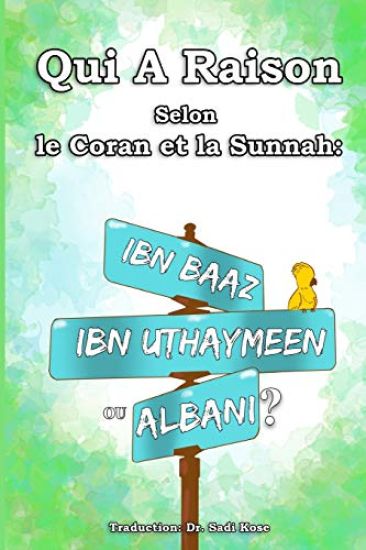
Qui A Raison Selon le Coran et la Sunnah: Ibn Baaz, Ibn Uthaymeen ou Albani?
A propos du livreLes adversaires des quatre madhabs, aussi connus sous le nom de Salafis, voudraient nous faire croire que les diff rences entre les madhabs n'existeraient pas si les madhabs avaient tous suivi le Coran et la Sunnah. En cela est une insinuation que les madhabs ne suivent pas forc ment hadith authentique. C'est pourquoi quand les Salafis voient un hadith dans Bukhari, Muslim, ou l'un des livres de Cheikh Albani qui contredit une pratique dans un madhab, ils arrivent la conclusion que les madhabs doivent se tromper parce qu'ils ont laiss de c t le hadith sahih et ont suivi l'opinion (ra'y) de leur imam, analogie juridique (qiyaas), ou une faible (daeef) narration. Afin de d montrer que ce n'est rien d'autre qu'une illusion, je pr sente les r ponses traduites 100 questions qui ont t pos es aux trois savants salafistes les plus populaires: Al-Cheikh Ibn Baaz, Al-Cheikh Ibn Uthaymeen et Al-Cheikh Al- Albaani. Je doute que n'importe quel salafiste supposerait que tous les trois suivent le Coran et la Sunnah incorrectement. N anmoins, ils parviennent des conclusions contradictoires. Voici un exemple: Question 45: Est-ce qu'on soul ve l'index pendant la s ance entre deux prosternations?R ponse: Ibn Baaz: La Sunnah n'est pas de lever l'index pendant la s ance entre les deux prosternations.Ibn Uthaymeen: Relever l'index est Sunnah pendant la s ance entre les deux prostration juste comme dans tashahhud.Albani: Relever l'index dans n'importe quelle s ance autre que le tashahhud est l'innovation (bid'ah).Nous avons trois r ponses diff rentes pour une question. Qui a raison selon le Coran et la Sunna?
Bid'ah According to the Four Madhhabs

Bid'ah According to the Four Madhhabs

Sadi Kose

Independently Published
2017
nidottu
About The Booklet: The concept of bid'ah has become a means by which the Muslim nation has become divided. There are some who call anything, which did not exist during the time of the Prophet (pbuh), bid'ah and label those who adopt some of those practices as people of innovation (bid'ah) or misguidance (dalaalah). The question that must be asked is: "How have the Muslims been dealing with newly introduced matters starting from the time of the Companions until recent times?" In order to provide an encompassing answer to this question, I gathered the views of the four schools of thought in this booklet (Hanbali, Shafii, Maliki and Hanafi madhhabs). From each Madhab, I include statements of some of the famous scholars regarding the meaning and classification of bid'ah (innovation). Henceforth, I include the magnificent research concerning bid'ah of one of the greatest scholars of 19th century: Al-Imaam Abu Al-Hasaanat Muhammed Abdulhayy Al-Laknawi Al-Hindi. In his research he demonstrated how the first three blessed generations responded to the newly innovated matters which cropped up during their time. He concludes his research by providing advice on how we should deal with bid'ah in our own time. I believe his advice contains therein a cure for the disease of corrupting the term bid'ah, perhaps inadvertently, to divide the Muslim community.
Isis: A Byproduct of Salafism?

Isis: A Byproduct of Salafism?

Sadi Kose

Independently Published
2017
nidottu
Whether we like it or not, the savage terrorist group ISIS and its sisters, such as Al-Qaeda, associate themselves with Islam. The heinous acts of terrorism that they perpetrate are supposedly done in the name of Islam. We can sit down and claim all day long that the savagery, bloodshed, injustice, wrongdoing and all other inhumane acts they commit not only have nothing to do with Islam but are also condemned in Islam yet the fact remains is that the youth who are the lifeline of these organizations are mostly the children of Muslims. If we want to put an end to losing our children to these terrorist organizations, we must be honest with ourselves and ask the question: Where have we gone wrong? What ideology among Muslims is responsible for resulting in a generation that is so violent, careless, mindless and savage? It turns out that two of the renowned Saudi Scholars have already responded to this question and I wanted to share their answers with the English speaking reader. It is refreshing to see that the Saudi Scholars are openly talking about this; for the realization of the problem can be half of the solution.
Do Salafis Really Follow the Daleel?

Do Salafis Really Follow the Daleel?

Sadi Kose

Independently Published
2018
nidottu
Second Edition: Oftentimes we, the madhab followers, are confronted by those who describe themselves as Salafis, for not following daleel (evidence) but instead following a madhab. I have come across some who cannot even read a verse of the Qur'an without making serious mistakes, yet they claim to be able to interpret and follow the daleel. One wonders how can someone in such a state follow and interpret daleel? Through a series of exchanges and observations, I found them to be nothing more than blind imitators of the contemporary Salafi teachers. These very teachers claim to understand, interpret, and follow the daleel all while promoting anti-madhabism. At length, I came to realize that when a young man of utmost ignorance claims to follow the deleel instead of imitating an Imaam of a madhab, he is in fact insinuating that his Salafi teacher follows the daleel but the Imaams of the four madhabs don't. Thus, I wanted to find out to what extent the learned Salafis or the Salafi teachers themselves follow the daleel (evidence). What is meant by "following the daleel" is that a qualified scholar gathers, on a given subject, all the proofs and then derives a ruling following the thorough analysis of the complete body of evidence (daleel). This involves sifting through a quarter of a million hadith spread across more than three hundred hadith books as well as hundreds of volumes of books of each madhab. One of the prominent Salafi teachers by the name of Shaykh Albani put it as follows: "I examine the positions of the Imams and their evidences for them, and then take the closest of them to the evidence of the Qur'an and Sunna"Thus, if we find a learned Salafi giving fatwas without knowing the positions or the evidences of the Imams, he is betraying this principle. I selected five examples from learned Salafis, including the owner of the above quotation, to demonstrate to the reader that in fact Salafi teachers do not adhere to their own principle. If they stopped at that, we would have said that is their choice. But they go on declaring some of the practices of the madhabs as INVALID or CONTRARY to the sunna without having looked at the evidences used by the madhabs. So, if the Salafis themselves do not strictly follow the daleel, then why do they call the madhab followers to their way under the slogan of "Follow the Daleel from Qur'an and Sunna "? I will attempt to answer this question at the end of the booklet God willing.May Allah make this little effort a means by which the truth can be understood. All praise is due to Allah and may His peace and blessings be upon our master Muhammed, upon his family, his companions and upon those who follow in his footsteps until the day of judgment. Ameen
Ruba'iyat of Sadi

Ruba'iyat of Sadi

Sadi

Createspace Independent Publishing Platform
2012
nidottu
RUBA'IYAT OF SADI Translation, Introduction & Notes by Paul Smith Here for the first time in beautiful, poetic English are eighty-eight of the immortal Sadi's wonderful short poems or ruba'is in the correct rhyme-structure and with all of the meanings. Some are deeply mystical, others romantic, satirical and humourous and others intelligently critical of the selfishness of the time... of all time. As fresh today as they were when they were composed some 800 years ago. Included is an Introduction containing The Life of Sadi, his Poetry and his influence on the East and the West and a history of the form of the ruba'i and examples by its greatest exponents. The correct rhyme-structure has been kept as well as the beauty and meaning of these beautiful, and mostly mystical poems. 153 pages.COMMENTS ON PAUL SMITH'S TRANSLATION OF HAFIZ'S 'DIVAN'."It is not a joke... the English version of ALL the ghazals of Hafiz is a great feat and of paramount importance. I am astonished. If he comes to Iran I will kiss the fingertips that wrote such a masterpiece inspired by the Creator of all." Dr. Mir Mohammad Taghavi (Dr. of Literature) Tehran."Superb translations. 99% Hafiz 1% Paul Smith." Ali Akbar Shapurzman, translator of many mystical works in English into Persian and knower of Hafiz's Divan off by heart."I was very impressed with the beauty of these books." Dr. R.K. Barz. Faculty of Asian Studies, Australian National University."Smith has probably put together the greatest collection of literary facts and history concerning Hafiz." Daniel Ladinsky (Penguin Books author). Paul Smith is a poet, author and translator of over 80 books of Sufi poets from the Persian, Arabic, Urdu, Turkish, Pashtu and other languages... including Hafiz, Sadi, Nizami, Rumi, 'Attar, Sana'i, Jahan Khatun, Obeyd Zakani, Nesimi, Kabir, Anvari, Ansari, Jami, Khayyam, Rudaki, Yunus Emre, Rahman Baba, Baba Farid, Lalla Ded and many others, as well as poetry, fiction, plays, biographies, children's books and screenplays. amazon.com/author/smithpa Published bt New Humanity Books
Sadi

Sadi

Createspace Independent Publishing Platform
2013
pokkari
*SADI* A Daybook Translation & Introduction by Paul Smith Sadi of Shiraz, along with Hafiz, Nizami & Rumi is considered one of the great mystical and romantic poets of Persia. His masterpieces, The Rose Garden and The Bustan (Orchard) have been a major influence in the East and West for the past 700 years. His Divan of ghazals are still much loved. His ruba'is have also been an influence on the poets that followed him. Here is a Daybook with a selection of 366 poems from his ghazals, ruba'is and masnavis. Introduction includes his Life and Times and Poetry. There is also a Selected Bibliography. The correct rhyme-structure has been kept as well as the beauty and meaning of these beautiful, inspirational and spiritual poems. A Daybook to remember each day. 394 pages. COMMENTS ON PAUL SMITH'S TRANSLATION OF HAFIZ'S 'DIVAN'."It is not a joke... the English version of ALL the ghazals of Hafiz is a great feat and of paramount importance. I am astonished. If he comes to Iran I will kiss the fingertips that wrote such a masterpiece inspired by the Creator of all." Dr. Mir Mohammad Taghavi (Dr. of Literature) Tehran. "Superb translations. 99% Hafiz 1% Paul Smith." Ali Akbar Shapurzman, translator of many mystical works in English into Persian and knower of Hafiz's Divan off by heart. "Smith has probably put together the greatest collection of literary facts and history concerning Hafiz." Daniel Ladinsky (Penguin Books author). Paul Smith is a poet, author and translator of many books of Sufi poets of the Persian, Arabic, Urdu, Turkish, Pashtu and other languages including Hafiz, Sadi, Nizami, Rumi, 'Attar, Sana'i, Jahan Khatun, Obeyd Zakani, Nesimi, Kabir, Anvari, Ansari, Jami, Khayyam, Rudaki, Yunus Emre, Mu'in, Amir Khusrau, Lalla Ded, Mahsati and many others, as well as poetry, fiction, plays, children's books, biographies and a dozen screenplays. amazon.com/author/smithpa
Sadi

Sadi

Paul Smith

Createspace Independent Publishing Platform
2014
pokkari
SADI: LIFE & POEMS Translation & Introduction by Paul Smith Sadi of Shiraz (13th century), along with Hafiz, Nizami & Rumi is considered one of the great Sufi and romantic poets of Iran. His masterpieces, The Rose Garden and The Bustan (Orchard) have been a major influence in the East and West for the past 700 years. His Divan of ghazals are still much loved by his countrymen. His ruba'is have also been an influence on the poets that followed him. Here is a selection of his ghazals, ruba'is and masnavis. Introduction includes his Life and Times and Poetry. There is also a Selected Bibliography. The correct rhyme-structure has been kept in this modern translation, as well as the beauty and meaning of these spiritual poems. 90 pages. Introduction to Sufi Poets Series Life & Poems of the following Sufi poets, Translations & Introductions: Paul Smith AMIR KHUSRAU, ANSARI, ANVARI, AL-MA'ARRI, 'ATTAR, ABU SA'ID, AUHAD UD-DIN, BABA FARID, BABA AZFAL, BABA TAHIR, BEDIL, BULLEH SHAH, DARA SHIKOH, GHALIB, HAFIZ, IBN 'ARABI, IBN YAMIN, IBN AL-FARID, IQBAL, 'IRAQI, JAHAN KHATUN, JAMI, KAMAL AD-DIN, KABIR, KHAQANI, KHAYYAM, LALLA DED, MAKHFI, MANSUR HALLAJ, MU'IN UD-DIN CHISHTI, NAZIR AKBARABADI, NESIMI, NIZAMI, OBEYD ZAKANI, RAHMAN BABA, RUMI, SANA'I, SADI, SARMAD, SHABISTARI, SHAH LATIF, SHAH NI'MAT'ULLAH, SULTAN BAHU, YUNUS EMRE, EARLY ARABIC SUFI POETS, EARLY PERSIAN SUFI POETS, URDU SUFI POETS, TURKISH SUFI POETS, AFGHAN SUFI POETS 90 pages each. Paul Smith is a poet, author and translator of over 150 books of Sufi poets of the Persian, Arabic, Urdu, Turkish, Pashtu and other languages including Hafiz, Sadi, Nizami, Rumi, 'Attar, Sana'i, Jahan Khatun, Obeyd Zakani, Nesimi, Kabir, Anvari, Ansari, Jami, Khayyam, Rudaki, Yunus Emre, Mu'in, Amir Khusrau, Lalla Ded, Mahsati and many others, as well as poetry, fiction, plays, children's books, biographies and a dozen screenplays. New Humanity Books amazon.com/author/smithpa
Sadi's Pand-Nama or Book of Wisdom

Sadi's Pand-Nama or Book of Wisdom

Sadi

Createspace Independent Publishing Platform
2017
nidottu
SADI'S PAND-NAMA or BOOK OF WISDOM Translation & Introduction Paul Smith Sadi of Shiraz (1210-1291), a contemporary of Rumi who influenced him, was another Perfect Master Poet who expressed himself in the ruba'i form as well as hundreds of ghazals in his beautiful Divan that often also contained images from dervish dancing. Sadi was a great traveller who spent forty years on the road throughout the Middle-East, North Africa and India and many of the incidents he experienced he wrote down in his two most famous works when he finally returned to his beloved birth-place... The Rose Garden (Gulistan) and The Orchard (Bustan). Sadi's mystical love poetry, his ghazals, although almost unknown in the West, are loved by his fellow-countrymen almost as much as those of Hafiz whom he greatly influenced. Sadi composed in rhyming couplets or masnavi form a faqmous Pand-Nama or 'Book of Wisdom' in the style of 'Attar who was the first to do so. "Concise and elegant the work is most popular throughout the length and breadth of the Persian-speaking East. This may indeed well be the case, inasmuch as, in addition to beauty of diction, it is written in a metre which flows in easy cadence, and fixes the words of the poem on the mind. Hence the lines are committed to memory to an extent not surpassed by any work in the Persian language." Arthur N. Wollaston. Here is the first translation in over a hundred years and in the correct rhyme-form for the first time. Introduction: Life & Times & Poetry of Sadi; Selected Bibliography; Appendix: Pand-Nama of 'Attar with selections. Large Format Paperback "7 x 10" 214 pages.COMMENTS ON PAUL SMITH'S TRANSLATION OF HAFIZ'S 'DIVAN'."It is not a joke... the English version of all the ghazals of Hafiz is a great feat and of paramount importance. I am astonished." Dr. Mir Mohammad Taghavi (Dr. of Literature) Tehran."Superb translations. 99% Hafiz 1% Paul Smith." Ali Akbar Shapurzman, translator of many works in English into Persian and knower of Hafiz's Divan off by heart."Smith has probably put together the greatest collection of literary facts and history concerning Hafiz." Daniel Ladinsky (Penguin Books author). Paul Smith (b. 1945) is a poet, author and translator of many books of Sufi poets of the Persian, Arabic, Urdu, Turkish, Pashtu and other languages... including Hafiz, Sadi, Nizami, Rumi, 'Attar, Sana'i, Jahan Khatun, Obeyd Zakani, Mu'in, Amir Khusrau, Nesimi, Kabir, Anvari, Ansari, Jami, Omar Khayyam, Rudaki, Yunus Emre, Baba Farid, Shah Latif, Mu'in, Lalla Ded, 'Iraqi, Ghalib, Nazir, Bulleh Shah, Ibn 'Arabi, Ibn Farid, Rab'ia, Majnun, Mansur Hallaj, many others, as well as his own poetry, fiction, plays, biographies, children's books and a dozen screenplays. amazon.com/author/smithpa Published by New Humanity Books
Ghazals of Sadi

Ghazals of Sadi

Sadi

Createspace Independent Publishing Platform
2017
nidottu
GHAZALS of SADI Translation & Introduction Paul Smith Sadi (Saadi or Sa'di) of Shiraz (1210-1291), a contemporary of Rumi who influenced him, was a Sufi Perfect Master (Qutub) Poet who expressed himself in the ruba'i form as well as hundreds of ghazals in his beautiful Divan that often also contained images from dervish dancing. Sadi was a great traveller who spent forty years on the road throughout the Middle-East, North Africa and India and many of the incidents he experienced he wrote down in his two most famous works when he finally returned to his beloved birth-place... The Rose Garden (Gulistan) and The Orchard (Bustan). Sadi's mystical love poetry, his ghazals, although almost unknown in the West, are loved by his fellow-countrymen almost as much as those of Hafiz whom he greatly influenced. Here for the first time in English they can be read in all their beauty and power and spirit. The correct rhyme-structure has been kept as well as the beauty and meaning of these unique mystical poems. All of the wonderful 603 ghazals from Sadi's Badayi and Tayyibat have been translated in clear, modern, meaningful English. Introduction: Life & Times & Poetry of Sadi of Shiraz and his influence on the East and the West and on the form and meaning of the ghazal. a Sufi Glossary and a large Selected Bibliography. Large Format Paperback "7 x 10" 517 pages. COMMENTS ON PAUL SMITH'S TRANSLATION OF HAFIZ'S 'DIVAN'."It is not a joke... the English version of all the ghazals of Hafiz is a great feat and of paramount importance. I am astonished." Dr. Mir Mohammad Taghavi (Dr. of Literature) Tehran."Superb translations. 99% Hafiz 1% Paul Smith." Ali Akbar Shapurzman, translator of many works in English into Persian and knower of Hafiz's Divan off by heart."Smith has probably put together the greatest collection of literary facts and history concerning Hafiz." Daniel Ladinsky (Penguin Books author). 'Perfect Translation." Amir, Amazon.com Paul Smith (b.1945) is a poet, author and translator of many books of Sufi poets from the Persian, Arabic, Urdu, Turkish, Pashtu and other languages... including Hafiz, Sadi, Nizami, Rumi, 'Attar, Sana'i, Jahan Khatun, Obeyd Zakani, Mu'in, Amir Khusrau, Nesimi, Kabir, Anvari, Ansari, Jami, Omar Khayyam, Rudaki, Yunus Emre, Baba Farid, Shah Latif, Mu'in, Lalla Ded, 'Iraqi, Ghalib, Nazir, Bulleh Shah, Ibn 'Arabi, Ibn Farid, Rab'ia, Majnun, Mansur Hallaj, Rahman Baba, Iqbal, Ghalib and many others as well as his own poetry, fiction, plays, biographies, children's books and a dozen screenplays. amazon.com/author/smithpa
A Year with Sadi

A Year with Sadi

Sadi

Createspace Independent Publishing Platform
2018
nidottu
A YEAR WITH SADI Translation & Introduction by Paul Smith Sadi of Shiraz, along with Hafiz, Nizami & Rumi is considered one of the great mystical and romantic poets of Persia. His masterpieces, The Rose Garden and The Bustan (Orchard) have been a major influence in the East and West for the past 700 years. His Divan of ghazals are still much loved. His ruba'is have also been an influence on the poets that followed him. Here is a selection of 366 poems from his ghazals, ruba'is and masnavis. Introduction includes his Life and Times and Poetry. There is also a Selected Bibliography. The correct rhyme-structure has been kept as well as the beauty and meaning of these wise, inspirational and spiritual poems. 393 pages. Thoreau: "I can find no difference between Sadi and myself... He is not Persian, he is not ancient, he is not strange to me... If Sadi were to come back to claim a personal identity with the historical Sadi, he would find there were too many of us..." Emerson: "Sadi, though he has not the lyric flights of Hafiz, has wit, practical sense, and just moral sentiments. He is the poet of friend¬ship, love, self-devotion, and serenity." COMMENTS ON PAUL SMITH'S TRANSLATION OF HAFIZ'S 'DIVAN'. "It is not a joke... the English version of ALL the ghazals of Hafiz is a great feat and of paramount importance. I am astonished." Dr. Mir Mohammad Taghavi (Dr. of Literature) Tehran. "Superb translations. 99% Hafiz 1% Paul Smith." Ali Akbar Shapurzman, translator of many mystical works in English into Persian and knower of Hafiz's Divan off by heart. "Smith has probably put together the greatest collection of literary facts and history concerning Hafiz." Daniel Ladinsky (Penguin Books author). Paul Smith (b.1945) is a poet, author and translator of many books of Sufi poets of the Persian, Arabic, Urdu, Turkish, Pashtu and other languages including Hafiz, Sadi, Nizami, Rumi, 'Attar, Sana'i, Jahan Khatun, Obeyd Zakani, Nesimi, Kabir, Anvari, Ansari, Jami, Khayyam, Rudaki, Yunus Emre, Mu'in, Amir Khusrau, Lalla Ded, Mahsati and many others, as well as poetry, fiction, plays, children's books, biographies and a dozen screenplays. www.newhumanitybooks.com