Kirjojen hintavertailu. Mukana 11 717 486 kirjaa ja 12 kauppaa.

Kirjahaku

Etsi kirjoja tekijän nimen, kirjan nimen tai ISBN:n perusteella.

399 tulosta hakusanalla Saladin Ambar

Malcolm X at Oxford Union

Malcolm X at Oxford Union

Saladin Ambar

Oxford University Press Inc
2016
nidottu
In 1964, Malcolm X was invited to debate at the Oxford Union Society at Oxford University. The topic of debate that evening was the infamous phrase from Barry Goldwater's 1964 Republican Convention speech: "Extremism in the defense of liberty is no vice; moderation in the pursuit of justice is no virtue." His response to this topic stands out as one of the great addresses of the civil rights era. In Malcolm X at Oxford Union, Saladin Ambar offers the first in-depth analysis of this important speech, illuminating its context and consequences. Delivered just months before Malcolm's assassination, the speech followed a period in which Malcolm had traveled throughout Africa and much of the Muslim world, advocating on behalf of blacks in America and other nations. The journey broadened his political thought to encompass decolonization and the revolutions underway in the developing world. His travels culminated in a revolutionary speech that tackled a staggering array of issues: the nature of national identity; US foreign policy in the developing world; racial politics at home; the experiences of black immigrants in England; and the nature of power in the contemporary world. The speech represented the most advanced stage of his thought, proffering a global and humanist approach to ushering in social change. Malcolm X at Oxford Union reshapes our understanding not only of the man himself, but world politics both then and now.
American Cicero

American Cicero

Saladin Ambar

Oxford University Press Inc
2017
sidottu
Mario Cuomo is in many respects one of the most significant liberal politicians in the postwar era: a three-term governor of one the nation's largest states and an eloquent defender of the Democratic Party's progressive legacy during a period of conservative ascendancy. Yet in other respects he never lived up to his supporters' hopes. His gubernatorial record was spotty, and when he had the chance to seek the presidency, he equivocated, Hamlet-like, before deciding against it and crushing the hopes of the party's progressive wing. His mixed record has made it very difficult for scholars and biographers to clarify his legacy. Was he a symbol of liberalism's long decline in twentieth-century American politics, or was he a prophet in the wilderness, heralding the rise of a new progressivism? Saladin Ambar's American Cicero weaves elements of biography, political history, and political theory into a novel interpretation of Cuomo's life and legacy. Tracing his life from the streets of an immigrant neighborhood in Queens to his final years in Albany, Ambar argues that Cuomo kept the spent embers of liberalism alive in an era when it seemed that conservatism was approaching full-spectrum dominance-even within the Democratic Party itself. In a series of important speeches over the course of the 1980s, Cuomo drew upon his singular oratorical powers to offer a progressive vision that revived and expanded upon the policymaking legacy of the New Deal and Great Society. At a time when pessimism about presidential electoral prospects reigned in the Democratic Party, his voice-buttressed by a string of electoral victories in New York-provided succor to the liberal faithful. Unsurprisingly, party professionals saw him as the next great Democratic presidential candidate. Yet when he had the chance to run-in 1988 and 1992-he decided not to. His political career ended in 1994, when he was voted out of office in New York in a nationwide Republican wave. To explain puzzling Cuomo's career trajectory, American Cicero begins with his background in New York City politics before shifting to his record as governor and his forays into presidential politics. Ambar traveled to Italy in search of answers to lingering questions about Cuomo, chiefly why he never ran for president. Conversations in Cuomo's ancestral land revealed concerns about an assassination attempt--his mother admonished him, "remember what happened to the last Catholic president"--and even proto-"birther" rumors that Cuomo had been born in Italy. Whatever clenched his decision not to run, Cuomo was nevertheless the nation's most articulate advocate for a progressive agenda at liberalism's ebb tide. His vision has had a measurable impact on twenty-first century Democratic progressives, most notably Barack Obama. American Cicero promises to not only re-establish Cuomo's central place in modern American liberalism, but also force readers to reassess liberalism's fortunes following the close of the New Deal era.
Stars and Shadows

Stars and Shadows

Saladin Ambar

OXFORD UNIVERSITY PRESS INC
2022
sidottu
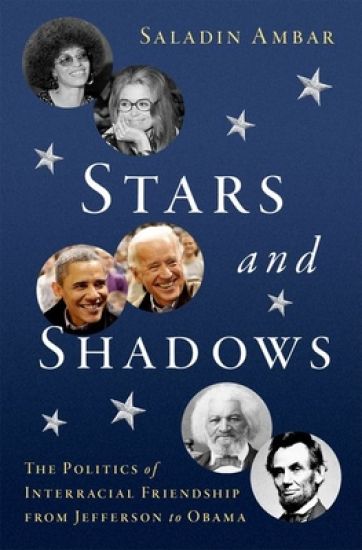
A sweeping look into interracial friendship's significance in American democracy from the founding to the present. The oppression of Blacks is America's original sin-a sin that took root in 1619 and plagues the country to this day. Yet there have been instances of interracial bonding and friendship even in the worst of times. In Stars and Shadows - a term taken from Huckleberry Finn - Saladin Ambar analyzes two centuries of noteworthy interracial friendships that served as windows into the state of race relations in the US and, more often than not, as models for advancing the cause of racial equality. Stars and Shadows is the first work in American political history to offer a comprehensive overview of how friendship has come to shape the possibilities for democratic politics in America. Covering ten cases - from Benjamin Banneker and Thomas Jefferson's ill-fated effort to navigate the limits imposed on democracy by slavery and white supremacy, to the more hopeful stories of James Baldwin and Marlon Brando as well as Angela Davis and Gloria Steinem - Ambar's study illuminates how friendship is critical to understanding the potential for multiracial democracy. Political leaders and cultural figures are frequently involved in translating private feelings, relationships, and ideas, into a public ideal. Friendships and their meaning are therefore a significant part of any effort to shape public or elite opinion. The symbolism inherent in interracial friendship has always been readily apparent, down to the powerful example of Barack Obama and Joe Biden, who were not only allied politicians, but most importantly, friends. Ambar weaves a set of interlocking stories that help create a working theory of multiracial democracy that demands more of us as citizens: a commitment to engage one another and to engage our past with even greater courage and trust. Such gestures are a vital part of the story of how race and America have been shaped. Stars and Shadows helps explain America's enduring difficulty in making friends of citizens across the color line - and why the narrative of racial friendship matters.
Malcolm X at Oxford Union

Malcolm X at Oxford Union

Saladin Ambar

Oxford University Press Inc
2014
sidottu
In 1964 Malcolm X was invited to debate at the Oxford Union Society at Oxford University. The topic of debate that evening was the infamous phrase from Barry Goldwater's 1964 Republican Convention speech:"Extremism in the defense of liberty is no vice; moderation in the pursuit of justice is no virtue." At a time when Malcolm was traveling widely and advocating on behalf of blacks in America and other nations, his thirty minute speech at the Oxford Union stands out as one of the great addresses of the civil rights era. Delivered just months before his assassination, the speech followed a period in which Malcolm had traveled throughout Africa and much of the Muslim world. The journey broadened his political thought to encompass decolonization, the revolutions underway in the developing world, and the relationship between American blacks and non-white populations across the globe-including England. Facing off against debaters in one of world's most elite institutions, he delivered a revolutionary message that tackled a staggering array of issues: the nature of national identity; US foreign policy in the developing world; racial politics at home; the experiences of black immigrants in England; and the nature of power in the contemporary world. It represents a moment when his thought had advanced to its furthest point, shedding the parochial concerns of previous years for an increasingly global and humanist approach to ushering in social change. Set to publish near the fiftieth anniversary of his death, Malcolm X at Oxford Union will reshape our understanding not only of the man himself, but world politics both then and now.
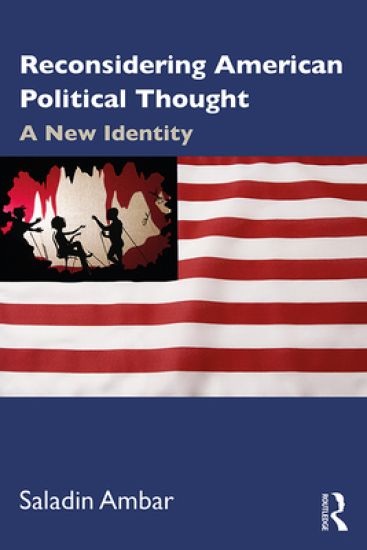
Reconsidering American Political Thought
Filling in the missing spaces left by traditional textbooks on American political thought, Reconsidering American Political Thought uses race, gender, and ethnicity as a lens through which to engage ongoing debates on American values and intellectual traditions. Weaving document-based texts analysis with short excerpts from classics in American literature, this book presents a re-examination of the political and intellectual debates of consequence throughout American history.Purposely beginning the story in 1619, Saladin Ambar reassesses the religious, political, and social histories of the colonial period in American history. Thereafter, Ambar moves through the story of America, with each chapter focusing on a different era in American history up to the present day. Ambar threads together analysis of periods including Thomas Jefferson’s aspiration to create an "Empire of Liberty," the ethnic, racial, and gender-based discourse instrumental in creating a "Yankee" industrial state between 1877 and 1932, and the intellectual, cultural, and social forces that led to the political rise of Ronald Reagan and Barack Obama in recent decades. In closing, Ambar assesses the prospects for a new, more invigorated political thought and discourse to reshape and redirect national energies and identity in the Trump presidency.Reconsidering American Political Thought presents a broad and subjective view about critical arguments in American political thought, giving future generations of students and lecturers alike an inclusive understanding of how to teach, research, study, and think about American political thought.
Reconsidering American Political Thought
Filling in the missing spaces left by traditional textbooks on American political thought, Reconsidering American Political Thought uses race, gender, and ethnicity as a lens through which to engage ongoing debates on American values and intellectual traditions. Weaving document-based texts analysis with short excerpts from classics in American literature, this book presents a re-examination of the political and intellectual debates of consequence throughout American history.Purposely beginning the story in 1619, Saladin Ambar reassesses the religious, political, and social histories of the colonial period in American history. Thereafter, Ambar moves through the story of America, with each chapter focusing on a different era in American history up to the present day. Ambar threads together analysis of periods including Thomas Jefferson’s aspiration to create an "Empire of Liberty," the ethnic, racial, and gender-based discourse instrumental in creating a "Yankee" industrial state between 1877 and 1932, and the intellectual, cultural, and social forces that led to the political rise of Ronald Reagan and Barack Obama in recent decades. In closing, Ambar assesses the prospects for a new, more invigorated political thought and discourse to reshape and redirect national energies and identity in the Trump presidency.Reconsidering American Political Thought presents a broad and subjective view about critical arguments in American political thought, giving future generations of students and lecturers alike an inclusive understanding of how to teach, research, study, and think about American political thought.
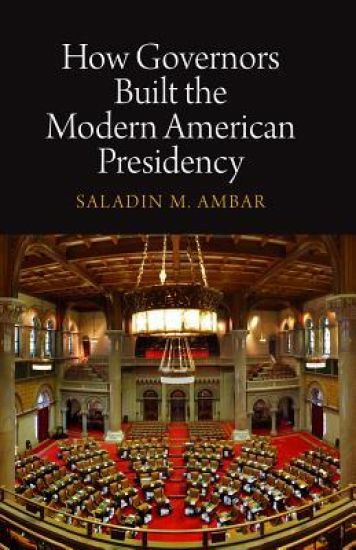
How Governors Built the Modern American Presidency

How Governors Built the Modern American Presidency

Saladin M. Ambar

University of Pennsylvania Press
2012
sidottu
A governor's mansion is often the last stop for politicians who plan to move into the White House. Before Barack Obama was elected president of the United States, four of his last five predecessors had been governors. Executive experience at the state level informs individual presidencies, and, as Saladin M. Ambar argues, the actions of governors-turned-presidents changed the nature of the presidency itself long ago. How Governors Built the Modern American Presidency is the first book to explicitly credit governors with making the presidency what it is today. By examining the governorships of such presidential stalwarts as Grover Cleveland, Theodore Roosevelt, Woodrow Wilson, and Franklin D. Roosevelt, political scientist Ambar shows how gubernatorial experience made the difference in establishing modern presidential practice. The book also delves into the careers of Wisconsin's Bob La Follette and California's Hiram Johnson, demonstrating how these governors reshaped the presidency through their activism. As Ambar reminds readers, governors as far back as Samuel J. Tilden of New York, who ran against Rutherford Hayes in the controversial presidential election of 1876, paved the way for a more assertive national leadership. Ambar explodes the idea that the modern presidency began after 1945, instead placing its origins squarely in the Progressive Era. This innovative study uncovers neglected aspects of the evolution of the nation's executive branch, placing American governors at the heart of what the presidency has become-for better or for worse.
Saladin

Saladin

Malcolm Cameron Lyons; D. E. P. Jackson

Cambridge University Press
1984
pokkari
Saladin is one of the best known figures of the Middle Ages, and this study makes use of hitherto neglected Arabic sources, including unpublished manuscript material - -notably the correspondence, both private and official, of Saladin’s own court -to set the whole of Saladin’s career and achievements, civil and military, within the specific framework of his age.
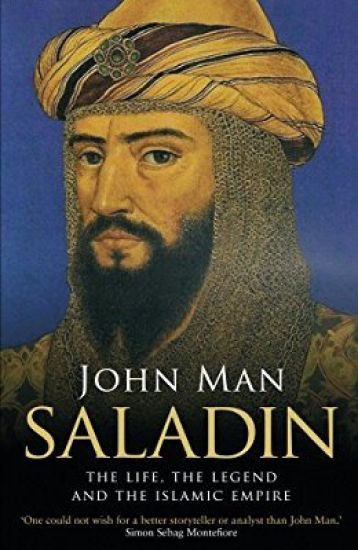
Saladin

Saladin

John Man

Transworld Publishers Ltd
2016
pokkari
Charting his rise to power, his struggle to unify the warring factions of his faith, and his battles to retake Jerusalem and expel Christian influence from Arab lands, Saladin explores the life and the enduring legacy of this champion of Islam, and examines his significance for the world today.
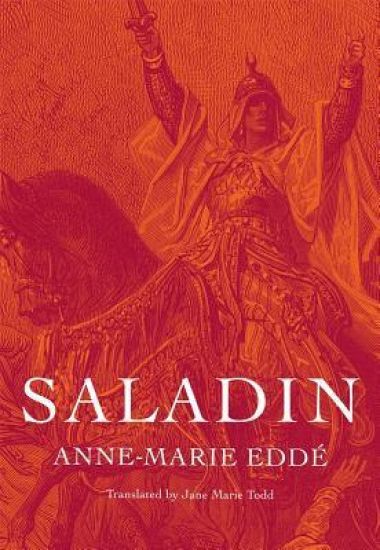
Saladin

Saladin

Anne-Marie Eddé

The Belknap Press
2014
nidottu
Working simultaneously on two levels, Saladin represents the best kind of biography—a portrait of a man who is said to have made an age, and the most complete account we have to date of an age that made the man. Unlike biographies that focus on Saladin’s military exploits, especially the recapturing of Jerusalem from European Crusaders in 1187, Eddé’s narrative draws on an incredible array of contemporary sources to develop the fullest picture possible of a ruler shaped profoundly by the complex Arabian political environment in which he rose to prominence. The result is a unique view of the Crusades from an Arab perspective.Saladin became a legend in his own time, venerated by friend and foe alike as a paragon of justice, chivalry, and generosity. Arab politicians ever since have sought to claim his mantle as a justification for their own exercise of power. But Saladin's world-historical status as the ideal Muslim ruler owes its longevity to a tacit agreement among contemporaries and later chroniclers about the set of virtues Saladin possessed—virtues that can now be tested against a rich tapestry of historical research. This tension between the mythical image of Saladin, layered over centuries and deployed in service of specific moral and political objectives, and the verifiable facts of his life available to a judicious modern historian is what sustains Anne-Marie Eddé's erudite biography, published to acclaim in France in 2008 and offered here in smooth, readable English translation.
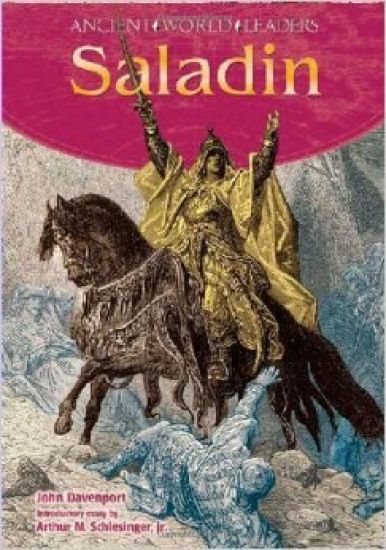
Saladin

Saladin

John Davenport

Chelsea House Publishers
2003
sidottu
Examines the life of the very powerful and influential Muslim sultan, Saladin, who led his people in an attempt to regain holy lands in and around Jerusalem that had been lost during earlier Crusades.
Saladin

Saladin

Hannes Möhring

Johns Hopkins University Press
2008
sidottu
Known in the West as a "noble heathen," the great Muslim sultan Saladin led Muslim forces in the reconquest of the Crusader kingdoms and captured Jerusalem in 1187. This concise history traces Saladin's role in the contest between Islam and Christianity during the twelfth century. Following the Sultan's life from the rise of the Crusader states through his triumph over the Franks to the Third Crusade, Mohring elucidates the sultan's accomplishments in uniting much of the Middle East, his enlightened relationship with European opponents, and the unique legacy of his rule in the Middle East and beyond. This faithful English-language translation also includes an introduction that places Saladinin his geographic, political, and cultural context.
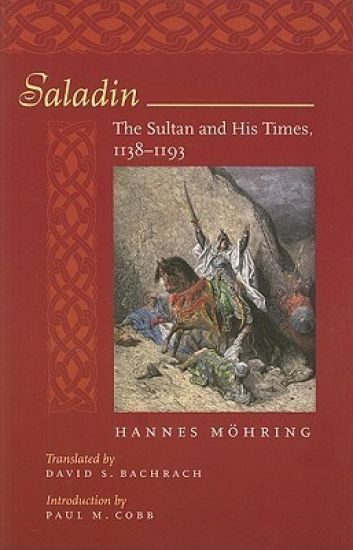
Saladin

Saladin

Hannes Möhring

Johns Hopkins University Press
2008
pokkari
Known in the West as a "noble heathen," the great Muslim sultan Saladin led Muslim forces in the reconquest of the Crusader kingdoms and captured Jerusalem in 1187. This concise history traces Saladin's role in the contest between Islam and Christianity during the twelfth century. Following the Sultan's life from the rise of the Crusader states through his triumph over the Franks to the Third Crusade, Mohring elucidates the sultan's accomplishments in uniting much of the Middle East, his enlightened relationship with European opponents, and the unique legacy of his rule in the Middle East and beyond. This faithful English-language translation also includes an introduction that places Saladinin his geographic, political, and cultural context.
Saladin

Saladin

Peter Gubser

Gorgias Press
2010
sidottu
Saladin, the great twelfth century Middle East leader, not only created an empire, but also reduced the Crusader presence in the Holy Land. In a comprehensive manner and clear prose, Peter Gubser describes how Saladin rose to power, conquered lands, governed peoples, and raised armies. In addition, he clearly addresses Saladin’s imperial motives, a combination of ambition and devotion to the ideal of unity in Islam.
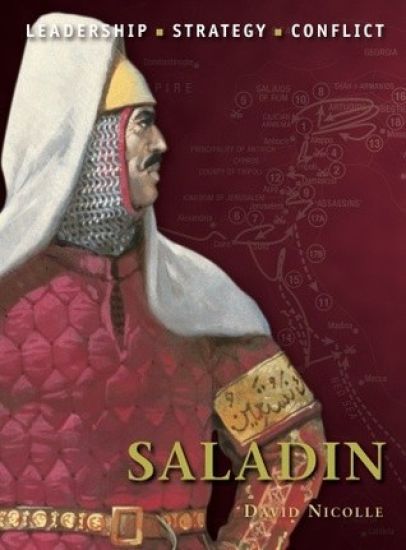
Saladin

Saladin

David Nicolle

Osprey Publishing
2011
nidottu
This Osprey Command book looks closely at the early life, military experiences and key battlefield exploits of Al-Malik al-Nasir Yusuf Ibn Najm al-Din Ayyub Ibn Shahdi Abu'l-Muzaffar Salah al-Din – or Saladin as he is more commonly known outside the Islamic world – who is broadly regarded as the greatest hero of the Crusades, even in Europe. Most chroniclers present him as a man of outstanding virtue, courage and political skill. More recently, however, efforts have been made to portray Saladin as an ambitious, ruthless and even devious politician, and as a less brilliant commander than is normally thought. This book sets out to reveal that the truth is, as usual, somewhere in between.
Saladin

Saladin

Stanley Lane-Poole

DARF PUBLISHERS LTD
1985
sidottu
Saladin, or Salah-al-Din (1138-1193), Sultan of Egypt and Syria, is perhaps best known as the implacable warrior who led his Saracen forces against the third crusade (1189-92) under King Richard I - Richard Lionheart.Resolved to drive out the Christians from Palestine, Saladin had earlier defeated them in battle at Tiberius in 1187. He then went on to capture Acre, Ascalon and Jerusalem.These Holy Wars were among the bloodiest in history, for both sides saw it as a responsibility of their faith to kill as many non-believers as possible. Massacres of women and children, and frightful atrocities to the vanquished, stain the reputation of both sides. Saladin, alone, stands as a manof magnanimous spirit and generosity. Even among his enemies he was regarded as a pattern for chivalric courage and honour. As the author himself states: 'If the taking of Jerusalem were the only known fact about Saladin, it were enough to prove him the most chivalrous and great-hearted conqueror of any age."Stanley Lane-Poole (1854-1931) writes sensitively on his subject and, although first published in 1898, his biography of Saladin remains a primary source for historians. This facsimile of the first edition, complete with original illustrations, will enable a wider readership to acquaint themselves with the life of a remarkable man.
Saladin

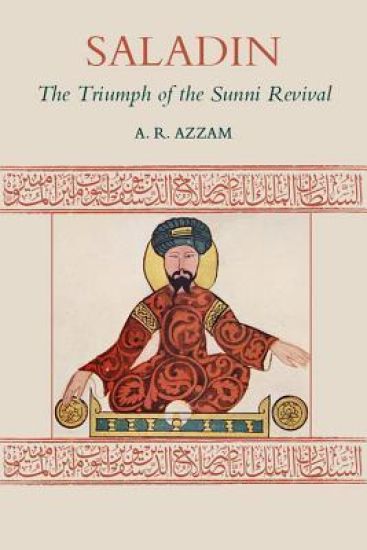
Saladin

Abdul Rahman Azzam

The Islamic Texts Society
2014
nidottu
In this groundbreaking biography, Abdel Rahman Azzam narrates the life of Saladin, placing him in historical context against the backdrop of the 10th and 11th-century Sunni revival, a powerful sweeping intellectual renaissance that transformed every field of Islamic thought. Azzam contends that Saladin was not just the brilliant military commander of popular imagination but that his true greatness lay in his political and spiritual vision. He was an outsider whose life was filled with paradoxes. Famous for driving the crusaders out of Jerusalem, and for his bitter war of attrition with Richard the Lionheart, and fabled for his chivalry and generosity, he became the most powerful man in the Islamic empire, but died penniless, without enough money to line his coffin. This book tells his fascinating and complex story. The author covers Saladin's political rise, his consolidation of power in Egypt with the support of the advisers and military men that he relied on.Indeed one of the main aims of the biography is to introduce to the reader the men around Saladin and the vital religious, military, and administrative roles they played, thereby offering a three-dimensional quality to the man himself. In the early chapters of the biography, Azzam's aim is to peel away the myths surrounding Saladin and to set aside the legend so that the reader may gain a better understanding of the historical figure by placing him in his historical context. Subsequently the first two chapters focus more on the context of the Islamic world than on Saladin himself, setting it apart from other works on Saladin. The remaining chapters of the book deal with Saladin's victory at Hattin and the ensuing Third Crusade, and ending with his death in Damascus. In the final chapter the author gives an insightful assessment of Saladin, bringing the book full circle to the opening Prologue.